

Answer Engine Optimization (AEO) is the practice of structuring content and your broader online presence so AI platforms like ChatGPT, Gemini, Google’s AI Overviews, Perplexity, and Claude surface and cite you directly in their answers. Traditional SEO competes for space on the search results page. AEO competes to be the answer itself.
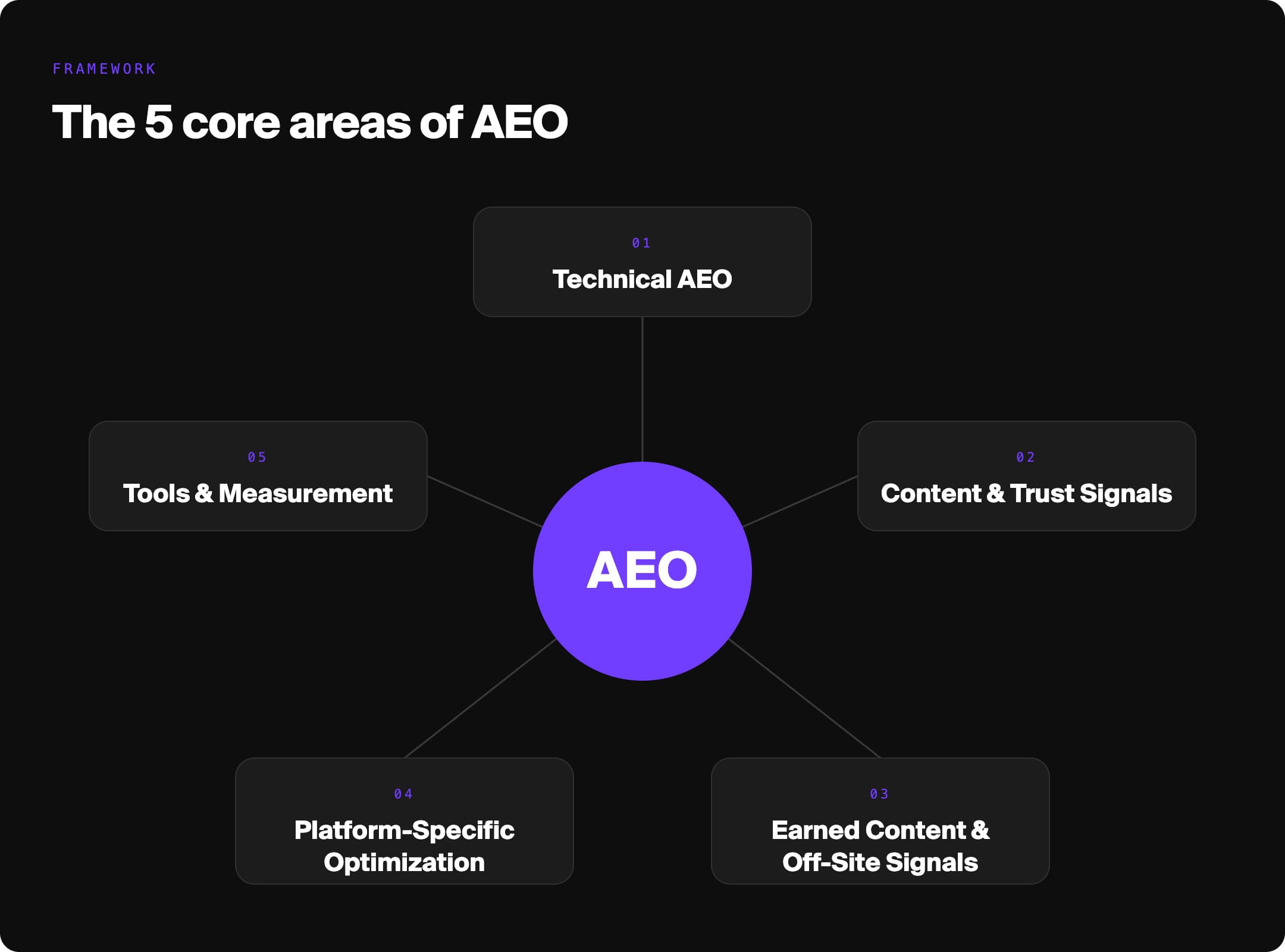
This guide breaks down what AEO is, how it differs from SEO and GEO, and the core areas you need to get right: platform optimization, technical setup, content and trust signals, earned media, and measurement. Consider this your home base for AEO. Each section below links out to a more tactical guide on that specific piece, so you can dig in wherever you need it most.
What Is Answer Engine Optimization (AEO)?
AEO, or Answer Engine Optimization, is the practice of optimizing content to provide direct, zero-click answers to user queries on AI-powered platforms like ChatGPT, Gemini, Google AI Overviews, and voice assistants like Alexa and Siri.
As search behavior changes and results shift from “10 blue links” to a single generated answer, optimization has to evolve too. AEO focuses on the same core question SEO always has: what is the user actually asking? But it optimizes the answer for how large language models read, parse, and cite content, rather than how they rank web pages.
AEO is best understood as an evolution of SEO, not a replacement for it. It shares SEO’s goal of matching content to user intent, but it’s built around a different unit of success: a citation or recommendation instead of a ranking position.
What Is an Answer Engine?
An answer engine is a platform that uses AI and natural language processing to understand a user’s query and return a direct, complete answer, rather than a list of links the user has to click through to find one.
There are two main categories:
- AI chatbots, like ChatGPT, Gemini, Claude, and Perplexity, which generate conversational, text-based answers to a typed or spoken query.
- AI-powered voice assistants, like Alexa, Siri, and Google Assistant, which use voice recognition to answer spoken questions in real time.
Both categories share the same core behavior. They extract an answer from available sources and present it directly, with little to no need for the user to visit the source page. That’s what makes answer engines fundamentally different from traditional search engines, and why getting cited by one matters even when it doesn’t send a click.
AEO vs. SEO vs. GEO: What’s the Difference?
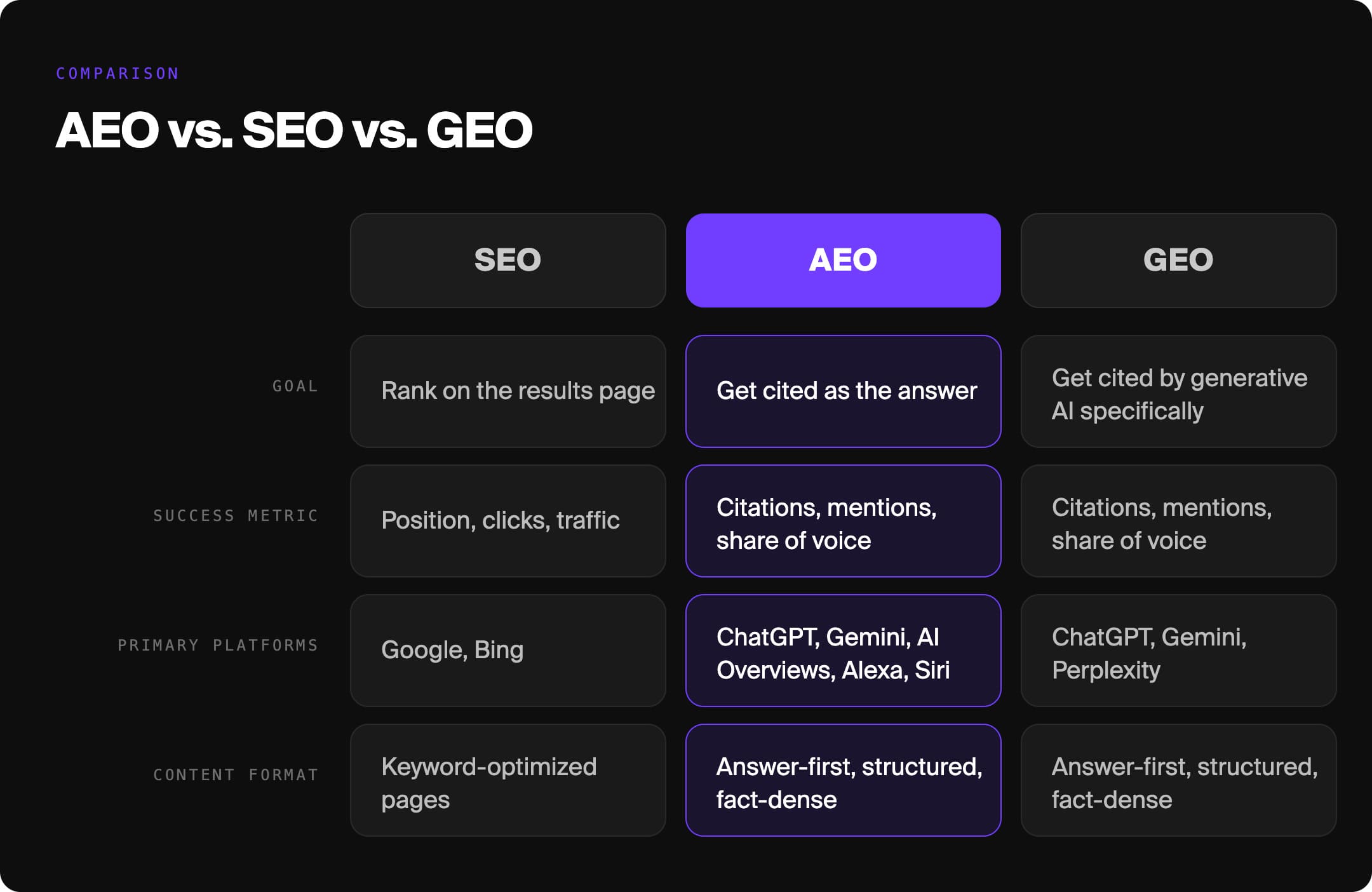
AEO, SEO, and GEO (Generative Engine Optimization) are often used interchangeably, but they’re not quite the same thing.
SEO is the practice of optimizing content to rank on traditional search engine results pages, primarily Google and Bing. Success looks like a top-10 ranking and a click.
AEO is the practice of optimizing content to be extracted and cited as a direct answer by AI platforms and voice assistants. Success looks like a citation, mention, or inclusion in a generated response, even without a click.
GEO is closely related to AEO and the two terms are often used to mean the same thing. Where a distinction exists, GEO tends to describe optimizing specifically for generative AI platforms like ChatGPT and Gemini, while AEO is the broader umbrella that also covers voice assistants and structured answer formats like featured snippets.
| SEO | AEO | GEO | |
|---|---|---|---|
| Goal | Rank on the results page | Get cited as the answer | Get cited by generative AI specifically |
| Success metric | Position, clicks, traffic | Citations, mentions, share of voice | Citations, mentions, share of voice |
| Primary platforms | Google, Bing | ChatGPT, Gemini, AI Overviews, Alexa, Siri | ChatGPT, Gemini, Perplexity |
| Content format | Keyword-optimized pages | Answer-first, structured, fact-dense | Answer-first, structured, fact-dense |
None of the three replace each other. Strong SEO fundamentals, like clean site structure and authoritative backlinks, still feed AEO and GEO performance. For a deeper breakdown of where AEO and SEO overlap and diverge, see our AEO vs. SEO guide. And for how AI search fits alongside traditional and social search more broadly, see Differences & Similarities Between Traditional Search, AI Search & Social Search.
Why AEO Matters Now
Search behavior has fundamentally changed. Users increasingly get their answer directly from an AI-generated summary or chatbot response, without ever clicking through to a website. This is often called a zero-click search, and it’s becoming the default way people interact with search engines and AI platforms alike.
For brands, this shift changes what “winning” search looks like. Ranking #1 on Google means little if the AI Overview above it answers the query and the user never scrolls down. Being the source that AI cites, quotes, or recommends is what drives visibility, brand recall, and ultimately traffic and conversions in this new environment.
This isn’t a temporary trend. It’s a structural shift in how information is discovered, and it’s accelerating.
The Core Areas of AEO
Platform-Specific Optimization
Each AI platform pulls from slightly different sources, weighs signals differently, and favors different content formats. A generic “AI-friendly” content strategy will get you part of the way there, but ranking consistently across ChatGPT, Gemini, Perplexity, Claude, and Google’s AI Overviews means understanding what each one actually rewards.
ChatGPT leans heavily on structured, authoritative content and increasingly pulls from real-time browsing results. Gemini draws from Google’s existing search index and favors content that already performs well in AI Overviews. Perplexity prioritizes source-backed answers and shows its citations openly, making it one of the more transparent platforms to optimize for. Claude tends to favor clearly reasoned, well-organized content and is less tolerant of promotional language. Google’s AI Overviews, meanwhile, pull from a mix of existing top-ranking pages and structured data, making traditional SEO fundamentals more relevant here than on any other platform.
For step-by-step guidance on each platform:
- How to Rank on ChatGPT
- How to Rank on Gemini
- How to Rank on Perplexity
- How to Optimize for Claude
- Google AI Overview SEO
- Social Search Optimization
Technical AEO
Content quality alone isn’t enough if AI crawlers can’t access or parse your site in the first place. Many AI crawlers, like GPTBot and ClaudeBot, can’t render JavaScript, can’t parse PDFs, and struggle with cluttered or inconsistent formatting the way Googlebot has learned to.
Getting the technical foundation right means making sure your content is structurally clean, semantically clear, and crawlable from the start. That includes proper heading hierarchy, clean HTML rendering without heavy reliance on JavaScript, structured data markup (like FAQ, HowTo, Product schema), and explicit crawler permissions for AI bots. It also means making sure your most important pages are actually indexed and not accidentally blocked.
This is also where AEO leans most directly on existing SEO work. Clean site architecture, fast load times, and proper indexation aren’t AEO-specific tactics; they’re the baseline that makes everything else in this guide possible.
For a full technical audit checklist and schema implementation guidance:
Content & Trust Signals
AI models don’t just check whether content answers a query, they check whether the source is credible enough to trust. That means signals like clear authorship, demonstrated expertise, up-to-date information, and consistent entity naming all factor into whether a model chooses to cite you over a competitor.
Freshness matters more here than in traditional SEO. AI assistants have been shown to cite content that’s measurably more recent than what ranks organically, so a regular refresh cadence isn’t optional if you want to stay in rotation.
Structure plays a key role in AEO: leading with a direct answer under a question-formatted header, then building out context underneath, is what makes a paragraph easy for a model to lift and cite cleanly. Content that’s clearly organized, answers questions directly, and reads as a self-contained, authoritative unit is what gets extracted and cited over content buried in long, unstructured paragraphs.

Topical authority carries significant weight, too: publishing original research, data, and consistently deep coverage of a niche signals the kind of expertise models are trained to prioritize.
For the deeper frameworks behind each of these:
- The Impact of Content Freshness on AI Citations
- AI Trust Signals
- How to Build Topical Authority
- AEO & SEO Content Strategy
- How To Optimize Content for AI Search
Earned Content & Off-Site Signals
Owned content only gets you so far. A large share of AI citations trace back to earned sources, not brand-owned pages, which means what gets said about you on Reddit, LinkedIn, YouTube, and across the web often carries more weight with AI models than your own site copy.
Reddit in particular punches above its weight. It’s one of the most frequently cited sources across AI search engines, and models tend to treat it as a more neutral, third-party-verified signal than brand-published content. The same logic extends to LinkedIn: articles and posts written to answer a specific question, rather than general feed content, generate meaningfully more citations, especially on platforms like Copilot and DeepSeek that lean on LinkedIn as a primary social source. YouTube functions similarly for platforms like Google’s AI Overviews, which pull video citations more than any other surface.
Traditional link building and digital PR still matter here too. Earned coverage in outlets AI models already pull from builds the same kind of third-party credibility that backlinks have always signaled to search engines, just applied to a new set of platforms.
For platform-specific tactics and the research behind each:
- Reddit for AEO
- LinkedIn AEO Guide
- YouTube AEO Guide
- What Is Link Building & Is It Still Relevant in the Era of AI?
- What Is Digital PR & How Does It Relate to Performance Marketing?
- Social Meets AEO: Winning AI Search via Social
- What Is “New Media” & What Does It Mean for Your Earned Strategy?
Tools & Measurement
You can’t optimize what you’re not tracking. AI search doesn’t have a rank tracker in the traditional sense: the same query can return different sources across different sessions, and answer inclusion, citation share, and sentiment matter more than a single position number. AI-generated answers can also change frequently, which makes dedicated measurement a key part of AEO, not an optional add-on.
The tooling landscape splits into a few categories: general AI visibility platforms that track citation share across models, tools built for specific segments like enterprise or eCommerce, and tools focused narrowly on content generation. Picking the right one depends on what you’re actually trying to answer, whether you’re cited at all, how you’re being described, or where you stand against competitors.
For breakdowns of what’s out there and how to measure performance once you’re set up:
- Best AEO Tools
- Best Tools for LLM Visibility
- Best GEO Tools for Enterprise Brands
- 9 Best AEO & GEO Tools for eCommerce Brands
- Profound Review vs. Goodie AI
- How to Track AEO Performance
- How To Track AI Traffic To Your Website
How to Get Started With AEO
There’s no single tactic that gets you cited in AI search. It’s a combination of the five areas covered above, applied consistently over time. At a high level, that looks like:
- Audit where you currently stand. Run your brand and core topics through ChatGPT, Gemini, Perplexity, and Claude to see what’s already being said, whether you’re getting cited, and who’s winning the citations you should own.
- Fix the technical foundation first. None of the content work matters if AI crawlers can’t access or parse your site. Confirm indexation, crawler permissions, and structured data before anything else.
- Structure and strengthen your content. Rewrite for answer-first formatting, consistent entity naming, and clear trust signals so what you publish is easy for a model to extract and cite confidently.
- Build earned signals off-site. Content alone rarely carries a brand into AI answers. Reddit threads, LinkedIn articles, digital PR, and link-building efforts all feed into building the credibility that models weigh when deciding who to cite.
- Track and iterate. AI answers change often, sometimes with no visible trigger, which means AEO is an ongoing practice, not a one-time project.
This is the short version. For a full step-by-step walkthrough of each stage, including cadence, prompt testing, and where to prioritize first, see our AEO guide.
Working With an AEO Agency
AEO is multi-disciplinary, touching several marketing channels and measurement simultaneously, which is more than most in-house teams can own alongside everything else on their plate. That’s typically where an AEO agency comes in: coordinating the technical audit and fixes, content structure and planning, off-site strategy, and citation tracking as one continuous program rather than a series of disconnected fixes.
What that engagement actually looks like varies. Some brands need a one-time audit and roadmap they execute internally. Others want ongoing content production, monitoring, and reporting handled end-to-end. Either way, a good AEO partner should be able to show you where you currently stand in AI search, not just promise results.
To help you evaluate your options:
NoGood offers end-to-end AEO services, from technical audits to ongoing content and citation monitoring.
Answer Engine Optimization FAQs
What is AEO vs SEO?
AEO and SEO share the same underlying goal of matching content to what people are searching for, but they optimize for different outcomes. SEO aims for a ranking position and a click. AEO aims to be cited or mentioned directly inside an AI-generated answer, whether or not that produces a click.
What does AEO stand for?
AEO stands for Answer Engine Optimization, the practice of structuring content and building trust signals so AI platforms like ChatGPT, Gemini, and Google’s AI Overviews surface and cite it directly in their responses.
What is an AEO agency?
An AEO agency helps brands get cited and recommended in AI-generated answers by handling technical audits, content restructuring, earned media strategy, and citation tracking across AI platforms. NoGood’s AEO services cover all four.
What is an AEO platform?
An AEO platform tracks how often a brand is cited, mentioned, or hallucinated across AI answer engines, giving marketers visibility into AI search performance the way a rank tracker does for traditional SEO.
What is AEO in marketing?
In a marketing context, AEO is the discipline of optimizing a brand’s content and online presence so it gets surfaced, cited, or recommended by AI platforms during a user’s research or purchase journey, even when that interaction never results in a website visit.
How do I optimize for answer engines?
Start with a technical audit to confirm AI crawlers can access your site, then restructure content into answer-first, clearly sourced sections, build earned signals through channels like Reddit, LinkedIn, and digital PR, and track citation performance over time.
What is the difference between answer engine optimization and generative engine optimization?
The two terms describe largely the same practice. GEO tends to refer specifically to optimizing for generative AI platforms like ChatGPT and Gemini, while AEO is the broader umbrella that also covers voice assistants and structured answer formats like featured snippets.
What is an answer engine?
An answer engine is a platform that uses AI and natural language processing to return a direct, complete answer to a query, rather than a list of links a user has to click through to find one.
What is an example of an answer engine?
ChatGPT, Gemini, Perplexity, and Claude are all examples of answer engines, as are voice assistants like Alexa and Siri.
Great Blog post, Thanks for sharing such useful posts.
This is an excellent and insightful guide on Answer Engine Optimization (AEO)! I love how you’ve highlighted the shift from traditional SEO to the emerging focus on providing direct, concise answers to user queries.