

A major part of AI search optimization involves structuring, formatting, and distributing content so AI systems like ChatGPT, AI Overviews, Perplexity, hell, even Alexa for Shopping, can find that content, parse it, and cite it in a generated answer.
What I find often gets left out of posts like the one I’m writing right now is how often you have to do it. Many talk about the how, but fail to mention how involved an ongoing process this is, and trust me, I do a lot of it.
So this piece will cover both. I’ll walk through what AI search optimization requires technically and structurally, then get into the part that gets skipped: the maintenance cadence that keeps you from doing this work once and calling it a day.
What Is AI Search Optimization? (SEO vs. AEO vs. GEO)
AI search optimization gets your content cited inside AI-generated answers, not just ranked on a results page. It’s sometimes split into AEO (answer engine optimization) and GEO (generative engine optimization), and functionally, they’re the same problem: getting a language model to trust and surface what you wrote.
The core difference from traditional SEO:
| SEO | AEO / GEO | |
|---|---|---|
| Goal | Ranking position | Inclusion in the generated answer |
| User action | Clicks through | Often none, zero-click |
| What you’re optimizing for | A crawler + ranking algorithm | A model deciding what to trust and cite |
Ranking well still matters. A lot of AI Overview citations lean on pages that already rank. But it isn’t sufficient on its own; plenty of page-one content never makes it into an AI answer because it isn’t structured in a way a model can extract cleanly.
AEO vs. GEO is mostly a matter of origin, not mechanics: AEO grew out of the “answer engine” framing (featured snippets, voice search, position zero), GEO came out of research on optimizing generative outputs specifically. We’ll use them interchangeably here, as most of the industry does.
The Two-Stage Process AI Search Runs On

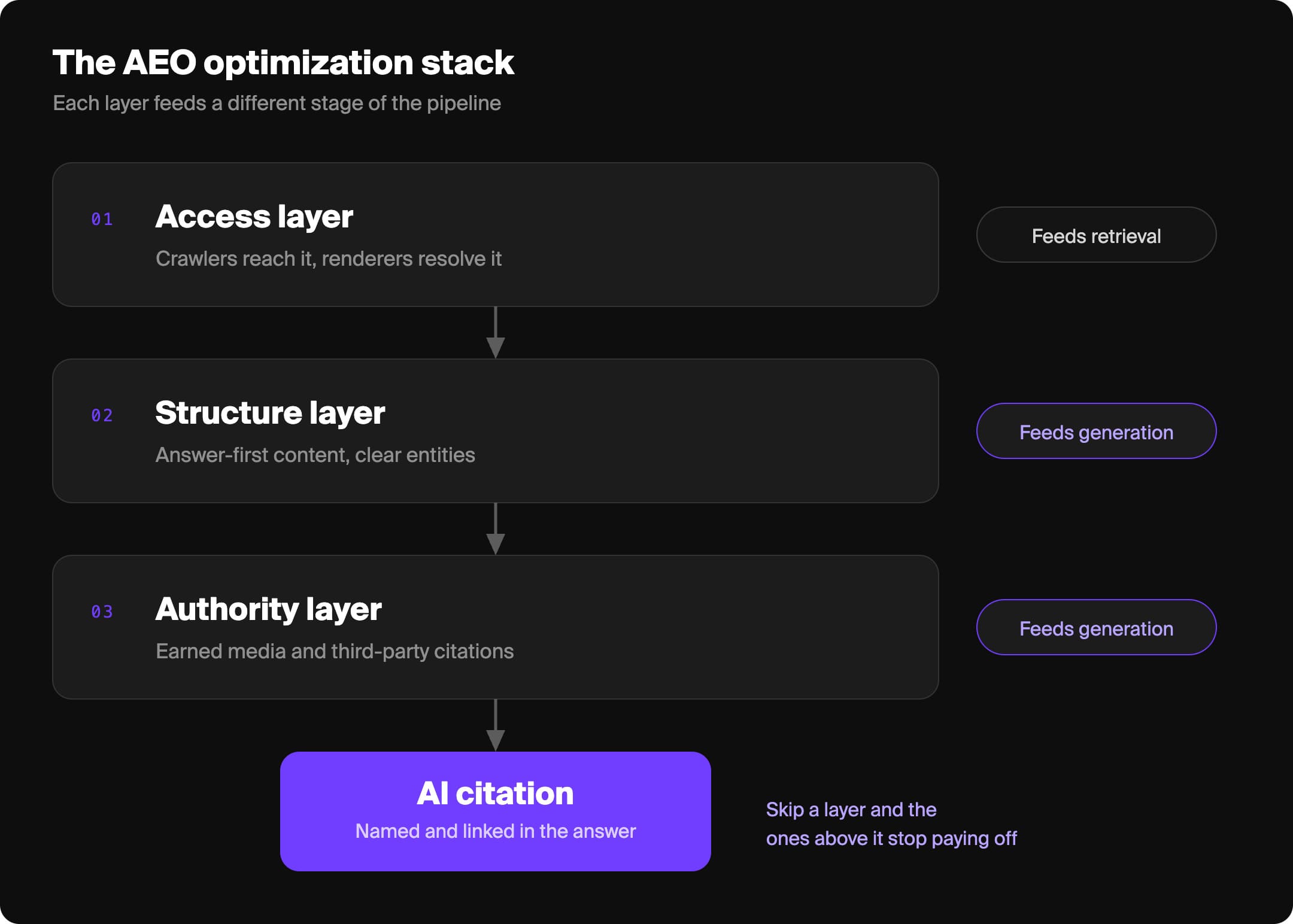
Every AI search system runs on some version of the same two-stage pipeline: retrieval, then generation. Knowing which stage a tactic belongs to is the fastest way to diagnose why something isn’t working.
- Retrieval: can the system find, access, and parse your content at all. Blocked crawlers, JS-only rendering, buried answers: all retrieval failures. If you don’t clear this stage, nothing else matters.
- Generation: once you’re in the candidate pool, does the model trust you enough to cite you by name versus quietly synthesizing without attribution. This is where structure, entity clarity, and authority signals do their work.
This split explains why “just add schema” and “just write good content” both feel true, and both feel incomplete on their own. Schema and crawler access fix retrieval. Structure and authority fix generation. They’re different problems with different fixes, and most content fails at one while looking fine on the other.
The next section is organized by stage, so you know exactly what you’re fixing as you go.
How to Optimize Content for AI Search
Every tactic below fixes either retrieval or generation, tagged as we go.
Structure Content for Extraction (Generation)
Lead with the direct answer, then support it. Answer the core question in the first 40-60 words under a question-formatted header, then build out context and nuance underneath. This is the single most repeated piece of advice in AEO content, and it’s repeated because it works, though Goodie AI’s research has found the effect is uneven: reference and how-to content responds well to a sharp answer-first rewrite, but long-form editorial often doesn’t, and can lose voice in the process. Structure earns its place here, but it’s not doing the heavy lifting. Originality and depth still outweigh formatting.
Here are some moves to make:
- Question-style H2/H3 headers that mirror how people ask AI tools things
- One idea per paragraph, self-contained enough to be lifted out of context and still make sense
- FAQ sections for anything with a clear question-and-answer shape
Make Entities and Topics Unambiguous (Generation)
Say exactly what you are, consistently, everywhere. Entity optimization is the practice of making sure AI systems have a clean, consistent definition of your brand, your products, and your people, since every other signal (content, schema, PR) works better when the underlying entity definition isn’t ambiguous or contradictory across sources.
This also means thinking beyond your target keyword. AI systems chunk content into semantic passages and generate their own sub-queries around a topic; ranking #1 for your head term doesn’t help if your content never addresses the adjacent questions the model is fanning out to answer.
Fix the Technical Access Layer (Retrieval)
If a crawler can’t reach your content, nothing else in this list matters. AI crawlers split into two jobs: some (like GPTBot) scrape for training data, others (like OAI-SearchBot or PerplexityBot) do real-time retrieval to answer a live query. Both need explicit access, which means:
- Auditing robots.txt for AI-specific user agents you may be unintentionally blocking
- Adding an llms.txt file if your CMS supports it
- Confirming key content renders server-side rather than only appearing after client-side JavaScript loads, since several AI crawlers don’t execute JS reliably
Use Structured Data Deliberately (Retrieval + Generation)
Schema tells AI systems what your content is, structurally, not just what it says. It supports both stages: it helps crawlers parse the page (retrieval) and gives the model explicit signals about credibility and content type (generation).
Prioritize:
- FAQPage for Q&A content
- Article/BlogPosting with author, datePublished, and dateModified
- Organization and Person schema to reinforce entity clarity
- HowTo for step-by-step content
JSON-LD is the standard implementation format. And structured data increases eligibility; it doesn’t guarantee inclusion, so don’t treat a schema pass as the finish line.
Build Authority Signals Off-Site (Generation)
Roughly 72% of AI citations trace back to earned sources, not owned content. That’s the single biggest lever most teams underinvest in. AI models form a view of your credibility from what’s said about you on Reddit threads, in industry publications, and across social platforms well before anyone asks a question that involves your brand.
The gap compounds, too: brands in the top quartile for web mentions receive more than 10x the citations of brands just one quartile below. Authority isn’t static. Think of it like a feedback loop that AI models keep reinforcing once you’re inside it.
Where to focus:
- Digital PR and earned coverage in outlets AI models pull from (this shifted meaningfully toward practitioner-level and social sources over 2025-2026, less legacy-publication-only than it used to be)
- Original research or proprietary data that others cite, which turns you into a source AI models return to repeatedly
- Consistent entity language across every channel, so nothing you control contradicts your own authority signals
How Often Do You Need to Revisit This?
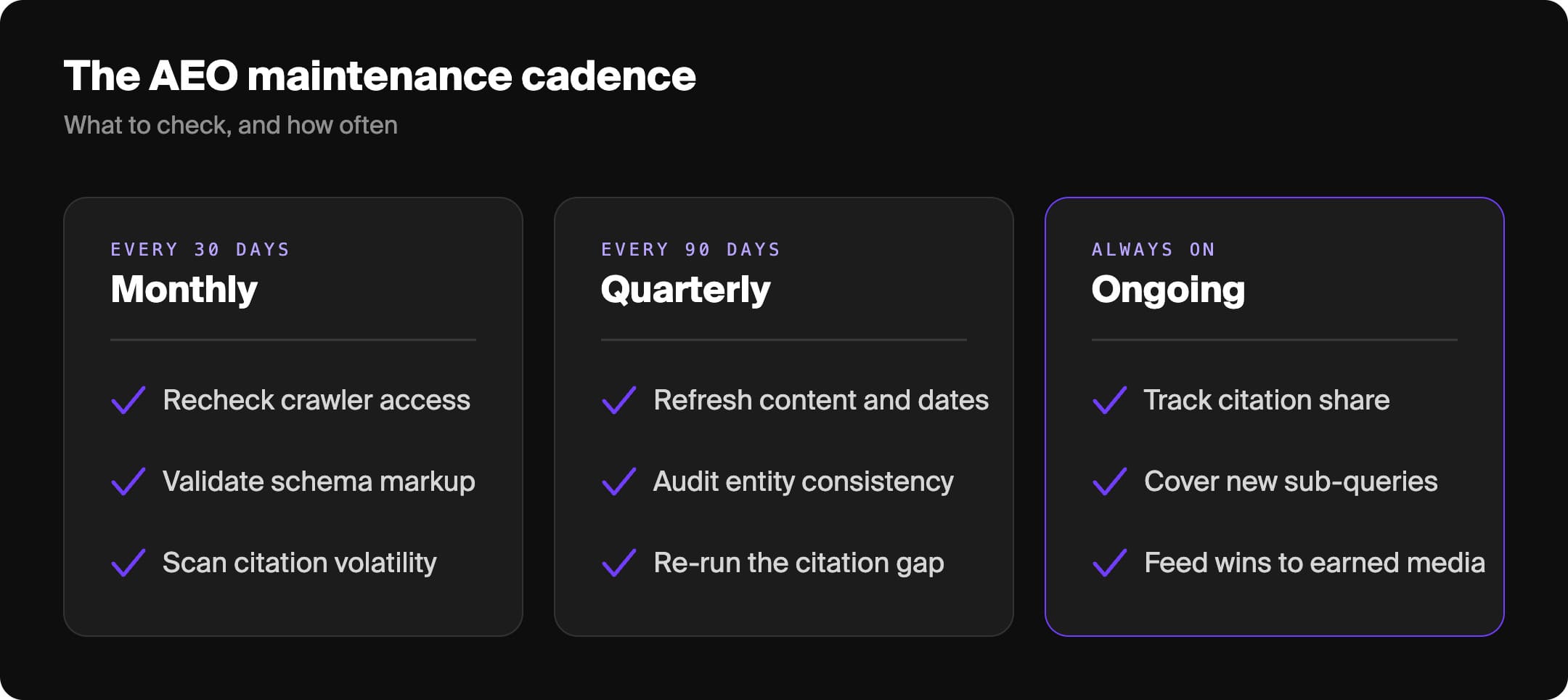
Answer: check technical access monthly, refresh content quarterly, and track citations continuously. AEO isn’t a project with an end date; it’s closer to maintaining a distribution channel than shipping a one-time asset.
Here’s why that’s non-negotiable, not optional diligence:
- AI Overview content changes for the same query roughly 70% of the time, and when it updates, nearly half the cited sources get swapped out. Only about 30% of brands stay visible across back-to-back responses to the same question.
- Perplexity leans even harder into recency: 70% of its top citations were updated within the past 12-18 months, and pages that sit idle past that window measurably decay out of rotation.
Model updates alone can reshuffle who gets cited, independent of anything you changed on your end. Waiting for a signal that something broke means you’re already behind.
But “how often” isn’t the same answer across every platform, and this is where a lot of cadence advice oversimplifies. Goodie AI’s research across 2.2 million prompts found the freshness requirement splits into two camps. Perplexity and Grok reward recent content the most aggressively; both run on live, real-time retrieval, so stale pages decay out of the candidate pool fast. ChatGPT and Claude tolerate older content more, provided it’s still accurate, and weigh established, credentialed authority more heavily than a recent publish date. Claude in particular is the strictest about penalizing stale claims once something is factually outdated, though that’s a trust penalty more than a recency preference. Gemini and Google AI Mode land in between, tracking rank and freshness in a way closer to traditional SEO than either extreme.
The implication: a cadence tuned for Perplexity is wasted effort on Claude, and vice versa. If Perplexity or Grok referral traffic matters to your brand, quarterly refreshes may not be tight enough; monthly is closer to right for your highest-priority pages. If your citation goals lean toward ChatGPT or Claude, that same quarterly cadence is probably sufficient, and your effort is better spent on accuracy and authority than on refresh frequency alone.
A Cadence to Work From
Monthly
- Re-check crawler access (robots.txt, llms.txt, any new AI user agents blocking you unintentionally)
- Validate schema is still implemented and error-free; CMS updates and template changes break this more often than people expect
- Scan for citation volatility on your highest-priority pages, tightened to weekly if Perplexity or Grok visibility is a stated goal
Quarterly
- Refresh factual content, stats, and examples on your top-performing pages, and update dateModified accordingly; this is a real signal, not just housekeeping
- Re-audit for entity consistency across owned channels
Ongoing
- Track citation share and sentiment, not just whether you’re mentioned, but how. A composite visibility score smooths out the week-to-week noise so you can tell a real decline from normal fluctuation.
- Expand coverage into new sub-queries or angles the model may be fanning out to that you haven’t addressed yet. This doesn’t need to happen on a fixed schedule, but it should happen whenever you notice a gap.
Platform-Specific Notes: Google AI Overviews, AI Mode, ChatGPT, Claude, Gemini, Perplexity & Copilot

The core tactics in this piece apply everywhere. What differs is where each platform pulls from, how it treats a citation once it has one, and in some cases, whether it links out at all.
Google AI Overviews
AI Overviews lean heavily on pages that already rank in traditional search, so your existing SEO equity carries over directly here in a way it doesn’t elsewhere. It also pulls YouTube citations more than any other surface, Google owns YouTube, and AI Overviews inherit that bias. If you have video content sitting unused, this is the platform where it earns its keep.
Google AI Mode
AI Mode runs on the same underlying Gemini models as AI Overviews but behaves more like a standalone research assistant, handling multi-turn, conversational queries rather than a single search-results injection. It’s also multimodal in practice, pulling from images, video, and documents alongside text, so a brand with only plain-text content is at a structural disadvantage here regardless of how well-written that text is.
ChatGPT
ChatGPT functions more like a generalist. It’s text-first in its retrieval and gravitates toward Reddit and LinkedIn over video or forum content, tolerating a wider range of content types and formats than most other platforms. Citations also aren’t always visible to the end user the way they are elsewhere; ChatGPT will synthesize from a source without necessarily naming it inline unless browsing mode is active. Worth flagging: ChatGPT’s share of measurable AI referral traffic has been falling, from roughly 89% down to the low 60s over the past year, so treating it as the only platform that matters is an increasingly outdated strategy.
Claude
Claude has picked up a meaningful chunk of the share ChatGPT has lost, and its behavior skews differently. It weighs author authority and demonstrated expertise more heavily than most other platforms, and it’s also the most aggressive about penalizing content once a claim reads as outdated or unverifiable. Claude leads other platforms in cross-referencing a claim against multiple sources before treating it as trustworthy, which means consistency across your owned and earned content matters more here than on platforms that take a single source at face value.
Gemini
Gemini powers Google’s other AI surfaces (AI Overviews, AI Mode, Assistant), which makes it a hub rather than a single destination. It’s genuinely multimodal, pulling from text, images, video, and charts, and it weighs author authority and credibility roughly on par with Claude. If your content only exists as plain text, you’re leaving a real gap here.
Perplexity
Perplexity is the clearest outlier. It’s built closer to a search-and-citation engine than a chatbot, every answer shows its sources directly, so getting cited is immediately visible and clickable in a way it isn’t on ChatGPT or Gemini. That visibility comes with a tradeoff: its bar for a citable source leans harder on structured data and recency than almost anywhere else. If you’re optimizing specifically for Perplexity, schema, clean markup, and current dates matter more here than on any other surface.
Microsoft Copilot
Microsoft Copilot is embedded across Bing, Edge, and Microsoft 365 (Word, Excel, Teams, Outlook), which splits its behavior in two. In Edge, it acts more like a shopping and browsing assistant, so clean product data and schema matter most. Inside Microsoft 365, it’s oriented around task completion rather than sending users out to the open web, which shows up in the numbers: despite Microsoft 365 Copilot’s paid seats roughly quadrupling over the past year, its share of measurable referral traffic has stayed close to flat. Anyone optimizing for Copilot specifically should expect steady, modest referral volume rather than a growth curve, and should track citation and mention frequency inside Copilot’s answers rather than betting on click-through.
My main point is: don’t run one AEO brief across all seven and call it done. Know which platforms your audience uses before deciding where the marginal hour goes.
How to Measure Whether It’s Working
Track answer inclusion rate, citation share, and AI referral traffic, in that order of reliability. Traditional rank tracking doesn’t map cleanly onto AI search, so this section covers the metrics that actually mean something here and how to start capturing them.
The Core Metrics
- Answer inclusion rate: how often your brand or content shows up at all when a relevant prompt is asked. This is the baseline. If you’re not appearing, nothing downstream matters yet.
- Share of influence/citation share: presence probability and influence measurement matter more here than a single ranking number, since the same query can surface different sources across different sessions.
- Sentiment and framing: being mentioned isn’t the same as being recommended. Track how you’re described, not just whether you’re named.
A single number rarely tells the full story week to week, since individual metrics fluctuate as models update how they retrieve and weight sources. A composite view across a 30, 60, or 90-day window is a more honest read than any one snapshot.
Setting Up AI Referral Tracking in GA4
This part is genuinely doable in an afternoon. Build a custom channel group that captures traffic from chatgpt.com, perplexity.ai, claude.ai, gemini.google.com, copilot.microsoft.com, and similar domains, then reorder it above your default “Referral” grouping so it doesn’t get buried. A few caveats worth knowing going in:
- A new channel group only tracks forward from the date you create it, it won’t backfill historical data, so set it up now rather than after you’ve already started an AEO push.
- GA4’s client-side tracking can’t detect AI bots crawling your content without a browser visit behind it, so this captures referral traffic, not crawl activity. Those are two different signals, and neither substitutes for the other.
What to Watch
- AI referral traffic volume, segmented by platform rather than lumped together, since Claude, Perplexity, and ChatGPT traffic behave differently once it lands (Claude and Perplexity traffic in particular tends to reflect a research stage, longer sessions, more comparison behavior)
- Branded search lift following a visibility push, a rise in direct brand searches can indicate AI exposure working even when it doesn’t show up as direct referral traffic
- Conversion quality for AI-referred visitors specifically, since AI referral traffic has shown meaningfully higher conversion rates than traditional organic in several studies, worth confirming against your own numbers rather than assuming it holds
Third-Party Tracking Tools
Manually monitoring prompts across five or six AI platforms doesn’t scale past a handful of queries, which is where a dedicated AI visibility platform earns its keep. We use Goodie AI here at NoGood. Goodie AI runs prompts at volume across ChatGPT, Gemini, Claude, Perplexity, and the rest, and tracks citation share, sentiment, and share of voice over time rather than as a one-off audit. If you’re building an AEO measurement stack from scratch, this category (continuous prompt-level monitoring rather than a periodic manual check) is the piece most teams underinvest in relative to how much they invest in content production itself.
Optimizing Content for AI Search Isn’t a One-Time Project
If there’s one thing to take away from all of this, it’s that AI search optimization doesn’t have a finish line. The technical fixes, the schema, the structure, all of that gets you in the door. But the door doesn’t stay open on its own. Models update, citation patterns shift, and content that was airtight six months ago can quietly fall out of rotation without a single thing on your end going wrong.
That’s the part most guides skip, and it’s the part that actually determines whether you’re still visible a year from now.
Not Sure Where Your Brand Actually Stands in AI Search?
We audit, build, and maintain AEO strategies for brands that don’t have time to babysit a cadence calendar every month.
Optimizing Content for AI Search: FAQs
Does Ranking on Google Help You Rank in AI Search?
It helps, but it isn’t sufficient on its own. AI Overviews in particular lean on pages that already rank well in traditional search, so strong SEO fundamentals give you a real head start. But plenty of page-one content never gets pulled into an AI answer because it isn’t structured for extraction, ranking gets you into the candidate pool, it doesn’t guarantee a citation.
How Long Should Answers Be to Rank in AI Search?
Aim for a direct answer in the first 40-60 words under a question-formatted header, then build out supporting context underneath. This works especially well for reference and how-to content. Long-form editorial responds less predictably to a strict word-count target, so treat this as a strong default rather than a hard rule for every content type.
What Is GPTBot, and Should I Allow It?
GPTBot is OpenAI’s crawler, used both for training data collection and for surfacing content in ChatGPT responses. Unless you have a specific reason to keep your content out of AI training sets or answers entirely, blocking it in robots.txt removes you from consideration in ChatGPT results altogether. Most brands optimizing for AI visibility should leave it, and comparable crawlers like ClaudeBot and PerplexityBot, unblocked.
Can AI Crawlers Read JavaScript?
Not reliably. Several AI crawlers don’t execute client-side JavaScript the way a browser does, so content that only renders after JS loads may never get seen. If your most important content, answers, headers, structured data, depends on client-side rendering, server-side rendering or static HTML is worth prioritizing before anything else on this list.
What Schema Markup Matters Most for AI Search?
FAQPage, Article/BlogPosting (with author, datePublished, and dateModified), Organization, and Person schema cover most of the ground. FAQPage is the most direct signal for Q&A-formatted content specifically. Structured data increases your eligibility to be parsed and cited accurately, but it doesn’t guarantee inclusion on its own, it’s a retrieval fix, not a substitute for genuinely useful content.
Is AEO a One-Time Project or Ongoing Work?
Ongoing, and not lightly so. AI Overview results change for the same query roughly 70% of the time, and citation patterns shift independently of anything you do on your end. Treat this closer to maintaining a distribution channel, monthly technical checks, quarterly content refreshes, and continuous citation tracking than a project with a defined end date.
What Tools Track AI Search Citations?
Dedicated AI visibility platforms run prompts at volume across multiple models and track citation share, sentiment, and mention frequency over time, something manual spot-checking can’t scale to. We use Goodie for this at NoGood; though several platforms in this category exist, the important thing is picking one that tracks continuously rather than as a one-off audit.
What’s the Difference Between AEO and GEO?
Functionally, very little, most tactics overlap. The distinction is closer to origin than mechanics: AEO grew out of the “answer engine” framing (featured snippets, voice search, position zero), while GEO came out of research specifically on optimizing generative outputs. Both are solving the same underlying problem: getting a language model to trust and surface what you wrote.