
Key Takeaways:
- AI assistants cite content averaging 25.7% fresher than what ranks organically on Google, and roughly half of all AI citations trace to content updated within the last 13 weeks.
- That advantage decays fast: the median citation half-life across platforms is about 4.5 weeks, so freshness is a position you keep re-earning, not a status you earn once.
- Platforms aren’t uniform. Perplexity and Grok weight freshness most heavily; Google’s AI surfaces are the most conservative; ChatGPT’s behavior has swung sharply across model releases and shouldn’t be treated as one stable number.
- Content decay and semantic drift are different problems that need different fixes.
- Changing a publish date without changing the content doesn’t work and is increasingly discounted by both Google and AI retrieval systems. Adding real statistics is one of the better-documented ways to earn a citation lift.
- The fix isn’t chasing freshness at the expense of quality. Rather, it’s a tiered refresh cadence built around real content changes and checked against actual citation data.
Content cited by AI assistants averages 25.7% fresher than the pages ranking organically on Google, and roughly half of all AI citations trace back to content published or substantively updated within the last 13 weeks. That gap is reshaping what it takes for a page to survive retrieval at all.
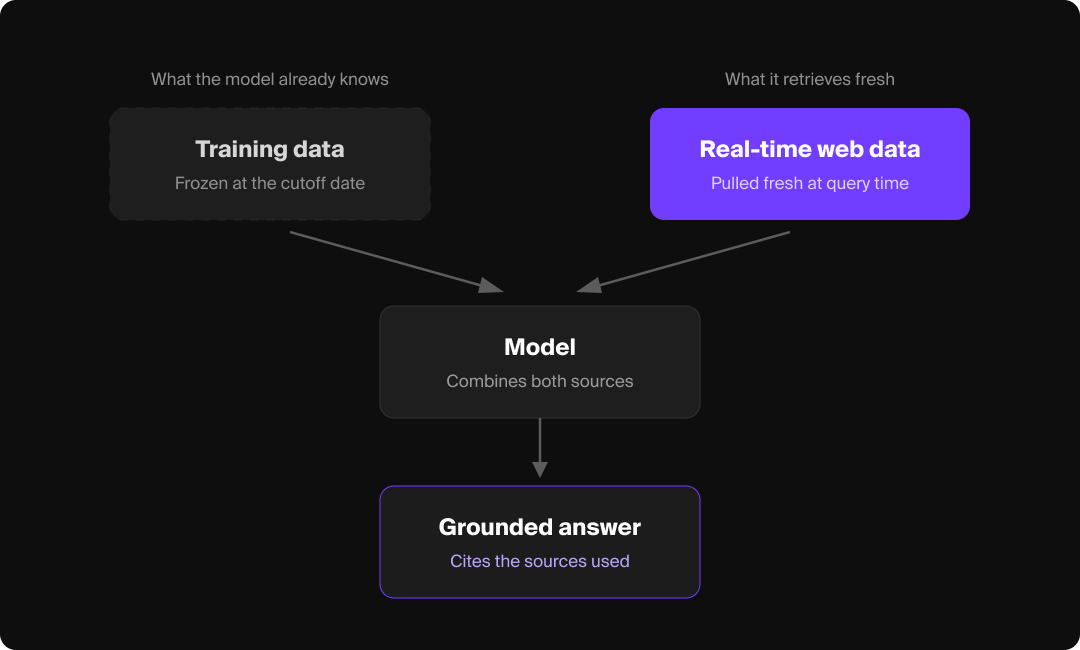
Part of why this happens comes down to mechanics rather than preference. A model’s parametric knowledge, what it actually learned during training, is frozen at its training cutoff, so anything that happened after that date simply isn’t in its weights. Every major AI search product gets around this with retrieval-augmented generation, or RAG: at the moment someone asks a question, the system runs a live retrieval step first. It searches real-time web data (or, in tool-using models, calls a search API directly), pulls back a set of candidate documents or passages, and hands those to the model as context alongside the original question. The model then generates its answer grounded in that retrieved text, rather than from memory alone, and cites the sources it pulled from.
That retrieval step is where freshness gets decided. A traditional Google ranking can reward a page that’s stayed relevant and well-linked for years, because the ranking itself persists between searches. RAG re-runs the retrieval every time, so the pool of candidate sources it’s choosing from is whatever the web data surfaces right now, not whatever ranked well historically. If two pages answer a query equally well, the retrieval step has every reason to prefer whichever one looks more current; picking the fresher source lowers the odds that outdated information ends up in the final answer. That’s the mechanical reason newer content keeps winning a disproportionate share of citations: it isn’t that AI engines have a stylistic preference for new content, it’s that the retrieval architecture re-evaluates the field from scratch on every query, and that recency is one of the early signals it has for filtering out sources that might already be wrong.
The Cycle Begins When You Hit Publish
Ahrefs conducted a study around 16.975 million cited URLs from their own Brand Radar dataset earlier in 2026. This study recorded each one’s first publish and last-updated date, and compared both against the organic Google results ranking for the same query. The freshness gap showed up in both measures: 25.7% by publish date, a narrower but still real 13.1% by last-updated date.
What makes this a story about decay rather than a one-time bar to clear is how fast that advantage erodes. Scrunch and Stacker tracked 3.5 million citation events between September 2025 and March 2026 and found the median citation half-life, the point where half of a given week’s cited sources have already dropped out of rotation, sits at about 4.5 weeks. A page that earns strong AI visibility in March is already losing ground by April, not because anything on the page changed, but because the field of competing answers renews itself roughly monthly. The connection here is that half-life is a view of the same mechanism: citation isn’t a status a page earns once; it’s a position a page has to keep re-earning against newer arrivals.
Not Every AI Engine Runs on the Same Cycle
The averages flatten out an interesting pattern once you split it by platform. ChatGPT is the outlier on the aggressive end: Ahrefs found it cites pages 393 days newer than organic results in its in-text references, and a full 458 days newer in its end-of-answer citations. ChatGPT and Perplexity both order their references from newest to oldest, a deliberate recency-first structure that neither the organic SERP nor Google’s AI Overviews follow.
Perplexity sits in the middle. Its average cited-URL age runs about 250 days newer than the organic baseline, meaningfully fresher than Google but nowhere near as aggressive as ChatGPT. What Perplexity gives up in freshness bias, it makes up in staying power: once a source earns a Perplexity citation, Scrunch and Stacker found it tends to hold on for about 5.8 weeks, the longest half-life of any platform measured, compared to ChatGPT’s roughly 3.4 weeks.
Google’s AI Overviews break the pattern entirely. Ahrefs found AI Overviews actually cite pages that run about 16 days older than organic results, the only platform in the study to skew that direction. That’s not a coincidence: AI Overviews draw from the same core ranking systems as organic Search, so freshness behaves for AI Overviews roughly the way it behaves for a normal ranking, one input among many, not a gate a page has to clear. (For a deeper look at optimizing specifically for Google’s AI surfaces, see NoGood’s AI Mode optimization guide.)
Goodie AI’s AEO Periodic Table V4, a separate framework built from 1.13 million prompts across six AI surfaces, scores “Content Freshness & Recency” directly as one of fourteen ranked citation factors, and its numbers line up with the Ahrefs pattern:
| Engine | Freshness score (0–100) |
|---|---|
| Perplexity | 87 |
| Grok | 85 |
| ChatGPT | 78 |
| Google AI Mode | 74 |
Goodie AI’s report doesn’t publish standalone freshness scores for Claude or Gemini, but its commentary places both toward the lower end: Claude is described as the most training-leaning of the six engines, citing on content substance, originality, and author authority rather than recency, and Gemini’s top drivers are relevance, search rank, and entity consistency, with recency noted as a secondary factor rather than a primary one. The report’s own framing captures the split cleanly: a strategy tuned for Perplexity needs an update cadence; one tuned for Claude does not.
Putting both the Goodie AI and Ahrefs studies side by side, platform by platform, makes the overlap and the gaps clearer:
| Platform | Ahrefs Study — Citation age vs Organic | Goodie V4 Study — Freshness Score | Notes |
|---|---|---|---|
| ChatGPT | +393 days (in-text) / +458 days (end-of-answer) | 78 / 100 | See the version-by-version caveat below |
| Perplexity | +250 days | 87 / 100 | Highest on both measures |
| -16 days (AI Overviews) | 74 / 100 (AI Mode) | Different Google surfaces, not directly comparable. But both points are conservative. |
Also, the timeline below shows the publishing of these 3 studies. It’s worth seeing when each of these findings was actually measured, because they don’t all describe the same moment in time:
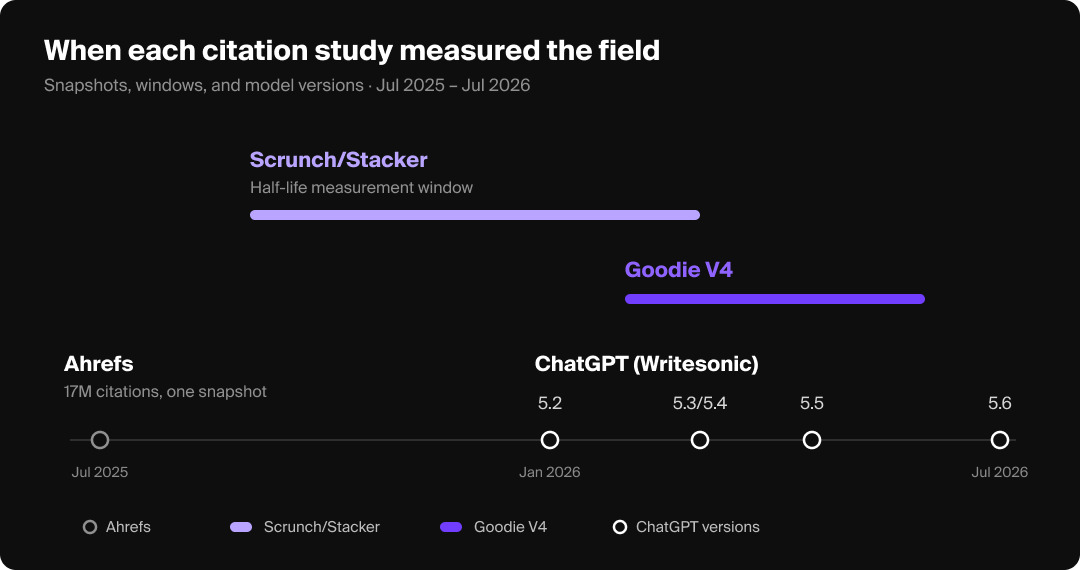
Read across every source in this section and one pattern holds steady regardless of when each study ran: Perplexity is the consistent outlier on the aggressive end, and Google’s AI surfaces are the consistent outlier on the conservative end. ChatGPT is the one everyone disagrees on, and for good reason. Its actual citation behavior has swung by 20-plus points on both freshness and brand-citation share across five model releases in under six months. Treat the poles as durable findings. Treat any specific ChatGPT number, including the ones above, as a snapshot with a shelf life measured in weeks.
Content Decay vs Semantic Drift
“Content decay” and “semantic drift” get used interchangeably, but they describe two different failure modes, and telling them apart changes what you fix.
| Criteria | Content Decay | Semantic Drift |
|---|---|---|
| What is it? | Citations fall off as newer competitors enter the pool | The page’s framing falls out of step with where the topic has moved |
| Is the content wrong? | No, the page hasn’t gotten worse | No, the original claims are still technically true |
| What actually changed | Fresher content is replacing the older content | Terminology, data, or consensus has shifted around it |
| How it shows up | The ~4.5 week citation half-life | Getting routed around in favor of sources that read as current |
| What fixes it? | Republish with something genuinely new | An actual edit: updated framing and current terminology |
Content decay is straightforward: a page’s citations or visibility fall off over time as newer competitors enter the pool, even though nothing about the original page has gotten worse. It’s the mechanism behind that 4.5-week half-life. The page is fine. The field around it just got younger.
Semantic drift is quieter and easier to miss. It’s the gap that opens between what a page says and where the current conversation on that topic has moved, even when every original claim on the page is still technically true. A page can be accurate about the facts as they stood at publication while sounding out of step with current terminology, newer data, or a shifted consensus. AI retrieval systems increasingly cross-reference a page’s claims against more recent sources, so a page that’s drifted, even without being wrong, becomes easier for a model to route around in favor of something that reads as current.
The distinction matters for triage. Decay usually just needs to be republished with something new. Drift needs an actual edit: updated framing, corrected emphasis, terminology that matches how the topic is discussed now.
The Refresh That Doesn’t Work (and What Does)
The tempting fix, once you know AI engines reward recency, is to touch the date and move on. It doesn’t work, and it’s increasingly detected. Google’s John Mueller has warned publicly against updating a publish date without a matching content change, and the same logic holds for AI retrieval, which is built to weigh substance over metadata. The tells are familiar: a dateModified bump with no content change, a year swapped in the title (“Best Tools 2025” to “Best Tools 2026”) with an untouched body, a single paragraph tacked onto the bottom, or an AI pass that rewords existing copy without adding a single new fact. None of it moves the signal that citation systems are actually reading.
A real refresh changes what the page says: current statistics in place of stale ones, a new section covering what’s happened in the last six to twelve months, corrected or removed claims that have since been disproven, new internal links as the surrounding cluster has grown, and a dateModified update that actually matches the change. That last piece works best paired with the first: research from Princeton, Georgia Tech, and IIT Delhi (Aggarwal et al., KDD 2024) tested nine content interventions across roughly 10,000 queries and found that adding statistics improved citation visibility by up to 37% in their real-world test on Perplexity.ai. Their single best-performing method overall was adding quotations from credible sources, which improved visibility by 41% on their broader benchmark. Also a reminder that “add statistics” isn’t the only lever, and the strongest one depends on which metric and platform you’re optimizing for.
dateModified itself is worth being precise about. It’s a schema.org property, typically set alongside datePublished inside Article or BlogPosting structured data, that gives crawlers and retrieval systems a machine-readable date for the last substantive change. It only works as a signal, not a liability, if two things are true: the date has to reflect a real edit, and the same date needs to be visible on the rendered page (“Published April 2024, updated April 2026”) so there’s no mismatch between what the schema claims and what a reader, or a model, can verify.
Building a Cadence Instead of a Scramble
Content is an engine, and that engine needs maintenance or optimization, a piece of the broader AEO practice that most teams are still building out. Scheduling can be done by priority: how much a page is worth and how fast its topic moves.
| Cadence | Scope | What to do |
|---|---|---|
| Weekly | Top 10 highest-traffic or highest-citation pages | Sanity-check for broken links and outdated facts flagged by readers or monitoring tools |
| Monthly | Top 20 traffic or citation pages | Fix outdated facts and stale references; update the visible date only when the content genuinely changes |
| Quarterly | Pillar and cluster pages | Rewrite with new data, new examples, new sections; refresh anything that’s lost traffic or citations |
| Annual | Full site | Audit and deprecate content that no longer fits the strategy, consolidate duplicate coverage, rewrite category-defining pages end to end |
Given a median citation half-life of roughly 4.5 weeks, the pages competing hardest for AI visibility, comparison content, statistics roundups, anything in a fast-moving category, belong toward the weekly or monthly end of that table, not the annual one. Pricing pages, “best of” lists, and regulatory or compliance guidance move fastest of all, since the underlying facts they describe change on their own timeline regardless of what AI engines reward. Financial services and other YMYL categories tend to need the tightest cycle for the same reason human readers need it: the cost of stale guidance is higher.
Foundational explainers, well-established how-to guides, and reference material can sit on a longer cadence without losing ground, and that’s worth saying plainly, because the data doesn’t argue for abandoning evergreen content in favor of a publishing treadmill. Ahrefs’ own numbers show the average AI-cited page is still nearly three years old. Depth and authority keep earning citations well outside any 13-week window. Freshness raises the odds on top of quality; it doesn’t substitute for it, and a thin page updated every week won’t out-cite a genuinely strong page that’s a year or two old. What changes is that even the strong page benefits from a periodic, substantive refresh rather than a single publish-and-forget cycle, because it’s still competing against a pool of alternatives that keeps getting younger.
Closing the Loop
None of this is worth doing on faith. Set a citation baseline before any refresh using an AI visibility platform, Ahrefs Brand Radar and Goodie AI, track citation frequency by URL and by engine, then compare citation volume and platform mix for the same page in the weeks after the update. Because citation half-life runs in weeks rather than months, a two-to-four-week window after a refresh is usually enough to see a directional read. Track the result by platform where you can. A refresh that lifts ChatGPT visibility may do nothing for Google’s AI Overviews, and each calls for a different follow-up.
Content freshness has moved from a minor SEO input to one of the clearer, better-documented levers in AI citation, and the data converges from independent sources on the same shape: content cited by AI runs about a quarter fresher than what ranks organically, roughly half of citations trace to content under 13 weeks old, and the median citation lifespan is measured in weeks. The response is to treat refresh as a standing operational discipline, tiered by page value, built around real content change, and checked against actual citation data rather than assumed.
Building a refresh cadence that actually holds up across six different AI engines is more than a content calendar problem; it’s what our AEO service works on with clients every day. If you’re not sure where your own content stands, that’s usually the first thing worth finding out.
FAQ
What is the 13-week rule for AI citations?
It’s the finding, from research by Lily Ray, that roughly half of all AI citations point to content published or substantively updated within the prior 13 weeks. It’s best read as a rough recency window rather than a hard cutoff.
How often should you update content to maintain AI citations?
It depends on the page’s value and how fast its topic moves: weekly for a handful of top-traffic pages, monthly for the next tier, quarterly for pillar content, and a full annual audit for everything else. Fast-moving categories, like pricing and comparison pages, need to sit closer to the weekly end.
Does changing the publish date without updating the content help AI citations?
No. Google’s John Mueller has warned against this for organic search, and the same logic holds for AI retrieval, which weighs substantive change over metadata. A dateModified update only works as a signal when it reflects a real edit.
Does evergreen content still get cited by AI?
Yes. Ahrefs’ data shows the average AI-cited page is still nearly three years old, and depth and authority keep earning citations well outside any 13-week window. Freshness raises the odds of citation on top of quality; it doesn’t replace it.
How do you track whether a content refresh improved AI citations?
Set a citation baseline before the refresh using an AI-visibility tool like Ahrefs Brand Radar or Goodie AI, then compare citation volume and platform mix in the two to four weeks after the update. Check the result by platform, since a gain on ChatGPT doesn’t necessarily show up on Google’s AI Overviews.
Sources
- Ryan Law and Xibeijia Guan, “New Study: AI Assistants Prefer to Cite ‘Fresher’ Content (17 Million Citations Analyzed)”, Ahrefs, July 28, 2025. Source for the 25.7% freshness gap, the per-platform age comparisons (ChatGPT, Perplexity, Gemini, Copilot, AI Overviews vs. organic), and the reference to John Mueller’s warning against date-only updates.
- Scrunch and Stacker, “The Half-Life of AI Citations: What 3.5 Million Citation Events Taught Us About AI’s Memory”. Source for the ~4.5-week median citation half-life and the per-platform half-life figures for ChatGPT and Perplexity.
- Pranjal Aggarwal, Vishvak Murahari, Tanmay Rajpurohit, Ashwin Kalyan, Karthik Narasimhan, and Ameet Deshpande, “GEO: Generative Engine Optimization”, KDD 2024 (Princeton, Georgia Tech, Allen Institute for AI, IIT Delhi). Source for the 37–41% citation lift from adding statistics.
- Goodie AI, “AEO Periodic Table V4: AI Search Visibility Factors”, 2026. Source for the per-engine Content Freshness & Recency scores (Perplexity, Grok, ChatGPT, Google AI Mode) and the qualitative notes on Claude and Gemini.
- Writesonic, ongoing citation studies comparing ChatGPT model versions (GPT-5.2 through GPT-5.6), published March–July 2026. Source for the brand-vs-third-party citation swings and the freshness volatility across ChatGPT releases referenced in the platform comparison section.
- Lily Ray (VP of SEO Strategy & Research, Amsive), research on AI citation age presented across multiple 2026 industry talks and referenced widely in trade coverage. Source for the finding that roughly 50% of AI citations trace to content under 13 weeks old. Amsive has not published this as a standalone report with its own URL as of this writing, so treat this figure as well-corroborated secondhand rather than a primary dataset you can pull yourself.
- NoGood, “How Do I Track AEO Performance? Measure ROI of AEO”. Internal link for the RAG explainer; see also NoGood’s “How to Do AEO” guide, which covers the same mechanic.