

An AEO (Answer Engine Optimization) agency’s goal is to get your brand to show up in AI search platforms, and more specifically, get you recommended by them. In practice, that work spans technical structure, content rewrites, schema, and off-site citation building. A typical AEO agency engagement starts with an audit, works through foundational fixes, moves into content and citation work, and reports throughout.
That’s the short version. The rest of this piece covers what the work actually looks like, ballpark costs, and how to tell a real methodology from an agency that slapped an AEO sticker on its SEO hat.
AEO is genuinely complicated. What earns a ChatGPT citation won’t necessarily earn one from Claude or Perplexity. Each platform trains on different data and weighs sources differently, which means each one is effectively running its own scoring rubric for who gets recommended. Optimize for only one platform, and there’s a good chance you’re still invisible on another.
And answer engines don’t have room for everyone. ChatGPT typically cites 1 to 5 sources per answer. Perplexity averages 5 to 8. AI Overviews cite 5 to 14. Compare that to a traditional SERP with ten organic slots plus pagination, and the math gets obvious fast. Fewer seats, more competition for each one, and a brand that used to rank on page one for a term can now watch a competitor get named in the answer while it doesn’t even get a mention.
Add to that: AI-referred visits convert at 3x the rate of traditional channels, and only a few marketers say they’re confident they can diagnose why their brand disappeared from an answer block in the first place. That gap between “this matters a lot” and “we don’t know how to fix it” is exactly the gap AEO agencies are hired to close.
What Does An AEO Agency Do?
You can break AEO work into four workstreams. Some agencies run all four. Others focus on one or two and partner out the rest. There’s also an argument that AEO touches nearly every organic marketing channel, from PR to social to influencer content, which we’ll get into later.
For now, here’s how the four core workstreams differ, since knowing this matters when you’re evaluating who to hire:
| Workstream | What It Involves | Who Usually Owns It |
|---|---|---|
| Technical & Entity Structure | Cleaning up how your brand, products, and key facts are represented so AI systems can parse them accurately (entity clarity, consistent naming, structured internal linking) | Agency or in-house dev team |
| Content Restructuring | Rewriting pages so answers are extractable: direct answers up top, clear definitions, scannable formatting that mirrors how answer engines pull text | Agency or content team |
| Schema & Structured Data | Implementing markup (FAQ, product, organization schema) that gives AI systems a clean, machine-readable version of the same information | Agency or dev team |
| Off-Site Citation & PR | Building third-party mentions, reviews, and forum presence, since answer engines weigh external validation heavily, not just what your own site says about itself | Agency, PR partner, or in-house comms |
Some agencies are AEO-native and built their whole practice around this work. Others are traditional SEO shops that added AEO as a line item once clients started asking for it. Neither approach is automatically disqualifying, but it’s worth asking which one you’re hiring. The depth behind each workstream tends to differ a lot depending on the answer.
How Does AEO Agency Work Differ From SEO?
As disciplines, AEO and SEO share a foundation but optimize for different outcomes. SEO earns a ranking position. AEO earns a mention inside an answer that a ranking position doesn’t guarantee.
Don’t confuse ranking and being cited as the same signal either. G2’s research on the shift notes that while there’s correlation between SERP position and AI citation, one doesn’t reliably cause the other. Answer engines build what’s closer to a consensus view, cross-referencing your site against forums, reviews, and third-party mentions before deciding whether to cite you. Good on-page copy alone doesn’t get you there. External validation carries real weight for AI models in a way it never fully did for traditional rankings.
Where the two disciplines overlap:
- Technical foundation. Crawlable, well-structured sites help both search engines and AI systems.
- Content quality. Clear, accurate, well-organized content performs in both worlds, though the formatting for each differs.
- Ongoing measurement. Both require tracking and iteration rather than a one-time fix.
Where they diverge:
- Entity consensus matters more than link equity. AI systems care whether multiple credible sources agree on who you are and what you do.
- Forum and UGC signals (Reddit, Quora, review sites) carry outsized weight in AI citations compared to their role in traditional rankings.
- Structured data functions less like an SEO best practice and more like a direct data feed AI systems parse.
If an agency pitches AEO as “the same SEO work with different keywords,” that’s a signal to ask harder questions.
What a First Engagement Typically Looks Like
Most engagements move through four phases, though the pacing and depth vary by agency and budget.
- Audit. Baseline visibility across platforms (ChatGPT, Perplexity, Claude, AI Overviews, Copilot), entity gaps, technical issues, and where competitors are already showing up instead of you.
- Foundational fixes. Schema implementation, entity cleanup, and structural changes to existing content.
- Content and citation work. New content built for extractability, plus outreach and PR aimed at third-party mentions.
- Measurement and iteration. Ongoing tracking of citation frequency and share of voice by platform, with adjustments as models update.
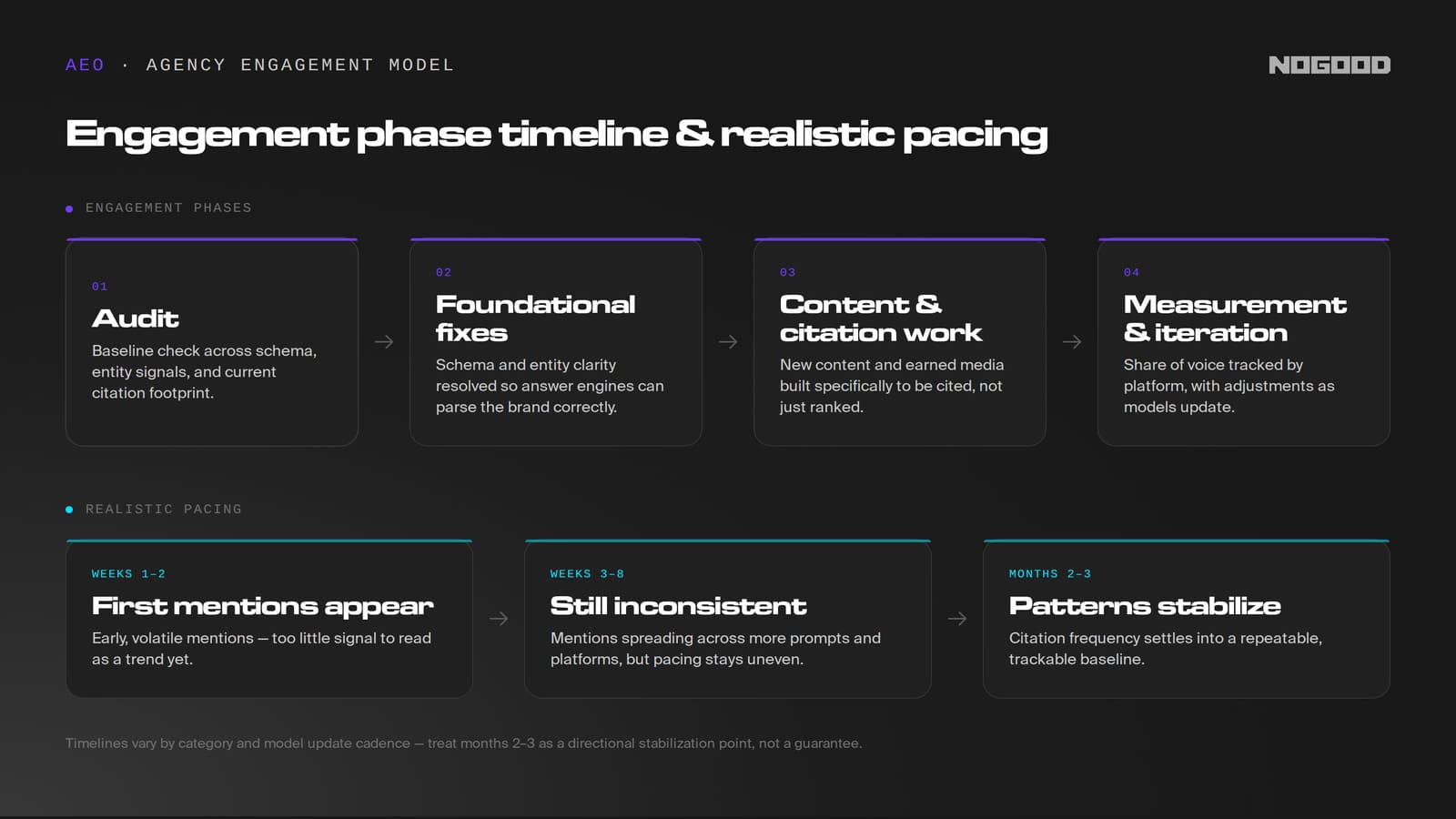
On timeline, be wary of inflated promises, as things don’t happen overnight with AEO. In general, for clients green to visibility in AI, you can expect early volatile mentions in the first 1-2 weeks, mentions spreading across more platforms (though still inconsistent) by weeks 3-8, and patterns stabilizing into consistent citations around the two to three month mark. That framework tracks with the broader consensus across independent AEO research: first signals in 30-60 days, more consistent multi-platform citation by 90 days, and sustained visibility building over 6-12 months.
Anyone promising citations within days isn’t describing AEO. They’re describing a branded name search, which is a different thing entirely.
How Much Does an AEO Agency Cost?
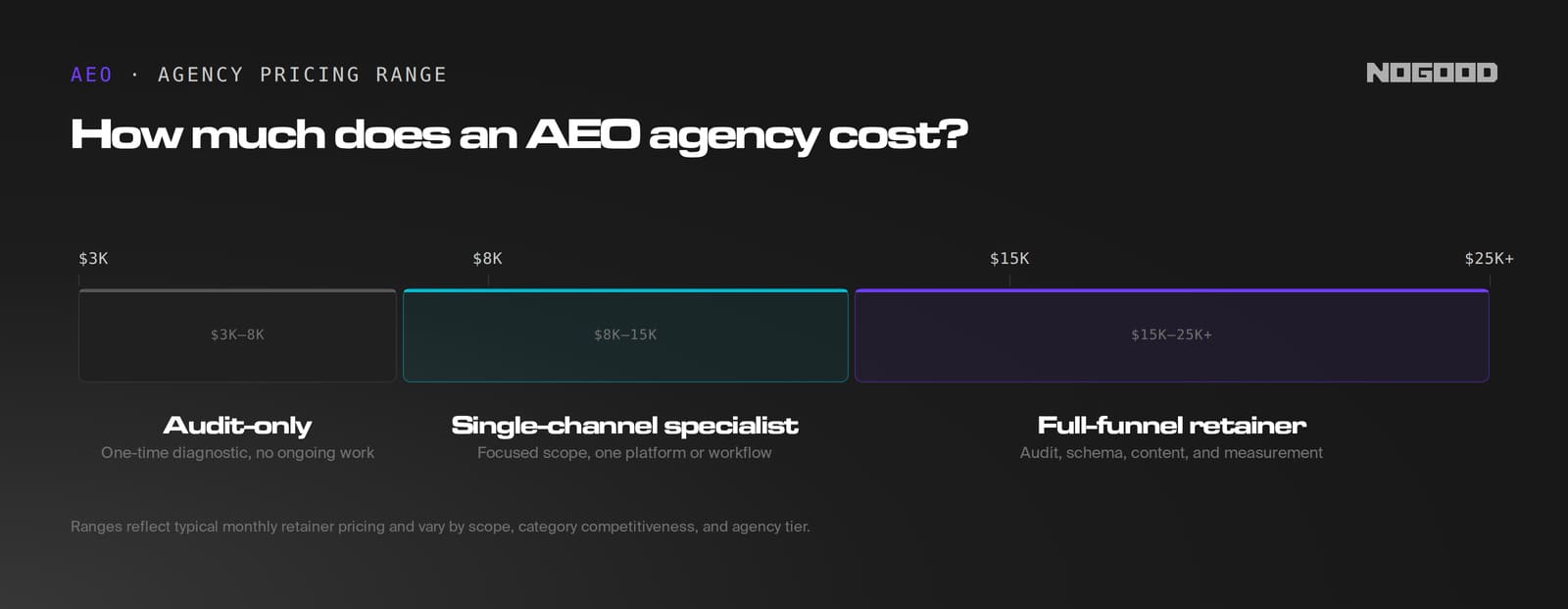
Retainers for AEO work generally run between $3000 to $25,000+ per month, depending on a few variables:
- Scope. Audit-only engagements sit at the low end. Full-funnel work (technical, content, PR, ongoing measurement) sits at the high end.
- Competitive density. A crowded vertical requires more content and citation-building work to move the needle.
- In-house vs. agency vs. freelancer. Freelance and gig-platform AEO services exist at a fraction of agency pricing, but they typically cover a narrow slice of the four workstreams (usually content tweaks or a one-time audit) rather than a full strategy with ongoing measurement.
None of this means the highest retainer is automatically the right one. It means the price should map clearly to which workstreams are actually included, which is exactly what the next section covers.
Questions to Ask Before You Sign
A few pointed questions upfront will save you the headache of a six-month retainer with nothing to show for it.
- How do you measure citations, and on which platforms? If the answer doesn’t include specific platform names (ChatGPT, Perplexity, Claude, Copilot, AI Overviews), that’s a gap.
- Will I see raw visibility data, or just a summary? You want access to the actual before-and-after, not a curated report that only shows wins.
- Who handles technical implementation? Schema and structural fixes often require dev resources. Know whether that’s the agency, your team, or a gap nobody’s covering.
- Is content written in-house or outsourced? Outsourced isn’t automatically bad, but it changes how closely the work reflects your brand voice and product accuracy.
- What’s the reporting cadence, and what’s in it? Monthly is standard. Ask what the report actually measures before assuming it covers what you care about.
- Does this include off-site and earned media work, or just my own site? This is worth asking directly. A chunk of what earns AI citations happens off your domain entirely: reviews, forum mentions, PR, and third-party validation. An agency that only touches your website is covering one of four workstreams, not the full picture. If digital PR, social, and influencer work aren’t part of the scope, ask who’s covering that lane, because it’s not optional if you want to actually move the needle.
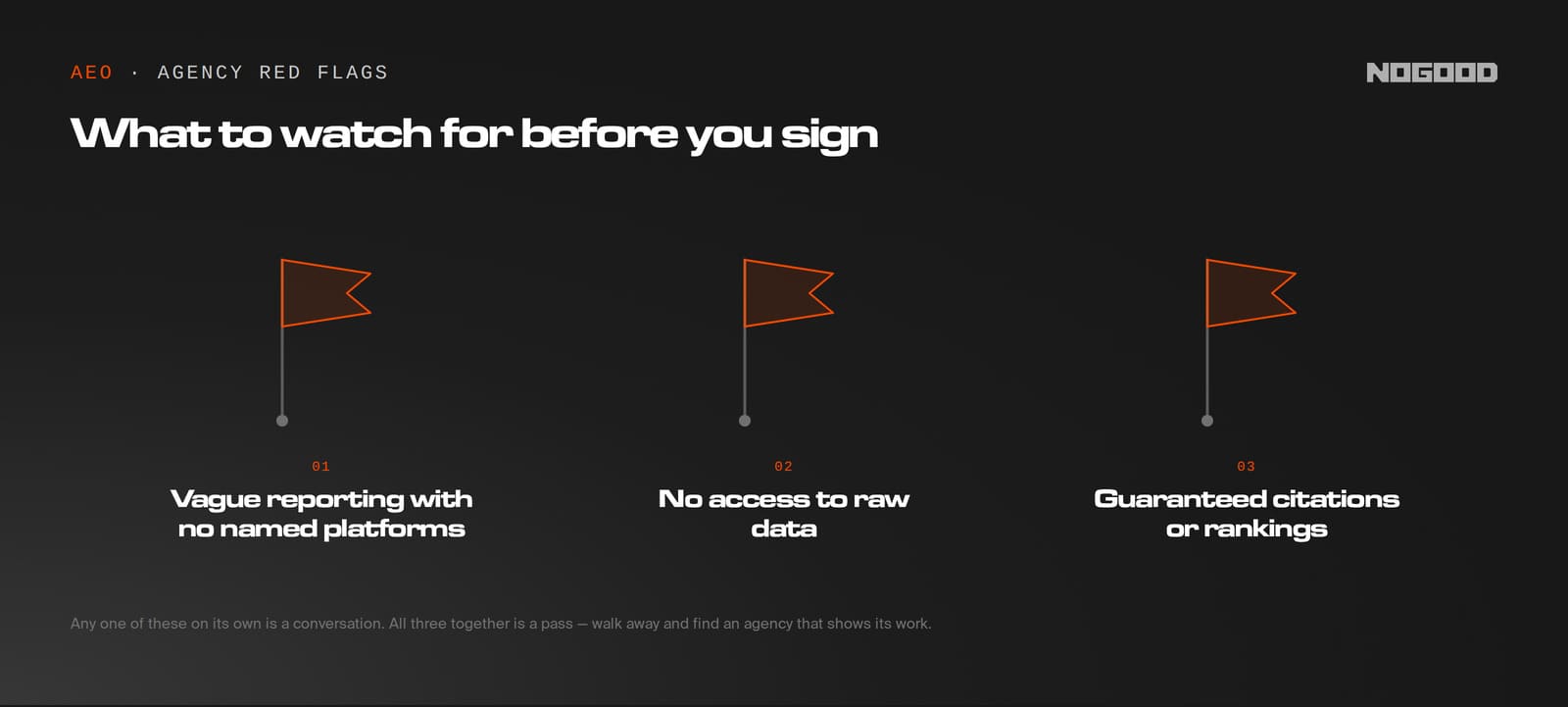
A few patterns should be treated as red flags: vague reporting that never names a specific platform, no visibility into raw data, and any promise of guaranteed citations or rankings. AEO doesn’t work like paid placement. Nobody can guarantee a specific answer engine will cite you on a specific timeline, and an agency that says otherwise is overselling what the discipline can actually deliver.
What Results Look Like
Success in AEO isn’t a ranking position, so the metrics look different than what you’re used to from SEO.
The core measures to expect:
- Citation frequency. How often your brand gets cited across a defined set of test prompts, tracked over time. The standard formula is queries where you’re cited divided by total queries tested, run consistently across platforms rather than once.
- Share of voice by platform. Since citation behavior differs so much by engine, this needs to be tracked per platform, not as one blended number.
- Referral traffic quality, not just volume. AI-referred traffic is still a small share of total visits industry-wide, but it arrives with more research already done. Volume alone undersells what’s happening here.
What “good” looks like will vary by vertical and competitive density, and any agency worth hiring should be upfront that this compounds over months, not weeks. The goal isn’t a single #1 spot. It’s a growing, trackable presence across the handful of platforms your buyers actually use to make decisions.
Bringing In an AEO Agency?
AI answer engines have room for a handful of sources per query, not a full page of results, and which sources make the cut depends on platform, competitive density, and how much groundwork is actually behind the pitch. That’s the filter to run any agency (or any DIY plan) through before committing a budget to it.
If you’re evaluating whether to bring in outside help or build this in-house first, our guide to choosing an AI SEO agency walks through that decision in more depth. And if you want a sense of what this work looks like in practice, from technical audits through content and citation building, that’s what we do at NoGood every day. If you want to talk through where your brand currently stands in the AI search world, get in touch.
Working With An AEO Agency: FAQs
What is an AEO agency?
An AEO agency helps brands get cited and recommended by AI answer engines like ChatGPT, Perplexity, Google AI Overviews, Copilot, and Gemini. The work spans technical structure, content formatting, schema, and off-site citation building.
What is the difference between AEO and GEO agencies?
In practice, the terms are used interchangeably by most agencies and clients. Both describe optimizing for visibility in AI-generated answers rather than traditional search rankings. Some firms use GEO to emphasize generative platforms specifically, but there’s no industry-standard distinction.
What services do AEO agencies offer?
Most AEO engagements cover four areas: technical and entity structure, content restructuring for extractability, schema and structured data implementation, and off-site citation or PR building. Full-service agencies run all four. Specialists often cover one or two.
How long does AEO take to show results?
Early, inconsistent mentions typically appear within 1-2 weeks. More consistent citations across platforms tend to build over 30-90 days, with sustained, compounding visibility developing over 6-12 months.
What metrics do AEO agencies track?
Citation frequency (how often you’re cited across test prompts), share of voice by platform, and referral traffic quality are the core measures. Metrics should be tracked per platform, since citation behavior varies significantly between engines.
What should I look for when hiring an AEO agency?
Look for platform-specific reporting, access to raw visibility data, clarity on who owns technical implementation, and whether the scope includes off-site and earned media work. Be wary of anyone guaranteeing specific citations or timelines.