

Product discovery is happening inside ChatGPT, Gemini, Amazon Alexa+, and Perplexity, and checkout is starting to follow. The question for every retail team in 2026 is: when an AI agent shops your category, do your products show up, and can you prove what that’s worth?
That’s the job of an eCommerce AEO tool. The best AI visibility tools do more than monitoring. eCommerce teams need a tool that can:
- Track how AI engines describe your brand and your SKUs
- Identify and fix product feed issues
- Evaluate content and technical signals that determine whether you get recommended
- Connect back to revenue
Orders attributed to AI search grew 11x on Shopify stores between January and November 2025, and AI-referred orders carried 14% higher average order values than organic search. Salesforce reported that AI agents influenced 20% of holiday orders in 2025, worth $262 billion in revenue. And McKinsey projects agentic commerce will reach $5 trillion globally by 2030.
Alongside the AI shopping boom, the tracking software category has exploded, growing from a handful of products to well over a hundred in about a year. But most of them do the same thing: show you a dashboard. Very few tools can see the AI shopping shelf at the product level, and even fewer can act on it.
We evaluated the field through an eCommerce lens specifically to find the best AEO tools for retail. If you’re short on time, here are the quick answers:
- Shopify is the infrastructure every DTC brand should turn on first.
- Goodie AI is the most complete AEO and agentic commerce platform covering the most agentic commerce surfaces and used by leading retail brands.
- BrightEdge is the enterprise pick when automated execution on Google’s AI surfaces matters most.
- Evertune brings the most statistical rigor.
- Semrush, Scrunch, Profound, Writesonic, Ahrefs, Peec, and Otterly each earn a spot for specific team profiles and budgets.
Read on to see how these tools compare and which one is best for your eCommerce AEO/GEO goals.
How We Evaluated Each Tool
Generic roundups score AEO tools based on dashboards and engine counts, but eCommerce has high stakes: your catalog, your feeds, and your margins are on the line. So we weighted six criteria to evaluate these tools based on what actually moves revenue for retail brands:
- Agentic commerce and AI shopping coverage (25%): Does the platform track product-level visibility inside ChatGPT Shopping, Google AI Mode shopping, Amazon Alexa+, and Perplexity Shopping, or does it stop at brand mentions?
- Optimization and action layer (20%): Can it fix product feeds, inject schema, generate PDP content, and push changes live, or does it hand you a score and walk away?
- Attribution and revenue linkage (20%): Can it connect AI visibility to sessions, carts, and conversions (ideally at the SKU level)?
- AI engine breadth (15%): How many LLMs and AI surfaces does it monitor, and how fresh is the data?
- Competitive and category intelligence (10%): Can it show you which products competitors win on and where the gaps are?
- Enterprise readiness and integrations (10%): Does it offer SOC 2, SSO, and native connections to Shopify, BigCommerce, Google Merchant Center, and Amazon?
We scored each tool from 1 to 5 on every criterion, based on public documentation, verified pricing pages, independent reviews, and published case studies as of July 2026, then combined the weighted scores into a final score out of 100.
One structural note: Shopify is graded as commerce infrastructure, not as a monitoring platform. It leads the list because it’s the foundation for everything else these tools measure, not because it competes on analytics.
eCommerce AI Optimization Tool Comparison Table
|
Platform |
Founded |
Category |
AI Shopping Surfaces Tracked |
Starting Price |
Score/100 |
|---|---|---|---|---|---|
|
Shopify |
2006 |
Commerce infrastructure |
Sells into ChatGPT, Copilot, AI Mode, Gemini, Perplexity |
From $39/mo |
74* |
|
Goodie AI |
2023 |
Full-Stack AEO + agentic commerce |
ChatGPT Shopping, AI Mode Shopping, Amazon Alexa+, Perplexity Shopping |
From $399/mo |
96 |
|
BrightEdge |
2007 |
Enterprise SEO + AI Catalyst |
None |
Custom |
76 |
|
Evertune |
2024 |
Statistical GEO intelligence |
ChatGPT product cards |
From $3,000/mo |
72 |
|
Semrush AIO |
2008 |
SEO suite + AI visibility |
ChatGPT Shopping (Enterprise only) |
$99/mo/domain |
69 |
|
Scrunch AI |
2023 |
Agent experience platform |
Product-level AI search view |
From $250/mo |
68 |
|
Profound |
2024 |
Enterprise AEO monitoring |
ChatGPT Shopping, Amazon Alexa+ |
$99/mo (Starter) |
67 |
|
WriteSonic |
2020 |
Content + GEO hybrid |
None |
$39/mo |
58 |
|
Ahrefs Brand Radar |
2010 |
SEO suite add-on |
None |
$199/mo/index + base plan |
49 |
|
Peec AI |
2025 |
AI visibility analytics |
None |
$95/mo |
47 |
|
Otterly AI |
2024 |
Entry-level monitoring |
None |
$29/mo |
69 |
*Scored as infrastructure: Shopify gives you the rails into AI surfaces, not the scoreboard.
The Top AEO and GEO Tools for eCommerce
1. Shopify: The Agentic Commerce Foundation
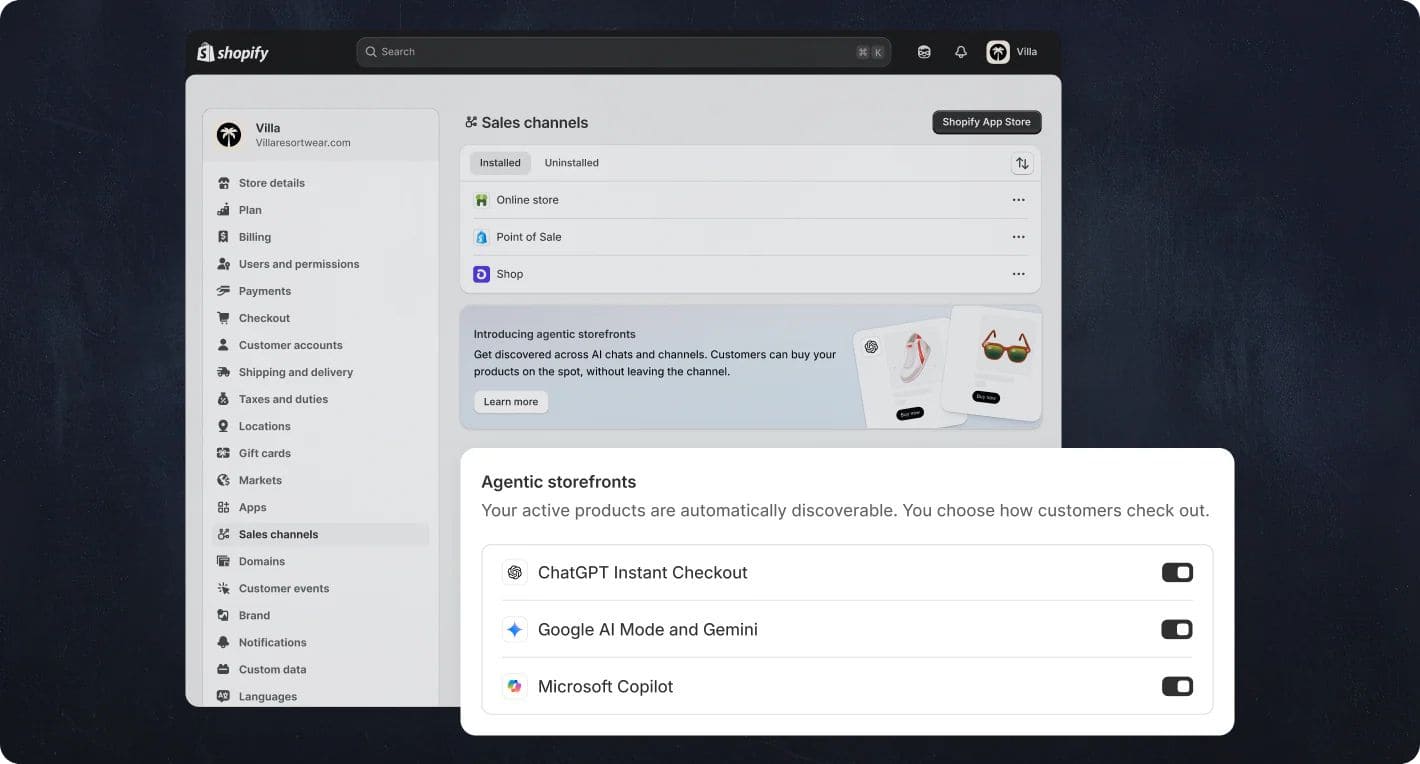
Founded: 2006 | Pricing: Included in Shopify plans, ranging from $39/month (Basic) to $2,300/month (Shopify Plus)
Shopify isn’t an AEO analytics tool, and that’s exactly why it leads this list. It’s the layer that decides whether AI agents can find, read, and transact with your catalog at all.
In 2025 and 2026, Shopify moved faster on agentic commerce than any other player in retail infrastructure. The receipts: Shopify co-developed the Universal Commerce Protocol (UCP) with Google, an open standard bringing commerce to agents at scale, with native shopping rolling out across AI Mode in Google Search and the Gemini app.
Agentic Storefronts began activating for all stores in late March 2026, auto-syndicating products through the Shopify Catalog, and the Spring ’26 Edition added auto-syndication to ChatGPT, Perplexity, Copilot, Google AI Mode, and Gemini, with MCP deployed by default. Merchants toggle AI channels in Admin; Shopify handles the ACP and UCP protocol plumbing underneath.
- Models covered (as sales channels): ChatGPT, Microsoft Copilot, Google AI Mode, Gemini, Perplexity.
- Agentic commerce capabilities: Shopify Catalog, Agentic Storefronts, Storefront MCP, Knowledge Base, Product Disclosures, embedded Copilot checkout, UCP co-authorship.
- eCommerce proof: The platform’s own data showed traffic from AI tools to Shopify stores grew 7x between January and November 2025, and orders attributed to AI search grew 11x.
- Pros: Turnkey access to every major AI surface and zero protocol engineering are included in your existing plan. Shopify is the default answer for brands asking, “how do I sell where agents shop?”
- Cons: No AI visibility analytics, no competitive intelligence, and no diagnostics explaining why a rival’s product gets recommended over yours. Shopify puts your products on the shelf. It doesn’t tell you whether AI is picking them, or why it’s not. That’s the job for the AI visibility and optimization tools below.
2. Goodie AI: The Closed-Loop AEO and Agentic Commerce Platform
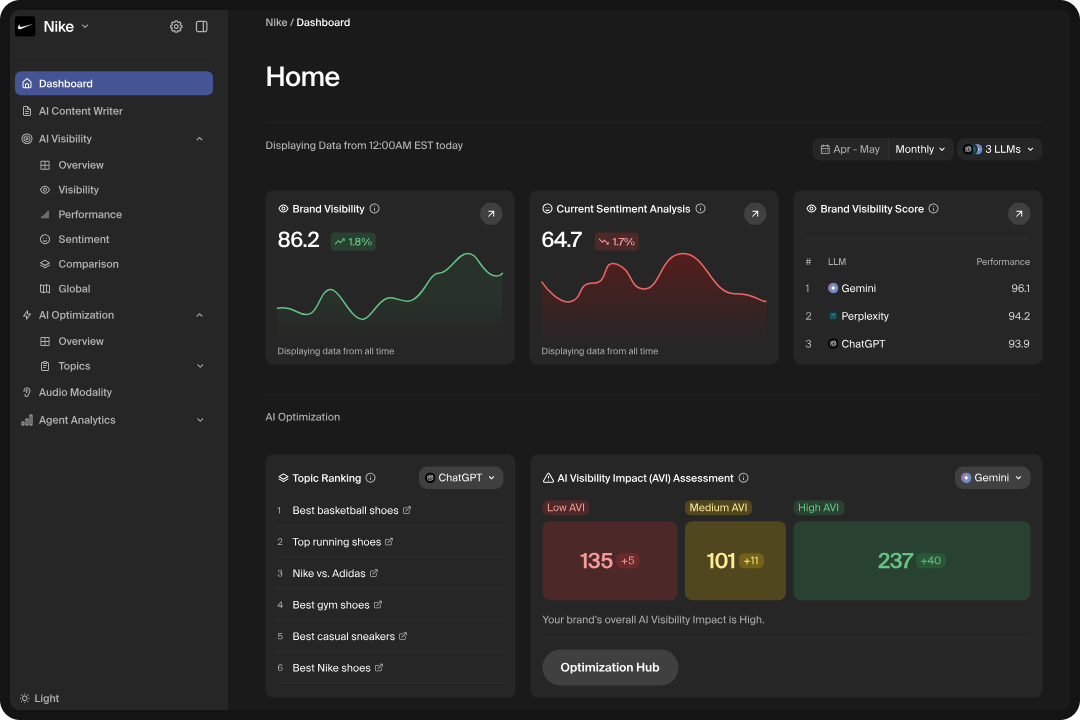
Founded: 2023 | Pricing: From $399/month; enterprise tiers are quote-based
Here’s the case for Goodie AI. Most AEO tools make you choose between monitoring and action. Goodie AI actually manages to close that loop: research, action, and measurement in one platform. On the brand side, that means daily visibility, sentiment, citation, and share-of-voice tracking across 11 AI engines, grounded in the AEO Periodic Table research that analyzed over 1 million prompts across major LLMs. On the commerce side, Goodie AI fixes product feeds, provides revenue attribution, and offers retail-specific features that almost no competitors in the category have.
The Agentic Commerce Suite tracks and optimizes how products appear across ChatGPT Shopping, Amazon Alexa+, Perplexity Shopping, and Google AI Mode Shopping at the SKU level. The platform monitors exactly which products get mentioned, where they rank in comparisons, which merchants sell them, and which competitor products appear alongside yours. Then, it acts. Goodie AI offers one-click feed remediation, auto-generated product descriptions and FAQs, schema injection, and image optimization deployed directly to storefronts and ad feeds.
Goodie AI also measures impressions and traffic through assisted carts and checkouts, with revenue attributed at the surface and SKU level, and net lift via match-back and incrementality reporting. That last piece matters because product visibility and revenue attribution look beyond brand visibility entirely; you’re not reporting mentions to your CFO, you’re reporting carts.
- Models covered: 11 engines including ChatGPT, Gemini, Claude, Perplexity, Grok, Copilot, Google AI Overviews and AI Mode, Meta AI, and DeepSeek, plus the four AI shopping surfaces mentioned above.
- eCommerce case studies: Dermalogica saw a 127% increase in AI conversions and 2.5x visibility improvement against competitive averages; SteelSeries grew AI search conversions 3.2x in six months and became the most-retrieved gaming brand across three major LLMs. Goodie AI’s roster also includes leading retail and CPG names such as Unilever.
- Agentic commerce capabilities: Goodie AI’s are the most mature in the category, with SKU-level monitoring, feed and schema execution, and revenue attribution across four AI shopping surfaces and integrations for Shopify, BigCommerce, Google Merchant Center, Meta Catalog, Amazon Seller Central, and custom APIs.
- Pros: The only platform on this list that covers monitoring, optimization, agentic commerce, and SKU-level attribution end to end; broadest engine coverage; daily refresh; SOC 2; research-backed recommendations rather than generic best practices.
- Cons: Priced for teams, not hobbyists; upper tiers are quote-based, which means a sales conversation; the feature depth carries a learning curve if all you want is a simple mention tracker.
3. BrightEdge: Enterprise Execution on Google’s AI Surfaces
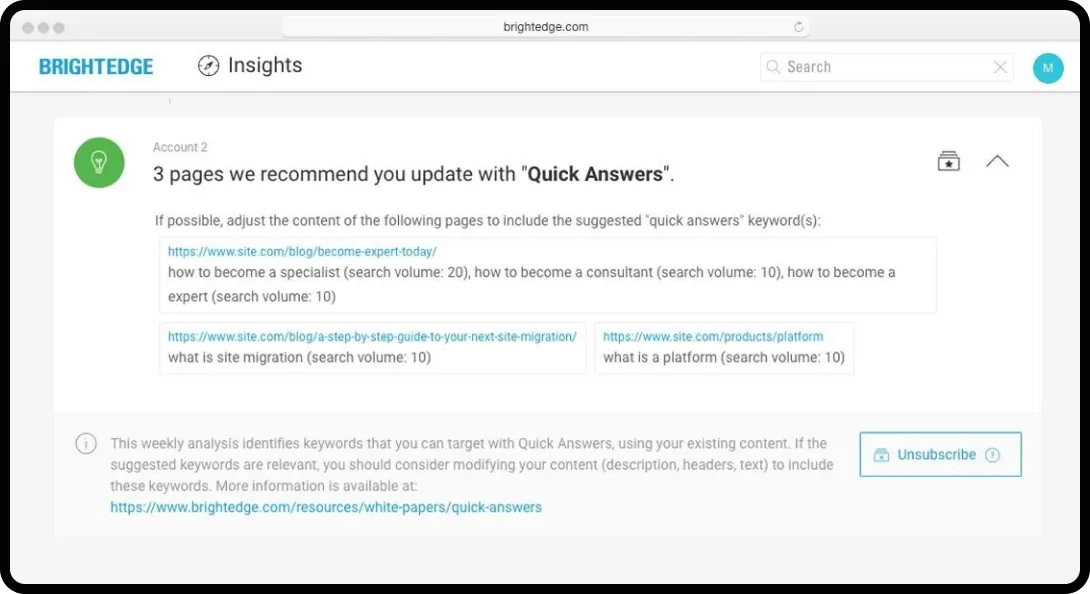
Founded: 2007 | Pricing: Custom enterprise contracts
Ranking a 19-year-old SEO platform this high on a list of AI tools will raise eyebrows, but hear me out. Most AEO platforms show you a dashboard and leave the work to you. BrightEdge actually ships the work: Autopilot deploys automated SEO changes through CMS integrations, and Copilot drafts optimized content inside the platform. In our weighting, execution and attribution together carry 40% of the score, and for a large retail org the binding constraint is rarely seeing the problem; it’s shipping the fix across 10,000 pages.
The AI layer is real, if Google-centric. BrightEdge’s AI Catalyst, launched in April 2025, tracks brand presence and sentiment across Google’s AI Overviews, ChatGPT, and Perplexity, sitting on the Generative Parser dataset BrightEdge has run against Google’s AI results since the SGE days. And if you buy the argument that Google’s AI surfaces are where the discovery volume lives today (I do; AI Overviews, AI Mode, and Gemini together represent the majority of AI search user share), depth there counts for more than raw engine-count breadth. Add revenue-connected executive reporting and two decades of enterprise retail relationships, and you get the safest AI visibility path for organizations already running BrightEdge.
- Models covered: AI Overviews, ChatGPT, Perplexity; narrower than the dedicated platforms.
- eCommerce case studies: Deep enterprise retail SEO heritage, though no flagship named AI-commerce win yet.
- Pros: Automated on-site execution at enterprise scale; strongest depth on Google’s AI surfaces; AI visibility wired into existing SEO revenue reporting; mature procurement-ready infrastructure.
- Cons: No agentic commerce or shopping-surface coverage, the gap that keeps it out of the top two; narrowest engine list of the enterprise tier; opaque pricing and annual contracts; SEO-first DNA.
4. Evertune: Statistical Rigor and Shopping Intelligence
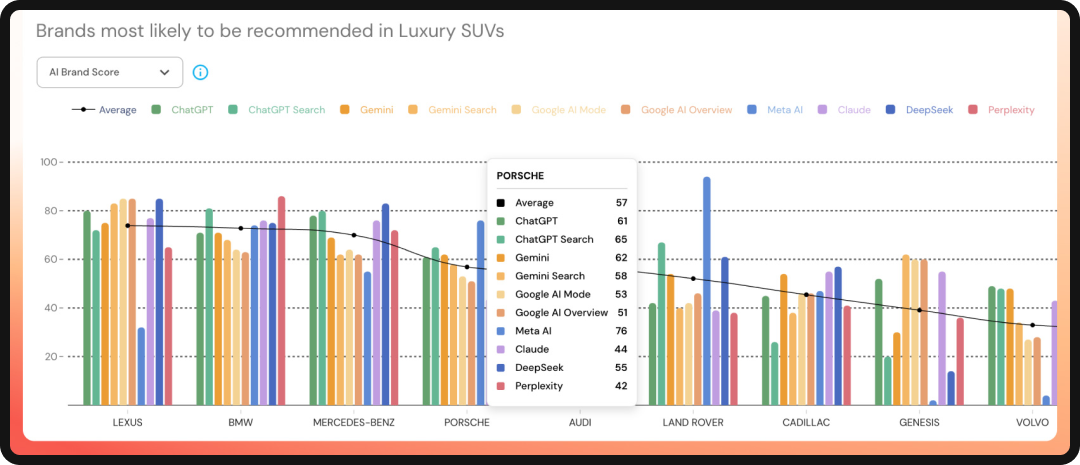
Founded: 2024 | Pricing: From $3,000/month, demo-led
Built by early Trade Desk team members, Evertune’s pitch is that most AI visibility scores are noisy, and theirs aren’t. The platform samples each prompt 100 times across every major LLM to capture true model behavior rather than a single noisy draw, and pairs that with EverPanel, a consumer panel tracking AI search behavior across more than 150 million real user prompts.
The eCommerce angle arrived in May 2026 with Evertune’s Shopping Intelligence, which captures ChatGPT’s product-card shopping experiences to show brands when their products appear, how visible they are versus competitors, and which retail partners drive the most AI discovery. The retail-partner lens is especially useful for brands that sell through distribution.
- Models covered: ChatGPT, Gemini, Claude, Perplexity, Meta AI, Copilot, DeepSeek, AI Overviews, AI Mode, and more; 11 models claimed.
- eCommerce case studies: Halo Collar reached #5 in ChatGPT for GPS fence dog collars with a 67/100 AI Brand Score, and an eCommerce travel company went from invisible to a top-10 category spot in two months, improving its Gemini score from 29 to 90. Canada Goose and Miro are named clients.
- Pros: The most statistically defensible data in the category; retail partner and pricing-perception intelligence; strong content strategy layer.
- Cons: $3,000/month is the published starting price and the motion is demo-led, which rules out most mid-market teams; no Amazon or Perplexity Shopping coverage; no SKU-level revenue attribution.
5. Semrush (AI Toolkit): Best for Teams Already in the Semrush Ecosystem
Founded: 2008 | Pricing: $99/month per domain for AI Visibility Toolkit; custom for Enterprise AIO
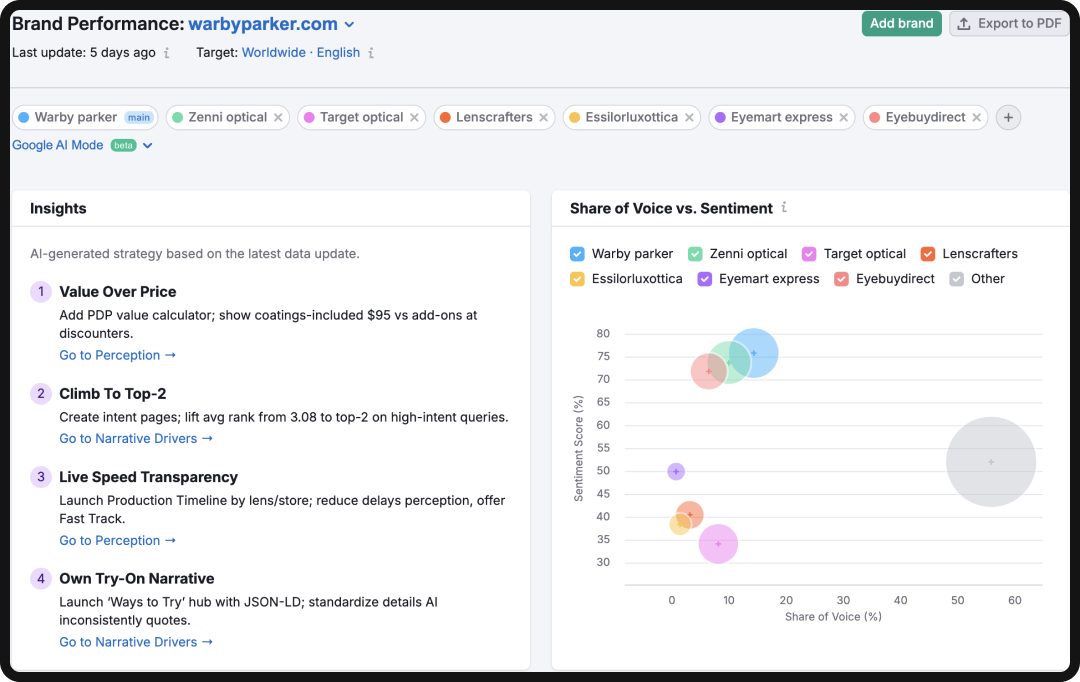
For teams already living in Semrush, this is the pragmatic pick. For $99/month, the AI Visibility Toolkit covers brand performance, prompt tracking, and an AI search health audit across ChatGPT, AI Overviews, AI Mode, Perplexity, and Gemini.
The serious eCommerce capability sits upstairs: Enterprise AIO extends coverage to nine LLMs including Copilot, Grok, Claude, and DeepSeek with unlimited prompt tracking, and adds Shopping Experience Tracking, showing which products surface inside ChatGPT’s shopping ecosystem, how they’re positioned against competitors, and which attributes drive recommendations.
- Models covered: Five on the standard toolkit; nine on Enterprise AIO.
- eCommerce case studies: Thin on named retail wins so far; the flagship AIO story is Roche, a B2B diagnostics brand.
- Pros: SEO and AEO in one contract; familiar workflows; a massive prompt database; the cheapest credible entry point for a team that already pays for Semrush.
- Cons: Shopping tracking is Enterprise-only; regional coverage spans only six databases with US-English data (a real limit for global retailers); no feed execution or revenue attribution.
6. Scrunch AI: How Agents See Your Store
Founded: 2023 | Pricing: From $250/month for brands and $500/month for agencies
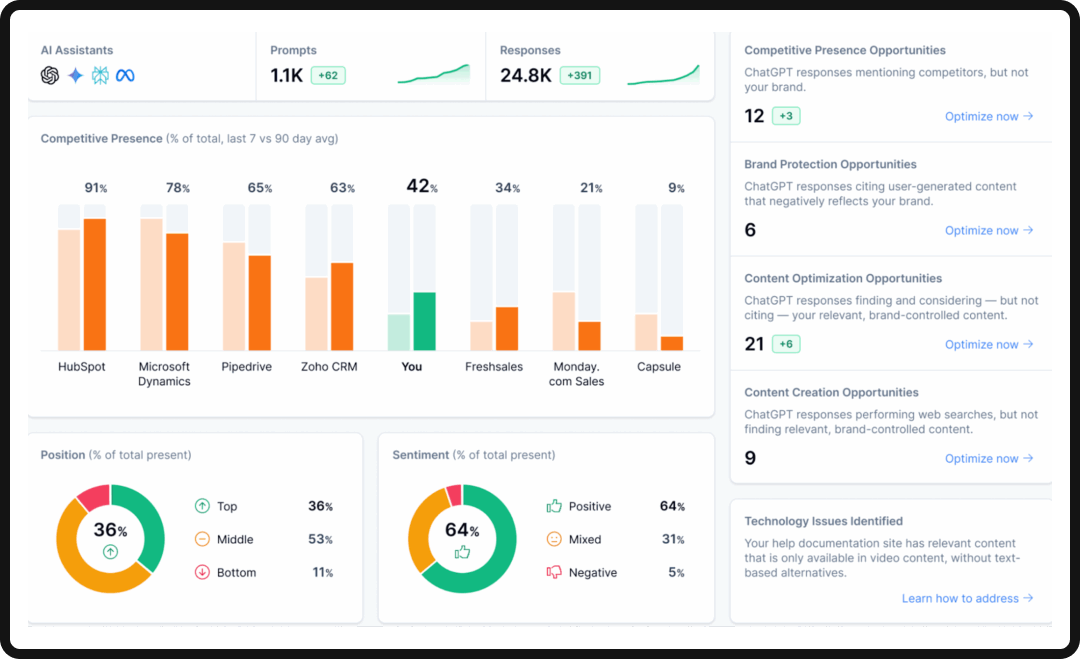
Scrunch attacks a problem most tools don’t even measure: whether AI can parse your site correctly in the first place. Its Agent Experience Platform creates machine-readable versions of your pages optimized for AI agents without changing what human shoppers see.
For catalog-heavy stores with complex specs, that’s the difference between AI quoting your PDP and quoting a competitor’s review roundup. It also offers product-level AI search performance through its Shopping view and real-time AI bot traffic monitoring.
- Models covered: ChatGPT, Perplexity, Claude, Gemini, Copilot, and others.
- eCommerce case studies: Serves 500+ brands with enterprise clients including Lenovo and Crunchbase.
- Pros: Unique agent-side content delivery; crawl health and misinformation detection; SOC 2 Type II.
- Cons: Entry pricing is 10x the cost of budget tools; the action layer is technical rather than commercial; no revenue attribution or feed remediation.
7. Profound: Monitoring-First Approach by the Category’s Biggest Name
Founded: 2024 | Pricing: $99/month Starter plan (ChatGPT only), $399/month Growth plan, custom Enterprise plans
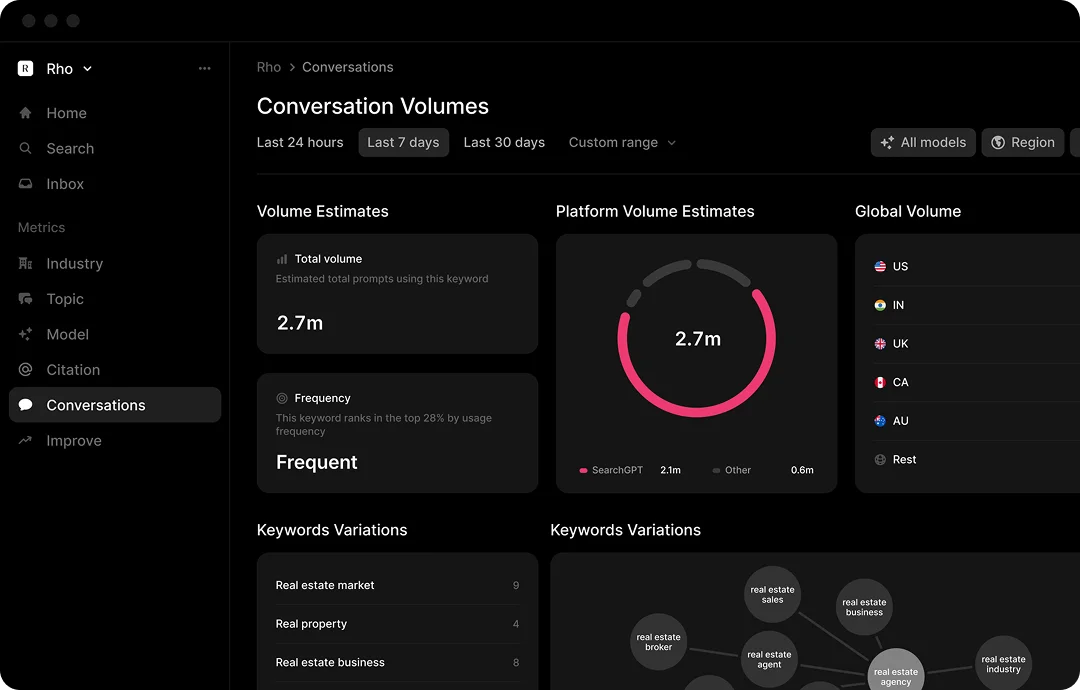
Profound is the highest-funded company in the category, with over $155 million in total funding after a $96 million Series C round at a $1 billion valuation closed in February 2026, and roughly 700 enterprise customers including Target, Walmart, Ramp, and MongoDB. The prompt-volume dataset, sourced from real user conversations rather than synthetic queries, is a real differentiator, and the platform spans five pillars: Answer Engine Insights, Agent Analytics, Prompt Volumes, Shopping, and Agents, across 11 AI surfaces including Amazon Alexa+ and unusually deep ChatGPT Shopping tracking.
So why does Profound rank mid-list for eCommerce AEO/GEO tools? Because for retail teams, Profound offers insight without execution. The shopping features live behind Enterprise pricing that reviewers put at $2,000+ per month, with a monitoring-heavy architecture that means most teams pay more and still need additional tools to execute.
There’s also no product feed remediation, no schema deployment, and no SKU-level revenue attribution. Profound’s flagship case study, a 7x AI visibility increase for Ramp, is a fintech story, not a retail one. Profound watches the shelf better than almost anyone; it just doesn’t stock it.
- Models covered: ChatGPT, Claude, Perplexity, Gemini, Grok, Copilot, Meta AI, DeepSeek, Google AI Overviews, AI Mode, Amazon Alexa+.
- eCommerce case studies: The customer list includes Target and Walmart alongside consumer brands like Mejuri and 8Sleep; no published SKU-level retail outcomes.
- Pros: Deepest prompt intelligence in the market; strong agent and crawler analytics with CDN integrations; SOC 2 Type II; fast shipping cadence for platform updates and features.
- Cons: Monitoring-first approach to eCommerce; shopping insights are limited to Enterprise plans; no execution or attribution layer; the $99 Starter plan is too thin to run a real AEO program; no free trial.
8. Writesonic: Content Production Meets GEO
Founded: 2020 | Pricing: From $39/month for Lite plan to $499/month for Advanced plan; custom enterprise plans
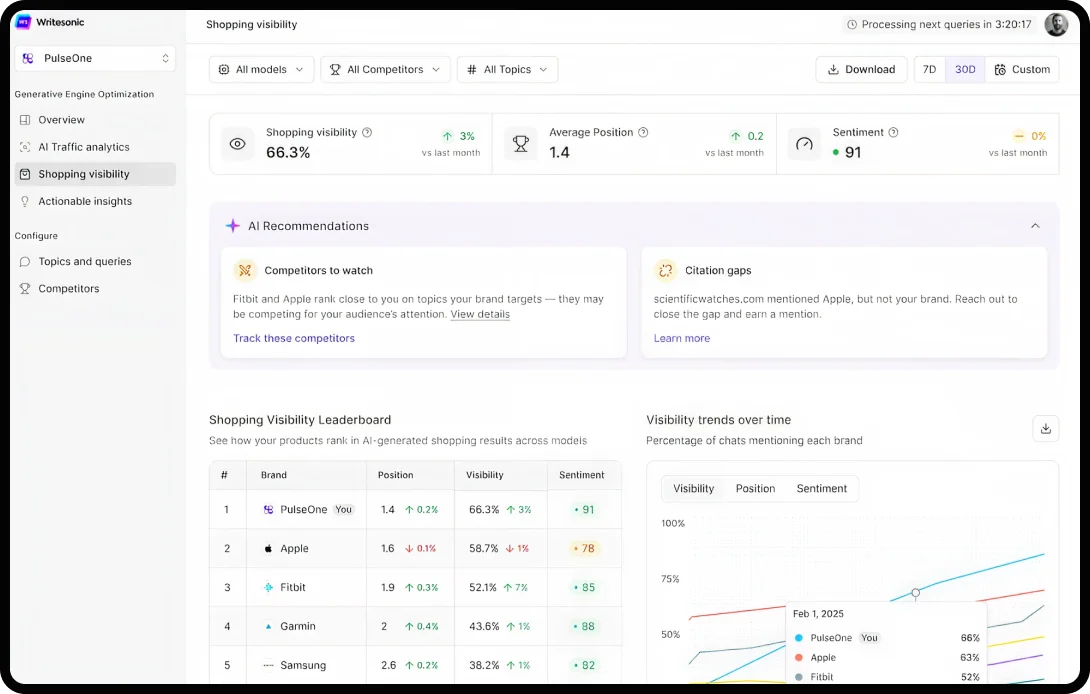
Writesonic started as an AI writing tool and repositioned itself as a GEO platform that tracks AI visibility across ChatGPT, Gemini, and 10+ AI search platforms. Then, it helps you act by creating new content, refreshing pages, or reaching out to sites that mention competitors but not you.
Writesonic’s combination of monitoring plus production in one subscription is a draw for content-constrained eCommerce teams. Plus, the starting price is a fraction of the cost of dedicated enterprise platforms.
- Models covered: ChatGPT, Gemini, Perplexity, Claude, AI Overviews, and more.
- eCommerce case studies: Mostly self-referential; the company reports $2M+ ARR generated from AI search using its own platform.
- Pros: Low-friction path from insight to published content; affordable starting price; SOC 2 Type II compliance; genuinely useful research arm.
- Cons: Content-first DNA means shallower analytics; no shopping-surface tracking, feed tooling, or revenue attribution; not built for enterprise catalog complexity.
9. Ahrefs Brand Radar: The SEO Suite Add-On
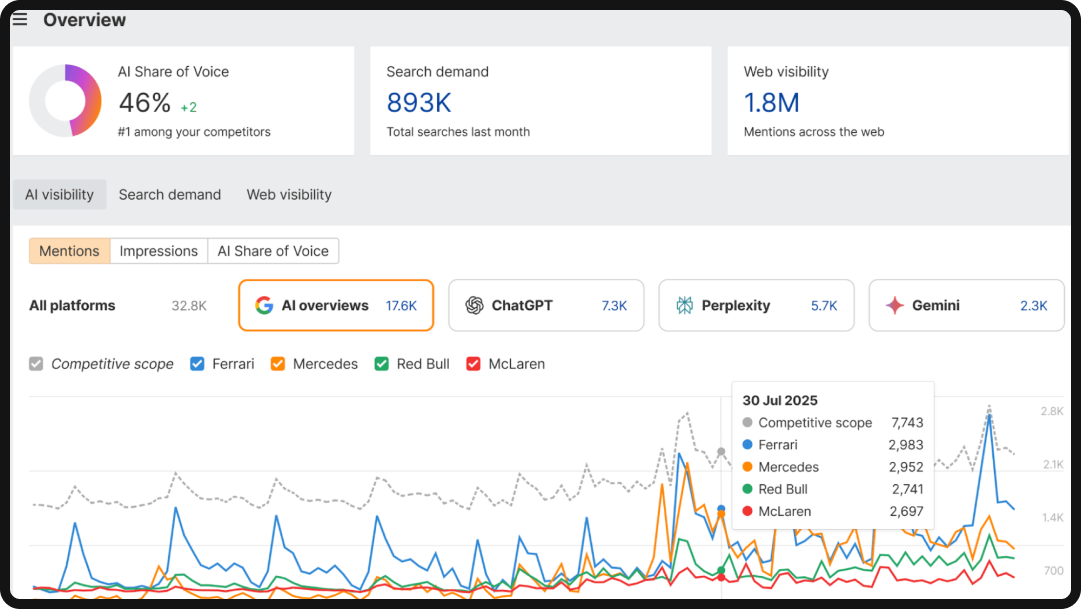
Founded: 2010 (Brand Radar launched in 2025) | Pricing: $199/month per AI index or $699/month for all six, on top of a base plan from $129/month
Ahrefs’ Brand Radar bolts AI visibility onto one of the best SEO datasets in the world, drawing on a database of more than 401 million organic prompts derived from real search behavior. It tracks six platforms: Google AI Overviews, AI Mode, ChatGPT, Perplexity, Gemini, and Microsoft Copilot, and it’s growing fast; by Profound’s own reporting, Brand Radar is Ahrefs’ fastest-growing product, generating $1M in ARR every two weeks.
However, there’s a catch for retail teams: independent testing found Brand Radar reported three ChatGPT mentions for a brand that actually had 123 and six Perplexity mentions instead of an actual 212. This gap traces back to Brand Radar’s snapshot-based methodology. Brand Radar samples data periodically rather than tracking continuously, so figures for non-Google platforms should be read as directional trends, not precise counts. Factor in the required base plan, and the realistic all-in cost runs $828 to $1,148 per month.
- Models covered: Six natively; Claude via custom prompts only; Grok data collection currently paused.
- eCommerce case studies: None named; the value is research breadth, not retail proof.
- Pros: Search-backed prompt data; unmatched integration with backlink and keyword workflows; web mention tracking that no dedicated AEO tool replicates.
- Cons: Accuracy gaps outside Google surfaces; no shopping coverage; no action layer; no attribution; expensive for what eCommerce teams actually need.
10. Peec AI: Clean, Affordable Analytics
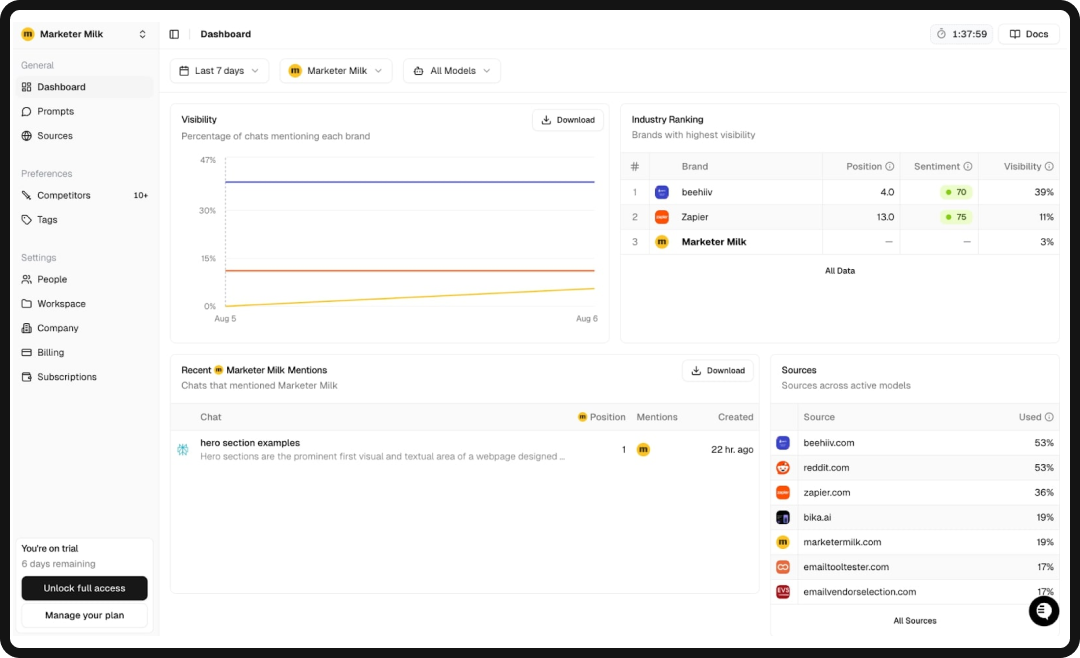
Founded: 2025 | Pricing: $95/month Starter plan, $245/month Pro plan, $495/month Advanced plan; per-engine add-ons cost extra
The fastest-growing startup in the category, Berlin-based Peec AI raised a $21M Series A led by Singular in November 2025 and serves 3,000+ marketing teams. Its brand customers include Zalando, Hugo Boss, Squarespace, TUI, Wix, and Fielmann. That retail logo density is notable for a monitoring tool.
Peec’s product philosophy is deliberately simple: set up prompts, see visibility, and act on top citations. Peec offers unlimited seats on every tier and a UI-scraping methodology that mirrors what real users see.
- Models covered: ChatGPT, Perplexity, and AI Overviews as the base; AI Mode, Copilot, Gemini, and Grok from a menu; Claude is Enterprise-only.
- eCommerce case studies: strong retail adoption (Zalando, Hugo Boss, Chanel, Breitling) but no published product-level commerce results.
- Pros: best-in-class UX; genuine multi-language and multi-country tracking; self-serve trial; honest pricing.
- Cons: monitoring only, with a recommendations engine meaningfully behind the leaders; closer to best-in-class measurement than a tool that tells you what to do next; no shopping surfaces, no attribution, no API below Enterprise
11. OtterlyAI: The Entry Point

OtterlyAI is the cheapest credible way for brands to answer the question, “Does AI search matter for us yet?” and was recognized as a Gartner Cool Vendor in 2025.
Otterly reruns your prompt sets daily across ChatGPT, Google AI Overviews, AI Mode, Perplexity, Gemini, and Copilot, and tracks share of voice, average position, and citation frequency over time. For a small DTC brand validating the channel before committing real budget, it does the job.
- Models covered: ChatGPT, Google AI Overviews, Perplexity, and Microsoft Copilot as the base four on every tier; Claude, Google AI Mode, and Gemini available as add-ons, priced separately per tier ($9–149/month each on Lite/Standard/Premium respectively for AI Mode and Gemini; $29–439/month for Claude); full model coverage nearly doubles the Premium price.
- eCommerce case studies: None named; published wins skew B2B software, not retail.
- Pros: Lowest entry price in the category; simple setup a one-person team can run; useful citation analysis for PR targeting.
- Cons: No commerce depth of any kind; light optimization guidance; model add-ons cost extra and scale hard with tier; you’ll outgrow it the moment AI search starts driving real revenue.
Three More eCommerce AEO/GEO Tools To Watch
There are three more options for brands to consider for specific situations. Adobe LLM Optimizer is, alongside Scrunch, the only technology offering content delivery designed specifically for AI agents, relevant if you’re an Adobe Commerce shop. Yotpo Discover pairs visibility tracking with agents that act on reviews data, a natural fit for brands already on Yotpo. And Azoma is the platform that explicitly tracks Amazon Alexa+ and Walmart Sparky alongside the major generative engines, worth a look for marketplace-first sellers.
Three more options fit specific situations:
- Adobe LLM Optimizer is one of the only tools (alongside Scrunch) built to deliver content directly to AI agents and makes sense for Adobe Commerce shops.
- Yotpo Discover pairs visibility tracking with agents that act on reviews data, so it’s a natural fit for brands already using Yotpo.
- Azoma explicitly tracks Amazon Alexa+ and Walmart Sparky alongside the major generative engines, making it worth a look for marketplace-first sellers.
How To Choose the Best AI Optimization Tool for Your Retail Brand
Match the tool to your stage, not the hype cycle.
Shopify site? Turn on Agentic Storefronts today; it’s included in your plan and the prerequisite for everything else.
Validating the channel? Start with Otterly or Peec for under $100 a month to learn whether AI engines mention you at all.
Already seeing AI search drive measurable discovery and need the full loop? Goodie AI is the most complete option, offering SKU-level shopping visibility, product feed fixes, and revenue attribution. (Yes, that’s our platform, so demo Profound and Evertune against it and make us earn it).
Standardized on Semrush or BrightEdge at the enterprise level? Their AI layers are the low-friction path, with the caveat that shopping coverage is either gated or absent.
Catalog complex enough that AI misreads your specs? Scrunch solves a problem nobody else measures.
One thing no tool fixes: capacity. Every platform here surfaces work. The brands winning the AI shelf in 2026 are the ones actually shipping the feed fixes, schema, content, and third-party proof, week after week.
FAQ: eCommerce AEO Tools
What is an AEO tool for eCommerce?
An AEO tool for eCommerce tracks how AI answer engines like ChatGPT, Gemini, Perplexity, and Amazon Alexa+ mention, describe, and recommend your brand and products, then helps you optimize the content, feeds, and technical signals that determine whether you get surfaced. The best ones also attribute AI-driven visibility to traffic, carts, and revenue.
Is there a difference between AEO and GEO?
Functionally, no. Answer Engine Optimization and Generative Engine Optimization describe the same practice; different corners of the industry prefer different acronyms. The work is identical.
If I’m on Shopify, do I still need an AEO platform?
Yes. Shopify’s Agentic Storefronts put your catalog in front of AI agents, but they don’t tell you how often you’re recommended, why a competitor’s product wins the comparison, or what to fix. Infrastructure and intelligence are different jobs; you need both.
How do I measure ROI from AEO?
Start with AI referral traffic in GA4, then layer in platform-level attribution: assisted carts, checkouts, and revenue tied to AI surfaces. Tools with SKU-level attribution and match-back reporting, like Goodie AI, close the loop; monitoring-only tools leave you inferring impact from visibility trends.
Which AI shopping surfaces matter most in 2026?
Four, today: ChatGPT Shopping, Google AI Mode shopping (backed by UCP and Universal Cart), Amazon, and Perplexity Shopping. Copilot checkout and Gemini are scaling fast behind them. Coverage lists change monthly, so weight platforms that add surfaces quickly.
The funnel didn’t just collapse; for a growing share of shoppers it now runs end to end inside a chat window. The stack you pick this year decides whether you can see that happening, and whether you get paid when it does.
How do reviews and UGC affect AI shopping recommendations?
AI shopping agents weigh reviews heavily when making product recommendations. Review volume, recency, and sentiment all influence whether your product is recommended over a competitor’s. Reddit discussions and YouTube product reviews also feed into the citation graph that shapes AI shopping answers.
How quickly can brands see results from GEO optimization?
Consumer brands typically see citation improvements for long-tail product queries within 4-6 weeks of optimization. Headline category terms (like “best wireless earbuds”) take longer, usually 3-4 months.
Feed remediation and structured data fixes often produce faster results because they resolve issues that were actively preventing AI agents from recommending your products.