

TL;DR
- LinkedIn AEO is the practice of making your LinkedIn content citable by AI tools like ChatGPT, Gemini, and Perplexity, not just discoverable in search.
- LinkedIn ranks #5 among the most-cited domains in AI answers, and citation share compounds: early authority is disproportionately hard to displace.
- To get cited, write in answer format, own one specific topic, structure articles and posts for extraction, and audit your profile like structured data, but always write for humans first.
- Human-first writing works for both audiences; AI-first writing works for neither.
Let me guess… you’ve been posting on LinkedIn consistently for a while now, right? You’ve gained a lot of followers over the past few months, have been posting maybe 2-3x a week, and things feel like you’re in a really good spot. Some would even call you “seasoned” or, dare I say, a “LinkedIn influencer.”
Until someone you were talking to dropped the word “AEO” mid-conversation. I’m going to assume they said, “This is something everyone in the industry is tapping into right now,” and out of curiosity, you did a quick Google search (or LLM search). Something along the lines of “LinkedIn” and “AI Search” appeared in a search prompt during this rabbit hole of yours, and suddenly, you landed here. Hi. Welcome.
Unless this wasn’t how it played out for you at all… well, you’re still reading this, aren’t you?
Chances are you’re already sitting around a 7 (or 9) out of 10 on the LinkedIn familiarity scale. You know the platform. You know it started as a job board, evolved into a networking app, and somewhere along the way had a subtle identity shift. It became a place where thinkers and practitioners post content that’s valuable enough to be forwarded in a Slack channel or added to your long list of bookmarks.
Now, it has become a source of substance (not just the typical resumes that are, more often than not, AI-generated).
What most people haven’t connected the dots on yet is what happened next. Once LLMs entered the picture, that same body of human-attributed, professionally-anchored content became something else entirely.
LinkedIn didn’t become a citation source by accident. It became one because it already had exactly what AI models are trained to trust.
What Is AEO?
To break it down quickly: AEO (Answer Engine Optimization) is the practice of optimizing your content to be cited by AI rather than ranked by a search engine. The goal you’re working towards is showing up inside the answer itself. Think about how you personally use AI tools now versus how you used Google two years ago. The instinct to scroll through results and pick a source is getting replaced by the instinct to just ask a question and trust what comes back. And being cited means you’re part of what comes back.
That can look like your LinkedIn post surfacing in a ChatGPT response, or your name coming up when someone asks an AI who the leading voices in your industry are. We’re all familiar with the long list of blue links, and don’t get me wrong, that’s still very much relevant (shoutout to the SEO managers).
But right now, all eyes are on figuring out what it takes to become the source AI points users to.
What Is AEO for LinkedIn?
LinkedIn AEO is the practice of optimizing your LinkedIn content and profile to be cited by AI models, rather than just discovered through LinkedIn or Google search.
If you’ve spent any time optimizing your LinkedIn presence, you’re probably already working from a solid set of guidelines: a keyword-optimized headline and About section, a consistent posting cadence, and content that aligns with what your audience is actively searching for. The typical manual for that still works and is worth following.
AEO just adds a layer on top of that. You’re no longer writing for the person who happens to stumble across your profile in a search result. Instead, you’re writing for the model that synthesizes your content into an answer for someone who never searched on LinkedIn at all.
That distinction is important because the strategy changed over time without you even realizing.
- LinkedIn SEO is about discoverability within a platform and its adjacent search surfaces.
- LinkedIn AEO is about becoming a source that AI trusts enough to quote.
Alex Josephson, LinkedIn’s VP of Brand and Content Strategy, put it plainly: LLMs gravitate toward “credible information from verified sources at scale,” which is exactly what LinkedIn’s professional ecosystem produces when people use it well. The platform was already built for this. Most people just haven’t started treating it that way yet.
Who Needs to Think About This?
Not everyone, and that’s something I’m willing to admit upfront. AEO for LinkedIn has the highest ROI for specific types of accounts, and if you don’t fall into one of these buckets, it’s probably not where you should be spending your energy right now. In other words, not every bandwagon needs to be jumped on.
Those who stand to gain the most are B2B brands and agencies trying to show up when buyers use AI to research categories, vendors, or solutions. That, or executives building personal brand authority in a specific domain, and thought leaders who want their POV to be the one AI cites when someone asks a question in their niche.
If you’re a B2B brand, consider what happens before a buyer even books a demo or reaches out to someone from your sales team. Increasingly, that pre-research phase is happening inside AI platforms. Someone is either asking ChatGPT to compare solutions side by side or using Perplexity to identify credible voices in a space. If your content isn’t being cited in those moments, you’re practically a ghost in a part of the buying journey you probably didn’t even know existed.
For executives and thought leaders, the stakes are slightly different (but equally significant). Your LinkedIn profile and content are increasingly feeding into how AI understands and represents your expertise. Let’s say you’re consistently publishing substantive, specific content in your domain. That body of work becomes a signal. However, if you’re posting sporadically or broadly, there’s nothing for AI to anchor to.
It’s less urgent for pure consumer brands with no B2B angle, and mostly irrelevant if your audience simply isn’t using AI to research before making decisions. Overall, understand and identify your audience before you overhaul your LinkedIn content strategy.

Why Is LinkedIn AEO Worth Prioritizing Right Now?
According to Goodie’s analysis of 58.6 million AI citations across ChatGPT, Gemini, Claude, and Perplexity between October 2025 and March 2026, LinkedIn ranks #5 among the most-cited domains globally, sitting ahead of Instagram, Facebook, and X. Social and community platforms collectively occupy the highest-influence tier for brands, meaning these are the domains where what you publish directly shapes how often you get cited.
The more consequential data point is how citation share changes over time. It compounds. Brands and individuals in the top quartile of citation share receive more than 10x the AI citations of those in the next quartile down. That right there is a structural gap. Those who establish authority early on are cited in ways that make it increasingly difficult for anyone else to displace them. The window to be an early mover on LinkedIn AEO is open right now, and it won’t stay that way for long.
LinkedIn is also making moves on its own end. The platform recently expanded its AI-powered conversational search from Premium members to all users, a signal that it’s investing in AI-driven discovery from the inside out. The feed you’re publishing into is increasingly one that AI is actively indexing, surfacing, and treating as a source of credible professional information.
Put it together and the case is straightforward. LinkedIn already has the domain authority, the professional credibility, and the content structure that AI models are trained to trust. The brands and individuals who show up consistently, write with specificity, and own a defined topic are the ones AI will keep pointing users to.
The LinkedIn AEO Methodology
Getting cited by AI on LinkedIn comes down to four practices: writing in answer format, owning a specific topic, structuring content for extraction, and auditing your profile.
Getting cited by AI on LinkedIn is a content practice, not a one-time fix. The tactics below are designed to help you write in a way that serves both the people scrolling your feed and the models synthesizing your content into answers. Some of it will feel familiar, but the new layer I’m breaking down is intentional.
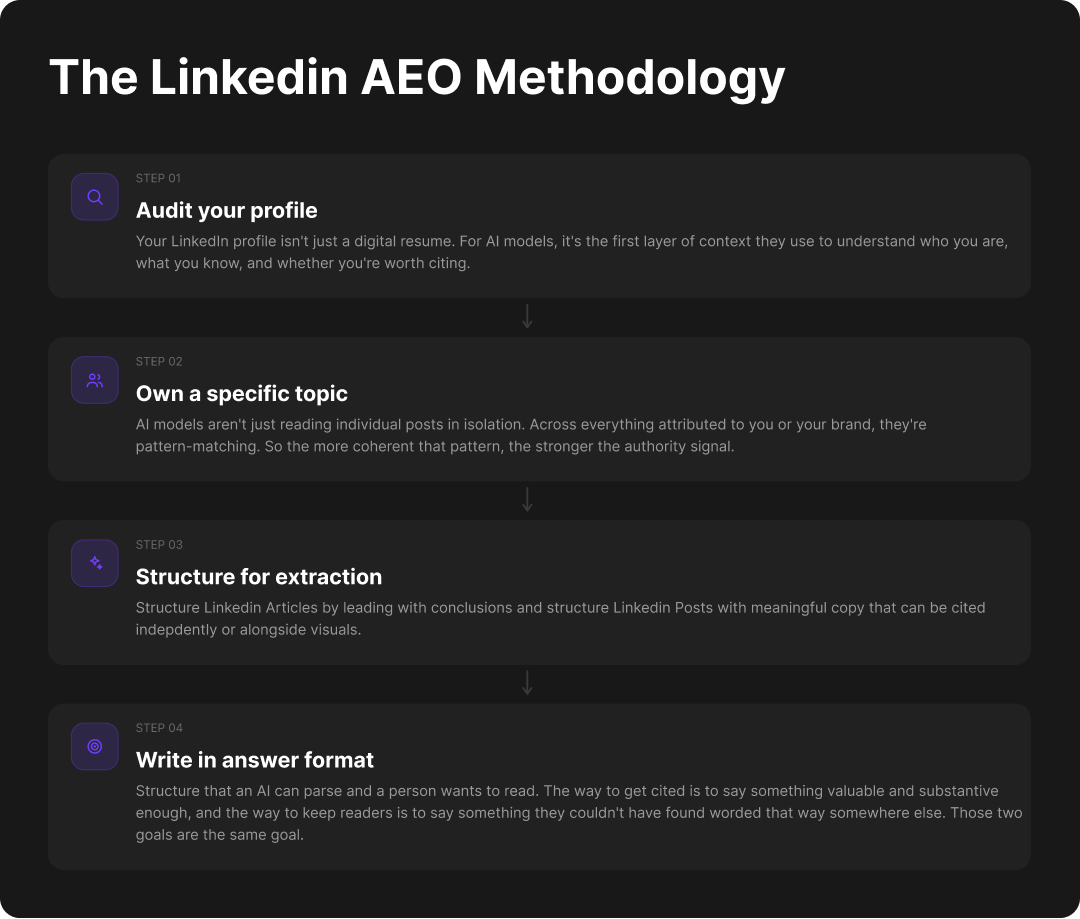
Write in Answer Format
AI models are built to extract clean, direct answers. When someone asks ChatGPT or Perplexity a question relevant to your industry, the model is most likely scanning for the answer that most clearly addresses it. Structure determines whether your content gets pulled into that response or skipped entirely.
The format that gets cited looks like this: open with the question, answer it immediately, then support it. Instead of a dense paragraph warmup, the payoff has to come first, because that’s what AI can extract, and frankly, it’s also what keeps readers like yourself from scrolling past.
Own A Specific Topic
One post won’t build AI authority. A body of work on a defined subject will.
Alex Josephson puts it plainly: when leaders, customers, and subject matter experts all publish consistently on the same topics and points, it sends a compound signal to LLM detectors. AI models aren’t just reading individual posts in isolation. Across everything attributed to you or your brand, they’re pattern-matching. So the more coherent that pattern, the stronger the authority signal.
This is where specificity does the heavy lifting. A profile that publishes broadly across ten loosely related topics gives AI nothing to anchor to. A profile that consistently publishes on, say, B2B demand generation for SaaS companies in a post-AI-search world gives a model something to cite when a relevant question comes up. The narrower your lane, the more likely you are to own it in AI responses.
For brands, this means getting leadership, subject-matter experts, and even customers to publish on the same core topics rather than each going off in their own direction. For individual executives and thought leaders, it means committing to a point of view and returning to it consistently, even when the temptation is to comment on whatever is trending that week (which is perfectly fine too, but balance is key here!).
Structure Content For Extraction
Not all LinkedIn content is created equal, and AI treats the two main formats very differently. Here’s how to structure each one.
LinkedIn Articles
Articles are the long-form format LinkedIn was built for, and they’re also the format best suited for AEO. The structure that gets cited follows a clear pattern: lead with the insight, then layer in the context. Don’t build to a conclusion; open with it. Declarative sentences, clear headers, and a logical hierarchy give AI models something to parse and extract cleanly.
The other thing worth knowing about articles: original content gets cited; reshares essentially never do. AI is looking for a source, not an amplifier. If your article is collecting someone else’s thinking without adding a distinct perspective of your own, there’s nothing there for a model to attribute to you. The bar is saying something, said clearly enough that a model can lift it and point back to you.
LinkedIn Posts
Posts work differently, and the AEO calculus shifts accordingly. Video drives engagement on the platform, but text is the taxonomy LLMs circle around. A video post accompanied by a substantive, well-written caption gives AI the text layer it needs to work with.
The same logic applies to carousels and static images. A carousel with structured, readable text that stands on its own without visuals can absolutely be cited. A static image with no meaningful caption text is essentially invisible to a model. Every post, regardless of format, needs a text layer that can be cited independently of any attached visual.
Audit Your Profile
Your LinkedIn profile isn’t just a digital resume. For AI models, it’s the first layer of context they use to understand who you are, what you know, and whether you’re worth citing.
The three areas that matter most are your headline, your About section, and your Featured content. Each one functions less like a personal branding exercise and more like structured data. What you put there shapes how AI attributes expertise to you, which means vague positioning actively works against you. “Passionate about growth” or “helping brands tell their story” gives a model nothing to anchor to. “B2B demand generation strategist for SaaS companies” or “Answer Engine Optimization practitioner at NoGood” gives it enough specificity to cite in a relevant response.
The LinkedIn SEO fundamentals apply here, and they’re worth revisiting with an AEO lens. A keyword-rich headline is part of in-platform search, and now, a part of how AI models parse your professional identity. An About section that clearly articulates your area of expertise, in declarative sentences rather than narrative flourishes, becomes content a model can extract and attribute. Featured content that showcases your strongest, most specific work signals topical authority in a way that a bare profile simply doesn’t.
Humans First, LLMs Second; Always
The ceiling on LinkedIn AEO is higher than most people realize right now, precisely because the space isn’t crowded yet. The Goodie compounding data makes the strategic case: citation share builds on itself, and early authority is worth more than late authority. The caveat is that you can’t manufacture it. AI cites content that’s worth citing, which means clarity, specificity, and consistency over time.
However, here’s something I recommend you NOT do, as someone who is on LinkedIn often: don’t optimize your content purely for AI citation. It’s a trap and it’s clear when you are doing just that. You can write content that an LLM can parse and still completely lose the person reading it. The reverse isn’t true. Content that resonates with a real person, that has a clear POV, and that they couldn’t find worded that way anywhere else will also give AI exactly what it needs to cite you.
Human-first writing works for both audiences; AI-first writing works for neither.
Think of it like opposing sides of a magnet. The harder you push toward AI optimization as the primary goal, the further you get from the people who are natively on the platform, scrolling your content, deciding whether to follow you, engage with you, or send your post to a colleague. Most of your readers are still coming from inside LinkedIn, not from a ChatGPT response. And those readers are quick to disengage when something reads like a listicle or feels two-dimensional, structured for extraction rather than for thought (myself included).
The move is to write with a substantive POV that earns both. Structure that an AI can parse and a person wants to read. The way to get cited is to say something valuable and substantive enough, and the way to keep readers is to say something they couldn’t have found worded that way somewhere else. Those two goals are the same goal.
Your LinkedIn presence is no longer just a professional record. For anyone operating in B2B, it’s increasingly a signal AI uses to explain who you are and what you know, whether you’ve thought about it that way or not. And the people and brands who find the light at the end of the tunnel here are those who own their narrative in writing for real people, and are confident enough in their own clarity and specificity that LLMs follow naturally.
LinkedIn AEO: Frequently Asked Questions
What is LinkedIn AEO?
LinkedIn AEO (Answer Engine Optimization) is the practice of optimizing your LinkedIn content and profile to be cited by AI tools like ChatGPT, Gemini, and Perplexity. While LinkedIn SEO focuses on discoverability within the platform’s search, AEO focuses on becoming a source AI models trust enough to quote in their answers.
Does AI actually cite LinkedIn content?
Yes. LinkedIn ranks #5 among the most-cited domains across ChatGPT, Gemini, Claude, and Perplexity, according to Goodie’s analysis of 58.6 million AI citations (ahead of Instagram, Facebook, and X). Original posts and articles with substantive text are cited; reshares essentially never are.
Do LinkedIn articles or posts get cited more by AI?
Articles are the format best suited for citation because they’re long-form, structured, and easy for models to parse. Posts can absolutely be cited too, but every post needs a substantive text layer (captions on videos, readable text in carousels) because text, not visuals, is what AI models extract.
How do I optimize my LinkedIn profile for AI?
Treat your headline, About section, and Featured content like structured data. Replace vague positioning (“passionate about growth”) with specific, declarative expertise (“B2B demand generation strategist for SaaS companies”). Specificity gives AI models something concrete to attribute to you; vagueness gives them nothing to anchor to.
Should I write LinkedIn content for AI or for people?
People first, always. Content with a clear POV that resonates with a real reader also gives AI everything it needs to cite you, but content structured purely for extraction loses human readers and rarely earns the engagement signals that build authority. Human-first writing works for both audiences; AI-first writing works for neither.