

Public Relations (PR), in its most abstract sense, is how humans have influenced public perception, not just for brands, but for government agencies, public figures, nonprofits, and educational institutions. The tactics used in PR have evolved alongside each major technological advancement: the printing press, web, and now AI. Each, dramatically changing how we get our news, who we trust, and how we perceive brands.
- Traditional PR involves coverage across print, radio, and TV.
- Digital PR involves coverage across digital news, blogs, and social media.
But a new shift is underway. Before, earned mentions fed a domain authority score. Now, they are feeding a direct line to revenue: what AI models say about your brand when someone asks them a question in your category. Getting mentioned in AI search is the new marketing gold rush and Digital PR is not playing a minor role. Earned media now makes up 72.2% of all AI citations, more than owned, competitor, and social combined. It’s quickly becoming one of the most measurable growth levers in the entire marketing stack. PR promotion incoming!
What Digital PR Actually Is
Digital PR is the practice of earning coverage, backlinks, and brand mentions across online publications, journalists, and third-party sites, then converting that coverage into search authority. It borrowed its instincts from traditional PR, where you pitched a story, built a relationship, got coverage, and watched as third-party advocates brought in new leads.
Traditional PR measures success in impressions and sentiment, “did the right people see this, and did it make us look good?” Digital PR measures success in links and authority, “did this coverage point back to our site in a way search engines, and now AI models, can find and trust?”
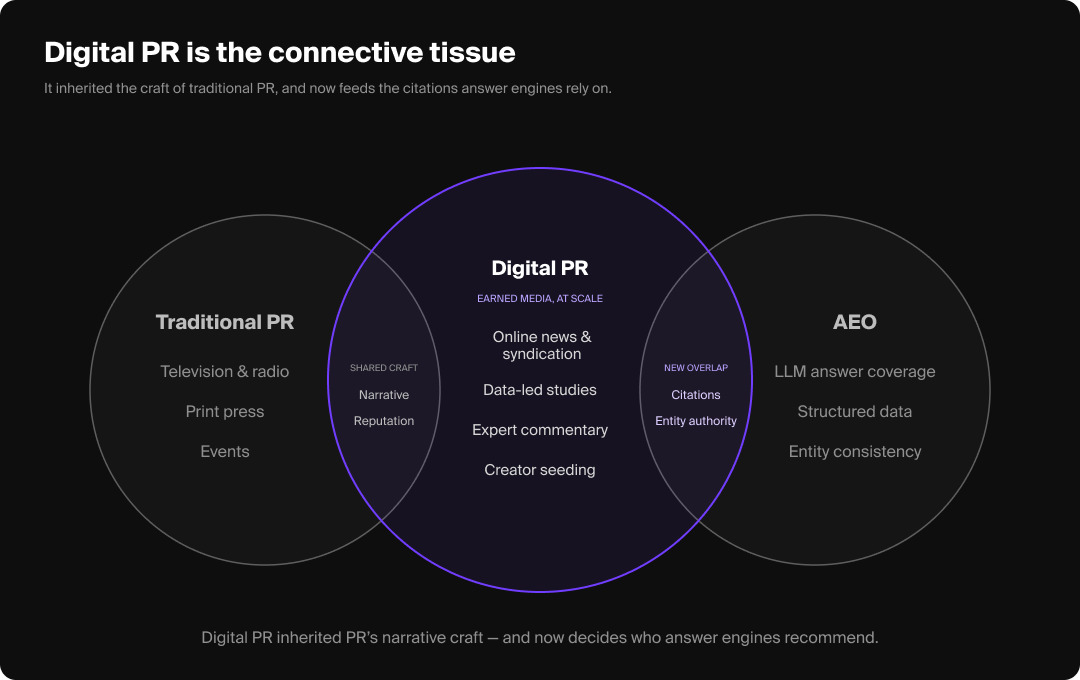
The overlap confuses most people because digital PR still borrows from traditional PR. But especially with the advent of AI and the rise of New Media, Digital PR is changing who professionals target, where, and what to optimize a pitch for.
Digital PR Is Not Link Building
It’s tempting to flatten digital PR into “link building with extra steps,” but the two disciplines solve different problems. Link building is often outbound and mechanical: guest posts, directory submissions, outreach at scale. Digital PR is inbound by design. You create something (a study, a data point, a genuinely useful expert take) newsworthy enough that a journalist links to you because the story is better with your source in it.
Digital PR Is Not Content Marketing
Content marketing is a close cousin to PR, but the distinction is in ownership. Content marketing builds what lives on your site. Digital PR gets other people’s sites to talk about what you’ve built.
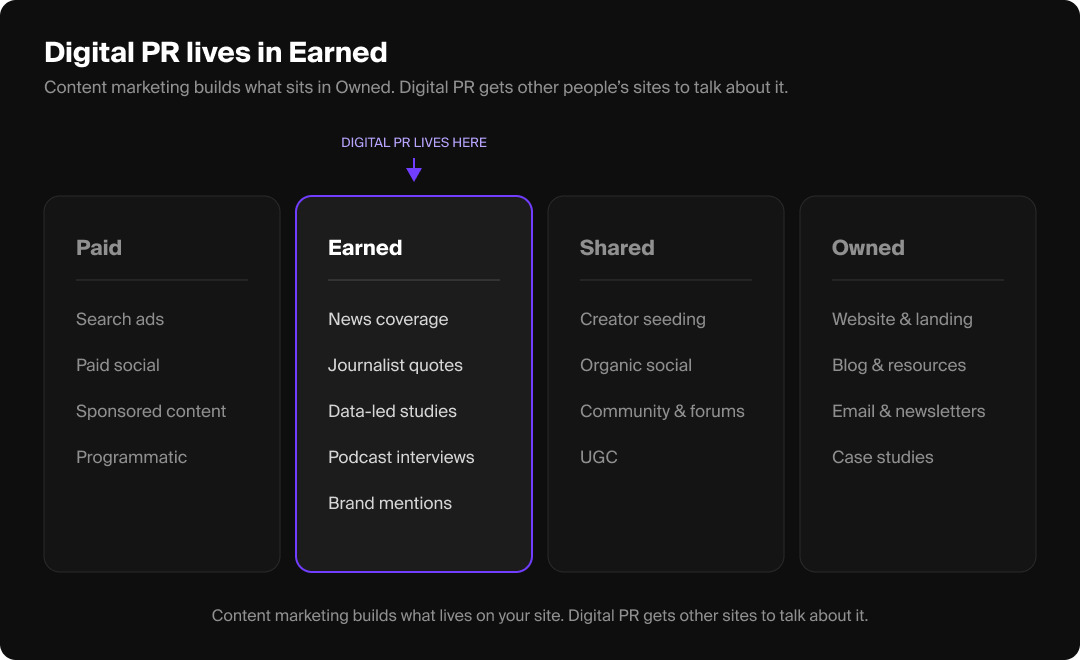
The PESO model (Paid, Earned, Shared, Owned) is the useful map here. Digital PR lives almost entirely in the Earned column, with occasional overlap into Social when you want to reach out to a content creator or influencer to share your news, or when a strong organic social campaign helps your brand get picked up by journalists.
The Backlink Economy That Built Modern PR
For most of digital PR’s history, the performance case was simple and measurable. You earned a target backlink or mention, watched your domain authority climb, and watched your search rank climb. Domain authority is a helpful proxy for the quality of your earned media coverage and most teams used to evaluate effective PR because it was the cleanest KPI.
The underlying mechanisms of digital PR still hold. Earned coverage still builds domain authority, and domain authority still correlates with ranking and thus visibility. What’s changing is where customers are searching and the platforms PR professionals now have to optimize for.
What is Digital PR 2.0
Roughly 2 out of 3 people have switched to using AI for product discovery. And in some cases, AI referral traffic converts 2x better than organic search.
When someone asks ChatGPT or Google’s AI Overview a question about your category, the model isn’t checking your domain authority score. It’s pulling from the sources across the web that already discuss your brand, weighing which ones look credible, and synthesizing an answer. Earned mentions, the exact same asset digital PR has always produced, are now direct training and retrieval inputs instead of indirect signals.
We’ve written before about the brand side of this shift in how “New Media” is changing earned strategy, which covers where credibility is being built now that creators and independent voices are displacing traditional publications. This piece is the performance-side cousin to that conversation: what that shift means for the metrics a growth team actually gets judged on.
How Do You Actually Measure Digital PR 2.0?
Measurement is where digital PR 2.0 gets harder.
The traditional metrics were number of backlinks earned, the domain authority of the sites linking to you, referral traffic, and the time lag before a campaign’s links translate into ranking movement (typically a matter of months since search engines need to recrawl and revalidate). A strong campaign might land 15 to 30 quality placements, but the authority and relevance of the sites doing the linking matter more than volume.
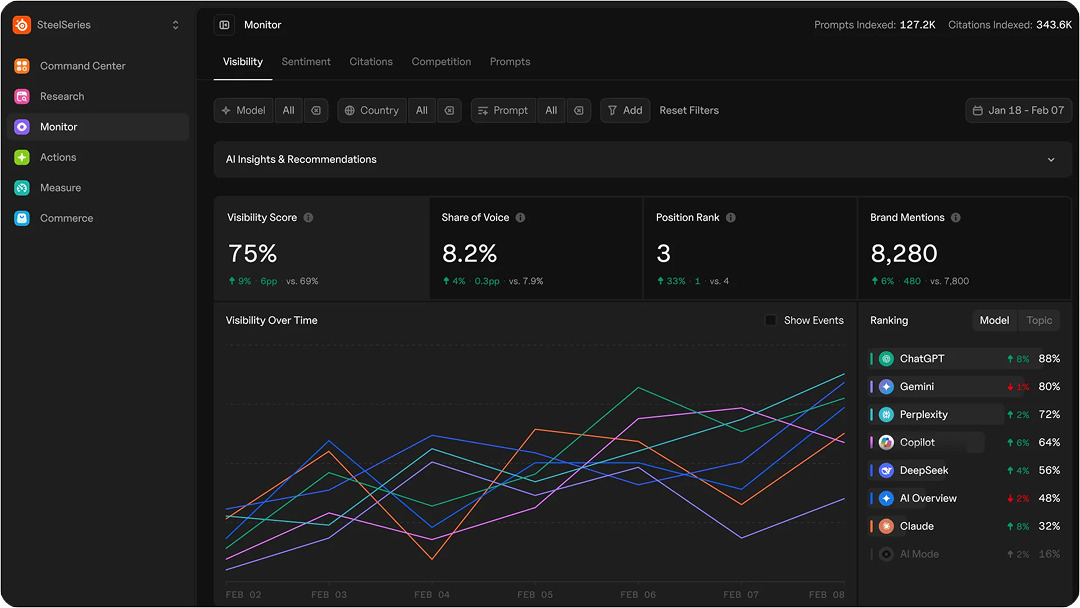
The newer metric to track is AI citation share (a.k.a. mention share, or AI Share of Voice (SoV)); this measures how often AI models cite or mention your brand when answering questions in your category. According to Goodie AI’s research tracking 45.2 million AI citations, earned media accounts for roughly 72.2% of all AI citations, by far the largest share of any source type and larger than owned and social content combined.
The tricky part is that citation share isn’t something you can check by hand. You’d need to run the same prompts across several models where you think your customers are searching, and track which sources get cited each time. Consistent citations can take weeks to form and real attributed revenue can take up to six months. In the earlier stages, citations can oscillate greatly week over week. Having a pulse on how you’re trending is exactly what platforms like Goodie AI are built to handle, tracking which domains and mentions are actually showing up, your SOV, sentiment, and more across models, regions, and languages.
The Tactics Doing the Most in Digital PR Right Now
Not every digital PR tactic ages at the same rate.
Data-driven PR
Data-driven PR is the closest thing digital PR has to a sure bet: original research, surveys, or proprietary data (the kind of structured content AI models actually want to cite) packaged into something journalists can’t get anywhere else. If you have data no one else has, you have leverage no one else has.
Reactive PR
Reactive PR, also called newsjacking, means attaching your brand’s expertise to a story already in the news cycle. It’s fast, timely, and one of the more reliable ways to get a journalist’s attention on short notice, since you’re solving their problem (a quote, a data point, an expert angle) rather than asking them to solve yours.
HARO
HARO (Help a Reporter Out) connects journalists looking for expert sources with people willing to provide quotes. It’s still useful, but it’s gotten noisier as more PR teams treat it as a volume play rather than a relationship one.
Community-native tactics
Community-native tactics deserve their own mention here. Platforms like Reddit are increasingly where AI models look for the kind of unfiltered, practitioner-level discussion that reads as more credible than a polished press release, which means showing up authentically in those spaces has become its own PR channel.
What Makes a Pitch Actually Land
A good pitch is short, specific, and useful to the journalist. In the first two sentences your hook should be clear and your understanding of the journalist’s beat and audience… crystal clear. Then you’ll want to communicate your value-add in as few words as possible. You should aim to make the journalist’s jobs as easy as possible by attaching relevant media, stats, studies, and graphics for journalists to add into a piece. Remember to also be transparent about your motivation for the partnership.
But no outreach will be worth the time if your outreach list is not successfully optimized. It’s no longer about getting mentioned in a top publication, you need to identify what niche trade publications or blogs are getting cited frequently by AI and reorient your outreach around those voices.
What Digital PR Tactics No Longer Work in 2026
Treating digital PR as a spray-and-pray game is quickly dying. Along those lines, any tactic that was aimed at gaming a mechanical scoring system will become outdated. AI models have gotten considerably better at spotting the difference between genuine authority and manufactured volume.
Build the Earned Media Strategy Your Growth Numbers Actually Need
Digital PR’s job hasn’t changed. It’s still the discipline of earning other people’s trust and converting it into your own authority. What’s changed is the scoreboard: the same earned mention that used to be worth a backlink is now worth a citation, and citations are increasingly what stands between your brand and the recommendation or narrative that an AI model gives a prospect before they visit your site.
If your earned media strategy still stops at counting links, you’re measuring half the return. Start by auditing which of your recent placements are actually showing up when AI models answer questions in your category, and build your next campaign around the sources that are already doing that work.
Digital PR & Performance Marketing: FAQ
What is digital PR?
Digital PR is the practice of earning backlinks, mentions, and coverage from online publications and third-party sites, then using that coverage to build domain authority, search rankings, and, increasingly, AI citation share.
What’s the difference between digital PR and traditional PR?
Traditional PR optimizes for impressions and sentiment. Digital PR optimizes for links, authority, and now AI citations, using largely the same relationship-building tactics pointed at a different outcome.
What’s the difference between digital PR and link building?
Link building is often outbound and mechanical. Digital PR is inbound by design: you create something genuinely newsworthy, and journalists link to you because the story is better with your source in it.
How does digital PR help AI search visibility?
AI models cite the same earned sources digital PR has always produced. Earned media makes up roughly 72.2% of all AI citations, making it the single largest lever for AI visibility.
How do you measure digital PR 2.0?
Track backlinks earned and domain authority of linking sites for the traditional SEO case, and citation share, how often AI models cite you when answering category questions, for the AI visibility case.
What digital PR tactics no longer work in 2026?
Mass, unpersonalized press releases and guest posts built purely for a backlink with no real expertise behind them. Both search engines and AI models have gotten better at spotting manufactured volume versus genuine authority.