

Every brand insists it wants a strong personal brand attached to its business, until that personal brand actually says something. Then it becomes a liability, a legal question, or an off-brand moment that needs managing.
That contradiction is the whole story of the personal brand vs. business brand conversation right now. Companies are pouring real budget into employee-generated content programs, founder-led growth, and executive thought leadership. A year ago these programs were just experiments, and now they’re becoming full of departments with headcount and line items. Salesforce and Gap have built actual EGC programs, founders are treating their personal accounts as primary distribution channels, and executives are being coached, ghostwritten, and pushed onto LinkedIn like it’s part of the job description now, because increasingly, it is.
These three things get talked about separately, but they’re really the same mechanism operating at three different altitudes. Every one of them is a bet that since a business brand alone can’t occupy enough space in someone’s attention, it borrows the reach of actual people to widen its surface area online. The founder gets narrative authority, the executive gets functional credibility, and the employee replaces the diminishing trust in paid influencers with a voice that already knows the brand from the inside out, and has an actual reason to care about it.
Once you see it that way, the question stops being “personal brand or business brand” and starts being something closer to an infrastructure question: how many people is your brand willing to lend its credibility to, and how much of theirs are you willing to borrow back.
What is the difference between a personal brand and a business brand?
A personal brand is a face, a story, and most importantly an opinion. It belongs to one person, which means it can move fast, contradict itself, change its mind, and evolve in real time without asking permission from a brand guideline.
A business brand is an institution. It’s designed to outlive any one person’s involvement, and usually lives in part in formal documentation like brand guidelines, design systems, and voice guides.
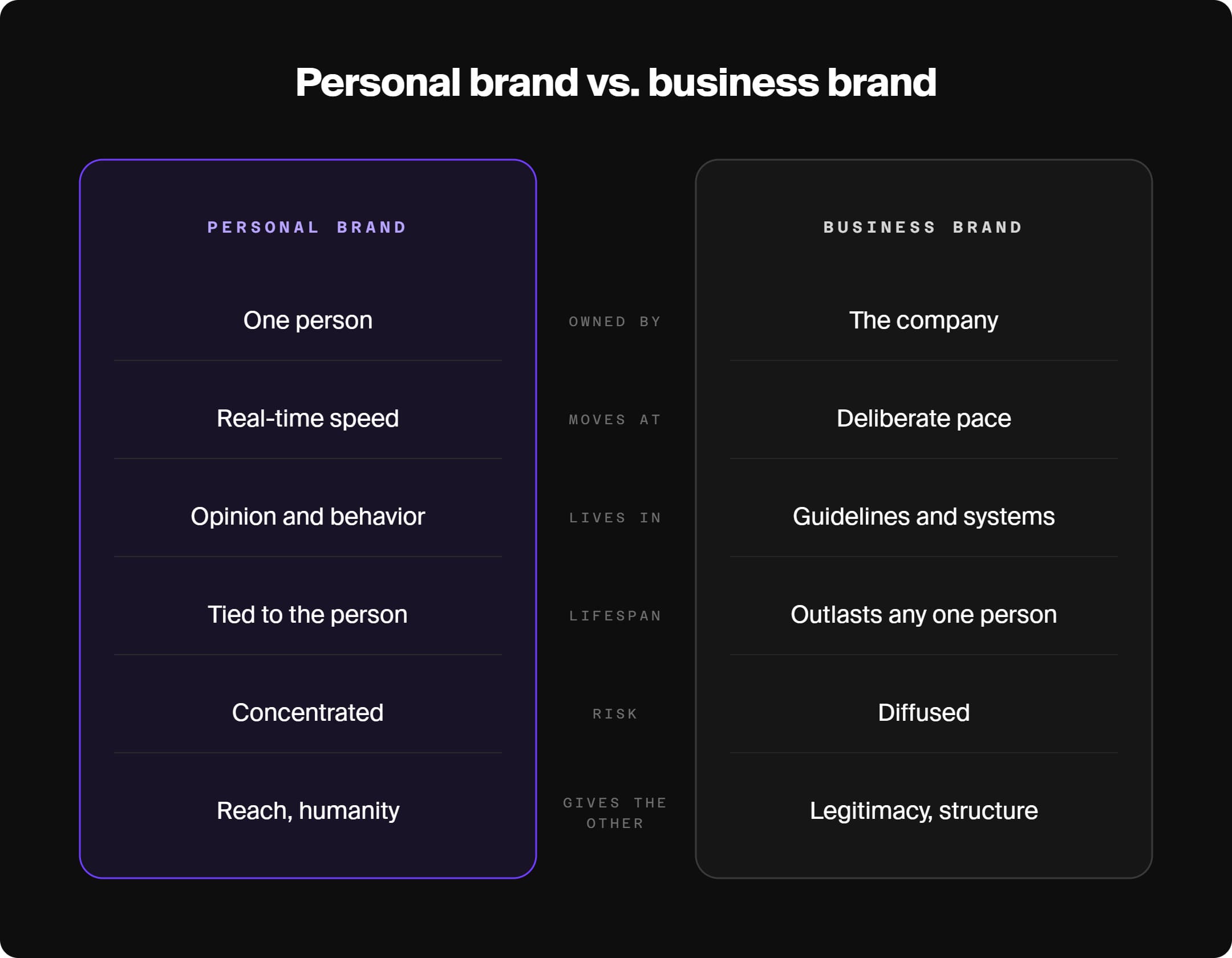
The clear distinction between the two is also why personal brands and business brands typically are not in competition with one another, rather they have the kind of synergistic relationship where 1+1=3. A business brand can’t have opinions the way a person can without risking the institutional stability it was built for, and a personal brand can’t offer the durability a business brand needs without losing the specificity that makes it worth following.
Which means the real question was never which one to build; it’s how visibly you let them touch each other, and how much of one you’re willing to expose through the other.
The feedback loop between the personal brand and the business brand
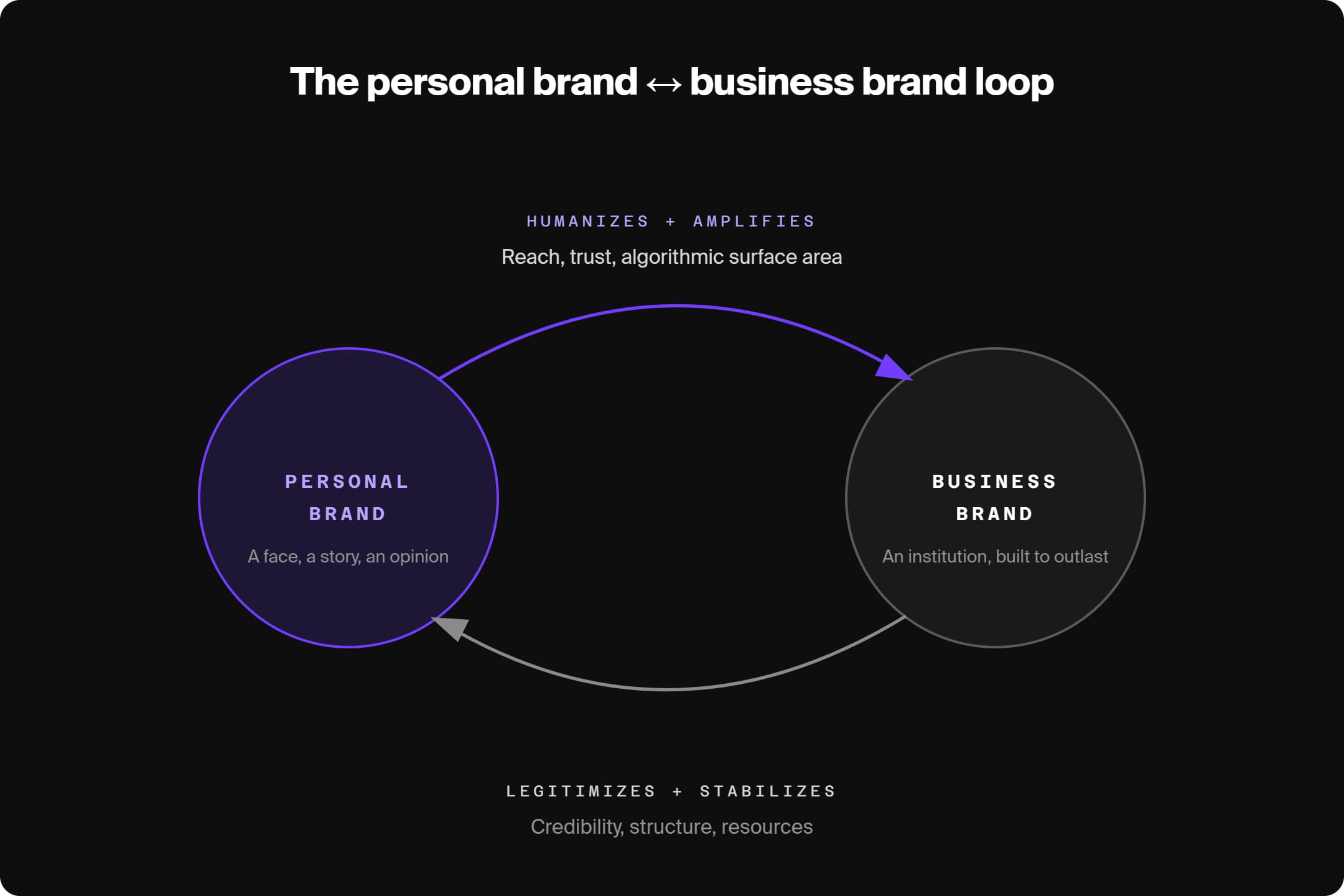
The relationship between the personal brand and the business brand can be seen as a loop where the exchange runs in both directions in a mutually beneficial manner. A personal brand makes a business brand more human and widens its surface area, since the algorithms tend to favor individual accounts over brand pages. In return, the business brand gives credibility to that person’s opinions through affiliation and context, grounding a POV in real experience and expertise instead of leaving it to stand on its own.
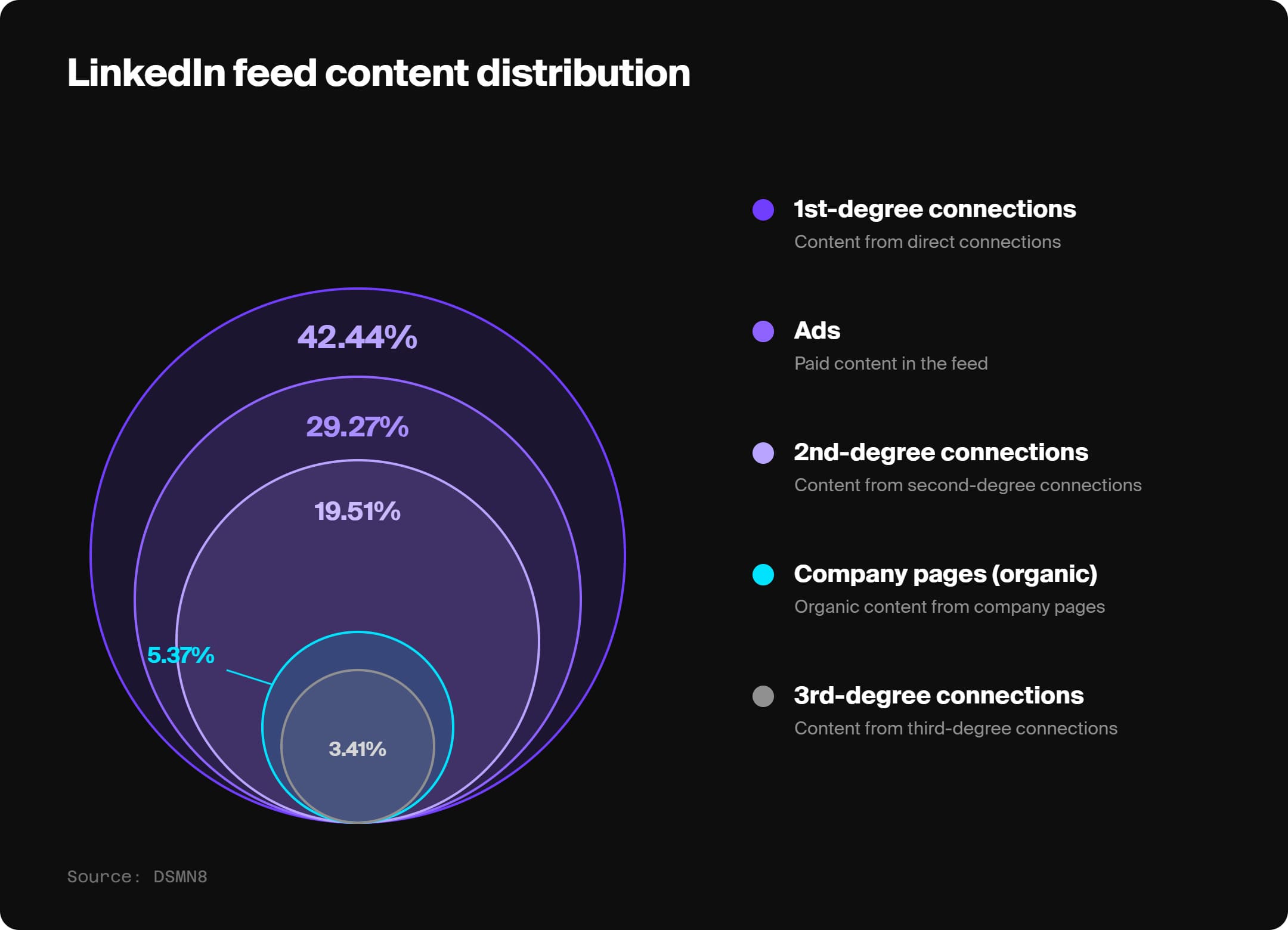
This goes beyond the soft claim that people trust people more than they trust brands; LinkedIn’s distribution data actually backs it up on a structural level. A study of 500,000 employee LinkedIn posts found that personal profile content generates nine times more engagement than company-curated posts, and personal profiles now receive roughly 65% of LinkedIn’s feed distribution compared to about 5% for company pages. It wasn’t always like this, organic reach for company pages dropped 60–66% between 2024 and 2026, meaning the LinkedIn algorithm has been slowly moving towards weighing peer-to-peer interactions more heavily than brand-to-person ones.
Should I build a personal brand or a business brand?
Trick question. The question assumes you have to choose one lane and stay in it, but the opposite is true. Your best bet is to deliberately build both at once with a clear strategy on how they overlap and amplify one another.
Let’s take a look at what’s happening with employee-generated content. A year or two ago, EGC meant a company loosely encouraging employees to post about work and hoping something decent came out of it. Now brands are building real infrastructure around it. Salesforce, Starbucks and Gap have built actual EGC programs, with content calendars, guidelines, and in some cases budget attached, treating employee accounts as a distribution channel worth investing in rather than a nice-to-have. This is direct proof of huge companies deciding that its actual surface area online is the sum of everyone who works there, not just the handle in its own name.

Founder-led growth follows the same logic from a slightly different angle. The practice of “building in public” is now treated as a primary distribution channel in its own right, with founders posting as consistently and strategically as any brand account would.
Neither of these moves work if you treat personal brand and business brand as separate investments competing for the same budget. A business brand is one entity broadcasting to whoever’s still listening. A personal brand is a network of individuals, each with their own algorithmic relationship to their own audience, each capable of reaching people the brand page might not be able to.
So build both, and build both well.

Can a personal brand hurt a business brand?
Yes, and there’s an asymmetric risk involved that’s worth noting. The same affiliation that lends a personal brand credibility also ties the business brand’s (to some extent) to the whims of a person’s judgment, mood, and public behavior.
Elon Musk and Tesla is the clearest version of this. Musk’s personal brand was, for many years, treated as an asset. His visibility drove attention, his persona did a version of marketing different from what their ads were doing. But that same visibility means Tesla’s stock price and brand sentiment now move on his personal statements, his political activity, and his behavior on his own platform, none of which Tesla’s brand team has full control over. The company built its narrative on a founder who refuses to be managed, and now absorbs the consequences of that decision.
Sam Altman and OpenAI carry a version of the same exposure, though the shape of it is different. OpenAI’s public identity is relatively inseparable from Altman’s; his statements and his personal credibility function as a proxy for the company’s own. When his judgment gets questioned, the company’s does too, whether or not the two points of view are actually related.
What both examples reveal is the same asymmetry: a business brand has far more to lose from a personal brand’s volatility than a personal brand has to lose from a business brand’s problems. A person can walk away from a company, but a company’s reputation is a lot harder to rebuild.
Is a personal brand more trustworthy than a business brand?
The obvious answer to this is that yes, people trust people more than they trust brands; and while true, it undersells how that trust is manifesting in search and discovery online. This is a structural preference on top of a psychological one, backed by data on how AI search engines pull citations to formulate their answer.
Owned brand content is a minor player in what AI models actually cite. According to research by Goodie AI, 72% of LLM responses draw from earned media rather than owned content, meaning the brand’s own domain, blog, and product pages account for a small fraction of what shows up when someone asks an AI model about you. Social content alone generates roughly 2.5 times more AI citations than owned brand pages, which means the conversation happening around a brand, not the content the brand publishes about itself, is doing most of the work of shaping how AI systems describe it.
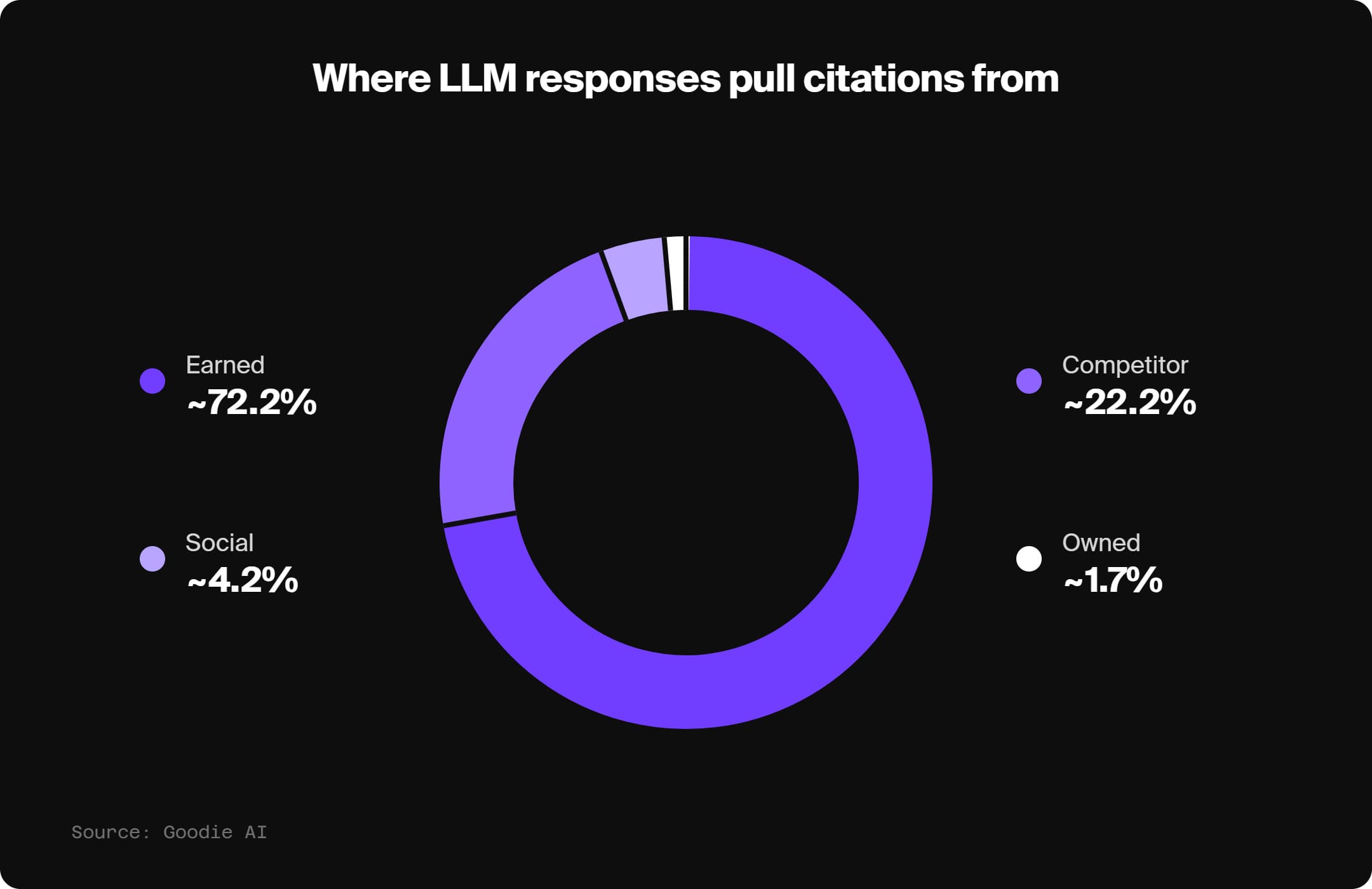
The gap between owned and earned is the whole argument for why a personal brand carries more structural trust than a business brand can generate on its own. When a founder gets quoted in a trade publication or when an employee’s post starts a conversation that spreads beyond their own feed, AI models read that as earned, third-party signals that they’re built to trust more.
Earned media, in this context, is really just the sum of what independent voices are saying about your brand, aggregated across every platform and publication where your brand name comes up. A single business brand can only generate so much of that on its own, since everything it publishes is, structurally, owned. A network of personal brands attached to that business, each getting cited, quoted, and referenced in their own right, is what builds the earned footprint AI models are already biased to trust.
What are examples of strong personal brands?
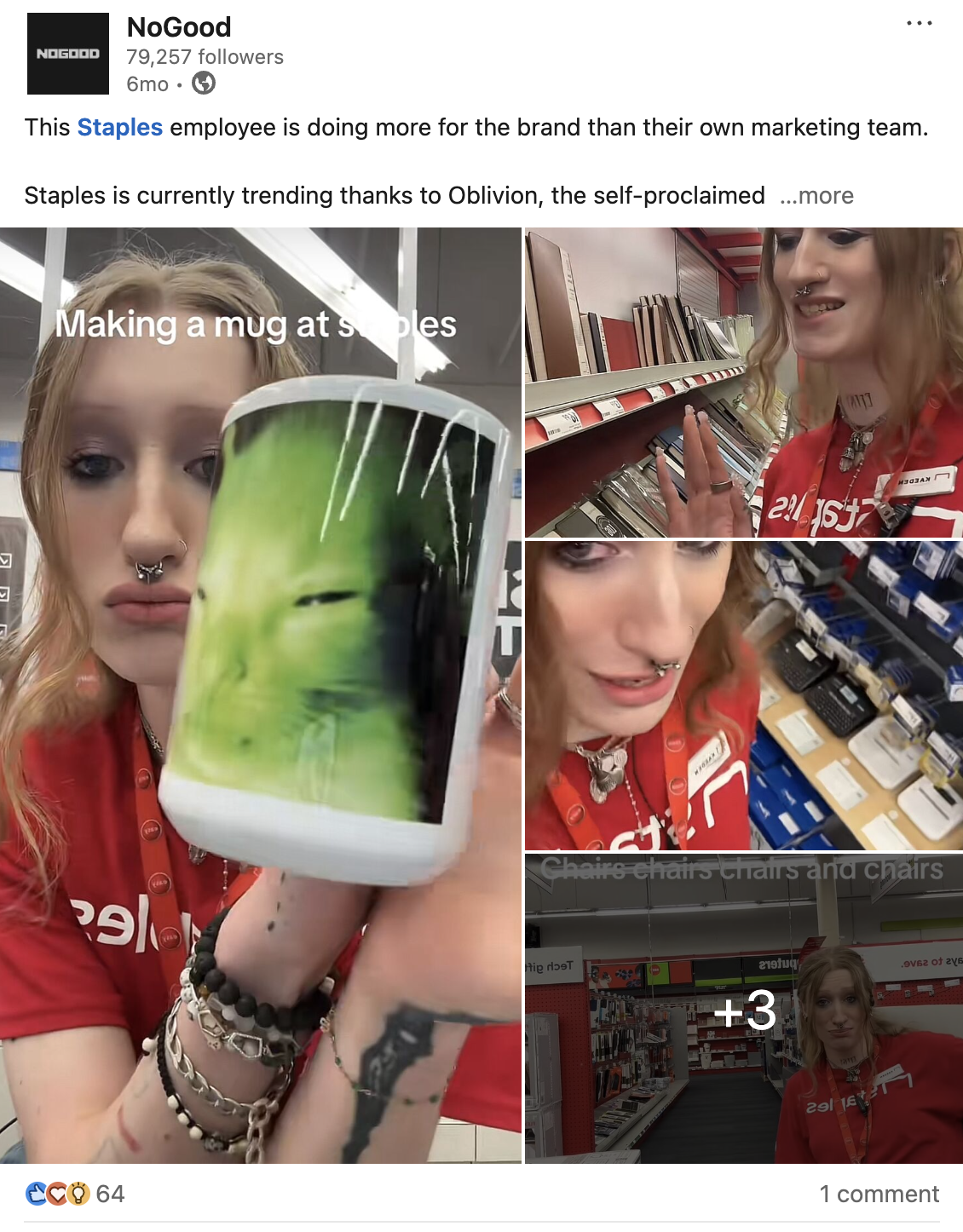
The “Staples baddie” is worth starting with because it inverts the usual direction of this relationship entirely. A Staples employee started making Staples content on her own, of her own accord, before the company noticed. The content worked because it was hers first and came out of a genuine desire to show more people what they could do at Staples.
Then there’s TikTok creator Krystal E. Jesieme (@krystalthechemist) who built her personal brand and online presence from talking about her experiences growing her career and working at HBO and Spotify. She leverages the authority and expertise she has from working at these big name companies, and centers her content around career empowerment with videos like “how to make sure your work gets noticed in corporate America” and “5 things I did to get me promoted at Spotify.”
The conversation around personal brands has also given rise to the idea of a “portfolio career,” where people are less interested in a fixed title and more interested in having a public, ongoing record of what they’re good at, what they’ve built, and what they believe, independent of any one employer. Being visible online has in many ways become a career asset in its own right. A resume might tell someone what you were hired to do, but a public body of work and a clear POV tells them what you can actually bring to the table.
What are examples of strong business brands?
A business brand can’t post like a person without losing the institutional stability that makes it a business brand in the first place. So instead of borrowing a real person’s life, some brands are building a persona that behaves like one.
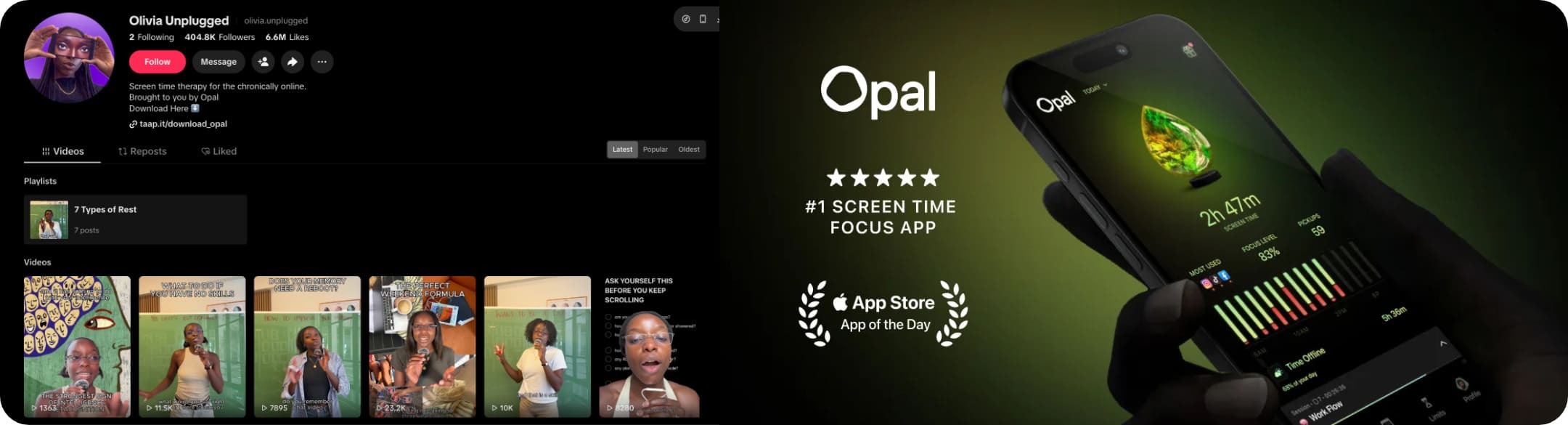
Olivia Unplugged (@olivie.unplugged) is a satellite account built for Opal, the app that helps people manage screen time, but at first glance you wouldn’t really know that. The account operates like a personal brand, centered around a person named Olivia who has a consistent voice, perspective and presence that humanizes the content in a way that makes it feel less scripted and brand-heavy.
Oura is another example of a great business brand. The brand’s own content leans into healthcare innovation and education, built to be credible independent of any one person. They then pair that authority by partnering with athletes’ personal brands, such as their collaboration with tennis player Taylor Fritz and NY Knicks player Jalen Brunson.

How do you transition from a personal brand to a business brand?
This is where the exchange gets tested for real. Building a business brand off an existing personal brand means the moat and the liability are the same asset.
Take Rhode for example. Hailey Bieber built the brand on the back of a personal brand that was already operating at massive scale; the products sold because her taste, her face, and her routine were already trusted before the product existed. That being said, since Rhode’s entire value proposition is downstream of one person’s continued relevance, the brand’s longevity is a bet on whether Hailey Bieber’s personal brand outlasts its current cultural moment. A business brand built this way doesn’t get to diversify away from its founder without undercutting the exact thing that made it work in the first place.
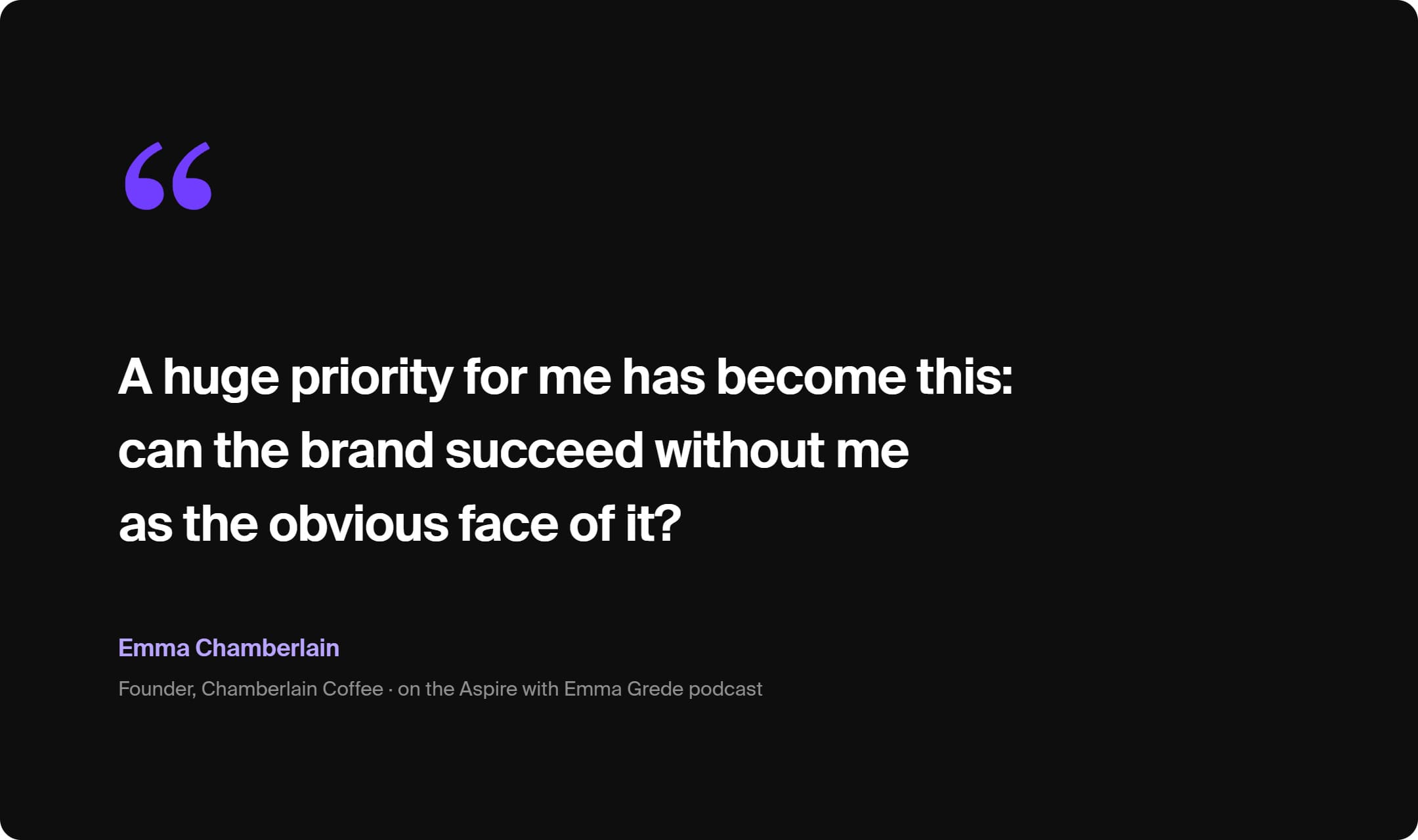
Emma Chamberlain recently went on the Aspire with Emma Grede podcast and spoke candidly about the upside of building Chamberlain Coffee off her own audience, and her new challenge of wanting the brand to eventually stand on its own, separate from her personal brand. She’s directly acknowledging the tension where the personal brand gets you to scale faster than a business brand could on its own, but the business brand only becomes durable once it can survive the personal brand stepping back.
When going from a personal brand to a business brand, it’s less so a transition and more an ongoing negotiation over how much of the personal brand the business is allowed to keep borrowing, and how much risk that borrowing leaves.
“Share of voice” was never just one voice
Stop asking yourself whether to invest in a personal brand or a business brand. Build both intentionally, stay aware of both the liability and the moat, and remember that share of voice was never about just posting more and more from the brand account. Know the brand narrative that’s being surfaced online and in search, and see each individual voice as a distributed extension of that narrative.