


AI didn’t kill link building. It changed what a link is for.
That’s the short version. The longer version is that link building’s value remains, but its execution and strategic importance have shifted. In the AI search and Answer Engine Optimization (AEO) era, the question is no longer “How many backlinks do I have?,” it’s “Does the web talk about my brand the way I want an AI model to understand it?” This guide covers what link building is, the terms you need to know, and how the practice differs between SEO and AEO in 2026 and beyond.
What Is Link Building in SEO?
Link building is the process of earning links to your website from other websites. Also called backlinks or inbound links, link building is a core component of a growth-driven SEO strategy, acting as a digital vote of confidence from one site to another.
Think of it like an academic citation. The more a research paper gets cited by other credible scientists, the more authoritative that research is considered. Backlinks work the same way: when a high-quality site links to your content, it’s an endorsement, a signal of trust and authority that search engines, including their AI systems, read and weigh.
What Is a Backlink? The Difference Between a Backlink and a Link
A backlink is any link on someone else’s website that points to yours. A link, more broadly, can point anywhere, including to a different page on the same site. Every backlink is a link, but not every link is a backlink; the distinction matters because backlinks are external endorsements, while links in general also include the navigational structure of a single site.
That structural half of the equation splits into two categories:
- External links point from your site to another domain, or from another domain to yours (a backlink is an incoming external link).
- Internal links connect pages within your own site. They don’t carry the same third-party trust signal as a backlink, but they help both search engines and AI crawlers understand your site’s hierarchy and which pages matter most.

Why Is Link Building Important for SEO and AEO?
Links were long considered one of Google’s top three ranking factors, a standard set back in 2016. That’s shifted: in 2023, Google’s own Gary Illyes said links no longer make that top-three list, and Google’s algorithm documentation has since downplayed their weight. Links still matter, just less as a direct ranking lever and more as the trust signal AI systems now lean on.
Backlinks matter for three overlapping reasons:
- They pass authority from an established site to a newer or less-established one
- They help search engines and AI crawlers discover new content
- They function as a trust signal that a third party found your content worth referencing.
What Is the Difference Between Dofollow and Nofollow Links?
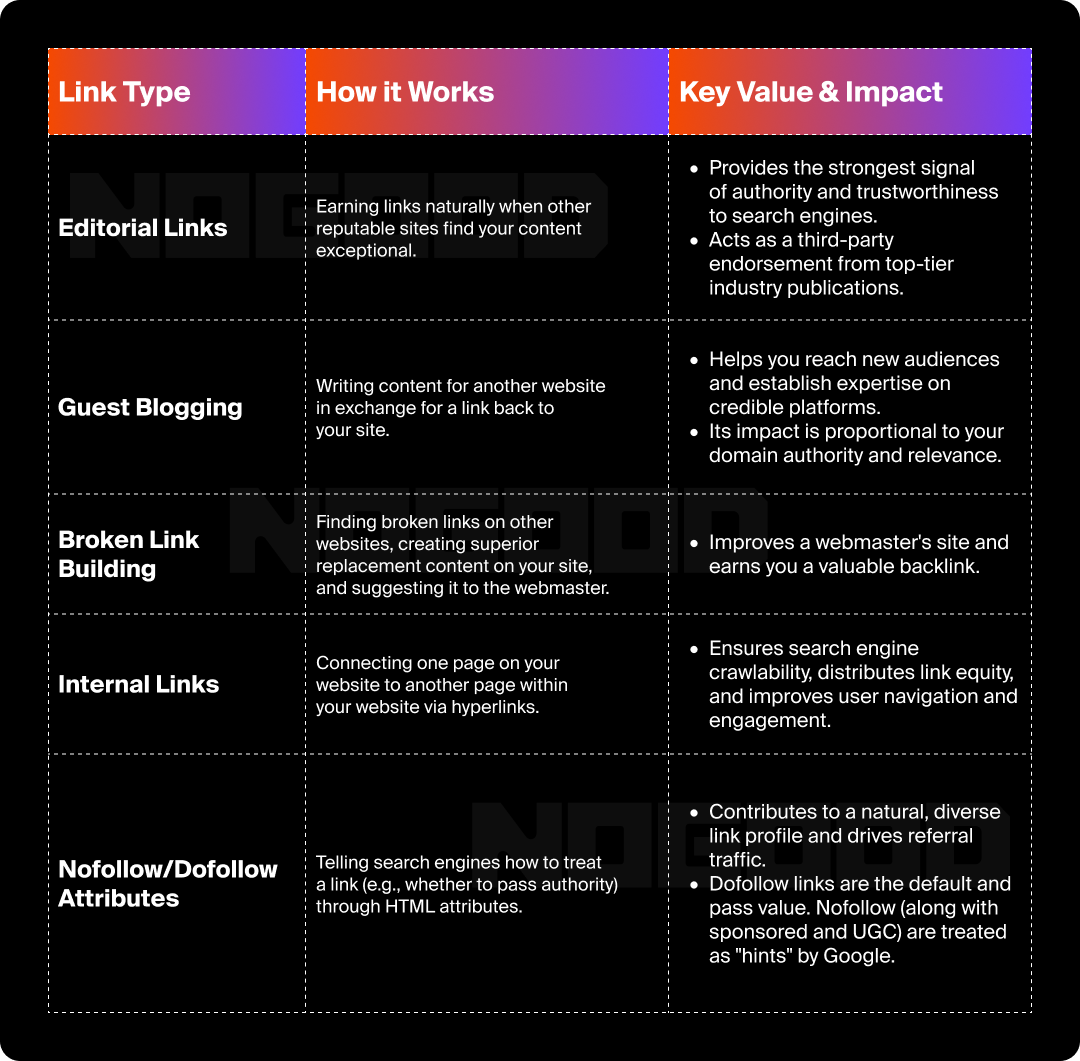
A dofollow link is the default: it passes link equity (more on that below) and tells search engines to follow the link and factor it into ranking. A nofollow link carries a rel=”nofollow” HTML attribute that tells search engines not to pass authority through it. Two related attributes narrow this further: rel=”sponsored” marks paid or affiliate links, and rel=”ugc” marks user-generated content links, like a comment or forum post.
In practice, a healthy backlink profile includes a mix of both. An all-do-follow profile can look manufactured; nofollow links from high-traffic sites (think major news outlets or Wikipedia) still drive referral traffic and brand exposure even without passing direct ranking equity.
What Is Anchor Text in Link Building?
Anchor text is the clickable, visible text of a hyperlink. It falls into a few categories:
- Exact match anchor text uses the precise target keyword (“link building services”).
- Branded anchor text uses the brand name (“NoGood”).
- Generic anchor text uses non-descriptive phrases (“click here,” “read more”).
- Naked URL anchor text is the raw URL itself, displayed as the link.
A natural link profile mixes all four types. A backlink profile dominated by exact-match anchor text is one of the clearest signals of manipulative link building, and it’s a pattern both Google’s algorithms and AI retrieval systems are built to detect.
What Is Link Equity and How Does It Work?
Link equity, sometimes called “link juice,” is the value or authority a link passes from the linking page to the linked page. Equity flows in proportion to the linking page’s own authority, its relevance to your content’s topic, and the number of other links that page already points to (equity divides across all outbound links on a page, so a link from a page with 200 outbound links passes less equity than one from a page with five).
What Is Domain Authority and How Do Links Affect It?
Domain authority describes how likely a website is to rank well, based largely on the quantity and quality of links pointing to it. Google stopped publicly displaying its own PageRank score years ago, so a handful of third-party metrics have become the industry standard for estimating it:
| Metric | Developed by | What it measures |
|---|---|---|
| Domain Authority (DA) | Moz | Likelihood a domain ranks well, scored 1–100 |
| Domain Rating (DR) | Ahrefs | Overall strength of a domain’s backlink profile, scored 1–100 |
| Page Authority (PA) | Moz | Ranking strength of a single page |
| URL Rating (UR) | Ahrefs | Backlink strength of a single URL |
| Authority Score (AS) | Semrush | Composite score factoring backlinks, referring domains, and traffic |
None of these are Google metrics, and none directly determine rankings. They’re useful as competitive benchmarks: gauging your link profile against competitors, evaluating potential link targets, and tracking your own progress over time. Links build these scores by adding to the quantity and quality of what’s pointing at a domain, but as the AEO section below covers, domain authority is increasingly better understood as a downstream proxy than a direct lever.
What Makes a High-Quality Backlink? Does Link Quantity or Quality Matter More?
Not every link carries equal weight, and quality has decisively won out over quantity. A high-quality backlink typically comes from a site that is:
- Relevant to your topic or industry (a link from a health publication carries more weight for a wellness brand than a link from an unrelated general-interest blog).
- Authoritative, with a strong domain rating and its own credible backlink profile.
- Editorially earned, meaning the linking site chose to reference you because your content merited it, not because of a paid placement or reciprocal exchange.
- Placed in context, within the body of relevant content rather than a sidebar, footer, or disconnected directory listing.
A single link from a highly relevant, authoritative, editorially-earned source outperforms dozens of low-quality directory or forum links. Search engines and AI systems alike are built to recognize manipulative link patterns, sudden spikes from irrelevant domains, over-optimized anchor text, link farms, and to devalue or actively penalize the sites behind them rather than simply ignoring the attempt.
What Is a Toxic Backlink?
A toxic backlink is one that risks harming your site’s rankings rather than helping them: links from spam domains, link farms, previously-penalized sites, or sites entirely unrelated to your niche. If you inherit toxic links (from a negative SEO attack, a previous agency’s black-hat tactics, or simply an old, messy backlink profile), Google’s Disavow Tool lets you formally tell Google to ignore specific links or domains when assessing your site.
What Is a Link Building Strategy?
A link building strategy is the deliberate, repeatable set of tactics a brand uses to earn backlinks, as opposed to link building that happens incidentally through content marketing alone. The most durable strategies share one trait: they earn links by creating something worth referencing, rather than by acquiring links through outreach volume alone.
Guest posting (guest blogging) means writing content for another site in exchange for a byline and typically a link back to your own site. Done well, it puts your expertise in front of a new, relevant audience. Done poorly (low-quality sites, over-optimized anchor text, thin content), it’s one of the fastest ways to accumulate a toxic link profile.
The skyscraper technique involves finding existing content that already earns a meaningful number of backlinks, creating a more comprehensive, more current, or better-designed version, and then reaching out to the sites linking to the original to suggest the improved version.
Broken link building means finding dead links on relevant, authoritative pages (a linked resource that’s since been taken down, for instance) and pitching your own relevant content as the replacement. It’s a low-friction outreach angle: you’re helping the site owner fix something broken, not just asking for a favor.
Resource page link building targets pages that exist specifically to curate helpful links on a topic (“Best Tools for X,” “Y Resources for Startups”). These pages are built to add more links, which makes them a natural, low-resistance outreach target.
Digital PR is the practice of earning press coverage, and the links and brand mentions that come with it, through original research, data studies, expert commentary, and journalist relationships (including tactics like HARO-style journalist outreach). Digital PR has become the highest-leverage link building strategy in the AI search era, for reasons covered in the next section: AI models weigh earned media and brand mentions more heavily than almost any other off-site signal.
Does Link Building Still Matter in 2026 (and Beyond)?
Yes, but as a part of the authority building engine that encompasses AI search. Google’s AI Overviews already appear on roughly half of all search queries as of early 2026, up sharply from the year before, and that coverage is projected to reach 65-75% of all queries by 2027-2028. Some forecasts put the decline in traditional organic search traffic at 50% by 2028. The trajectory is clear: the search results page that links were originally built to dominate is shrinking as a share of how people actually find information.
That doesn’t make links irrelevant. It makes them differently relevant. Links remain one of the clearest, most measurable signals of third-party validation on the web, and third-party validation is exactly what AI models rely on to decide who to trust and cite. The mechanism has shifted from “link equity flows through the graph and boosts your rank” to “the presence, context, and company of your mentions across the web tells a model what kind of entity you are.” Heading into 2027, brands that treat link building purely as a ranking tactic for a shrinking blue-links results page will find the tactic’s returns compressing. Brands that treat it as one input into a broader entity-authority and citation strategy will find it as valuable as it’s ever been, just measured differently.
How Do Links Affect AI Visibility and AEO?
This is where the story gets more specific than “links still matter.” Ahrefs’ analysis of 75,000 brands measured which signals actually correlate with Google’s AI Overview visibility, using Spearman correlation coefficients (higher is stronger). The results reorder the traditional link-building priority list:
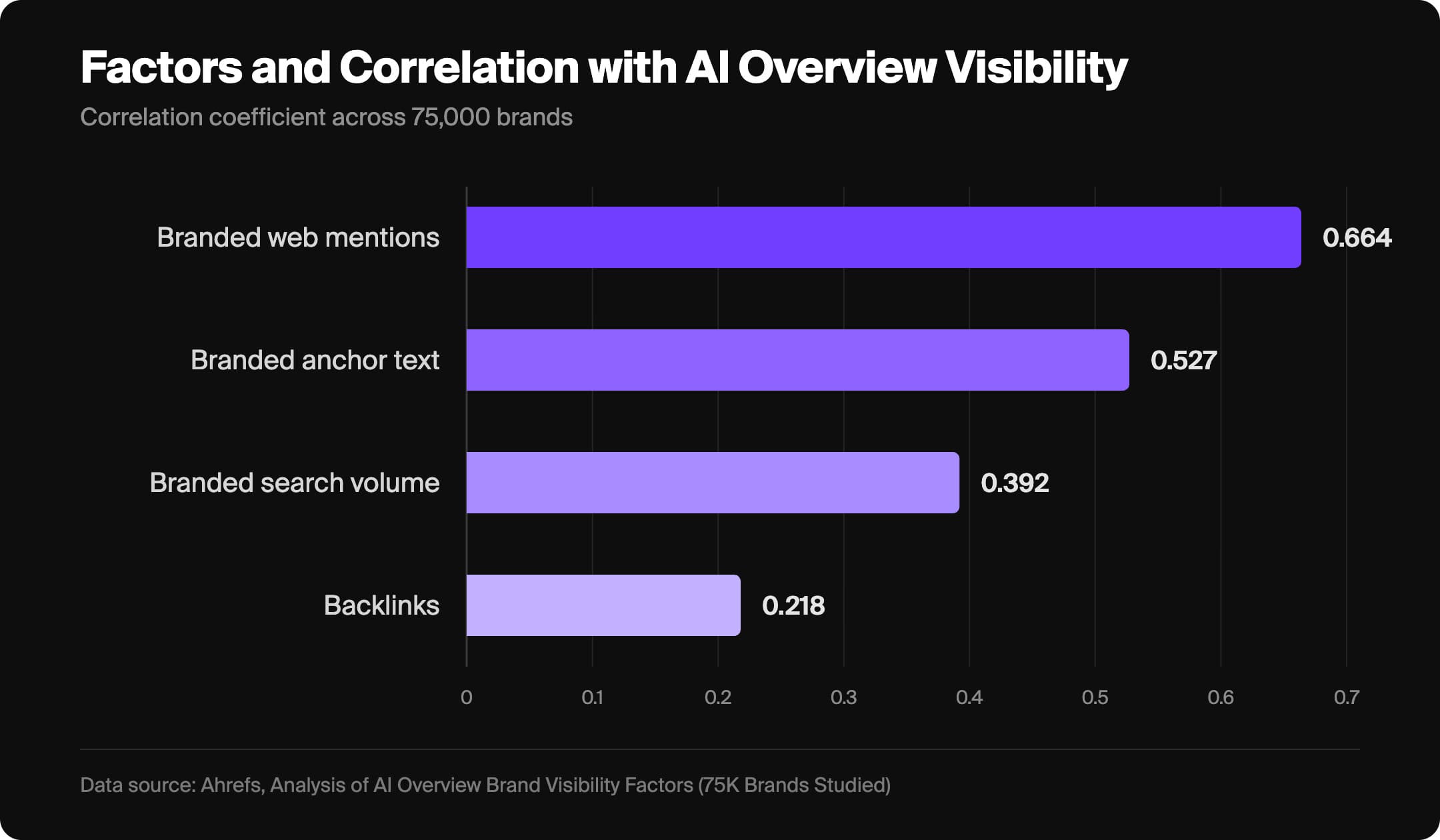
Backlinks still correlate positively, but they’re the weakest of the four off-site factors measured, roughly a third the strength of branded web mentions. The practical read: an unlinked mention of your brand in a credible article now tells an AI model more about your legitimacy than a traditional hyperlink does. AI systems are reading the mention itself, the co-occurrence of your brand name with relevant topics and other credible entities, not just following the link graph the way a 2015-era crawler would.
| Factor | Correlation with AI Overview visibility |
|---|---|
| Branded web mentions (linked or unlinked) | 0.664 |
| Branded anchor text | 0.527 |
| Branded search volume | 0.392 |
| Backlinks | 0.218 |
Goodie’s fourth-edition AEO Periodic Table, drawn from 1.13 million prompts across six AI engines, backs this up from a different angle: Earned Citations and Social & Community Citations together hold 22% of total citation leverage, more than any single on-page content factor. Entity Consistency and Co-Occurrence, how consistently your brand is named and how often it appears alongside relevant category terms across the web, is its own tracked factor, distinct from backlinks entirely.
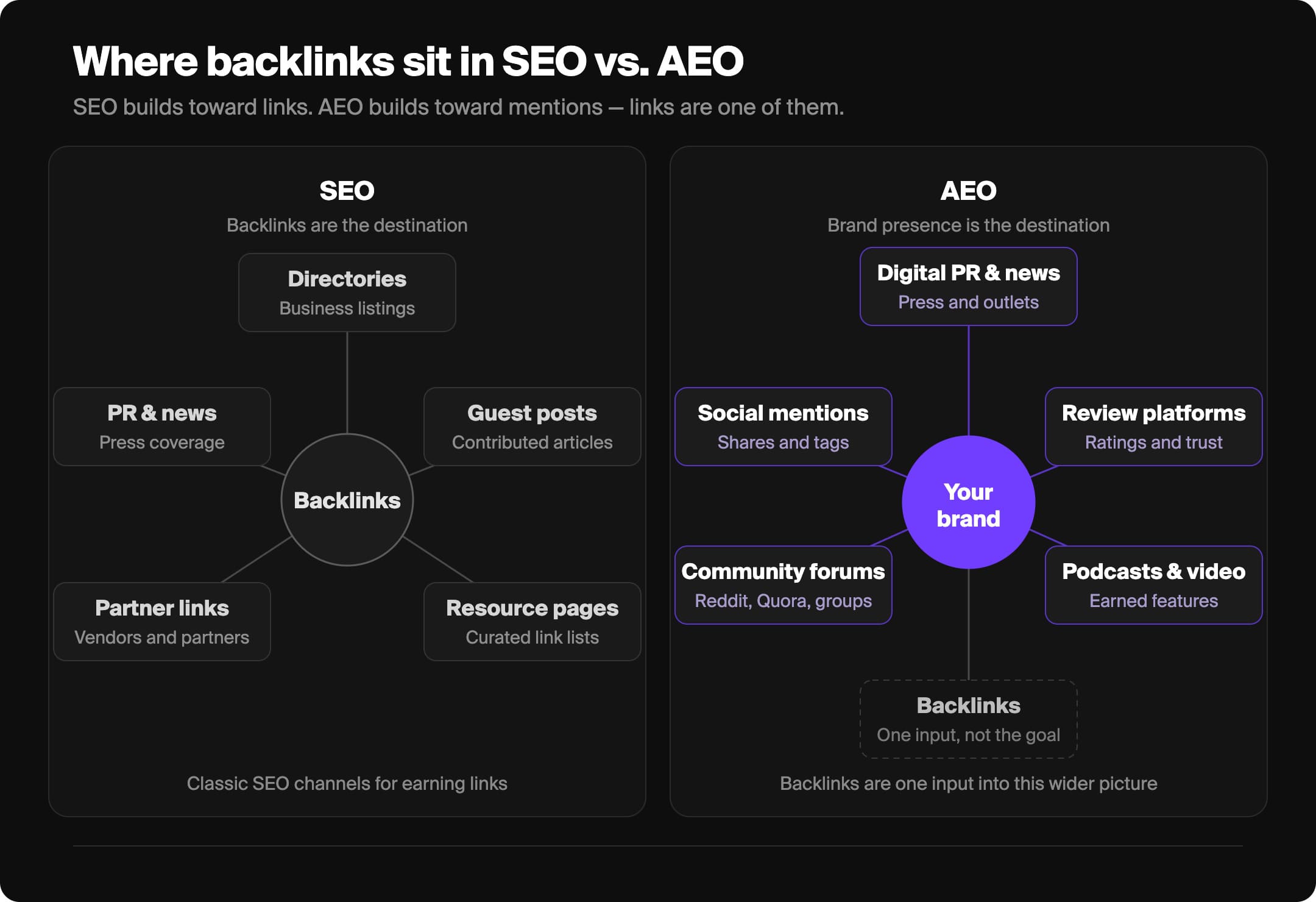
None of this makes backlinks worthless for AEO. It reframes their job. A backlink from a relevant, authoritative source still helps you rank, and ranking is still one of the strongest correlates of citation for engines that ground on live search, like Gemini and Google AI Mode. But the AEO opportunity most brands are leaving on the table isn’t more backlinks; it’s the unlinked mentions, review platform profiles, and community discussion that never show up in a traditional backlink audit at all.
Adapting Your Link Building Strategy for AEO and SEO Today
The tactics link builders have always used still work. What’s changed is where the effort should concentrate.
- Reclaim unlinked mentions, but don’t stop there. Monitoring for unlinked brand mentions and converting them into links is still worthwhile for the SEO benefit, but don’t treat an unconverted mention as a missed opportunity. For AI visibility specifically, the mention itself is already doing real work, whether or not it carries a hyperlink.
- Invest in digital PR and original research over volume outreach. Data studies, proprietary research, and expert commentary earn the kind of editorial coverage that both ranks well and reads as credible to AI systems. This is consistently the highest-return category of link-building effort in the current landscape.
- Claim and maintain review platform profiles. Domains with active, well-maintained profiles on platforms like G2, Capterra, and Trustpilot see higher citation rates in AI answers. An abandoned or unclaimed profile is a bigger liability than having no profile at all.
- Audit for entity consistency across the web, not just your backlink profile. If your brand name, category, and positioning read inconsistently across Wikipedia, LinkedIn, review sites, and press coverage, an AI model resolving “what is this brand” will side with the plurality, and it may not be the framing you want.
- Keep a clean backlink profile as table stakes, not a growth lever. Regular audits and disavowing toxic links still matter for baseline trust, but chasing additional link volume past a reasonable authority threshold produces diminishing returns compared to the earned-media and community-presence work above.
Overall: Is Link Building Still Relevant?
Link building is still relevant, but it’s no longer the whole game, and by 2027 it will likely be a smaller piece of a much larger entity-authority picture than it was even a few years ago. The fundamentals, earning links from relevant, authoritative sources instead of manufacturing them, still hold. What’s changed is the scoreboard: it’s no longer just about where you rank, but whether the web, and by extension, the AI models reading it, describe your brand consistently, credibly, and often enough to be trusted. Build for that, and the links follow.
If an AI model tried to describe your brand right now, would it get it right? That’s the question link building has become. NoGood’s AEO service audits your entity presence across the web and builds the mention, citation, and authority strategy to close the gaps, so you’re not just ranking, you’re the answer. See how NoGood approaches AEO today.