

In 2024, we wrote a guide on social backlinking that largely focused on one thing: how to secure links on socials that tie back to your site and ultimately elevate your SEO ranking. Fast-forward to today and that relationship still holds; it’s just no longer the most interesting or most important benefit to social backlinking.
AI visibility is.
AI Overviews and chatbots are rapidly replacing traditional search engines, ushering in a new era of AI search. But in order for AI models to construct timely answers, summaries, and product recommendations, they’ve turned increasingly toward social media as a key citation surface.
New research from Goodie AI tracked 5.88 million AI citations across 10 major AI models between January and August 2026 (the fourth version of their ongoing social study) and found:
- Social platforms comprised 6.5% of total citations when AI models were prompted with brand-relevant questions, up from 3.9% the year prior.
- Additionally, brand-owned pages, the focus of most SEO strategies, sit at just 2.5% of total citations and continue to shrink.
So while social backlinking remains an effective SEO strategy, the current landscape demands marketing teams consider their brand’s visibility and reputation in AI search, and position their social backlinking to double as an AI retrieval source.
This article breaks down the interplay between social, content marketing, and your AI homepage: the symbiotic relationship social backlinking unlocks to shape a brand’s visibility in today’s search landscape.
What Are Social Backlinks?
Social media backlinks refer to any hyperlinks originating from a social platform that lead users to your site, product, or content. Most carry a nofollow or UGC tag, which tells Google not to pass ranking authority through them. These virtual connectors are crucial to enhancing visibility, driving traffic, and establishing credibility in relevant communities.

Platforms for social backlinks
Strategically placing social backlinks involves leveraging a variety of social media platforms, including YouTube, LinkedIn, X, Instagram, TikTok, Pinterest, and Reddit. Emerging platforms like Substack, or even Letterboxd, also offer unique opportunities to engage with tighter-knit, hobby-based communities, albeit with less total reach. More on how to decide which platform to build on later.
Formats for social backlinks
Social media backlinks can live in profile bios, post captions, comments, and stories. Each placement attracts valuable traffic and engagement, but triggers different click behavior depending on where it sits.
Sources of social backlinks
Think of social backlinks as coming from three core sources:
- Your brand’s social channels
- Your employees’ social channels
- Third-party brand advocates (influencers, creators, or any user who shares or mentions your content)
The last source is one of the most effective and valuable for both SEO and AI search optimization. A link from your brand’s handle is easy to control, but carries less weight. A link from a real person, like an employee or a genuine advocate, is harder to manufacture and counts for more. However, audiences have gotten better at spotting promotional content from influencers and started to trust these voices less. More on the state of influencer partnerships in 2026 here.
How do Social Backlinks Help SEO?
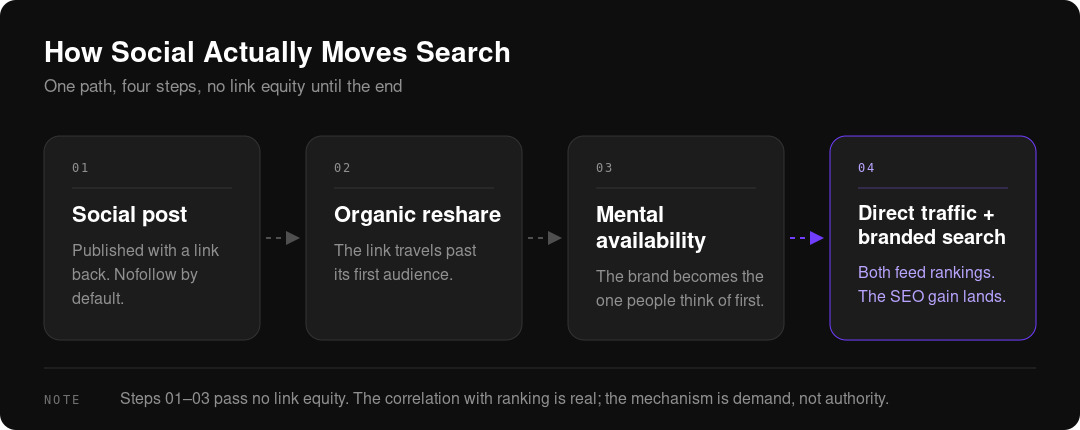
To be clear, a social backlink will not raise your domain authority directly. It isn’t treated as a traditional backlink, which is dofollow by default. Social signals also don’t directly raise your search ranking; that’s a common myth.
There is, however, a strong correlation between a strong social media presence and improved search ranking. The mechanism behind this is indirect. Backlinks get shared organically, which raises your brand’s mental availability. As a result, direct traffic and branded search demand grow, and both of those do feed rankings.
How do Social Backlinks Affect AI Search Visibility?
Our 2024 guide couldn’t prove this piece, but, in 2026, this is the new aim and benefit of social backlinking: increasing AI search visibility.
Across Goodie AI’s eight-month study, social citations surfaced 2.6x more than owned citations. That gap widened to 4.1x by August 2026. Social is the fastest-growing citation type in AI search, and it’s compounding while owned-page citation share shrinks in parallel.
Which Platforms Actually Move the Needle?
| Platform | Link Type | Primary SEO Value | AI Platform Relevance |
|---|---|---|---|
| UGC/nofollow | Community discovery, fast indexing | Top ChatGPT social source (89.5%) | |
| YouTube | Nofollow | Referral traffic, long-form authority | Top Gemini social source (66.1%) and Perplexity (64.0%) |
| Nofollow | Thought leadership, B2B discovery | Top Deepseek social source (82.5%) and Meta AI (62.2%) | |
| X | Nofollow | Real-time visibility, speed and amplification | Top Grok social source (54.5%) |
| TikTok | Nofollow | Visual discovery, ecommerce relevance (TikTok Shop) | Top Claude social source (44.9%) |
| Nofollow | Visual discovery, brand awareness, branded search | Mixed | |
| Nofollow | Image SEO, product discovery | Negligible |
Which Platforms Are Best For SEO?
For pure SEO value, prioritize these platforms:
- Reddit indexes fast and puts your content in front of niche communities actively researching before they buy, the strongest trigger for earning a real, dofollow link elsewhere. Note: Reddit’s automated AI governance systems have cracked down on inauthentic marketing, and traditional “seeding” or link-building playbooks. See our Reddit marketing guide for more.
- LinkedIn works the same way for B2B. Articles posted under a named person, not your company page, build the kind of visible expertise that trade publications and analysts cite.
- YouTube doubles as its own search engine. Optimized titles, descriptions, and transcripts extend your keyword footprint and drive steady referral traffic after a long video.
- Instagram‘s SEO value lives in visual discoverability. Keyword-rich captions, human-written alt text, and a clear bio all feed Instagram’s own search and help your account surface for branded and niche queries.
- Facebook can drive direct referral traffic. A link in your business page or a well-placed post reaches audiences immediately, and Facebook Ads can accelerate reach and indexing for new content.
- X wins on speed. Dropping links in timely threads can help your brand get noticed and picked up for new stories, the opposite of LinkedIn’s slower, expert-driven pickup.
- Pinterest earns its keep almost entirely in e-commerce and visual-search categories, where it drives long-tail product discovery.
None of these pass link equity directly. What they pass is exposure, and exposure is what turns into the editorial links that actually move rankings.
Which Platforms Are Best For AI Visibility?
Not every platform is created equal here either. Rankings shift constantly as licensing deals and platform ownership shake out among the major AI models. Goodie AI’s social data found the average AI platform reshuffles their “social diet” 16% every month.
Here are the platforms winning AI retrieval right now and what you should know about them:
- YouTube overtook Reddit as the most-cited social surface in May 2026, driven almost entirely by long-form content with dense, extractable transcripts.
- Reddit was the most-cited social platform pooled across AI engines for most of the year, but its share dropped from 43.3% to 25.3% of pooled social citations between January and August 2026, largely caused by a dip in ChatGPT’s total social citation share.
- LinkedIn has grown steadily as a citation surface across nearly every AI model and remains the strongest platform for B2B discovery and thought leadership. Articles earn roughly 5.8x the citations of feed posts.
Outliers worth watching:
- Instagram trails behind LinkedIn with a 4.3% pooled citation share. It’s been likened to a digital storefront many consumers use to validate and assess a brand before buying.
- TikTok is the fastest-growing AI citation source in the data, climbing from 0.5% to 6.3% of pooled social citations in eight months.
- X is largely a Grok story (duh, xAI owns it), but it still earns its keep as a real-time surface for B2B SaaS brands engaging builders and industry voices.
- Pinterest is worth watching if you’re an e-commerce brand. Citation share is small today, but the platform is actively building out its agentic commerce capabilities.
- Substack is the newest entrant to AI citation tracking, cited almost exclusively by Claude so far. It over-indexes with intellectual, hobbyist audiences, which makes it a strong fit if your brand’s POV can genuinely add value in those conversations.
The takeaway here isn’t to post everywhere, but that securing social backlinks across platforms helps protect your AI visibility as models continue to shift what they surface without warning. This is sometimes called AI’s “social diet” and it is constantly reshuffling due to licensing deals, ownership, and litigation. This fact can’t be stressed enough.
Building A Social Backlink Strategy in 2026
Enhancing your social backlink profile involves a strategic approach that combines the strengths of your website content and social media presence. Here’s how to build one that works for SEO and AI visibility at the same time:
1. Get the basics right first. Frequently check and update your profiles across different social media platforms. Verify that each profile reflects accurate information and functional links to your site. Consistency across platforms enhances the overall coherence of your online presence.
2. Activate all three sources: your brand, employees, and advocates. Your own channels are the easiest to control, but they are the weakest signal. Employee advocacy (especially individuals with large followings on LinkedIn) and third-party mentions from creators, customers, and journalists carry far more weight with search crawlers and AI models alike.
3. Prioritize Net Information Gain. Quality is no longer enough to earn a share or a citation. Now you must incorporate a point of view specific enough that no competitor, or AI model, could replicate. Balance your content with a mix of evergreen assets, which compound backlinks over time, and real-time takes on what’s trending, which proves you’re paying attention to the world and what your audience cares about.
4. Capitalize on reviews and third-party mentions. Customer reviews and unprompted UGC are exactly the kind of third-party content AI models and search engines trust more than brand-authored posts, so prompt for them deliberately. The same logic also works in reverse: publicly crediting other expert voices and resources in your channels increases the odds they reshare or link back.
5. Build a cross-model strategy. YouTube long-form, Reddit threads, and LinkedIn articles are the top social sources for most AI surfaces. Building backlinks and organic shares there is ideal. Alternatives like Instagram, TikTok, X, Substack, and Pinterest, are becoming increasingly important.

6. Match format to platform. Long-form and step-by-step “how-to” formats out-perform generic posts because AI crawlers can extract a clear, structured answer from them. Strong native visuals or video are also great formats because they are easy for other people to actually embed and link to.
7. Diversify deliberately. Given how fast platforms rise and fall in the data above, treat platform concentration the way a financial manager would handle a stock portfolio: a few sure bets, no guarantees, and multiple risks to manage.
Need additional SEO guidance?
How to Track Your Social Backlinking Efforts
Tracking your social backlinking efforts is crucial to understanding the impact of your strategy and making informed decisions. Here’s are the steps we recommend taking:

What’s Stayed the Same
Standard tracking still applies: referral traffic in GA4, backlink monitoring tools like Ahrefs, Moz, or SEMrush, and UTM-tagged links. UTM parameters let you track the source, medium, and campaign associated with each link in Google Analytics.
Example of a UTM link: www.yourwebsite.com/page?utm_source=facebook&utm_medium=social&utm_campaign=social_backlinking
Additionally, utilize built-in analytics features on social media platforms. Platforms like Facebook, Twitter, and LinkedIn provide insights into post performance, engagement, shares, saves, and click-through rates. Track the links shared and their impact.
To further refine your social backlinking efforts, conduct A/B testing with different social media strategies and implement conversion tracking in Google Analytics to understand the impact of social backlinks on specific actions such as form submissions, purchases, or other desired outcomes.
What’s Different
What’s changed is the cadence. The AI social citation mix reshuffles month-by-month, requiring continuous tracking and triangulation with related partnerships and licensing deals. To track AI’s social citation mix by model, try manually promoting or using a GEO platform with robust model coverage and deep citation analytics. Goodie AI, for example, tracks 11 AI models, and maps visibility gaps directly into content ideas for social teams to act on (like writing a post on a certain topic or partnering with a highly-cited social influencer).
Final Thoughts: Build A Social Backlinking Portfolio
Social media platforms offer powerful avenues for fostering immediate leads through increased visibility and engagement. It also helps nurture the seeds of long-term brand visibility across traditional and AI search. Striking a delicate balance between these two objectives is key, ensuring that the allure of immediate gains does not overshadow the enduring benefits of organic link-building.
Establishing trust and authority over time is the key to a robust link-building strategy, with social media catalyzing connection formation, fostering engagement, and solidifying a brand’s position in the ever-evolving digital ecosystem. As a result, brands will have to manage their social media presence like a portfolio: posting across platforms to diversify risk, watching key licensing deals reshaping what AI models trust, and pursuing enduring credibility through a unique and consistent POV. This is the best pathway to sustained success.
Want a clearer read on where your brand actually shows up across traditional and AI search? Talk to our team.
FAQs: Social Backlinking
Are social media links nofollow? Do nofollow links help SEO?
Most are nofollow. They don’t pass PageRank directly, but Google still crawls them, and they still drive discovery, brand signal, and traffic, all of which support SEO indirectly.
Does social media affect Google rankings?
Not as a direct ranking factor. It affects the inputs that do: indexing speed, referral traffic, branded search volume, and the odds of earning a genuine editorial link.
What’s the difference between social backlinks and editorial backlinks?
Social backlinks are nofollow links posted on social platforms, usually by you or your audience. Editorial backlinks are dofollow links a publisher chooses to include because your content is genuinely useful. Social backlinking is often the discovery path that leads to the editorial link.
What’s the difference between social backlinks and brand mentions?
A backlink is a hyperlink. A brand mention is your name or product referenced without one. Both matter for AI citation, since models can attribute an answer to a source without a clickable link, but only a link drives direct referral traffic.
Is social backlinking an SEO or AI visibility optimization strategy?
Social backlinks remain an effective and important SEO strategy. Afterall, SEO is the foundation to any AI visibility one. However, AI models are dependent on social platforms for timely, relevant signals and thus make social backlinking an even more effective strategy for AI visibility and citations.