

Google’s own John Mueller said the quiet part out loud last year: “The louder someone shouts a new AI search acronym and the more urgency they manufacture, the more likely they are running a scam.” He is mostly right. The field has been overrun by “GEO experts” who showed up a year ago, some of them AI-generated themselves, selling five-figure packages to dominate a channel they cannot explain.
So a list of “top AEO experts” is a risky thing to publish. Most of them are noise. This one is built to survive scrutiny.
A disclosure before we start. I work at NoGood, and our founder, Mostafa, is number two on this list. He is also my boss, so discount his placement accordingly. I am not going to pretend that conflict away. What I will do instead is make the objective case for every person here, Mostafa included, and put the criteria on the table so you can check my work and reorder it if you disagree. For what it is worth, almost everyone credible in this space has the same problem. Tim Soulo ranks Ahrefs in Ahrefs’ own lists. Alex Birkett ranks his agency. Ethan Smith ranks his. Skin in the game is the norm here, which is exactly why the criteria matter more than the names.
This is not a popularity contest. I scored every person against a fixed rubric and sanity-checked it the way an AEO visibility tool measures any brand: by asking the AI engines themselves who they surface.
How I Picked Them (And How You Can Check My Work)
I started from a simple filter. An AEO expert is someone who has changed how the field thinks or how brands actually execute, backed by evidence, not someone with a fresh “AI SEO” headline and a Calendly link. That filter alone removes about ninety percent of the people posting about this on LinkedIn.
Then I scored everyone left standing across five dimensions, twenty points each, one hundred total:
- Authority and foundational contribution. How authoritative and foundational their voice is on search and AI search, whether they named the discipline or define the ground truth beneath it.
- Original research and first-party data. Do they publish proprietary studies with real sample sizes, or recycle other people’s stats?
- Frameworks, teaching, and named concepts. Have they given the field language and mental models that travel?
- Building and operating at scale. Do they run a tool or a team actually executing AEO against real budgets, or only talk about it?
- Signal quality and recency. What do you concretely gain by following them right now?
For the model test, I used the approach tools like Goodie AI run. Take a set of discovery prompts (“who are the top AEO experts to follow,” “best GEO experts 2026,” “who should I learn answer engine optimization from”) and run them across ChatGPT, Gemini, Perplexity, Claude, Grok, and Google’s AI Overviews. Then measure three things per name: whether it surfaces, how consistently it surfaces across engines, and what sources the engines cite to justify it. It’s share of voice for people instead of brands.
One honest caveat. The scores below are my editorial composite across the five dimensions, directionally validated against that engine test. They are not a precise per-engine citation count. If you want the hard version, that is literally what Goodie does, and the methodology here is yours to replicate.
A last note on order. The top two are my deliberate one and two. Below them, the order tracks the scoreboard. This also happens to be the sequence I would tell a new strategist to work through. Reasonable people will reshuffle the middle; the gaps there are small.
The Scoreboard
Grouped by the dimensions above, twenty points each. These are my editorial scores, directionally checked against the engine test, not a precise citation count.
| Expert | Authority & Origin | Research & Data | Frameworks & Teaching | Building at Scale | Signal & Recency | Total |
| John Mueller | 20 | 13 | 17 | 20 | 20 | 90 |
| Mostafa ElBermawy | 19 | 20 | 19 | 17 | 14 | 89 |
| Rand Fishkin | 19 | 20 | 18 | 16 | 15 | 88 |
| Tim Soulo | 15 | 20 | 17 | 18 | 16 | 86 |
| Aleyda Solis | 16 | 15 | 20 | 15 | 17 | 83 |
| Ethan Smith | 16 | 18 | 16 | 18 | 14 | 82 |
| Lily Ray | 14 | 18 | 16 | 14 | 18 | 80 |
| Alex Birkett | 13 | 16 | 16 | 18 | 16 | 79 |
| Mike King | 17 | 14 | 17 | 16 | 14 | 78 |
| Ty Magnin | 13 | 15 | 16 | 16 | 16 | 76 |
Two things about these scores. Mueller tops the table on authority and signal, the two dimensions where being Google’s official voice is simply unbeatable, even though he does no AEO research or advocacy by design. Mostafa sits one point back, carried by original research and frameworks. Given who signs my checks, read that one-point gap as me leaning against my own bias, not toward it. And the back half is a tight cluster: Aleyda and Ethan are closely matched, with the framework and teaching being the main differentiator. Lily, Alex, Mike, and Ty are landing within a few points of each other, each strong in a different way, so treat their order as close to interchangeable depending on whether you want research rigor, education, pipeline execution, or technical depth.
1. John Mueller, Search Advocate at Google
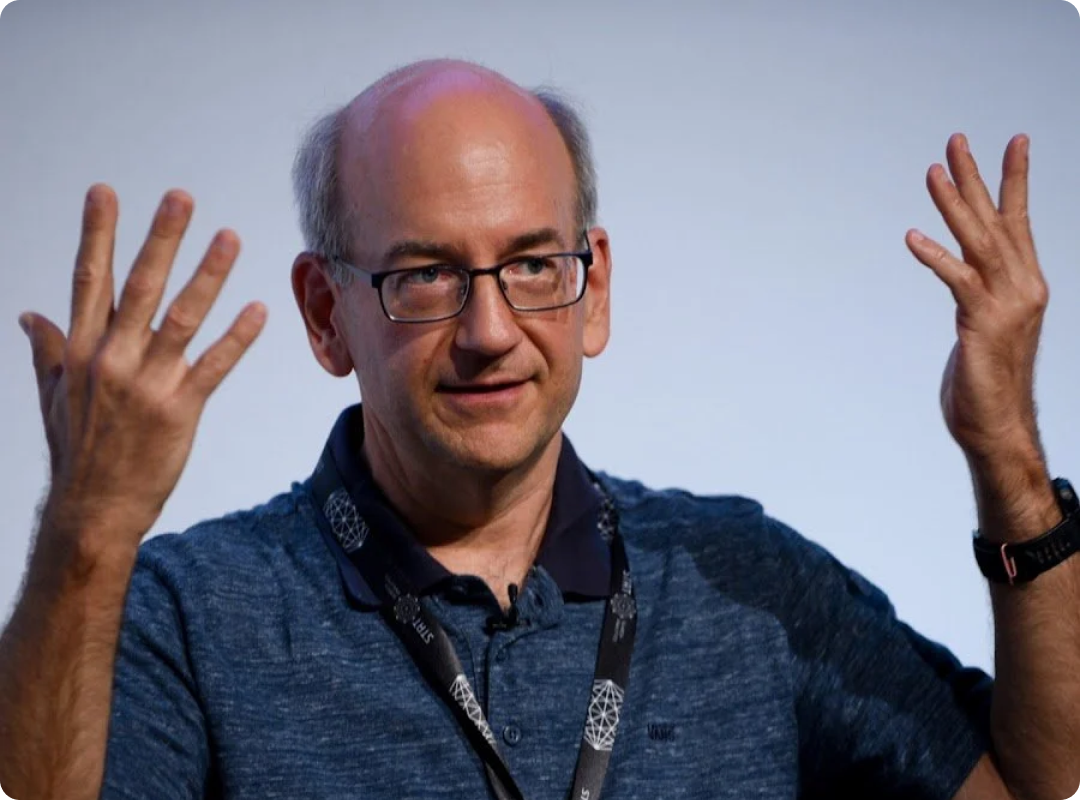
Start here, and not with an AEO guru. Mueller is the one person on this list who is not selling answer engine optimization, which is exactly why he is number one. He is Google’s Search Advocate and Search Relations lead, the official bridge between Google’s engineers and the public web, and he has done it for nearly two decades. If you want ground truth on how Google’s AI surfaces actually treat content, you read him, not the influencers interpreting him.
His value in 2026 is the primary source and the reality check rolled into one. He has warned that using LLMs to mass-produce topic clusters just builds “liability” and reasons not to visit your site. He has called formulaic SEO content “digital mulch.” And he is the source of the line at the top of this piece, that aggressive new AI optimization acronyms often signal spam. You will not always like what he says, and I do not always agree with how narrowly Google frames “AEO is just good SEO” for its own surfaces. But no one else gives you the signal he does, straight from the largest discovery surface on earth, and that beats any vendor’s dashboard.
Best work to read: the Google Search Central blog and the official guidance hub at g.co/searchcentral, plus his running commentary on Bluesky.
Where to follow: most candid on Bluesky (@johnmu.com), also on LinkedIn.
What to follow him for:
- How Google genuinely sees AI search, straight from the source.
- A built-in BS detector for the flood of AEO and GEO hype.
- Technical SEO fundamentals that still underpin AI visibility.
2. Mostafa ElBermawy, Founder & CEO of NoGood & Goodie AI
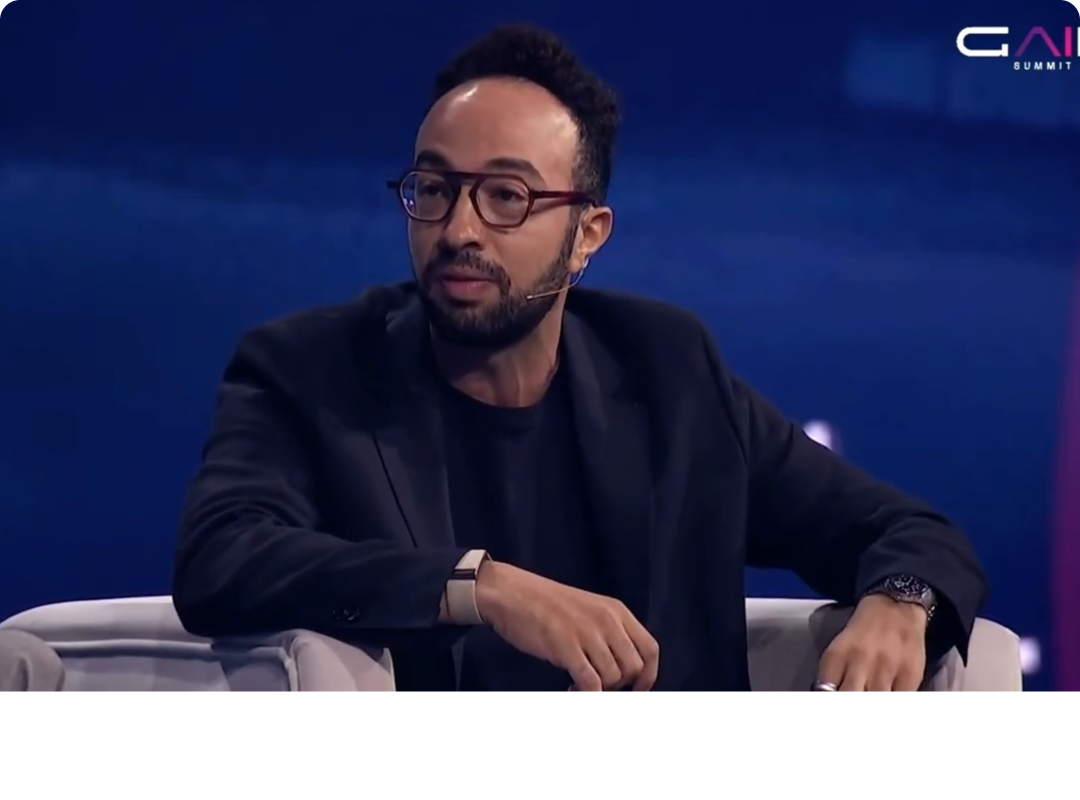
The case: Mostafa has a stronger claim to pioneering this space than almost anyone, and the record backs it. He was an early adopter of Answer Engine Optimization and has spent the last three years giving the discipline rigor. He ran a panel on the future of search at SXSW in 2023, before AEO meant anything to anyone, built an early AEO course on Reforge, and created the first AEO course on Maven, the AEO Masterclass, now one of the most widely taken AI search courses anywhere. Goodie AI, which he founded, is one of the first platforms built for end-to-end AEO. At NoGood, he runs the same playbook for category leaders.
The objective case rests on the research, not the title. Goodie AI’s AEO Periodic Table analyzed more than a million prompts across six engines to reverse-engineer the factors that actually drive citation. The AI search social citation study went further, mapping millions of citations to show that social is accelerating faster than any other source type and now generates more than twice the citations of owned content. That body of original work is where the concepts he is known for come from, like platform coupling and the argument that to win AI search, you have to win social. Few people in this field are publishing first-party research at that scale.
Best work to read: the AEO Periodic Table research, the AI search social citation study, and the AEO Masterclass on Maven. More analysis at bermawy.com.
Where to follow: most active on LinkedIn, with longer writing and research at bermawy.com.
What to follow him for:
- Original AEO research with real sample sizes, often before it becomes consensus.
- Named frameworks you can apply, like platform coupling and the social-first thesis.
- A contrarian read on where AI search is heading, from agents to agentic commerce.
3. Rand Fishkin, Co-Founder & CEO of SparkToro
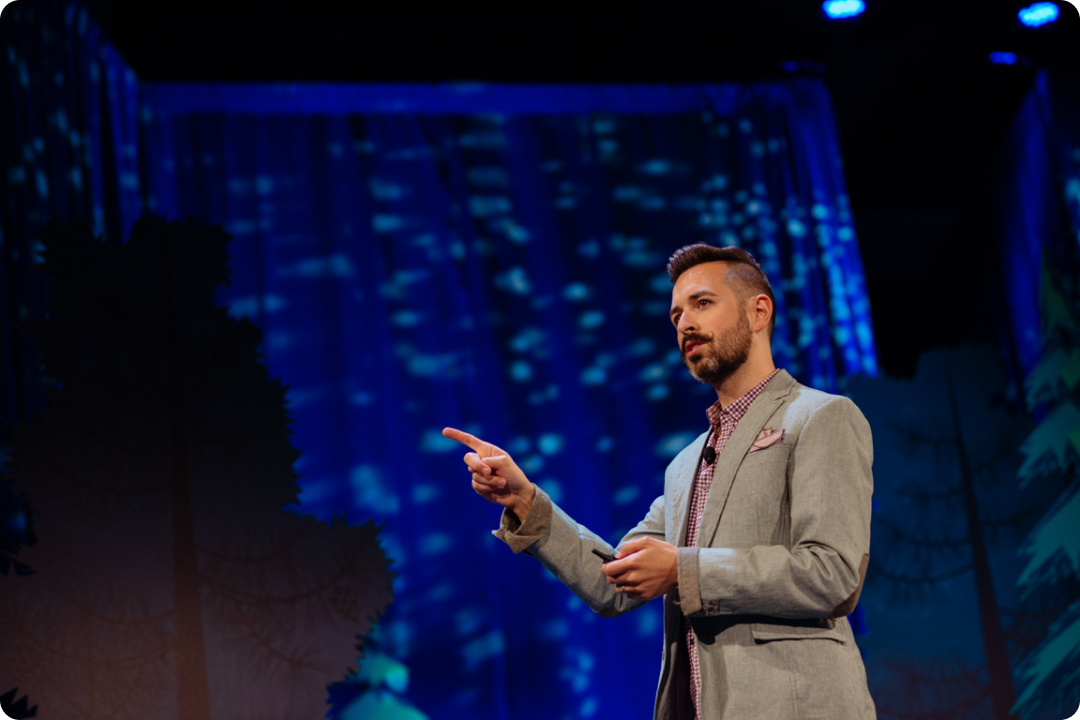
The case: Rand is the closest thing this field has to a founding intellectual. He built Moz into the institution that trained a generation of SEOs, wrote Lost and Founder, and most importantly, he quantified zero-click search. Everything the AEO conversation rests on, the idea that engines increasingly answer the question and keep the click, is downstream of work he started in 2019 and has updated relentlessly with SparkToro and Datos clickstream data.
His latest numbers are the ones to internalize. In the first four months of 2026, by his analysis with Similarweb’s panel, just over 68 percent of US Google searches ended without a click to anywhere. He pairs that with a thesis I share: stop worshipping last-click attribution, start measuring aggregate influence, and build presence where your buyers actually are, including LLMs. His framing of zero-click marketing and building on rented land is the strategic spine under a lot of good AEO thinking, even when he is skeptical of the acronym itself.
Best work to read: Zero Clicks Does Not Mean Zero Sales, his SEO Week talk You Are Bigger Than SEO, and the ongoing zero-click research on the SparkToro blog.
Where to follow: most active on LinkedIn, with deep research on the SparkToro blog.
What to follow him for:
- The best longitudinal data on how search behavior is actually shifting.
- A genuinely honest take on why attribution is broken and what replaces it.
- Audience research thinking, where buyers pay attention beyond search engines.
4. Tim Soulo, CMO of Ahrefs
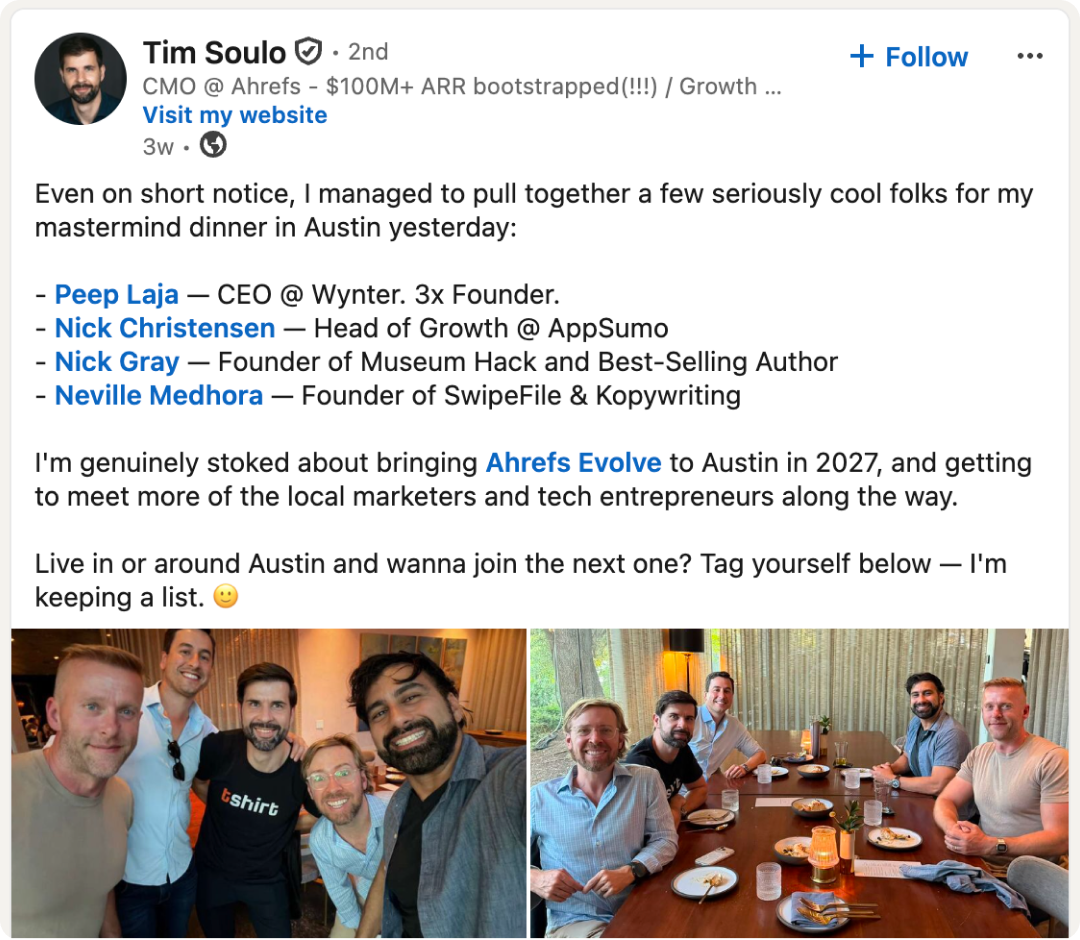
The case: Tim has turned Ahrefs into one of the most prolific research engines in AI search, and instead of gating the findings, he publishes them in plain sight. Over six months his team ran fourteen studies across more than a billion data points, and the takeaways are now reference points: “best X” listicles are the single most cited page format in ChatGPT, roughly two-thirds of ChatGPT’s top citations come from sources marketers cannot directly influence like Wikipedia and homepages, and YouTube mentions show the strongest correlation with AI brand visibility of any factor they measured.
He also ships the tooling. Ahrefs Brand Radar tracks AI visibility across the major engines using prompts derived from real “People Also Ask” data rather than synthetic queries, sitting on fifteen years of search infrastructure. His through-line, that citations are the new backlinks and AEO depends on how you are represented across the whole web, is one of the cleaner mental models out there. He also writes blunt tool comparisons that admit where competitors are better.
Best work to read: his 1 billion data points on AI search optimization, Best AI SEO Tools for 2026, and the Ahrefs guide What We Actually Know About Optimizing for LLM Search.
Where to follow: most active on LinkedIn, with long-form pieces on Medium.
What to follow him for:
- Large-sample AEO research you can actually act on.
- A builder’s honest view of the AI visibility tooling, including the weaknesses.
- The “citations are the new backlinks” model for off-site strategy.
5. Aleyda Solís, Founder of Orainti & SEOFOMO
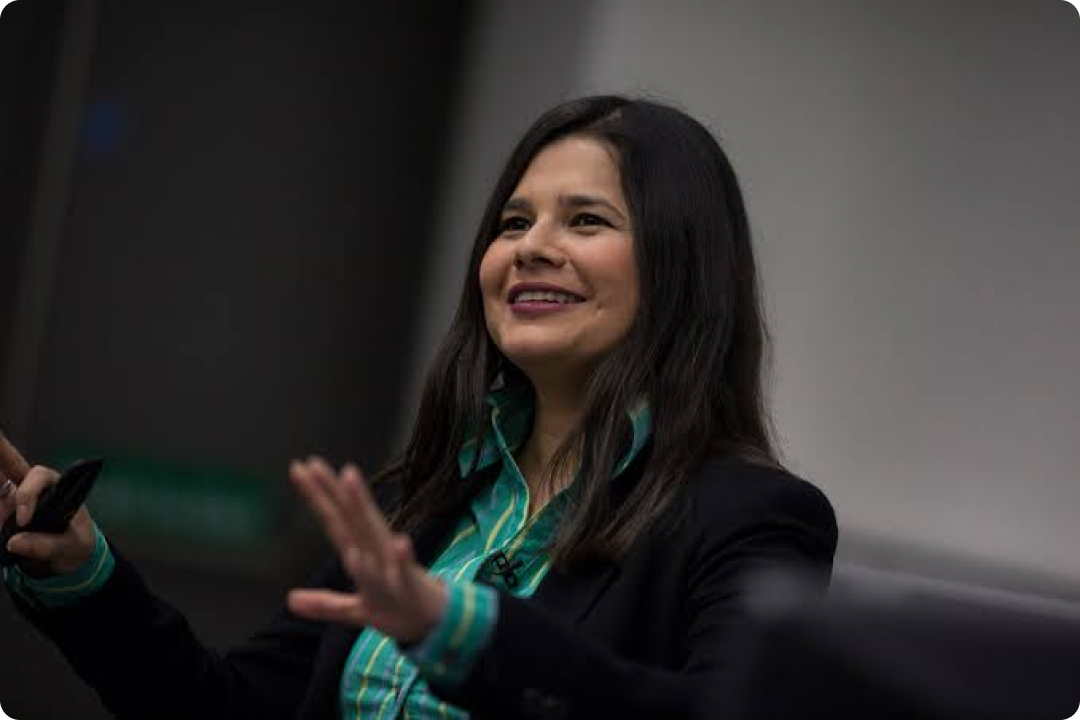
The case: Aleyda is the most trusted independent educator in AI search, full stop. She runs Orainti, a boutique consultancy advising brands worldwide, but her real influence comes from how generously she teaches. Her SEOFOMO newsletter reaches more than 45,000 practitioners, and her free AI Search Optimization Roadmap is the single best starting point for anyone learning the discipline. She is not selling hype. She curates and pressure-tests what actually works.
Her contribution is structure and clarity. Her AI Search Content Optimization Checklist breaks the work into concrete steps, chunk-level optimization, citation-worthiness, topical breadth, schema, and crawlability, and her State of AI Search Optimization survey is one of the few honest reads on what teams are actually doing versus what they say. She is also refreshingly grounded on the SEO-versus-AEO debate, arguing that mature, semantic SEO already overlaps heavily with what AI search rewards, while staying clear-eyed about what genuinely changes.
Best work to read: the free AI Search Optimization Roadmap, the AI Search Optimization Checklist, and the State of AI Search Optimization survey.
Where to follow: most active on LinkedIn and X (@aleyda), with the deep resources at learningaisearch.com and the SEOFOMO newsletter.
What to follow her for:
- The clearest, most reliable AI search education anywhere, much of it free.
- Practical checklists and frameworks you can hand to a team tomorrow.
- A grounded, hype-free read on what carries over from SEO and what does not.
6. Ethan Smith, CEO of Graphite

The case: Ethan has spent eighteen years in SEO and built it into a dominant channel at Thumbtack, MasterClass, and Ticketmaster before scaling Graphite into a research-driven growth agency working with the likes of Webflow and Adobe. His two Lenny’s Podcast appearances, the definitive SEO guide and then the AEO guide on getting ChatGPT to recommend your product, are among the most referenced explainers in the space, and his claim that ChatGPT traffic converts roughly six times better than Google search reframed how a lot of founders value the channel.
He is also one of the sharpest first-principles thinkers here. He argues that long-tail keywords are now longer and more conversational, that you should mine real prompts from places like Reddit rather than asking AI to invent them, and that AI-generated content still accounts for only a small share of what actually gets cited because the model companies want human signal. He teaches at Reforge and IE Business School and runs Graphite’s “five percent” blog, named for the idea that most of what we do does not matter and only a sliver does.
Best work to read: Lenny’s Newsletter ultimate guide to AEO, the companion ultimate guide to SEO, and Graphite’s research at the Five Percent blog.
Where to follow: most active on LinkedIn, with original research on the Graphite blog.
What to follow him for:
- First-principles AEO from someone who built SEO at scale for years.
- Research on what AI actually cites, including the limits of AI-generated content.
- A clear-eyed take on prioritization, the five percent that moves the needle.
7. Lily Ray, Founder of Algorythmic, VP, SEO & AI Search at Amsive
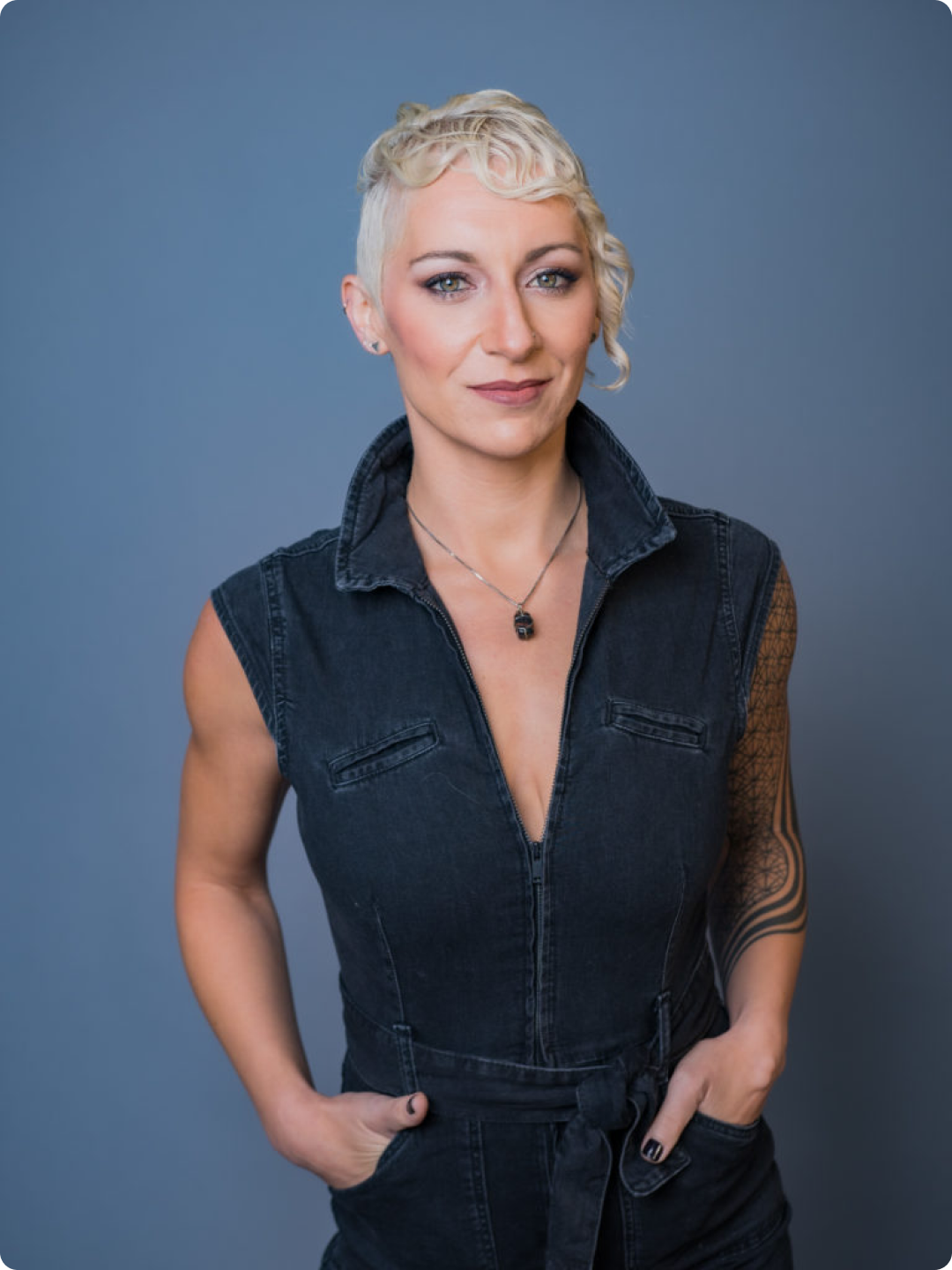
The case: While most voices in the AEO space were publishing opinion, she was running studies: 220+ websites tracked against AI content scaling platforms, 100 queries analyzed to separate AI citations from actual brand recommendations, and a direct correlation drawn between Google organic drops and AI citation losses across real subfolders. That last finding matters more than it sounds: it’s empirical proof that SEO and AEO are not parallel tracks, they’re the same track. That’s a thesis most people assert. She’s one of the few who showed the data.
The reason she sits at #7, just ahead of Alex, Mike, and Ty but not higher, is equally honest. She doesn’t run a proprietary platform. She didn’t name the discipline. Her frameworks are solid but haven’t traveled as broadly as the top tier’s. What lifts her above that next cluster is the research cadence itself, nobody below her on this list is publishing sample-sized studies at her pace right now, and that recency edge is exactly what the engine test rewards. What she does have is a practitioner’s instinct for which tactics are about to break before the rest of the field catches on, and the credibility to say, “your GEO strategy might be destroying your SEO,” and have people listen. That combination, rigorous, timely, and running against real sites, is exactly what earns a spot on a list like this.
Best work to read: Are Citations in AI Search Affected by Google Organic Visibility Changes?, Your GEO Strategy Might Be Destroying Your SEO, and Why Calling Yourself the ‘Best’ Could Be Helping Your Competitors Win in AI Search. Her MozCon 2025 talk, GEO, AEO, LLMO: Separating Fact from Fiction, is the clearest single resource for orienting a senior practitioner who needs to quickly understand where the field actually stands versus where it’s being oversold.
Where to follow: most active on LinkedIn and her Substack, with research syndicated to Search Engine Land and Search Engine Journal.
What to follow her for:
- The clearest empirical case of Google organic performance and AI citation performance not being independent systems, but rather moving together.
- A running, data-backed early warning system on which GEO tactics are beginning to attract algorithmic penalties before the rest of the industry catches on.
- The E-E-A-T frame as a practical operating philosophy for AEO, grounded in over a decade of watching shortcuts fail at scale.
8. Alex Birkett, Co-Founder of Omniscient Digital
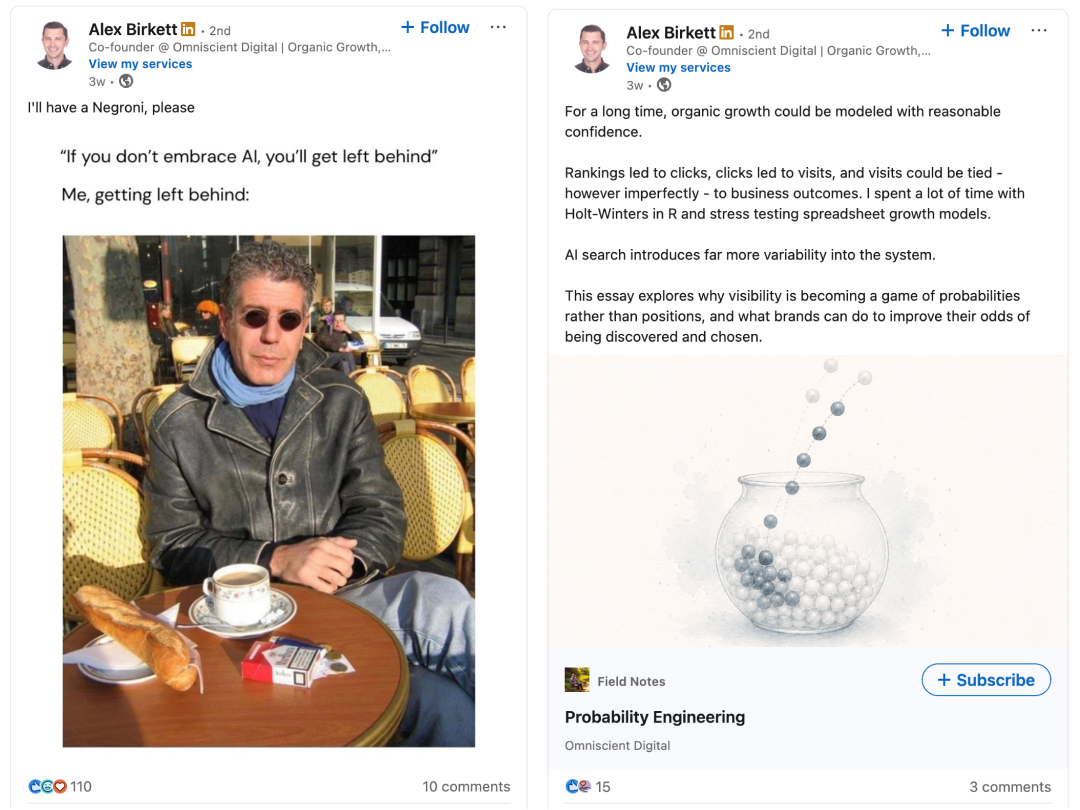
The case: Alex is what an AEO practitioner looks like when they came up through experimentation and CRO instead of pure SEO. He learned the craft at CXL, HubSpot, and Workato, then co-founded Omniscient Digital, an organic growth agency that ties SEO, GEO, and content to pipeline rather than vanity traffic. His content is consistently among the most intellectually honest in the agency world, and his evaluations of GEO tools are genuinely useful because he tested nearly all of them for his own clients first.
What sets him apart is the revenue framing. He shares real numbers, like an Omniscient client whose LLM-referred traffic converted at 30 percent versus 5 percent for traditional organic, and he was early to name “negative AEO,” competitors writing deliberately misleading comparison pages to poison your brand in AI answers. He thinks in terms of experiments, share of voice, and digital PR as a citation lever, which is the right attitude for B2B.
Best work to read: his definitive Omniscient Digital review, his GEO and AEO essays at alexbirkett.com, and the AEO episode of The Long Game podcast.
Where to follow: most active on LinkedIn, with deeper essays at alexbirkett.com.
What to follow him for:
- AEO tied to pipeline and revenue, not traffic for its own sake.
- Honest, hands-on GEO tool reviews from an agency operator.
- An experimentation and CRO lens most SEO voices lack.
9. Mike King, Founder & CEO of iPullRank
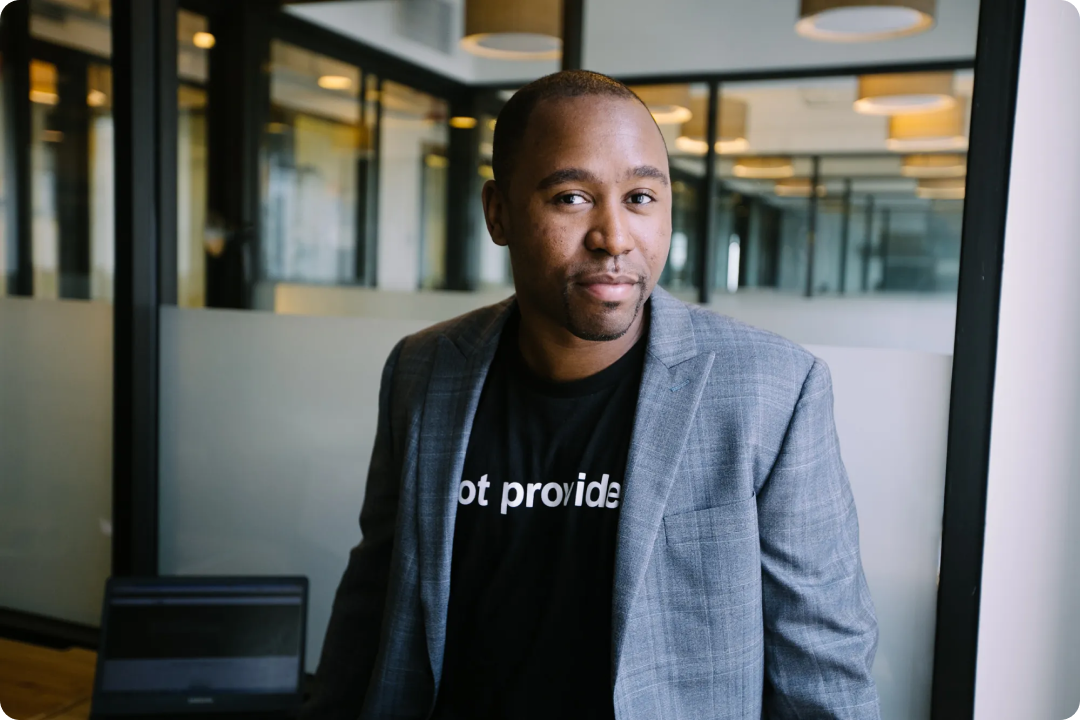
The case: if Aleyda Solis is the field’s best educator, Mike King is its best engineer. He runs iPullRank, the agency other agencies study, and he is the most technically rigorous voice in AI search today. He does not just report that search has changed. He dissects the patents, white papers, and system architecture to explain exactly how. His widely read teardown of how Google’s AI Mode works, including the query fan-out and passage-level retrieval that govern what gets cited, is required reading.
His contribution is a whole framework: relevance engineering, the idea that visibility in AI systems is engineered at the passage and embedding level, not won with page-level authority alone. He coined the term, built free tools like Qforia to simulate query fan-out, was one of the people who made the Google API leak public, and founded the SEO Week conference in New York. If you want to understand the machinery under AI search rather than the talking points, follow Mike.
Best work to read: How AI Mode Works and How SEO Can Prepare for the Future of Search, The AI Search Manual, and his piece on the probability of AI search.
Where to follow: most active on LinkedIn and X (@iPullRank), with deep technical writing on the iPullRank blog and the Rank Report newsletter.
What to follow him for:
- The deepest technical explanation of how AI search actually retrieves and cites.
- Relevance engineering, a framework for optimizing at the passage and embedding level.
- Patent and system teardowns you will not get from anyone else.
10. Ty Magnin, CEO of Animalz
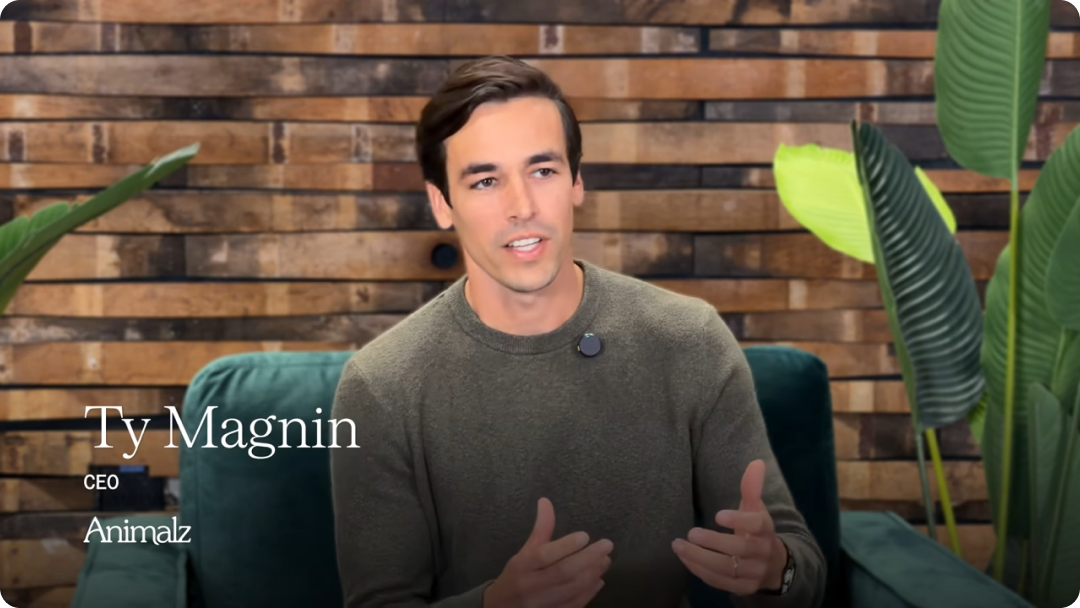
The case: Ty rounds out the list as the content-quality conscience of AEO. He runs Animalz, long regarded as one of the best content marketing agencies in B2B, and came up leading content at UiPath and Appcues, so he thinks about content as a system, not a content mill. In an era where everyone can generate infinite words, his obsession with editorial taste and net value is more relevant, not less.
His recent work is exactly the kind of clear-eyed analysis the field needs. He published a candid breakdown of how “Reddit’s AEO moment” lasted about eight months before citations shifted, a useful antidote to single-tactic thinking. His AI content playbook, built from interviews with operators actually doing the work, lands on principles I share: mine your own data and expert POV, train AI on your real voice, and appoint a human “head chef” to sign off on everything. He hosts the Animalz podcast and keeps a steady drumbeat on AI, SEO, and AEO.
Best work to read: Write Smarter, Not Harder: How to Use AI Without Losing Your Soul, his candid breakdowns at the Animalz blog, and the Animalz Content Marketing Podcast.
Where to follow: most active on LinkedIn, with the podcast and essays at animalz.co.
What to follow him for:
- Content quality and anti-slop discipline in the AI era.
- Honest reads on which AEO tactics are real and which are fads.
- The content-as-AEO angle, from someone who runs a top content team.
AEO & GEO Experts: Frequently Asked Questions
Is AEO just rebranded SEO?
Partly, and this is where I split from the “it’s all just SEO” camp. Classic SEO is the foundation; crawlability, quality content, and authority still matter, and on Google’s own surfaces, Mueller is right that good SEO is most of good AEO. But AI search runs on training data, retrieval partnerships, and real-time citation across many engines, and those are regimes classic SEO never had to optimize for. One Google-shaped strategy does not transfer cleanly to ChatGPT, Perplexity, Claude, and Grok.
What is the difference between GEO and AEO?
They describe the same goal, getting your brand surfaced and recommended inside AI answers. Ethan Smith prefers AEO because “answer” is more precise than “generative,” and that is roughly where most of us land. The label matters less than the discipline.
How do I actually get cited by ChatGPT?
Be the credible, structured, extractable answer, and be mentioned where the engines look. That means strong technical foundations, content built for chunk extraction, and a deliberate off-site and social presence, since a large share of citations come from sources you do not own. Goodie’s research and Ahrefs’ both point to the same conclusion: social and earned matter more than most teams assume.
Do I need a dedicated GEO tool?
Eventually, yes, once AI is a meaningful slice of your discovery. But heed the warning shared by several people on this list, including Tim Soulo: a tool that only shows you that you are invisible without helping you fix it is half a product. Buy for the workflow, not the dashboard.
The Real Takeaway
The people worth following in 2026 have one thing in common. They run the experiment before they run their mouth. They publish data with their name on it, they admit what they do not know, and they update when the evidence moves. That is the whole filter.
The field is going to keep flooding with self-proclaimed experts faster than the engines can cite them. Learn from the people who are building and measuring, ignore the ones manufacturing urgency, and run the prompts yourself. The engines will tell you who is real.