
Performance marketing automation can save you hours on research, campaign builds, and reporting. But after 6+ years in paid media, I’ve learned that handing AI full control of optimization usually costs more than it saves. Here’s what I automate, what I don’t, and why.
“Comment ‘AI Playbook’ and I will send you the full guide.”
“Growth marketing is dead; this is how AI will automate everything.”
“Nobody needs marketing agencies anymore. AI can do it all.”
I bet you have read at least one of these sentences on LinkedIn this week. A lot of people are rushing to conclusions and integrating AI into every single step of their workflow without giving it a second thought.
To be honest, even I feel like I am in a race, trying to bring myself up to speed with every automation skill that can be incorporated into my daily workflow.
But let’s pause for a moment. Before trying to automate everything, let’s look at how this is affecting the overall ecosystem of the growth marketing industry, in terms of ad-ops, content, and career growth. I will be using myself as an example, and how my skills with AI have changed, especially in 2026, as AI updates have been relentless.
What Is Performance Marketing Automation?
Performance marketing automation is the use of software and AI to handle repeatable paid media work: competitive research, campaign builds, automated bid management, budget pacing, and reporting. The goal is to give marketers more time for strategy, not to replace it. AI-powered marketing automation has made more of this possible in the last two years, but ‘possible’ and ‘worth it’ aren’t the same thing.
How Performance Marketing Has Changed Since 2020
Starting with my career: I have been doing growth marketing, specifically performance marketing, since 2020. I remember when Broad Targeting was the worst choice, Lookalikes dominated paid social, and when you launched an SEM campaign on Google Ads, your ads showed up, and that was it. It was much simpler back then. Even for analytics, there was no need for artifacts or sophisticated dashboards. We got the data we needed, with the help of data scientists who helped us read between the numbers.
Fast forward to today, and SEM is getting more difficult and requires regular maintenance. Paid social has become easier on the targeting side, thanks to AI targeting like Meta’s Advantage+ audiences, and is now more about brand positioning and creative strategy. This can be automated to some degree for certain businesses, such as ecommerce, through catalog frameworks and dynamic fields. But you cannot depend on this alone for a full brand paid social activity.
Is Performance Marketing Automation Important?
Yes, but only with guardrails. Comparing the two periods, I was achieving results in both. My day-to-day work has just shifted. I am carrying more workload, and why? Because the more experience you have, the more you are expected to deliver with AI’s help, at higher quality. That is fair. But it is also the core reason we feel pressured to rush into automating everything, FOMO aside.
I also believe that in 5 to 10 years, there will be a significant gap between juniors and seniors. What I’m seeing more and more is companies wanting seniors and managers to own the strategy, then automate the ad-ops, creative strategy, optimizations, martech, CRM, segmentation, and I could keep going on with more. That is not inherently wrong, since AI is genuinely helpful for automation and speeds things up significantly. But it needs guardrails before you start automating blindly.
How to Automate Performance Marketing: My 5-Step Roadmap
That is why, with my experience, I want to walk you through my personal roadmap for approaching AI integration, so you can avoid the bumps I hit and the days I wasted trying to automate tasks that would have been faster to do manually.
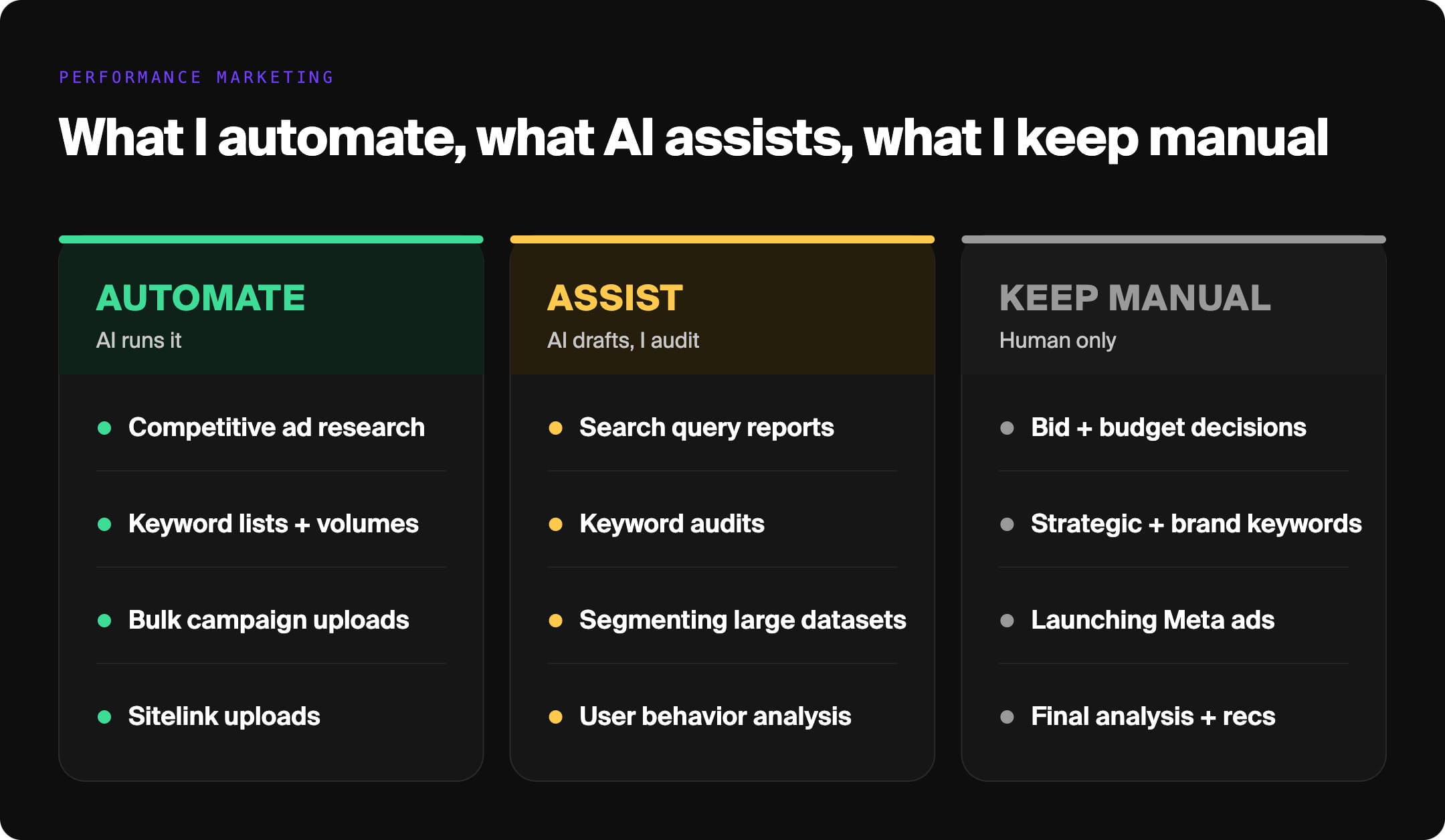
Step 1: Build the Foundation Before You Open an LLM
Let’s take a brand performance marketing plan launch as an example. Before anything else, take time to reflect:
- Have you worked on something similar before?
- What problems did you face?
- What worked?
- What were the average metrics?
Write these down in a simple document. If you have no previous experience, do basic research, use the Ads Library, scroll through similar accounts, apply that pure human eye. Build the foundation before heading to the LLM. Start brainstorming with it once you know what you want from the session. This will help you refine your prompts and waste less time going down rabbit holes.
Step 2: Automate Competitive and Keyword Research
After that, I automate the research process. Why? Because research is where AI adds the most without taking control. It isn’t doing the work; it’s adding finishing touches and filling gaps I might miss. I break this down by platform:
- For Paid Social, Manus helps me review the Meta Ad Library and gives me structured feedback on what content types are being used, what marketing angles I am missing, and what the overall strategic themes are.
- For Paid Search, I use the Ahrefs connection with Claude. It’s really helpful for pulling keyword ideas and search volumes, and Claude suggests match types from there. I build that list, add what personally feels important, then hand it to Manus to query those keywords in Google Search and show which competitors are bidding on them, plus their headlines and ad copy. The output is a compiled document with everything I need to launch.
Step 3: Speed Up Ad Ops for Automated Paid Media Campaigns
On the ad ops side:
- For Paid Social, the easiest path right now is connecting Claude to Meta Ads Manager through Meta’s official Ads AI connector. You provide the images, ad headlines, and CTA, and it handles the rest. I still do this manually, and I have not yet hit a scale problem that forces me to automate it.
- For Paid Search, I use Google Ads’ bulk upload templates and upload it directly to the account. This helps with campaign creation, bulk sitelink uploads, and ad edits at scale.
Step 4: Keep Automated Bid Management and Optimization Human-Led
Moving to ad optimization, I personally do not trust giving AI full control here. Some ads are kept for strategic and long-term goals. Some keywords are bid on for brand awareness, not pure performance. There are in-platform rules that handle conditional actions well enough. I have not let go of this part yet, and here is my breakdown:
For budget allocation across Paid Social and Search, I use a normalization technique. Each metric gets a weighted score based on its importance to the account and the business.
The equation:
x′=(x−xmin)/(xmax−xmin)
normalizes each metric, applies a weight, sums the scores, and assigns each campaign or platform a budget allocation score. It makes the process significantly more consistent and defensible. For metrics where lower is better, like CPA or CPC, flip the score (1 − x′) so the cheapest campaign scores highest.
For SEM, specifically SQRs and keyword audits, I use Claude to assist and then fully audit its recommendations myself. You need to give Claude deep context about each keyword and search term for it to return anything valuable.
Step 5: Pair AI-Assisted Analytics with Manual Review
For analytics, I live in Google Sheets, pivot tables, custom segmentation, the works. For larger datasets that are not easily segmented with standard functions, I tell Claude what I want and how I want it structured, then take that output back into my own analysis. Running both in parallel ensures I am not missing anything.
For customer journey analysis, I use Microsoft Clarity. The Microsoft Clarity MCP server is particularly useful here. It lets Claude pull behavioral metrics like dead clicks, rage clicks, and scroll depth. Combined with my own manual review, I get a strong picture of what is happening and what to act on.
What Are the Best Performance Marketing Automation Platforms?
| Workflow stage | Tool | What I automate | What stays manual |
|---|---|---|---|
| Competitive research | Manus + Meta Ad Library | Content types, angles, themes | Final strategic read |
| Keyword research | Claude + Ahrefs | Keyword lists, volumes | Business-priority additions |
| Paid social ad ops | Meta Ads AI connector | Building ads from supplied assets | Launch (still manual at my scale) |
| Paid search ad ops | Google Ads bulk uploads | Campaigns, sitelinks, ad edits at scale | — |
| Optimization | In-platform rules + Claude | Conditional rules, SQR first pass | Bids, budgets, strategic keywords |
| Analytics | Google Sheets + Claude + Microsoft Clarity MCP | Large-dataset segmentation, behavior metrics | Final analysis and decisions |
Why Saying No to Automation Can Be a Growth Strategy
This is how I’m currently approaching marketing workflow automation. Every time I try to fully automate something, I fall into the AI slop trap. It is still too early, in my view, to hand over full control. Years of experience, client context, and brand understanding cannot be fully automated.
Do I feel the pressure? Every day. I ask myself whether I am integrating AI enough, whether I am wasting time on manual work, whether this is costing my clients efficiency. Then I remember how many tools launched this year alone claiming to be essential, and quietly disappeared, because they were adding layers to processes that did not need them. I have not even touched on AI credit costs and whether the automation is actually worth it. That deserves its own post.
Saying no to automation is not always a step backward. Automation is attractive and makes you feel like you are moving fast, but always ask whether it is genuinely moving the business forward.
I am not in a position to predict whether AI will eliminate marketing jobs. What I am witnessing is a shift toward the full-stack marketer, which is not inherently bad, but everyone will have stronger muscles in some areas than others, shaped by their experience. I am genuinely concerned about the junior marketer pipeline and how the supply side of the industry will be affected in the coming years.
I also have a hunch that many companies are quietly returning to manual content creation, pulling back from mass AI-generated ads and copy. How that tension resolves, I do not know.
What I do know is this: the marketers who will win are not the ones who automate the most, they are the ones who know exactly when not to.