

Google Ads keyword matching isn’t what it used to be. Google’s AI has completely reshaped how your ads connect with search queries, shifting from predictable, literal matching to intent-based targeting. As with most other marketing disciplines, what worked in 2021 doesn’t work in 2026, and advertisers who haven’t adjusted their keyword match types strategy are burning budget on the wrong traffic.
What Is Keyword Matching?
Keyword matching is the setting that tells Google how loosely or strictly to interpret your keywords to signal when your ad should show:
- Broader match types like Broad Match or AI Max cast a wide net.
- Tighter match types like Phrase Match and Exact Match keep you focused on highly relevant searches.
The shift that we’re seeing matters because Google’s keyword matching options now prioritize search intent over exact words (and we’re seeing a similar trend with organic search, too). Your Google Ads campaign now needs to account for how the AI interprets queries and matches them to your keywords based on meaning, not just the specific terms used.
What Is Search Intent?
Search intent refers to the underlying goal or purpose behind the words someone uses in a Google search. While Google used to rely on the exact words typed into the search bar to decide what ad to show, AI has allowed the platform to expand on understanding the context and reason the user is searching for the terms that they enter.
What Are the Three Types of Keyword Matching?
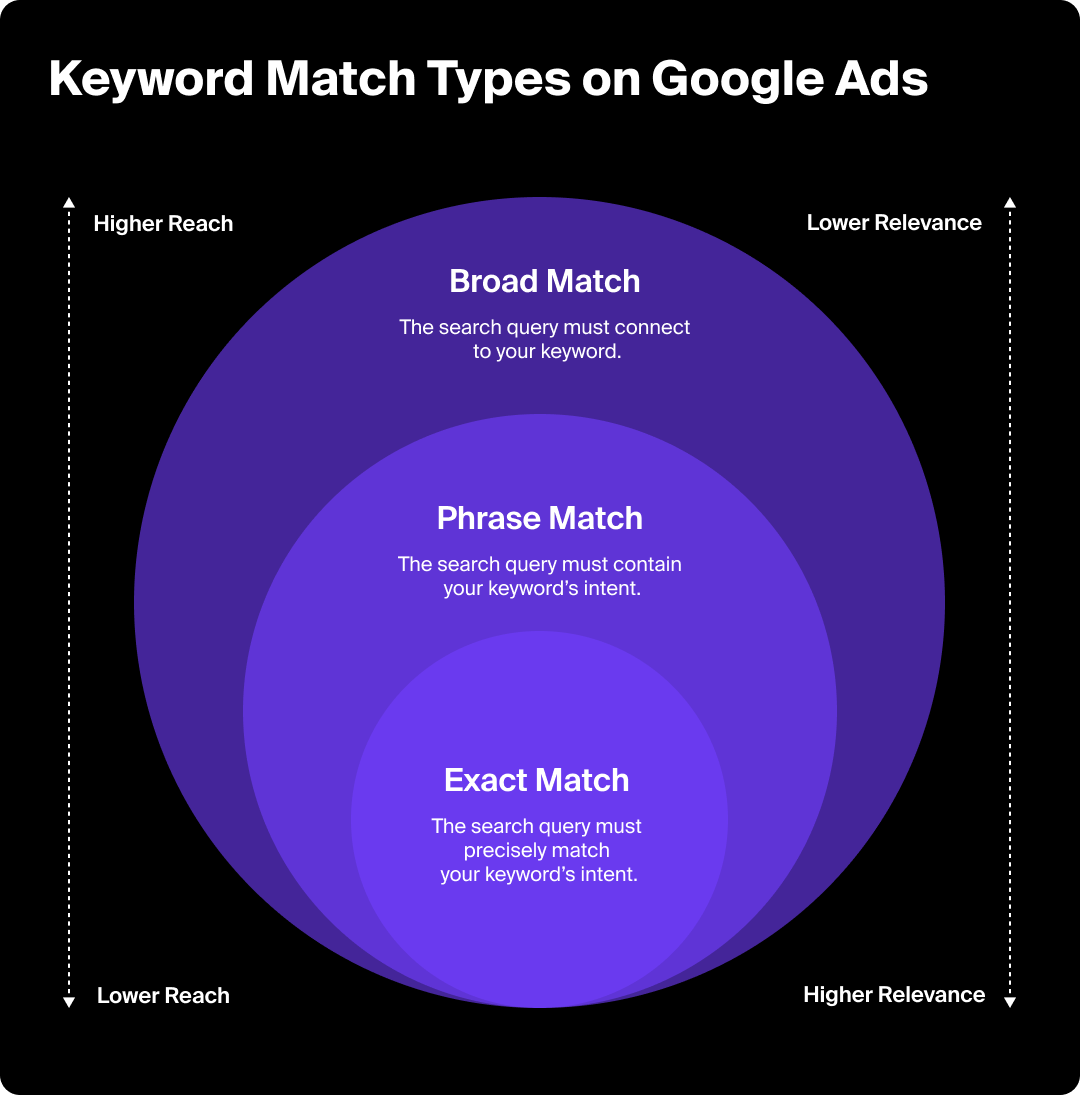
Google Ads uses three keyword match types: Broad Match, Phrase Match, and Exact Match. Each controls how much reach versus precision you get in your PPC campaigns.
- Broad match casts the widest net, triggering your ads when Google’s AI determines the search is relevant to your keyword. This includes synonyms, related concepts, and variations. You get maximum exposure, but risk Google’s interpretation of your intended audience being incorrect.
- Phrase match requires the core meaning of your keyword to appear in the search, though other words can come before, after, or substituted for similar terms. This strikes a balance between discovery and control, making it useful for scaling campaigns without losing relevance.
- Exact match keeps your ads focused on searches with the same intent as your keyword, though Google still interprets close variations based on context. This gives you the tightest control while allowing flexibility for how people phrase their searches.
Read more from Google to learn more about how these work together.
The Evolution of Google Ads Exact Match
Historically, Google’s Exact Match keywords were triggered only for search queries that used the same words or very similar variations (things like misspellings, plurals, and function words).
- 2021 Exact Match Example: [women’s shoes] = women’s shoes, womens shoes, women’s shoe
- Phrase Match: “women’s shoes” = (all exact match variations) + buy women’s shoes, best shoes for women, girls shoes for sale
- Broad Match: women’s shoes = (all exact and phrase match) + snow boots, popular shoes in 2026, red shoes in my area
The benefit of this was that advertisers could be very segmented with their targeting, ensuring only the highest intent audience saw their ads, negating wasted spend.
The downside was highly relevant searches that didn’t use the exact words were being missed. This could include variations that were still relevant, but just required a longer and more comprehensive keyword list to capture the full breadth of searches.
Current Match Type Structure
Now, with the updated match structure, exact match is much more similar to phrase match. Instead of requiring the exact same words, the search query has to match the meaning or intent.
Let’s take our same example from 2021 and teleport it into 2026:
- 2026 Exact Match Example: [women’s shoes] = (all 2021 variations) + ladies’ shoes, shoes for women, women’s footwear
- Phrase match: “women’s shoes” = (all exact match variations) + buy women’s shoes, best shoes for women, girls shoes for sale
- Broad Match: women’s shoes = (all exact and phrase match) + snow boots, popular shoes in 2026, red shoes in my area

So, Why Use Exact Match for Google Ads?
After taking a look at the above examples, you might be asking yourself the same questions that many advertisers did when this change went into effect: if Exact and Phrase Match are so similar, why use Exact Match at all?
It’s because Exact Match is best for high-intent targeting. While it generally has a higher CPC, Exact Match makes up for it with higher conversion rate and ROAS. There’s an added layer of niche targeting that Phrase Match just doesn’t have, which is especially important for niche product lines.
Let’s take another example: if you’re running a Google Ads campaign for an auto insurance company, the Phrase Match for “(company) auto insurance” would also trigger searches like “(company) insurance”. That means your ads that are intended for users in search of auto insurance could also show for people searching for the same company’s life, health, or home insurance.
In this scenario, you’re not just wasting budget on irrelevant ads. You’re also signaling to Google that your expected CTR and landing page experience is lower, reducing your ad rank threshold, limiting your ads likelihood of showing in top search result positions, and increasing your CPC.
The Negative Keyword Shift
With the evolution of Exact Match, negative keywords have also become more critical than ever for controlling ad spend. Today’s Exact Match triggers on intent and close variations, not just the specific words you targeted. Words get reordered, added, or substituted, and your ad still shows. That means you need to add more negative keywords to block broader matches that wouldn’t have caused an issue before.
Here’s what makes this more challenging: negative keywords work similarly to positive keywords, but not exactly the same. Unlike positive keywords, negative keywords don’t automatically match to variants, misspellings, or reordered words. You need to add each variation manually to your negative lists for complete coverage.
- Negative Exact Match: Blocks your specific keyword and its close variations, but doesn’t always capture spelling errors or the wider intent range that the positive counterpart does.
- Negative Phrase Match: Blocks searches where your keyword phrase appears in order, regardless of surrounding words. Gives you broader protection against categories of searches you want to avoid, but misses the overlap of similar misordered phrases.
- Negative Broad Match: Blocks searches that include all your negative terms, even when scattered throughout the query. Offers the widest exclusion range but carries the highest risk of accidentally blocking good traffic.
Understanding the difference between negative match types is essential for protecting your budget and feeding Smart Bidding algorithms clean data. The difference comes down to precision versus coverage:
|
Search Query |
Negative Exact Match |
Negative Phrase Match |
Negative Broad Match |
|---|---|---|---|
|
Keyword |
[free software] |
“free software” |
free software |
|
project management |
✓ |
✓ |
✓ |
|
software |
|||
|
free trial |
✓ |
✓ |
✓ |
|
best free software |
✓ |
X |
X |
|
software free download |
✓ |
✓ |
X |
|
free software |
X |
X |
X |
Building Your Negative Keyword Strategy
The loosening of positive match types means you need aggressive, comprehensive negative keyword lists to keep your budget in check. Here’s how to do it:
- Start with foundational negatives before you launch. Add explicitly known waste terms as negative exact matches. These are searches you know will never convert: [(company name) login], [(company name) careers], [(competitor) software]. Block those from Day One.
- Layer in broader exclusions for common themes. If you don’t offer a free version, add negative phrase matches around “free software” or “software for free”. But be specific. If you offer a free trial, you can’t just block “free” or you’ll exclude “software with free trial” searches from people who might actually convert.
- Add overarching negative categories as broad matches. Think about terms you never want associated with your brand: worst software, lawsuit, scandal, scam. These protect your brand from showing up in the wrong context.
- Review your search terms report regularly and look for high spend, low conversion queries. With Google’s AI interpreting keywords based on intent, you’ll find irrelevant searches you never expected. Use shared negative keyword lists to apply exclusions across campaigns efficiently, especially for Performance Max where you have less targeting control.
Disciplined negative keywords do more than prevent wasted clicks. Cleaner conversion data means Smart Bidding optimizes toward your actual target audience. Tight negative keyword lists protect your Quality Score by ensuring ads only show for relevant searches, keeping your ad rank threshold competitive and your CPCs lower.
Conclusion: What the Shift Towards Intent-Based Targeting Means for Advertisers
The shift to intent-based keyword matching requires a different approach:
- Stop building exhaustive keyword lists with every variation.
- Focus on core search keywords that represent your offering and let Google’s AI handle the matching.
- Use Exact Match for your proven, high converting keywords to maintain control over your most valuable traffic.
Your keyword research should identify search intent, not just high search volume terms. Think about how user queries evolve and what consumer demands drive searches in your industry. Balance reach with relevance by using phrase match for scaling and exact match for precision.
Review your search query reports regularly and adjust your keyword matching rules to keep your ads showing for relevant traffic.
The goal with Google Ads is staying the same, and it isn’t clicks or impressions. It’s bids and conversions that drive real business results at your target cost per conversion. It’s just now, the strategy to get there looks different; are you caught up?