

Healthcare decisions start online for patients and business teams alike. According to Hema Budaraju, VP at Google Search, over one billion health questions come to Google Search every day, from people trying to understand a nutrition label, navigate a new diagnosis, or compare treatment options.
But visibility in search isn’t just a patient acquisition problem. Hospital administrators are evaluating EHR vendors. Physicians are researching clinical equipment. Medtech and Pharma buyers are comparing solutions before they ever speak to a sales rep. The search bar is the first stop across the entire Healthcare ecosystem.
The instinct is to let organic do the work: earn rankings, and avoid paying for clicks. The reality is a little different. Even when you’ve invested in content and earned strong organic positions, a competitor running paid ads can push your result below the fold. Or Google’s AI Overview surfaces above your #1 ranking and intercepts the click entirely. Both scenarios cost you traffic you thought you had owned.
This guide addresses both problems. It covers what Healthcare SEM is, how it works across B2C and B2B contexts, what makes it uniquely constrained as an industry, and how to build a strategy that earns visibility in both traditional Google results and AI answers.
What Is Healthcare Search Engine Marketing & How Does It Work?
Healthcare search engine marketing (SEM) is the practice of increasing a Healthcare organization’s visibility in search engines through paid advertising (PPC), organic search optimization (SEO), and answer engine optimization (AEO) (the emerging discipline of structuring content to be cited by AI-generated search responses).
- Paid Search (PPC): Ads appear at the top of the SERP when someone searches high-intent terms, a patient looking for a “fertility clinic near me” or a hospital administrator searching “enterprise EHR software comparison.” You pay per click.
- SEO: Optimizing your website, clinical content, and technical infrastructure so you rank organically for the queries that matter, whether those are patient-facing or HCP and buyer-facing.
- AEO (Answer Engine Optimization): Structuring content through schema markup, direct Q&A formatting, and E-E-A-T signals so that AI platforms like Google’s AI Overview, ChatGPT, Perplexity, and Bing Copilot cite your content when answering health queries.
Most Healthcare organizations need all three.
- Paid search captures immediate, high-intent demand.
- SEO builds durable, compounding visibility.
- AEO positions your content as the authoritative source inside AI-generated answers, increasingly where both patients and B2B buyers get their first response before clicking a link.
The urgency of AEO is real: research shows that 80% of consumers now rely on “zero-click” results in at least 40% of their searches, meaning your brand needs to be present inside the answer, not just below it.

What Makes Healthcare SEM Different From Other Industries?
Three constraints define Healthcare SEM, for both B2C and B2B:
- HIPAA Compliance: Patient data cannot be freely used for behavioral retargeting. Standard remarketing practices common in eCommerce and SaaS are off-limits and for B2B, data from HCP-facing campaigns must be handled with the same care.
- Regulatory Restrictions: The FDA governs how treatments, devices, and pharmaceutical products can be marketed. Google has its own policy layer: remarketing to users based on inferred health conditions is prohibited.
- YMYL Scrutiny: Google classifies health content as YMYL i.e. “Your Money or Your Life”. Pages offering medical guidance, whether for patients or clinical buyers are held to a significantly higher quality standard than most other content categories.
This narrows the targeting playbook. But it also creates a durable competitive advantage for organizations that build genuine content authority and technical compliance.
What Are the Key Components of Healthcare Search Engine Marketing?
Local SEO
For Healthcare practices and health systems, local search is the highest-volume, highest-intent channel available and Google Business Profile (GBP) is the foundation.
When a patient searches for “dermatologist near me” or “pediatrician accepting new patients in New York,” the Local Pack dominates the SERP. And as of December 2025, Google has completely removed AI Overviews from local provider intent queries. Searches like “dermatologist near me” or “cardiologist near me” now return zero AI Overview coverage as per a BrightEdge study.
This means local SEO remains a high-return, human-curated channel and GBP optimization is more important than ever.
What a fully optimized GBP requires:
- Complete and accurate NAP; that’s Name, Address, Phone (consistent across every directory: Healthgrades, Zocdoc, WebMD, Yelp)
- Services listed at the granular level and not just “healthcare,” but “knee replacement,” “telehealth psychiatry,” “pediatric urgent care”, etc.
- Hours updated in real-time, including holiday schedules
- Actively managed patient reviews with responses, every review, positive or negative
- Regular GBP posts: new providers, seasonal services, patient education content
Why Reviews Compound: A 2024-2025 patient survey found that 8 in 10 patients now Google their provider before calling and 51% read at least six reviews before making a decision. Patients now cite public reviews as more influential than personal recommendations.

Paid Search (PPC)
Paid search puts your organization at the top of the SERP for the exact moment a patient or buyer is ready to act, before any organic result. Even if you were ranking high organically, not running a paid media ad can put you at disadvantage as the organic search result gets buried below paid placements, PAA sections, and the Local Pack.
The mechanics are the same; the audience and intent structure differ significantly between B2C and B2B.
B2C Intent Segmentation
|
Intent Level |
Example Query |
Campaign Approach |
|---|---|---|
|
Transactional |
“book cardiologist appointment NYC” |
Tight ad groups, direct to booking page |
|
Comparative |
“LASIK vs PRK surgery” |
Educational ad + landing page with CTA |
|
Urgent |
“urgent care open now near me” |
Location extensions, call extensions prominent |
B2B Intent Segmentation
|
Intent Level |
Example Query |
Campaign Approach |
|---|---|---|
|
Vendor Evaluation |
“best EHR software for small practices” |
Comparison landing page, lead capture |
|
Category-Level |
“medical device inventory management system” |
Educational content + demo CTA |
|
Competitor Displacement |
“[competitor] alternative for radiology billing” |
Direct comparison page with CTA |
|
Compliance-Driven |
“HIPAA-compliant telehealth platform” |
Trust-forward ad copy, case study landing page with CTA |
Structural Best Practices That Apply to Both
- One offering per ad group: “ACL reconstruction” and “orthopedic surgery” are different ad groups, just as “medical billing software” and “revenue cycle management” are. Make sure the ads are tightly connected with the search query.
- Sitelinks pointing to relevant conversion actions; appointment booking (B2C) or demo request / case study (B2B)
- Geotargeting by zip code or radius for B2C; account-based or firmographic targeting for B2B where possible within Google’s policy constraints
The intent tables above are illustrative. Depending on your Healthcare subcategory like Pharma, Medtech, Specialty Care, Digital Health, the keyword themes and conversion goals will vary significantly.
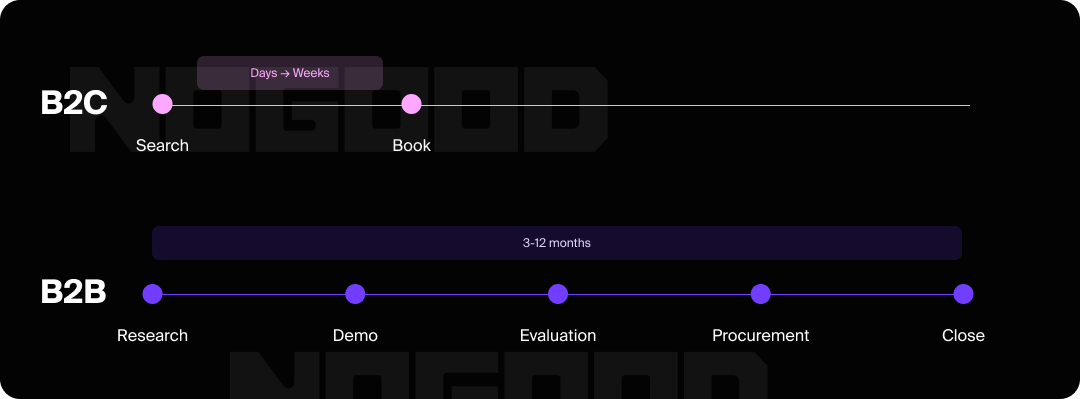
B2B-Specific Consideration: B2C Healthcare decisions typically happen within days to weeks. B2B Healthcare sales cycles run anywhere from 3 to 12 months or longer, depending on deal size and procurement complexity. Paid search opens the door, but content, nurture sequences, and sales enablement are what close B2B deals.
Content Strategy: Building Authority for SEO & AEO
Healthcare content that ranks and gets cited by AI is not content written to fill pages. It’s content that answers specific questions with clinical or technical accuracy, clear structure, and verifiable sourcing.
This applies equally to patient-facing content (“What are the symptoms of Type 2 Diabetes?”) and HCP or buyer-facing content (“How does [Product] integrate with Epic EHR?”).
The AI health answer landscape shifted significantly in early 2026. Google, facing criticism over inaccurate and misleading AI Overview responses for medical queries, pulled back, removing AI Overviews from a broad range of clinical and symptom-related searches.
Meanwhile, other AI companies moved in the opposite direction:
- ChatGPT Health launched in January 2026, giving users a dedicated space to connect medical records and wellness apps for personalized health guidance, with over 40 million users already asking ChatGPT health questions daily.
- Anthropic followed with Claude for Healthcare, targeting providers, payers, and patients. Perplexity continues to answer clinical queries without the guardrails Google has applied.
What this means for Healthcare SEM: the AI answer opportunity has not shrunk, it has moved. Learn more about how AI is reshaping healthcare in 2026.
What high-performance Healthcare content looks like:
- Q&A Format: Direct question as the heading, direct answer in the first paragraph. This is the format AI systems extract from.
- Clinician or Expert Authorship: Patient-facing pages should carry a licensed clinician’s byline with credentials. B2B content should have clinical whitepapers, product documentation, technical guides, and should be authored or reviewed by clinical or technical subject matter experts.
- Linked Citations: Reference the CDC, NIH, PubMed, or peer-reviewed journals for clinical content. Reference third-party validation, analyst reports, or case study data for B2B content.
- Condition- or Solution-Level Pages: A page for “knee replacement surgery” outperforms a generic “orthopedics services” page. Equally, a page for “HIPAA-compliant medical billing software” outperforms a generic “healthcare technology” page.
- Regular Content Audits: Clinical guidelines and product capabilities change. Outdated content is a liability.
Technical Optimization: The Infrastructure Layer
Technical SEO is the foundation everything else sits on. A slow, poorly structured, or insecure site undercuts every other SEM investment, regardless of whether you’re targeting patients or procurement teams.
Core technical requirements:
- Page Speed: Target LCP (Largest Contentful Paint) under 2.5 seconds. Healthcare sites carrying large image files or outdated JavaScript frequently fail Core Web Vitals benchmarks.
- Mobile-First: The majority of health searches happen on mobile. B2B searches increasingly happen on mobile too, your site must be fully functional across devices.
- HTTPS: A trust signal for patients, buyers, and search engines alike.
- XML Sitemap: Ensures search engines can crawl and index every service, condition, and product page.
- Structured Data (Schema Markup): Where technical SEO directly intersects with AEO.
Schema Markup for Healthcare AEO
|
Schema Type |
Use Case |
|---|---|
|
MedicalCondition |
Helps AI systems identify and cite condition pages in health answers |
|
FAQPage |
Increases eligibility for rich results and AI-extracted Q&A, valuable for both patient FAQs and B2B product FAQs |
|
LocalBusiness / MedicalOrganization |
Reinforces local search signals and entity recognition |
|
IndividualPhysician |
Marks up provider profile pages with credentials, medical specialty, hospital affiliation, and certifications |
|
PhysiciansOffice |
Marks up the physical practice location a physician operates from; reinforces local search signals, entity recognition, and NAP (Name, Address, Phone) consistency across clinic and provider pages |
|
Product / SoftwareApplication |
For B2B Healthcare technology companies; marks up product details for AI and rich result eligibility |
AEO: Answer Engine Optimization for Healthcare
AEO is how Healthcare brands earn citation in AI search responses, the answers appearing at the top of Google, inside ChatGPT, through Perplexity, and via Bing Copilot before a user ever clicks a link.
Patients and Healthcare professionals now get answers from Google’s AI Overviews without visiting a brand’s website. 44% of AI-powered search users use AI as their main source of insight, compared to 31% who use traditional search according to McKinsey.
What AEO requires in Healthcare:
- Direct-Answer Content Structure: AI systems extract answers from content that provides a clear question followed by a clear, concise answer. Structure every FAQ, service page, condition page, and product page this way. Don’t bury the answer.
- Semantic Completeness: A page about “hip replacement surgery” should cover: what it is, who needs it, how it works, recovery timeline, risks, costs, and what to ask your surgeon. A page about a medical billing platform should cover: what it does, which EHRs it integrates with, compliance certifications, pricing model, and implementation timeline.
- Cited, Verifiable Facts: AI systems prefer content that cites primary sources. Every clinical claim should link to a supporting study, guideline, or agency.
- Schema Markup: FAQPage and MedicalCondition schema are the most direct AEO signals in Healthcare. For B2B, Product and SoftwareApplication schema serve the equivalent function.
- Entity Authority: AI systems recognize entities: your hospital, your physician network, your product brand. Building your entity footprint, authoritative directory profiles, press coverage, third-party reviews on G2 or Capterra for B2B, increases the likelihood that AI systems reference your brand as a known, trusted source.
What Are the Benefits of SEM for Healthcare Organizations?
The core benefit of Healthcare SEM is this: you show up at the exact moment a patient or buyer is actively seeking a solution, in the exact context where they’re making decisions.
- Measurable Acquisition: Unlike brand campaigns or awareness plays, search marketing targets demonstrated intent. Every click, call, form fill, and demo request is attributable to a specific keyword, ad, or piece of content.
- Geographic & Account-Level Precision: B2C Healthcare revenue is local, paid search and local SEO let you target by radius, zip code, or proximity to facilities. B2B Healthcare sales are often regional or account-specific, paid search layered with CRM-based audience targeting lets you reach the right health systems, clinics, or procurement teams.
- Compounding Returns: Paid search provides immediate volume. SEO and AEO build over time and generate traffic without ongoing per-click spend. In B2B, where sales cycles run 3–12 months, this compounding model is especially valuable, content that educates a buyer at the research stage creates familiarity that shortens the sales cycle later.
- Competitive Positioning: In B2C, paid search lets a regional specialty clinic appear above WebMD and Healthline for the specific queries that drive appointments. In B2B, it lets a challenger vendor appear above entrenched incumbents for the high-intent comparison and evaluation queries that drive demo requests.
What’s the Difference Between SEO, AEO & SEM in Healthcare?
SEO, AEO, and SEM are complementary strategies with different timelines, costs, and applications. The right balance differs between B2C and B2B contexts.
|
SEO |
AEO |
SEM (Paid) |
|
|---|---|---|---|
|
Cost Model |
Investment in content and technical infrastructure; no per-click cost |
Investment in content structure, schema, and entity authority; no per-click cost |
Pay-per-click; cost scales with volume |
|
Time to Results |
3-6+ months for meaningful organic movement |
2 weeks to 6 months+; builds as AI systems index and trust your content |
Days to weeks |
|
Longevity |
Compounds over time; rankings persist |
Compounds over time; brand visibility builds |
Stops when spending on campaigns stops |
|
Best For (B2C) |
Building long-term patient trust |
Earning brand visibility and citations in AI health answers |
Launching new service lines; immediate patient volume |
|
Best For (B2B) |
Category education; authority building with HCPs and procurement teams |
Positioning brand as the cited answer for buyer research topics |
Capturing active evaluation intent |
|
Targeting |
Keyword and intent-based; geographic signals |
Topic, and schema-based |
Keyword, location, device, schedule, audience list |
Here’s the strategy:
- Launch paid search immediately for high-priority service lines or product categories.
- Build organic content authority in parallel.
- Use paid search performance data (which keywords convert, which ad copy wins) to inform your content and SEO strategy.
- As organic rankings and AEO citations build, shift budget allocation toward the channels generating the best cost-per-patient or cost-per-lead.
Which SEM Strategies Are Most Effective for Healthcare Organizations?
The highest-ROI strategies in Healthcare SEM are the ones that create compounding infrastructure, assets that improve in value over time, for both patient and buyer audiences.
- Integrated Paid + Organic Keyword Strategy: Run paid search on top-priority service lines or product categories. Track which keywords generate appointments or demo requests, not just clicks. Build organic content around those exact queries. Over time, organic authority reduces paid CPCs through quality score improvements.
- Review Generation as a Search Lever (B2C): Patient reviews directly impact local pack rankings and paid ad quality scores. Automate post-visit review requests via email or SMS. Respond to every review.
- G2 / Capterra / Peer Review Optimization (B2B): For Healthcare Technology companies, third-party review platforms are the B2B equivalent of Google Business Profile. AI systems increasingly reference these platforms as entity authority signals. An actively managed G2 or Capterra profile, with recent verified reviews improves both direct lead volume and AEO citation likelihood.
- AI Overview Targeting: Identify topics where Google’s AI Overview is already appearing, use Google Search Console impression data with low CTR as the signal (the AI Overview is intercepting clicks). Build or optimize content for those queries using the AEO framework shared above.
- Provider & Expert Profile Authority: Physician profiles with full credentials, published research, and patient reviews build the entity signals that both Google and AI systems use to evaluate credibility. For B2B, the equivalent is executive and SME profiles, thought leadership attributed to named clinical or technical experts strengthens both brand authority and AEO eligibility.
Healthcare SEM operates on three tracks simultaneously: paid search for immediate demand capture, SEO for long-term organic authority, and AEO for brand citation inside AI-generated answers that are increasingly the first thing patients and buyers encounter.
The same fundamentals apply whether you’re marketing a specialty clinic or a Medtech platform. Show up where decisions are being made. Build content that earns trust before the first click. Make it easy to take the next step.
Organizations winning in Healthcare search right now aren’t outspending competitors, they’re building smarter infrastructure: tighter campaign structure, expert-authored content built for AI extraction, and technical schema that signals authority to both algorithms and LLMs.