

TL;DR: SEM’s core unit of meaning has shifted from the keyword to intent. Broad Match, AI Max, TikTok search, and ChatGPT Ads are all expressions of the same change: platforms now match users based on signals and context, not query strings. AEO isn’t a separate discipline from SEM; the signals that win AI citations (direct answers, entity clarity, intent-matched content) are the same signals that make AI-driven paid campaigns perform. Strategies still optimized for keyword control are optimizing for a shrinking version of search.
Remember launching SEM campaigns in 2020? It was clean. Exact match, phrase match, structure the account well, hit launch, and watch your ads show up across every relevant query. No obsessing over Quality Scores or ad copy nuance. The real skill, the one that separated good growth marketers from average ones, was how you approached the problem.
Account architecture. Strategic framing. That’s it.
That skill still matters, by the way. It wasn’t one-size-fits-all then, and it isn’t now. Those days didn’t last.
My 2021 Take on Broad Match, Revisited
Google saw the shift coming before most of us did. Broad Match was their bet: match queries based on intent, not just literal keywords. The idea was right. The early execution was rough, at least in my experience. The match type needed signals. It needed negatives, time to learn, and ideally offline conversion data feeding it. Most accounts, especially lead gen ones, weren’t set up that way. So it underperformed, and we wrote it off too fast.
The lesson I took too long to internalize: Broad Match is a learning machine. Give it the right data and enough runway, and it earns its place. At this point, it’s the top-performing match type in 90% of the accounts I touch.
But while we were debating match types, something bigger was happening.
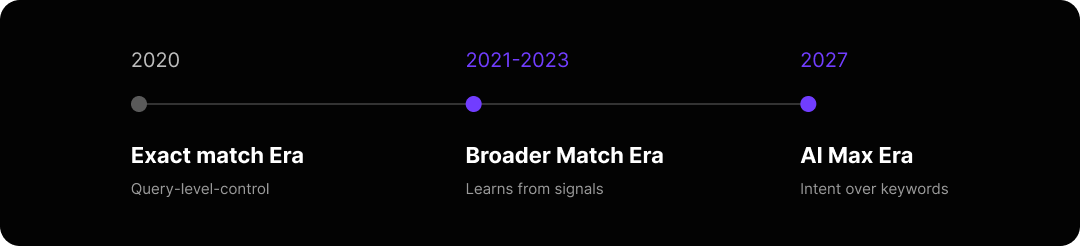
Search Moved Off of Google Before We Noticed
Users started treating YouTube as a second search engine. Someone looking for “top consulting firms in the US” wasn’t reading a listicle; they were watching a breakdown, pulling the info they needed, and navigating directly to a site.
We noticed it, but we didn’t really register what it meant. We were still thinking in Google-shaped boxes.
That was Level One.
Then Instagram, TikTok, and Facebook stopped being scroll surfaces and became search surfaces. Someone evaluating project management tools wasn’t just typing into a search bar. They were watching a TikTok comparison, saving a Reel with a side-by-side breakdown, clicking a link in a LinkedIn comment thread. The discovery behavior was there. The platform was just different.
TikTok search is something else. I’m not even a heavy TikTok user, but when I want fast product information, it’s the first place I go. They saw that use case clearly, and built out search ads in 2023. Everyone was hungry for it, including me. But I still think it needs time to mature. The problem right now is that advertisers are taking their Google keyword lists and pasting them straight into TikTok campaigns.
It didn’t work for us; users search very differently on each platform, and there’s no clean keyword volume tool for TikTok. Tools like Ahrefs won’t surface it; you need backend data, which makes planning a dead end. A native keyword planner from TikTok or Ahrefs integrating social search data would change that.
Separate from the search evolution, attribution remains a persistent problem. Multi-touch journeys make it hard for ads to attribute results accurately , especially for app promotion, where web-to-app handling adds another layer of complexity. That deserves its own post.
LLMs Are Here
The way users interact with AI tools is a direct window into search intent at a level of specificity that traditional keyword research never captured cleanly.
When someone types into ChatGPT or Gemini or Perplexity, they do not search the way they searched on Google in 2016. They write naturally. They give context. They ask in full sentences with constraints built in.
“What is the best CRM for a ten-person B2B sales team that already uses HubSpot and does not want to retrain the whole team?” is a prompt. It is also a long-tail keyword cluster that tells you the landing page structure, the ad copy angle, the objection hierarchy, and the comparison framing the user needs before they will convert.
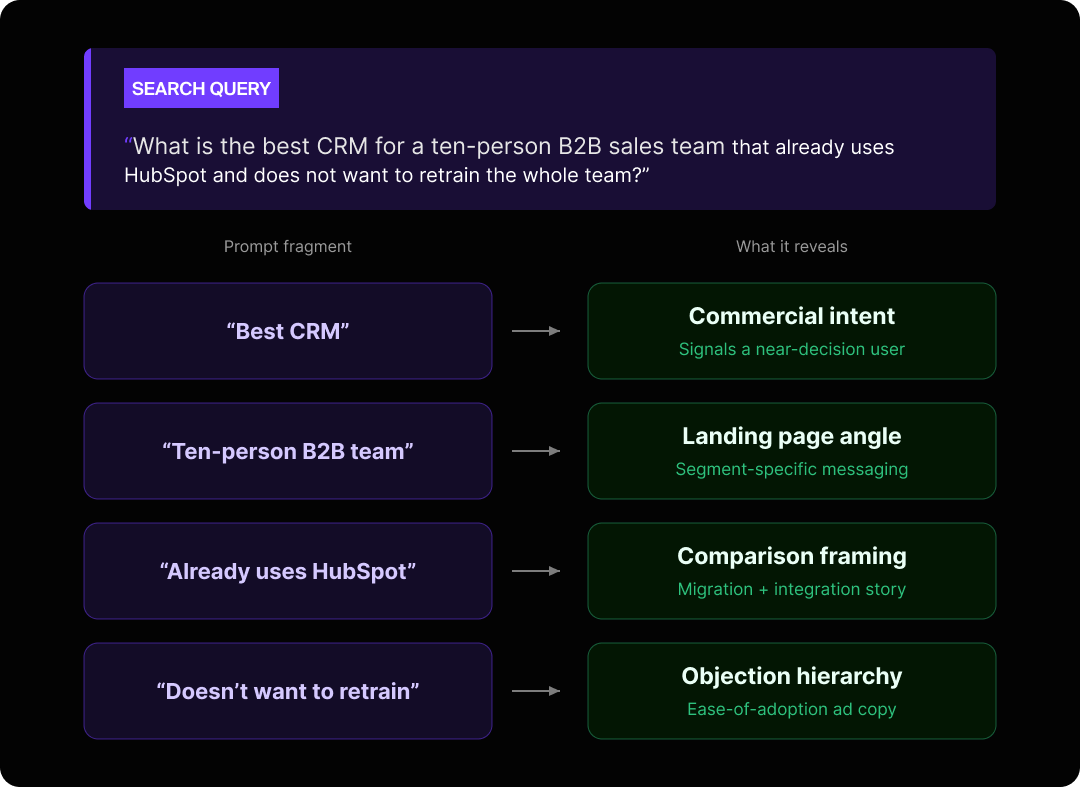
If you start systematically exploring how different user segments would phrase their search as a prompt, you uncover intent patterns that pure volume-based tools miss. The queries are longer. The competition is often lower. The commercial intent is frequently higher because the specificity signals a user who is closer to a decision, not just researching broadly.
I have been using this as a research layer on top of traditional keyword work. I will take a core category, explore it through how someone would prompt an AI tool to answer their question, map that to long-tail variations, and then cross-reference search volume. A decent portion of the terms that come out of that process have workable volume, low competition, and conversion rates that outperform the high-volume head terms because the alignment between query and page is much tighter.
Let me be clear: this is not a replacement for Ahrefs or traditional SEM research. It is an additional lens that reflects how people are actually thinking about their problem, which is increasingly the same way they are searching for it.
AI Max Is Coming to the Rescue
AI Max is not just an evolution of Broad Match. It is a structural shift from matching queries to matching intent. The system is trying to understand what the user actually wants, not just what they typed. And the signals it uses to do that are what determine whether it gets that right or not:
- Your creative assets
- Landing page content
- Feed data
- Historical conversion patterns
- Audience signals
This is where a lot of campaigns are running into problems right now. The targeting flexibility is genuinely powerful. But if your signals are weak, if your creative is generic, if your landing page does not clearly answer the intent, your feed is thin or inconsistent, the system does not have enough quality information to work with. It fills in the gaps on its own. And that is when you start seeing spend go to places that are difficult to explain in a performance review.
I have managed accounts where AI Max delivered strong efficiency gains, and others where it required significant guardrails before it stopped bleeding into irrelevant intent clusters. The difference was almost always the signal quality going in:
- The accounts with clean creative, tight landing page alignment, and well-structured feed data gave the system enough to work with.
- The accounts where creative was recycled, pages were generic, and the feed was an afterthought created noise that was hard to pull back from without restructuring the foundation.
| Strong Signals In: Efficient Scaling (matches intent) | Weak Signals In: Spend Bleeds (system fills the gaps itself) |
| Clean, differentiated creative | Recycled, generic creative |
| Landing pages aligned to intent | Generic, unfocused landing pages |
| Structured, consistent feed data | Thin or inconsistent feed data |
It was a smart move from Google Ads, building on the semantic understanding already baked into Broad Match and layering in search history and user behavior signals to better capture intent as queries and customer journeys grew more complex.
How Does AEO Make Your SEM Strategy Sharper?
Answer Engine Optimization (AEO) is the practice of structuring content so AI answer engines like ChatGPT, Gemini, and AI Overviews can retrieve, cite, and surface it.
This is where it all comes together, and why I think AEO is not a separate discipline from SEM. It is a framework that makes your SEM sharper if you let it.
When you understand how answer engines retrieve and surface content, you start to see the pattern behind what actually performs. A landing page that directly answers a specific question outperforms one that lists features, not just for organic visibility, but for paid conversion, too. The reason is the same in both cases: intent alignment. The user had a question. The page answered it. The next step became obvious.
Long-tail, intent-rich keywords convert better at lower volume for the same reason answer engines cite specific, structured content over generic overviews. The specificity signals relevance. And relevance, whether measured by a retrieval system or by a user deciding whether to fill out a form, is what drives the outcome.
The signals you build for AEO are the same signals that make AI Max work better, that make your landing pages more efficient, and that help you identify keyword opportunities your competitors are not seeing yet:
- Clear entity structure
- Direct answers to specific questions
- Content that matches how people actually phrase their intent
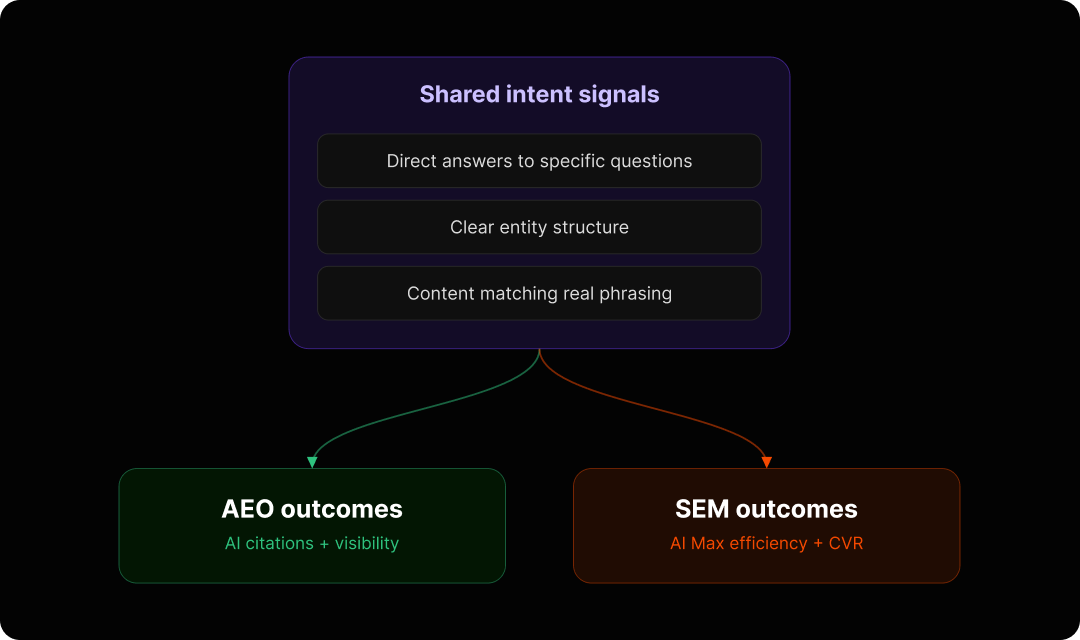
It is not a coincidence. It is the same underlying shift. Search is becoming less about matching strings and more about understanding intent. AEO is just the version of that conversation that has been most explicit about naming it.
ChatGPT Ads Logic Is the Future
Have you used ChatGPT Ads yet? Honestly, across the accounts I’ve tested it on, it still needs more maturity (in terms of ad customization, Martech, analytics, and even the overall experience).
However, what caught my attention is how you provide context for the ads…
Here’s my read. All search-based platforms will converge on this model: you provide context and topics, not keywords, and the system matches intent. Bleed will happen while models calibrate to your account, but the addressable volume will be significantly larger and far more flexible than keyword targeting allows.
What Should Growth Marketers Do About the Intent Shift?
The mechanics of SEM have not disappeared. Bids, structure, negative lists, match type discipline… they still matter. But the logic underneath has shifted. It is less about controlling which queries trigger your ad, and more about whether the intent your ad reaches is the intent your product actually serves.
I do not think most GMMs have fully sat with that shift yet. I am still working through parts of it myself. There are accounts where I am more confident in the signal architecture than others. There are optimization decisions I still make manually because I do not trust the automated layer to hold the strategic context that changes what a keyword is worth.
What I do know is that the search landscape is not moving back toward simplicity. The query is no longer the primary unit of meaning. Intent is. And intent now lives across platforms, surfaces through prompts, and gets processed by systems that are looking at everything you send them, not just the keyword you selected.
The question worth asking is whether your SEM strategy is built around that reality, or still optimized for a version of search that has quietly become the minority.
How AEO Affects SEM: FAQs
How does AEO affect SEM and paid search?
AEO and SEM are converging around the same principle: intent alignment. Landing pages that directly answer specific questions improve both AI citation potential and paid conversion rates, and the structured, intent-matched content that answer engines favor also gives AI-driven campaign types like AI Max stronger signals to work with.
Is broad match worth using in Google Ads now?
Yes, with the right setup. Broad match is intent-based rather than literal, so it performs best in accounts with strong conversion data, negative keyword lists, and time to learn. Given quality signals and runway, it’s frequently the top-performing match type in mature accounts.
What is AI Max in Google Ads?
AI Max is a suite of targeting and creative enhancements for Search campaigns that matches ads to user intent rather than literal queries. It relies on your creative assets, landing pages, feed data, and conversion history, meaning signal quality, not keyword selection, determines performance.
How do LLMs change keyword research?
People prompt AI tools in full, context-rich sentences, revealing intent that volume-based keyword tools miss. Exploring how different segments would phrase their problem as a prompt uncovers long-tail terms with lower competition and higher commercial intent, which can then be cross-referenced against traditional search volume data.
Do ChatGPT Ads use keywords?
No. Advertisers provide context and topics rather than keyword lists, and the system matches ads to conversational intent. This context-based model is likely the direction all search advertising platforms are converging toward, trading keyword-level control for larger, more flexible addressable volume.