

Walk into any Equinox, line up at the start of a local 5K, or scroll through your For You page, and you’ll spot it: the WHOOP band. It’s on the wrists of both Olympic swimmers and people just beginning their fitness journey.
WHOOP’s marketing strategy started with a laser focus on one audience: the elite athlete. The kind of person who obsesses over recovery windows, tracks HRV before a training block, and considers sleep a non-negotiable part of their performance plan. But somewhere along the way, something interesting happened. Everyday people started seeing themselves in that description, too. Not necessarily because they’re training for the Olympics, but because they want to be the kind of person who does. Catering to that feeling is the real story behind WHOOP’s winning social media marketing strategy.
While you might think that a brand positioning themselves to such a high standard of athletic performance would set them back, it actually had the opposite effect. WHOOP built a brand identity so aspirational and grounded in real performance science that it inspires everyday people to see what they’re capable of.
People view WHOOP as the device that will help unlock their potential. With WHOOP, they can achieve anything; who knows, they might just discover there’s been an elite athlete hiding inside them all along. That’s where I see WHOOP’s true power. In hope. Helping people believe that within all of us lives a better and stronger version of ourselves that they can help extract.
Whether you’re a college student pulling all-nighters, a 40-year-old trying to get their sleep score up, or a weekend cyclist who takes their training block more seriously than their day job, WHOOP makes room for all of them without ever losing the thread back to elite performance.
Now valued at $10.1 billion, WHOOP is no longer the scrappy underdog in a market dominated by Apple and Garmin. It’s a category leader, and its marketing playbook is worth dissecting. Without further ado, let’s take a closer look.
How WHOOP Got So Popular: The Origin Story
WHOOP’s story starts in 2012. Will Ahmed, a young student athlete on the squash team at Harvard University, was actively looking to improve his health but felt like he was lacking the right data and insights to reach his peak performance. Like a lot of athletes, he struggled to strike a balance between training volume and recovery to achieve the best possible results. This personal experience of struggle is exactly what sparked his idea to develop WHOOP.
Ahmed enlisted two fellow Harvard students to bring his vision to life: John Capodilupo, who brought the software development expertise to the table, and Aurelian Nicolae, whose materials science experience could drive the hardware strategy. Together, they set out to build a wristable that took personal health insights beyond the conventional heart rate and step count measurement. Instead, WHOOP set out to focus on metrics that helped track recovery, strain, and sleep, the three pillars Ahmed considered foundational for performance improvements.
Developed by an athlete, for athletes, WHOOP stood out from competition from the get-go thanks to its precise, targeted focus on a core audience persona. Unlike other wearables designed with casual users in mind, WHOOP was clearly designed for elite athletes who required precision in the insights they got. This key differentiation set the tone for everything WHOOP’s marketing strategy would achieve in the years to come.
It’s important to also note how the timing of WHOOP’s emergence has contributed to the brand’s rapid growth. For one, the global fitness tracking and wellness market has evolved steadily over the course of WHOOP’s lifespan, projected to reach $77 to $95B in valuation in 2026 alone. This number is projected to reach $176.77 billion by 2030, building on the growing public awareness of the value of health management and optimization. With the tech getting more advanced and the public focusing on mental and physical wellbeing increasingly more after the COVID-19 pandemic, wearable technology has seen exponentially increased demand and will continue to grow well into the next decade.
5 Lessons from WHOOP’s Marketing Strategy
If you look closely, WHOOP’s marketing strategy breaks down into five key moves. Let’s explore how each of these intentional choices helped make WHOOP a category-leading brand.
1. Get Specific on Your Ideal Customer Profile
WHOOP cut through the noise in the wearable market industry by focusing on a very specific persona: the elite athlete. The brand’s strategy from day one has relied on the fact that the data the product provides is not average, and it’s okay if it’s not meant for the average consumer; it’s part of the allure. The bar is set high, and the expectation is that their ideal customer is the kind of person who wants to rise to meet it.
From the outside looking in, WHOOP did something many startups struggle to do in their early years: they said no. No to expanding their audience, no to softening their positioning, no to the kind of growth that looks good on a slide deck but slowly dilutes what makes a brand worth paying attention to. WHOOP essentially put all of their eggs in one basket, which is a big gamble for any early-stage brand.
Going after an athlete audience so early in their growth journey meant forgoing the resources to educate the non-athlete audience on the benefits and value of good sleep and recovery. By going deep on one target audience rather than casting a wide net, they reached the hyper-focused elite athletes that Fitbit, Apple, and Nike, all busy courting the mainstream consumer at that point, aren’t positioned to serve.
Even though the move was risky, WHOOP managed to build a community of power users ranging from Michael Phelps to Cristiano Ronaldo. And here’s what’s interesting about that roster: those names function like mirrors to WHOOP’s target audience, reflecting their aspirations back onto them. When everyday people saw their favorite athletes crediting WHOOP for their recovery and performance, they didn’t think “that’s not for me”, they realized “I want that too.” That aspirational pull is what makes WHOOP’s strategy so compelling.

2. Align Your Brand With the Right Spokespeople
If you choose elite athletes as your core audience, how do you partner with them on the record if they have exclusive contracts with legacy brands? Take it from WHOOP, there’s value in playing the long game.
Between 2012 and 2016, rather than chasing endorsement deals, they focused on delivering real value to star athletes and providing the exact insights they sought to improve their performance and the bet paid off. WHOOP became the official wearable of record for MLB and NFL players, as well as the Navy SEALs, without spending millions on formal brand deals. Instead, they earned their place on the wrists of tier-1 athletes by becoming an irreplaceable part of their training routines. At a time when most brands were leading with flashy campaigns and social stunts, WHOOP let the product do the talking first.
This set WHOOP up for success in 2015 when it officially became available to the public, and the spokesperson strategy has only gotten sharper since. Today, WHOOP’s roster reads like a who’s who of elite athletes: Cristiano Ronaldo, Lewis Hamilton, Charles LeClerc, Michael Phelps, Nelly Korda, and Rory McIlroy among others. Each athlete helps reinforce the brand’s stance on performance. However, the real genius of these partnerships goes beyond the names themselves. These are athletes who have built global fandoms around community, world-building, and legacy, and that cultural currency transfers immediately. Every time a world-class athlete credits WHOOP for their recovery or their sleep score, it sends a signal (subliminal or overt) to the everyday person scrolling past: if it works for them, imagine what it could do for me.

3. Develop a Breakout Content Strategy
For WHOOP, social media is only the front door. Before a potential customer ever clicks “shop now,” WHOOP’s social profile has already done the heavy lifting: building trust, establishing authority, and inviting viewers into their world. In a category where price creates a high barrier to entry, WHOOP’s social strategy is centered on making you feel like you belong in their community.
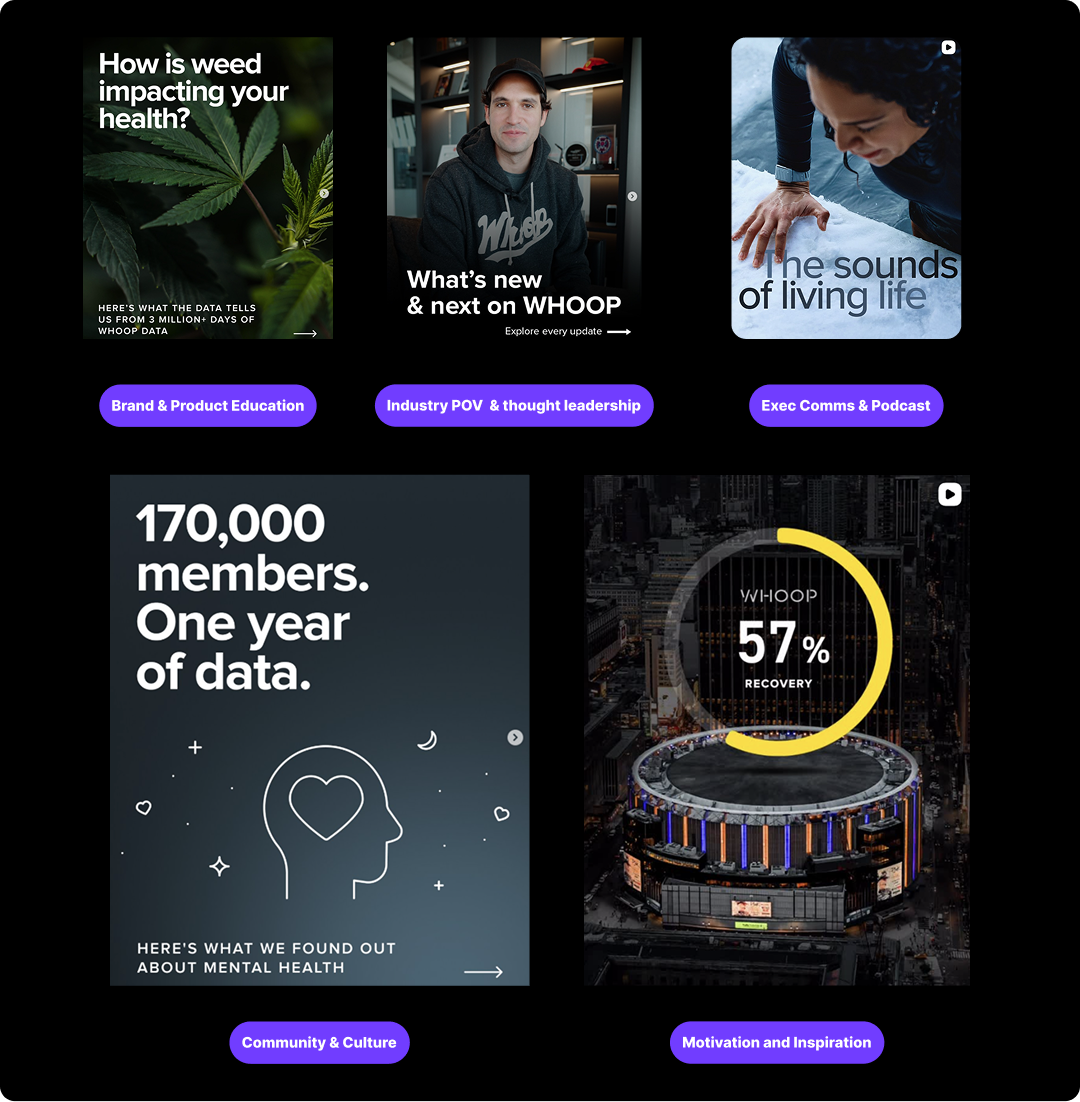
Their content breaks down into five clear pillars:
- Community & Culture. WHOOP keeps a strong pulse on how their users actually interact with the product by leveraging a community-led growth approach. Athlete spotlights, real UGC, and social-first formats create a feed that maintains a consistent brand positioning while showing they’re evolving with the current landscape.
- Brand & Product Education. Data stories, feature deep dives, and performance breakdowns show WHOOP in action. This is where the product sells itself, not through overly branded ads, but through content that you walk away from feeling like you learned something new.
- Industry POV & Thought Leadership. WHOOP tracks your performance and provides actionable insight on it, both on a personal and global scale. Their take on broader fitness and wellness trends shows their audience they’re in the know, positioning them as a credible voice in the industry.
- Motivation & Inspiration. Tied to seasonal moments and personal milestones, this pillar speaks directly to why people start their WHOOP journey in the first place. It’s the content that reminds you of your own potential.
- Exec Comms & Podcast. Will Ahmed is far from a silent founder. Between his own content and “The WHOOP Podcast,” which takes deeper dives into the science behind strain, recovery, and longevity, WHOOP has built trust and rapport with their audience by intentional founder-led communication.
4. Data: The Secret Sauce
The magic of WHOOP’s offering has always been its data: in-depth insights, actionable recommendations, and personalized snapshots of performance. It’s this data-driven focus that landed them the first milestone relationships early in their growth journey; now, it’s both the biggest selling point and a major pillar in their content strategy.
A large portion of their social content incorporates proprietary data stories that translate interesting insights into captivating content, providing educational value to both WHOOP users and colder audiences. Think Spotify Wrapped, but for your body. The data stories the brand shares reflect the wide range of depth and timeliness WHOOP provides, from evergreen insights (data comparing members residing in Texas and New York since the start of the NBA playoffs) to timely cultural moments (what #offcampus characters data would look like if they wore WHOOP).
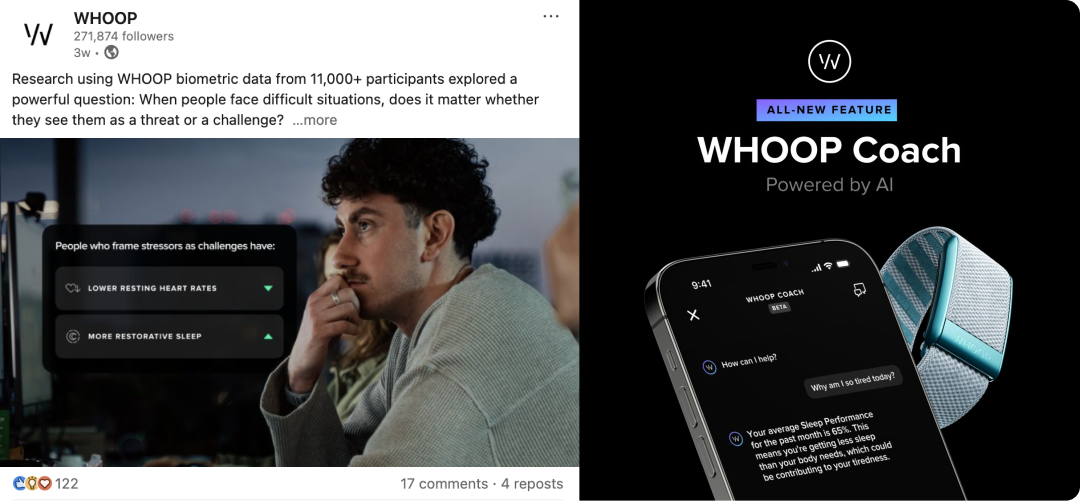
But where WHOOP has taken their data offering to the next level is with WHOOP Coach, their AI-powered feature that turns raw biometric data into personalized, conversational guidance. Instead of handing you a dashboard and wishing you luck, WHOOP Coach synthesizes your strain, recovery, and sleep data to give you specific, actionable recommendations in real time. It’s the difference between knowing your HRV dropped overnight and understanding what to do about it. For a brand that has always positioned itself as a performance coach first and a wearable second, WHOOP Coach is the natural evolution of that promise.
5. Get the Pricing Structure Right
There are a few things about WHOOP’s pricing strategy that make the brand stand out from their competitors.
First and foremost, WHOOP provides the hardware for free and charges users a monthly subscription fee for access to its analytics platform, a model they deliberately switched to in 2018. Unlike most wearables that rely on a one-time hardware purchase, the band is included in the membership at no additional cost, which immediately eases hesitation for anyone on the fence.
Here’s a snapshot of their pricing tiers:
| Tier | Key Features |
| WHOOP One | Core sleep, strain, and recovery insights |
| WHOOP Peak | Real-time stress monitor, health alerts, healthspan and pace of aging |
| WHOOP Life | Heart Screener with ECG, blood pressure insights, On-demand AFib Detection |
For the consumer, this lowers the barrier to entry significantly. Rather than dropping several hundred dollars upfront on a fitness tracker they’re not sure about, users can get started without a heavy financial commitment, making the product stickier and the decision to join easier. And once you’re in, the model has a compounding effect: the more you use WHOOP, the more results you see, and the more results you see, the harder you want to work. Hitting your goals is addictive, and WHOOP has built their entire pricing structure around that truth.
For WHOOP, the subscription model does something more interesting than generate recurring revenue. It keeps users locked into a relationship with their own data. Every month, your strain scores, recovery trends, and sleep patterns accumulate, creating a personal performance archive that becomes harder to walk away from over time. The longer you’re a member, the more valuable your data becomes, and the more invested you are in what it’s telling you. It’s truly a win-win situation for both WHOOP and their customers.

What WHOOP’s Marketing Strategy Teaches Every Growth Brand
WHOOP is a strong contender to continue scaling, challenging, and dominating the wearables market. As of 2026, the brand is more accessible through retail partners like Best Buy, Amazon, Dick’s Sporting Goods, the FSA Store, Target, and Walmart. In the U.S. WHOOP has also introduced a B2B enterprise offering, diversifying their model beyond B2C.
From a marketing perspective, WHOOP’s consistency is what makes their product-led growth strategy memorable. They built a brand that people want to be associated with, and then let that identity do the work across every touchpoint, from their spokesperson roster, content pillars, and pricing model.
Here’s a summary of the key moves that have brought WHOOP to their current success and will likely continue to drive the brand’s growth:
- WHOOP’s brand strategy: Niche down before scaling up. Going deep on one audience rather than casting a wide net is what allowed WHOOP to reach the people that bigger brands missed.
- WHOOP’s content marketing approach: Treat social like your front door. Before anyone clicks on your website, consumers are parsing through your social media and reading between the lines about what your brand is, does, and can offer them. You don’t have much time to spare so make sure your socials translate what you believe is core to your brand.
- WHOOP’s influencer marketing playbook: Choose spokespeople who build worlds. Partnerships transfers cultural weight to your brand, whether it’s positive or negative. Don’t rush the process; Be intentional with who you choose to be your brand ambassadors; after all, they’re the ones with an increasing share of voice. The last thing you want is a scandal that forever taints your narrative, all because of one influencer post gone wrong.
- WHOOP’s business model: Build pricing around behavior. The more your users engage, the more invested they become. If you can help it, design with that in mind.
Ready to Build a Marketing Strategy That Actually Scales?
WHOOP didn’t become a $10B brand by accident. They made deliberate, data-driven decisions at every stage of their growth. If you’re looking to apply the same level of strategic thinking to your brand’s marketing, NoGood can help.
From growth strategy and content marketing to influencer partnerships and performance analytics, we help brands find their unfair advantage and scale it.