

Imagine being able to sit in on Whitney Wolfe Herd’s Bumble pitches to college campuses and sorority houses; or watch Daniel Ek redesign how the world consumes music with Spotify in real-time; or even shadow Mike Cessario as he convinced retailers that a punk rock canned water called Liquid Death was the future with counter-culture marketing genius.
For decades, that kind of access was reserved for the inner circle: co-founders, early employees, investors, and maybe the odd journalist lucky enough to land the profile.
Not anymore.
Today’s founders and top executives are handing out front-row seats to their brains on LinkedIn; mini strategy sessions, digestible frameworks, personal failures, and hard-won lessons that once stayed locked in the “boardroom”. Across LinkedIn posts, newsletter drops, and personally-branded content, these leaders are building visibility and influence in ways that would have seemed impossible a decade ago.
Not only are they accessible, they’re actively inviting thousands of people into the room (their mind) where decisions get made.
But why now? Traditional B2B marketing channels are saturated and losing trust. Decision-makers are tuning out brand messaging and looking to people, not logos, to validate business relationships. Founder-led growth turns this shift into a strategic advantage, driving company ROI (inbound leads, brand credibility, talent attraction) while building personal equity that compounds over time. Yet most executives remain on the sidelines, unsure what to post, how often to show up, or whether the effort will actually move the needle.
This playbook breaks down what works, who should do it, and how to execute. By the end, you’ll know how to build a founder-led presence in your organization that earns trust, drives growth, and positions your talent as leaders people want to follow.
What Is Founder-Led Growth?
Founder-led growth happens when executives step out from behind the brand and become the brand’s most visible advocates. They share expertise, tell stories, spark conversations, and build trust through their personal presence. While this playbook takes you through steps primarily for LinkedIn content, Founder and Executive-led growth can appear in podcasts, keynote speeches, newsletters, Substacks or in front of the camera. The goal is simple: turn leadership into a strategic channel for awareness, credibility, and revenue.
This approach works because people connect with people, not logos. And right now, that human connection has never mattered more in business.
Are Founder-Led Companies More Successful?
The data suggests yes, but there’s always some nuance. Founder-led companies tend to outperform on key metrics like stock performance, long-term vision, and employee engagement. Research from Bain & Company found that founder-led companies in the S&P 500 delivered 3.1x better returns to shareholders than non-founder-led peers over a 15-year period. They’re also more likely to prioritize long-term value over short-term pressures, which creates sustainable competitive advantages.
But success doesn’t come from a founder or C-suite executive simply posting without intention and strategy. Leaders who actively engage with their audience, through thought leadership, social media, or direct customer interaction, build deeper trust, attract better talent, and create emotional resonance that traditional marketing can’t replicate.
In B2B especially, where trust and credibility drive purchasing decisions, a visible founder and/or top executive can be the difference between being considered and being overlooked. 75% of executives say they’re more likely to support vendors that consistently produce high-quality thought leadership, and founder-driven content is the most potent form of that leadership (Edelman-LinkedIn, 2025).
The Trust Economy: People Over Logos
We’ve been witnessing the erosion of trust across brands but trust in people has held strong. The shift is backed by hard numbers: 64% of decision-makers trust thought leadership content more than branded marketing materials and product sheets when assessing a company’s capabilities (Edelman-LinkedIn, 2025).
This trust advantage translates directly into performance, too. Content shared by executives sees 2x more engagement than brand content, meaning founder-led posts are not only trusted more, they’re interacted with more.
The 2025 data shows that decision-makers are actively seeking out leadership voices. 63% of business professionals now spend more than an hour per week consuming thought leadership content, nearly matching the engagement of primary buyers (Edelman-LinkedIn, 2025).
But the most compelling case for founder-led growth shows up in business outcomes:
- 71% of decision-makers say thought leadership is more effective than traditional marketing at demonstrating a vendor’s potential value.
- 75% of executives have explored products or services they weren’t considering after engaging with compelling thought leadership content.
- 79% of decision-makers are more likely to support proposals from vendors that consistently produce high-quality thought leadership (Edelman-LinkedIn, 2025).
All in all, the numbers don’t lie: thought leadership has moved from a “nice to have” to an essential infrastructure step in how relationships are built and deals get done.
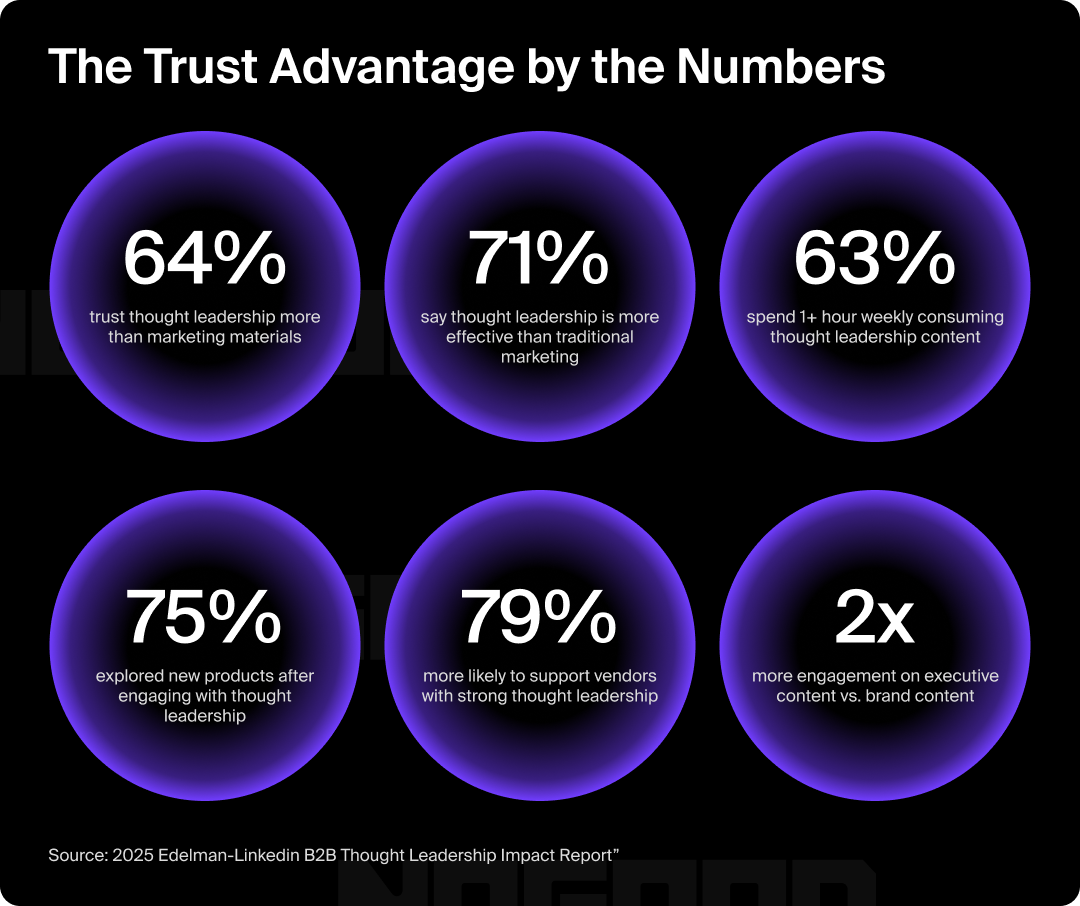
The math is simple: when founders and executives lead with the intention to educate visibly, they build belief, advocacy, and momentum. And belief drives business.
The Evolution of Thought Leadership
Thought leadership certainly hasn’t always looked like this. Two decades ago, executives waited for permission to share what they had to say: bylines in shrinking trade publications, quotes in Forbes if you were extremely lucky, maybe a speaking slot at the right industry conference.
But that was really only a reality for the top leaders working at the top 5% of companies. The strategy was ultimately one of brand recognition: get your name in print and hope that someone notices.
Free social media access flipped that system on its head. Platforms evolved, barriers dropped, and suddenly executives didn’t have to deal with gatekeeping media outlets anymore. They could speak directly to their audience, build a following, and create momentum on their own terms.
Here’s how we got here:
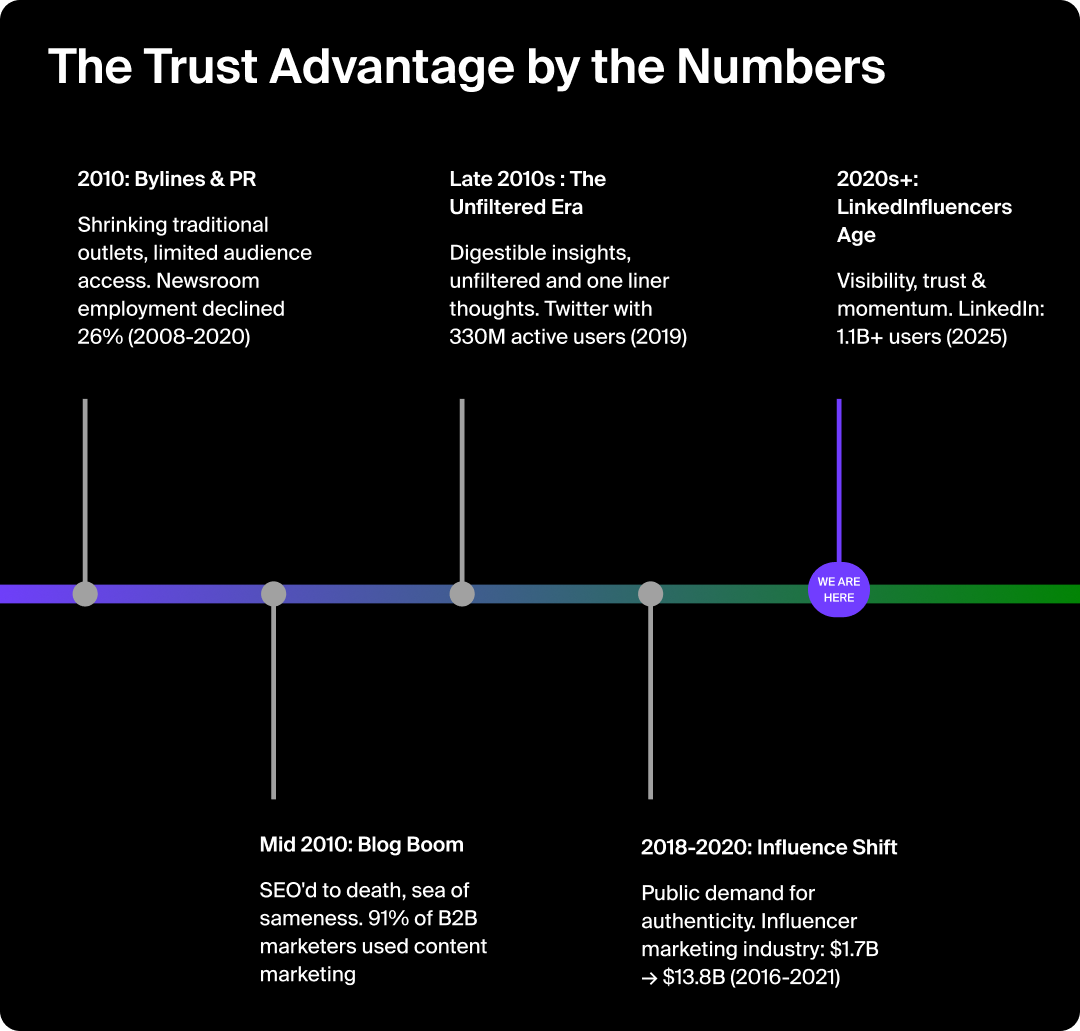
This evolution tells us something important: thought leadership moved from scarcity (who gets published) to abundance (everyone has a blog) to chaos (opinion noise) to strategy (LinkedIn as the professional megaphone). The executives marketing their organization (and elevating their personal career) are showing up with intention, consistency, and a point of view that cuts through the fluff. LinkedIn gives the infrastructure, but the leaders who actually break through bring substance.
What Founder-Led Content Actually Drives
The case for founder-led growth shows up in two areas: business support and executive equity. Both value streams compound over time, and when they’re an intentional investment and working together, the ROI is undeniable.
On the company side, executive content:
- Drives 2x more engagement than brand channels
- Attracts inbound from press, partners, talent, and investors
- Builds top-of-funnel momentum
- Makes the brand human
As is the case with many marketing disciplines in the mid 2020s, people trust people, not logos.
On the executive side, visibility opens doors to sales, capital, and advisory opportunities. It grows high-trust reach through personal networks and future-proofs influence across companies and careers.
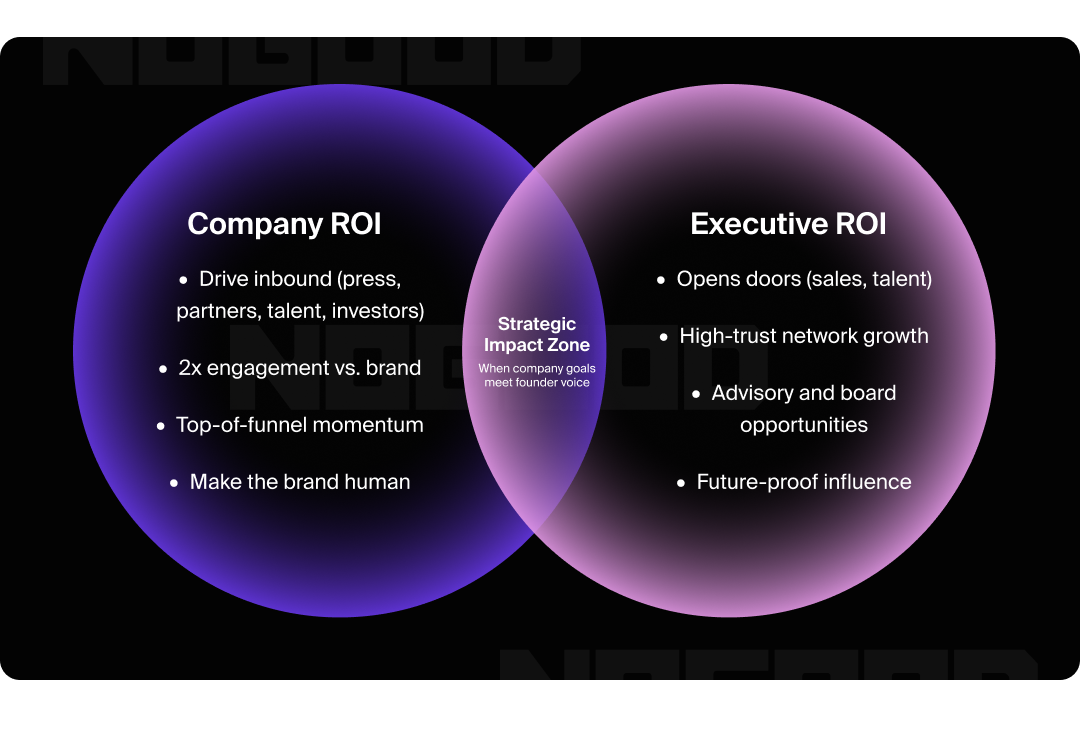
The sweet spot happens within the overlap: when company goals meet founder voice. Here, your return is a strategic asset that keeps driving visibility, trust, and velocity.
So, Which Founders & Executives Should Lead? The 3-Part Formula
Let’s be honest: not every person has rhythm, most shouldn’t act, and very few have the discipline to become elite athletes. We accept this as truth in every other domain, that certain abilities require specific combinations of talent, training, and circumstance.
The same can be said in this particular case. Not every founder or executive should be pushed into the spotlight. Force the wrong person into this role, and all that you’ve created is corporate theater: overly polished, hollow content that sounds like it was written by a committee and had no trouble getting approved by legal.
For someone to succeed with thought leadership on LinkedIn, three conditions must align:
Condition 1: Start With Conviction
The executive needs relevant, credible ideas and a strong point of view worth hearing. Public conviction fuels growth.
When someone has spent years in the trenches of their industry, they’ve accumulated perspective on what’s broken, what’s changing, and where the opportunities hide. That lived experience translates into thoughtful, opinionated content that draws the right audience in.
Generic corporate speak about “embracing innovation” or “being customer obsessed” will not cut it. People can smell that stiffness from a mile away.
Condition 2: Validate the Audience
Brilliant content dies in an empty room. Before committing resources, check whether the executive’s network actually includes the people who matter.
Search for customers, partners, potential hires, industry peers that are already within their network. And crucially, are those people active on LinkedIn? If your ideal audience lives on Reddit or in niche Slack communities, LinkedIn thought leadership becomes a vanity project. The platform has to match the people you’re trying to reach.
Condition 3: Commit to Resources
This is the step most companies underestimate. Whether you’re a massive tech brand or a small B2C startup, pooling in the right executive assistants, program POCs and carving out genuine time in everyone’s schedule to focus on social media is what makes or breaks your investment.
Founder-led content doesn’t scale in a silo. One executive posting sporadically between big industry events won’t move the needle. Real impact requires time, testing, collaboration with internal teams, and sustained effort over months. Without that commitment, and without a content strategist who knows each voice, a designer who can create scroll-stopping data visuals, and a calendar that treats this like the growth channel it is, the whole effort fizzles out after a couple months of mediocre material.
Get all three of these pillars right and you’ve found your voice in the market. Miss even one, and you’re performing thought leadership instead of practicing it.
Finding Your Angle: 4 Strategic Content Pillars & How To Execute
Before you panic about what to post, start here. These aren’t revolutionary content buckets, however, they’re foundational pillars that work across industries because they answer the basic questions that audiences actually care about:
- What are you building?
- Who are you building it with?
- Where is the industry headed?
- Who are you as a person?
Think of these as the scaffolding for your founder-led growth strategy. The specifics will shift based on your industry, your executive’s expertise, what they care about, and what your audience needs to hear. But the structure holds:
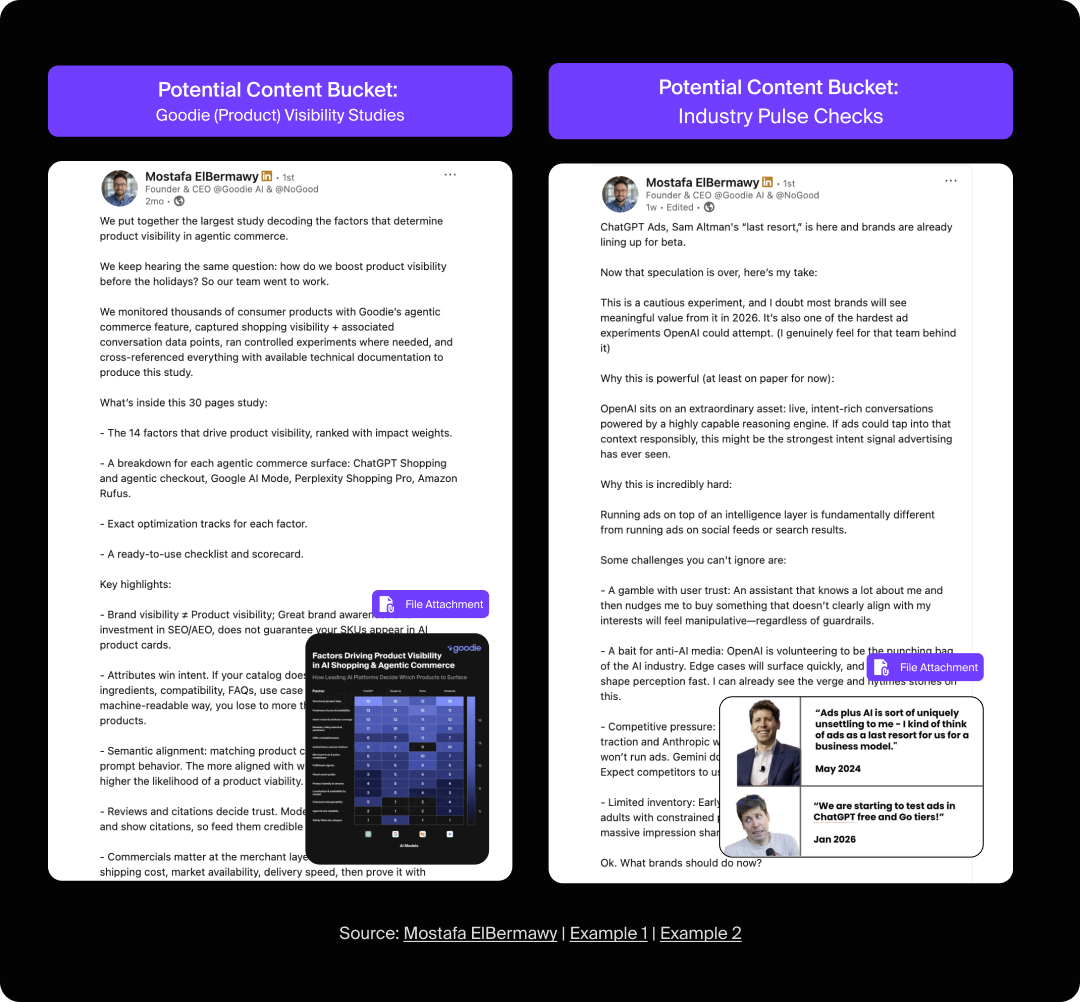
- Partner Stories: Feature major, new, or prioritized partnerships and timely launches to show how the company and industry leaders drive real-world impact together.
- [Company/Industry] POV or Difference: Demonstrate how the organization’s offering drives real-world impact, spotlighting real use cases of innovation that empowers teams and transforms industries.
- Industry Trends: Lead the conversation on what’s next. Become the go-to source for emerging industry and market shifts, positioning leaders as authoritative voices.
- Personal POVs: Share raw, genuine stories of career challenges, growth, and how personal and professional life intertwine to build trust and relatability.
How To Execute Content Pillars In The Wild
Case Study: The Jolyon Varley Model
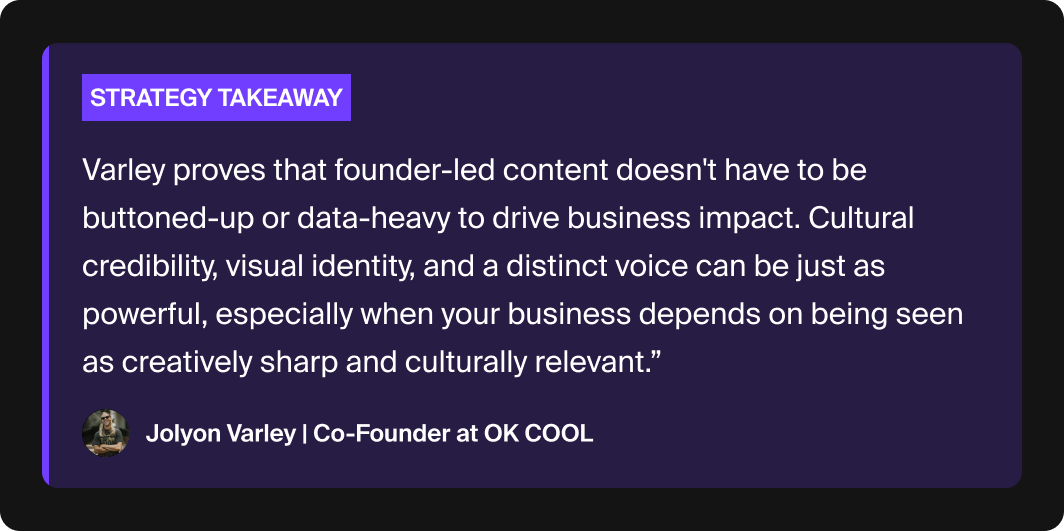
The above example is data-driven authority; this is culturally fluent creativity. Jolyon Varley, Co-Founder at OK COOL, represents a completely different approach to founder-led content: one built on cultural commentary, visual identity, and unfiltered opinions about what brands are getting right (or spectacularly wrong).
His Content Architecture: Varley’s posts read like you’re getting a beer with someone who deeply understands brand strategy, but refuses to sound like a consultant. He’ll dissect why Gen Z’s hyped BuzzBallz handbags sold out in 40 seconds, or why a household name brand’s latest campaign missed the mark.
His profile is immediately recognizable: neon green callouts (aligned with his agency’s creative branding), bold visuals, and case study carousels that look like editorial features. That visual consistency makes his content skimmable and shareable.
Let’s break down Varley’s four perceived content themes:
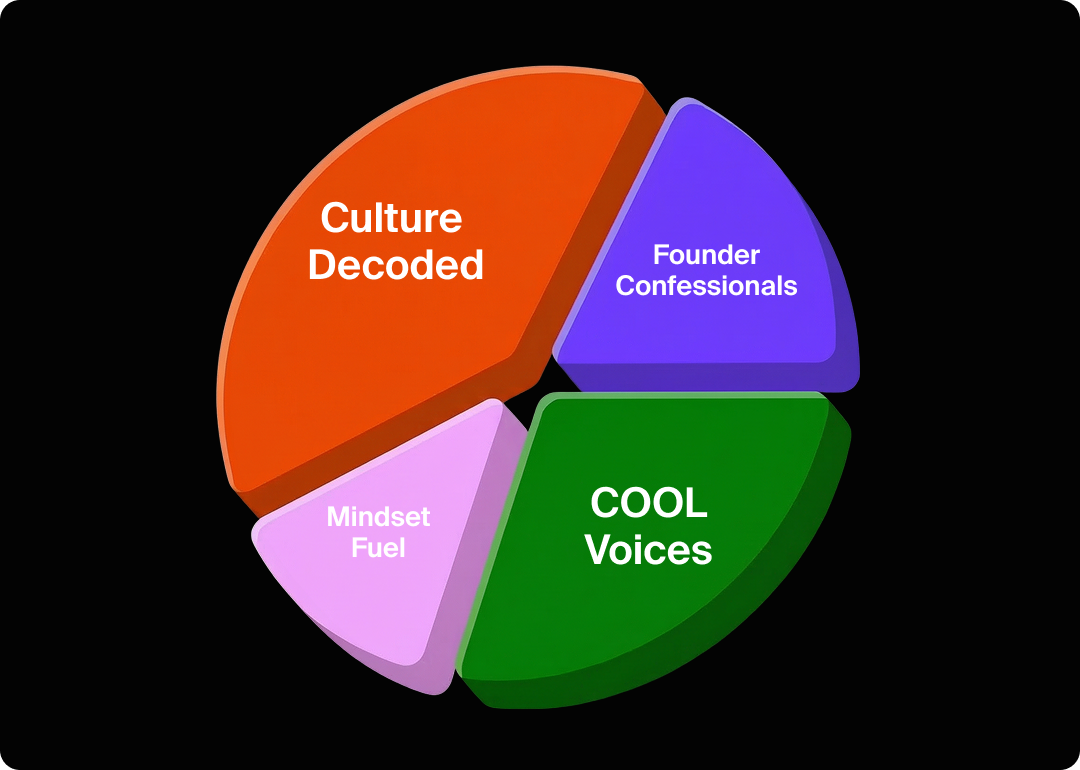
- Culture Decoded: Dissecting what’s happening now. Weighing in on standout brand moments, trends, and culture wins (or flops). This positions him as someone who reads the room and shares his opinion faster than most marketers.
- Founder Confessionals: Pulls back the curtain on how things are built. Lessons from the trenches, pivots, and innovation stories that showcase leadership and impact. This humanizes the agency and shows he’s building, not just advising.
- COOL Voices: Amplifies agency employee voices, celebrates wins, spotlights team culture. Positions employees as credible thought leaders shaping the future of work, tech, and culture. This builds OK COOL’s reputation as a place where smart people want to work.
- Mindset Fuel: Shares punchy, thought-provoking quotes (both personal and curated) that motivate, challenge conventional thinking, and reflect his mindset and energy as a creative leader.
Why He Cuts Through the Noise
Varley is unfiltered and unapologetically creative. His delivery has an edge, sharp wit, cultural fluency, and a willingness to call out mediocrity. He’s not trying to be safe. He acts as a culture translator with a strong POV, which makes him valuable to brands trying to figure out what Gen Z actually responds to or why their latest campaign flopped on TikTok.
Most importantly, he owns a visually branded presence that actually makes you want to follow along. In a sea of generic LinkedIn posts with stock photos and corporate jargon, his feed feels like a creator channel you’d actually follow.
How To Get Started: Building The Muscle
I get it. The leaders you’ve chosen are clearly smart: experts in GenAI, FinTech, whatever their domain may be. But just because someone can architect a go-to-market strategy or explain transformer models, doesn’t mean they know what’s going to land with their audience on LinkedIn.
Here’s what happens: leaders branching out to become content creators can often get hyperfixated on what they care about deeply. And yes, the intention and authenticity matter. But they can get too microscopic with their ideas. When you’re deep in the weeds of your expertise, it’s easy to forget that your audience might be wrestling with questions or pain points that you moved past long ago.
This content should showcase your expertise and your organization’s strength, but it also needs to educate the people who look up to you. Offer free value and insight. Answer the questions people are actually in desperate need or simply curious about, not just the ones you find intellectually interesting. That’s what makes people listen, follow, engage, and eventually come back for more of what you or your company offers.
Launching with a rigid or overly specific content strategy before you know what works is often the biggest beginner mistake.
The First Month: A Discovery Mindset
Month One is discovery, not performance. You’re testing formats, hooks, tones, and figuring out what resonates with your specific audience before locking into any rhythm. Post a text-only reflection one week. Try a carousel breaking down a framework the next. Record a 60-second video sharing a quick take on an industry shift. See what lands.
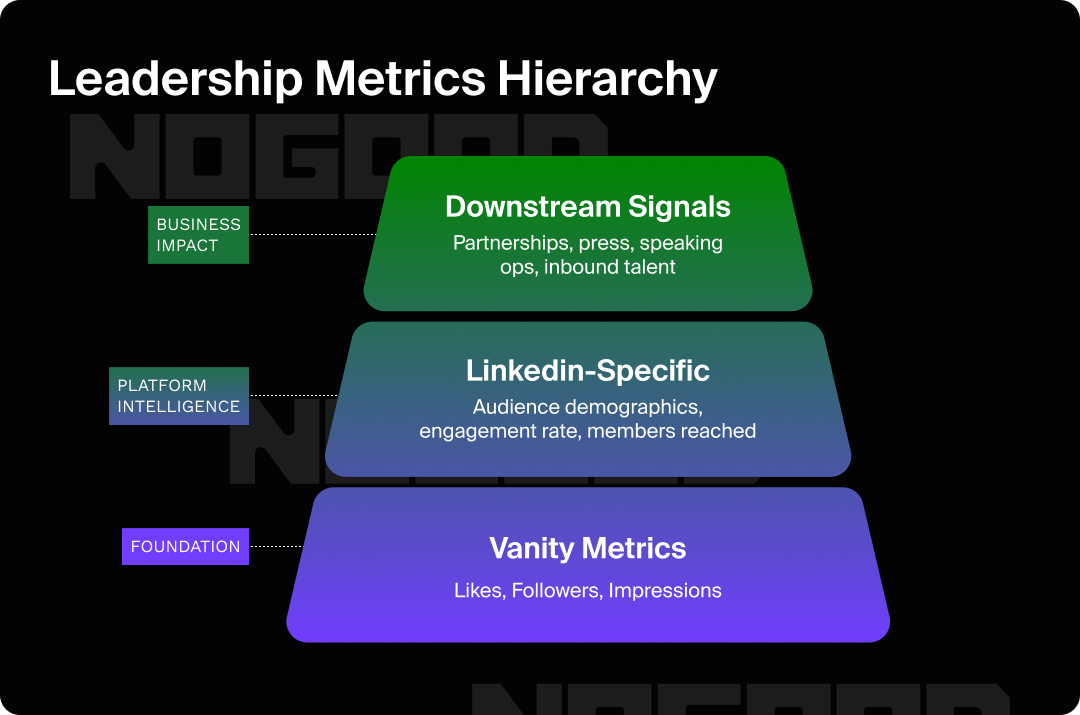
Pay attention to more than vanity metrics. Yes, track views, shares and comments, but also watch who’s engaging. Are you attracting the right people? Potential customers, industry peers, talent you’d want to hire? A post with 50 reactions from your target audience beats 500 from randos every time.
Identify your top three performers by the end of the month. What did they have in common? Was it the format, the topic, the tone, or the timing? Use that signal to inform what comes next. There’s no need to commit to a content factory yet, you’re learning what your voice sounds like when it actually connects.
Don’t overthink cadence at this stage. Posting once or twice a week with intention beats daily mediocrity. Build the muscle first, then increase frequency.
Next: Find Your Content Pillars
Once you’ve tested enough to know what resonates, build a content mix that shows range. The strongest founder-led content doesn’t stay in one lane; it pulls from multiple basic buckets:
- Strategic: Industry trends, company POVs, partnership stories, personal insights that position you as a forward-thinking leader.
- Evergreen: Crisis management philosophy, hiring approach, failure stories, work-life balance takes. These are the posts that people bookmark and reference months later.
- Opportunistic: Conference recaps, travel observations, team wins. Lighter, faster content that keeps you human and present.
The goal is balance. Too much strategic content and you sound like a think tank. Too much opportunistic content and you lose authority. The mix signals that you’re both a serious expert, and an actual person building and learning in real time.
DIY vs. Getting Support
You shouldn’t be operating in a silo. The most effective founder-led content involves collaboration with the people already around you: your organization’s marketing team, communication managers, executive assistants, or brand leads. Authorship exists on a spectrum from full ownership (you draft, edit, and post everything) to strategic partnership (you provide direction, key points, and final approval while your team handles structure, formatting, and execution).
Here are some other key things to keep in mind;
- When to bring in support: If consistency is slipping, quality is suffering, or you’re spending hours agonizing over a single sentence, it’s time. Your internal team can handle drafting, formatting, and scheduling, freeing you to focus on the ideas and final approval.
- If you don’t have internal resources, consider bringing in a content strategist or agency partner who understands social, Linkedin and a determination to nail your voice.
- Make it efficient: Use templates for recurring formats (weekly reflections, trend breakdowns, case study carousels). Build workflows that capture your voice in real time for easier thought dumps: voice memos, bulleted notes after events, Zoom transcriptions, Notes App entries of phrases you use often. It all counts and when working with support, the more information you can share with them the better.
- Protect the voice: The biggest risk with support is sounding generic or stiff. Quality assurance means reading everything before it goes live, cutting anything that doesn’t sound like you, and making sure the final product reflects how you actually think and speak. If your audience can’t tell the difference between a post you wrote solo and one you collaborated on, the system works.
Platform Mastery: Linkedin
LinkedIn rewards certain formats. Lean into them:
- Native articles work for deep dives. Use them for research findings, long-form case studies, or comprehensive frameworks that need more than a caption can hold. They signal authority and give people something to save and reference in their own work.
- Multi-image carousels are storytelling tools. Use them for step-by-step breakdowns, visual case studies, or data presentations. They perform well because they encourage people to swipe through, which signals engagement to the algorithm.
- Video clips get algorithmic favor however, still seem to be hit or miss depending on your following and audience demographics. Watch the performance of these closely, then refine and pivot if needed. A 60-90 second take on a huge industry headline, a quick behind-the-scenes moment from a massive conference, or thoughtful sentiment on a career milestone. Keep it simple (phone quality works if the insight is sharp).
- Strategic tagging matters for events and conferences. Tag speakers, partners or your team attendees to expand reach beyond your immediate network. It’s community-building and visibility in one move. Show your thanks to the people getting progress done.
The platform can often feel as complex as humans, but has preferences. Find them. Use them.
Don’t Underestimate The Power Of Commenting
Publishing content is only half the equation. To build real influence, treat engagement like a strategic practice, not an afterthought. If you’re not responding to comments on your own posts, engaging with other leaders’ content within your network on your feed, or participating in industry discussions, you’re leaving half the value on the table.
When someone comments on your post, respond with substance. Answer follow-up questions, acknowledge thoughtful pushback, continue the thread. This signals to the algorithm that your post is generating real conversation, which increases distribution. More importantly, it shows you’re actually present and interested in what people have to say about your thoughts, not just broadcasting.
When engaging with other’s posts, add value instead of defaulting to “Great post!” Build on their point with a related observation, share a concrete example from your experience, or provide a thoughtful opposing POV when you genuinely see things differently.
Tagging strategically matters here, too, as a way to bring other voices into conversations: colleagues with relevant experience, partners who contributed to a launch, industry peers whose perspective adds value. This creates community, increases engagement for everyone, and expands your reach beyond your immediate network.
Don’t think about engagement as polite; it’s strategic. It’s how you build relationships, establish credibility, and prove you’re an active participant in your industry’s conversations, not just a content vending machine.
Start Small, Then Scale
Don’t launch and expect to become an instant influencer. You won’t be fully formed right away. Focus on your momentum.
How to scale:
- Lock in voice and tone first. Before worrying about cadence, figure out how you sound. Are you analytical and data-driven? Conversational and story-led? Sharp and opinionated? Test a handful of posts until you find the tone that feels natural and resonates with your audience.
- Identify 3-5 key themes. These become your content pillars, the topics you’re known for. They should reflect your expertise, your company’s positioning, and what your audience actually needs to hear. Stick to them until they’re recognizable.
- Create an evergreen content series. Find a repeatable format that makes showing up easier: “Friday Founder Lessons,” “Monthly Market Moves,” “Behind the Product.” A signature series builds familiarity and gives people a reason to keep coming back.
- Build consistency, then increase frequency. Start with one strong post per week. Once that feels sustainable and you’re seeing traction, add a second. Posting daily with no strategy burns you out and dilutes your message. Two great posts a week beat seven mediocre ones every time.
Scale when the system works, not before.
What NOT to Do
Here’s what kills founder-led content faster than anything else:
- Faking it. People have advanced BS detectors these days. If you don’t believe what you’re saying, why would they?
- Sounding like a robot. If your post reads like a TED Talk script or Q2 earnings call, scrap it. Write how you talk.
- Showing up only for launches. Disappearing for months then popping up with a product announcement makes people tune out. You’re not a groundhog.
- Writing like a press release. If your post could’ve been written by your legal or PR team, start over. No one asked for corporate speak.
- Handing it all off to comms. Collaboration is fine. Outsourcing your entire voice is not. People can tell when someone else is writing under your name, and it’s weird.
- Overthinking it. If you’ve been staring at a draft for 45 minutes, you’re overthinking. You’re not Shakespeare. Have a few sleeps then try again.
- Oversharing. There’s a line between humanizing yourself and airing out your personal life. We’re here for insights, not your deeply personal family updates.
- Posting and ghosting. If you’re not engaging with comments, tagging thoughtfully, or responding to your audience, you’re missing half the value. LinkedIn rewards conversation, not broadcasting.
- Quitting after three posts. This isn’t paid ads where you see ROI in 48 hours. Thought leadership compounds over time. If your first few posts underperform, that’s normal. Adjust and keep going.
Inauthenticity, inconsistency, and impatience are the killers. Everything else is fixable.
How to Measure the Performance of Thought Leadership Content
Here’s where most programs stall: companies can’t prove the value of thought leadership because they’re measuring the wrong things. Trying to measure founder-led content the same way you would measure performance marketing, will not help your case (sidenote, check out our blog on how AI is changing Marketing Analytics).
Stakeholders want to see direct conversions, immediate pipeline impact, and attribution models that tie a LinkedIn post to closed revenue.
That’s not how this works.
Founder-led content is a brand and influence play. The metrics that matter are different from your standard marketing dashboard. You’re not measuring clicks or conversions in the traditional sense; you’re measuring influence, reach, and whether the right people are paying attention. Think of this as the top of your funnel, the trust-building layer that makes everything else easier downstream.
Organic Social Metrics (The Fundamentals)
- Reach and impressions (how far your content travels)
- Likes, comments, shares (surface-level engagement signals)
- Engagement rate (interactions relative to reach)
- Total followers and follower growth over time
- Total clicks and click-through rate (if linking externally)
- Drop-off rate (where you lose attention)
- Video completion rate (for video content)
LinkedIn-Specific Metrics (Audience Quality)
- Profile visitor and follower demographics: job function, seniority, industry, company size, location
- Members reached (actual distribution beyond your immediate network)
- Page views and unique visitors
- Custom button clicks and CTA performance
Employee Advocacy Metrics
- Employee engagement with company content (likes, shares, comments from your team)
- Amplified reach through employee networks
Downstream Impact Signals (The Real ROI)
- Inbound partnership conversations sparked by content
- Candidates mentioning your posts in interviews or applications
- Press inquiries tied to specific takes you shared
- Speaking invitations and advisory opportunities
- Investor or customer outreach referencing your LinkedIn presence
Long-Term Brand Lift (6+ Month Horizon)
- Brand search volume increases
- Profile view growth and quality of profile visitors
- Improvement in quality and volume of inbound opportunities
Engagement Quality Check (Most Important)
- Who is engaging? (Target customers, potential hires, investors, industry peers vs. random connections)
- Are comments substantive or just emoji reactions?
- Are the right people saving, sharing, and referencing your content?
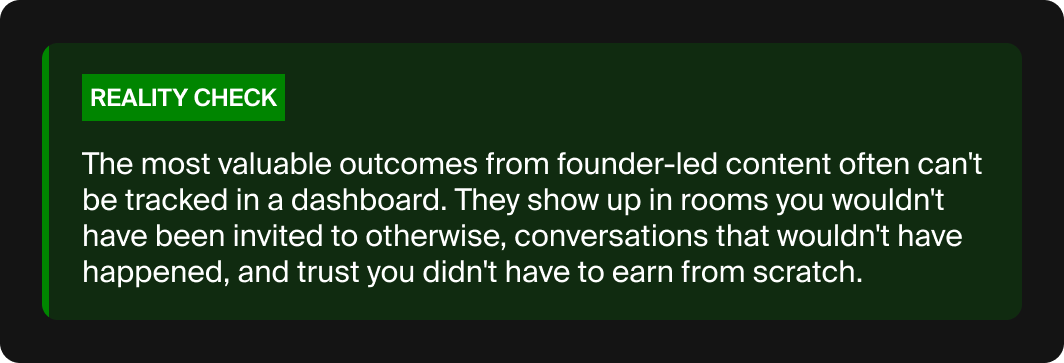
Measure what you can, but don’t mistake a lack of immediate attribution for a lack of impact. The strategy compounds over time, visibility builds trust, trust builds momentum, and momentum opens doors.
The Bottom Line on Founder-Led Growth
Founder and executive-led growth turns leaders from background operators into frontline storytellers. When company goals meet real voices in the strategic impact zone, you create content that builds trust, drives inbound, and positions the brand as human, credible, and culturally fluent.
This only works if you treat it like brand infrastructure, not a marketing tactic. The brands winning here are building content engines, complete with strategy, creative production, distribution plans, and measurement frameworks. They’re investing in personal branding, voice development, visual identity, and long-term consistency the same way they’d invest in product marketing.
If you’re ready to build that engine, now you know where to start.