

Before you jump on a trend because it’s “going viral,” please stop and think about it for a second. Good marketers move at the speed of culture, but moving at the speed of culture also means moving with strategy and intention toward a larger vision of cultural participation.
Being first to the moment means nothing when you don’t have clarity around which moments are actually yours to be part of.
The reason why every brand desperately wants to earn the highly coveted status of cultural relevance is because cultural currency cannot be replicated or manufactured.
- Organic social content can certainly be amplified with paid media spend, but the initial audience resonance cannot be bought.
- Virality is unpredictable, attention is fleeting, and audiences are increasingly becoming excellent judges of authenticity.
Earning cultural currency then starts with removing your ego, and coming to terms with the fact that brands are rarely the ones creating culture. Brands can respond to culture, but culture ultimately happens in communities, subcultures, niche groups, and social networks that exist mostly independent of your brand strategy. Your job is not to manufacture cultural moments, but to recognize which ones you can authentically participate in without disrupting the equilibrium that made them culturally valuable in the first place.
Cultural currency is earned through restraint as much as action. Being late to a trend is worse than not showing up at all, and the cost of being everywhere is being nowhere that matters. Respectfully: show up where you’re wanted, then earn the right to be relevant.
What Is Cultural Currency?
In simple terms, cultural currency is the permission that your audience grants you to participate in their world. It’s a liquid asset that can include many things, like accumulated trust from your target audience, a language of shared humor, or even more quantifiable measurements like brand sentiment or share of voice.
Reddit user @pheisenberg offers a useful individual-level definition: “cultural knowledge, performances, habits or demeanors that can be displayed to gain status, group membership, affection, influence, etc.”
For brands, this translates to whether you can demonstrate fluency in the codes, references, and values of the communities you’re trying to reach. It’s important to note that cultural currency takes on different forms based on the different communities it exists in. Entertainment and relatability works for some communities, while deep expertise works better for others. The brands with cultural currency have figured out what their specific audience considers valuable and consistently deliver it.
Let’s look at some examples: knowing a lot about Star Wars is cultural currency among Star Wars fans, or in a brand context, Reformation tapping into the Victoria Beckham drama in a cheeky email subject line is cultural currency amongst the Gen Z fashion and pop culture community.
To be truly in tune with the zeitgeist means understanding what people care about, what references resonate with them, and what social contexts shape their lives.

The Highsnobiety framework captures this dynamic well: “Coolness is unquantifiable, but a term that comes close is cultural currency, or, a knowledge that creates a perception around a product that elevates it beyond reductive notions of cost and quality. You can’t just buy cultural currency; it is earned and has an intrinsic value tied to perception.”
When a brand has cultural currency, people don’t evaluate you solely on features and pricing; they factor in what it means to be associated with you.
This is different from cultural capital, which refers to the knowledge, skills, and cultural experiences that individuals accumulate and leverage for social advantage. Cultural capital is personal; you build it through taste, education, and exposure. Cultural currency, by contrast, is relational and earned. It’s what happens when the distance between a brand and its audience collapses, measured on whether your audience believes you understand what they value beyond the product you’re selling.
If you’re not sure whether or not your brand has cultural currency, ask yourself if your audience would:
- Defend you when you’re criticized?
- Recommend you without being asked?
- Integrate you into how they express who they are?
If the answer is yes to any of those, you’ve built something more valuable than brand awareness; this is because cultural currency sets the difference between people knowing your brand exists, and people caring that it does.
Why Every Brand Wants Cultural Currency
Cultural currency fundamentally changes the economics of how brands operate. Brands with it benefit from a flywheel of organic distribution because their audience actively wants to engage with them, meaning that their content gets voluntarily shared in group chats, Reddit threads, Instagram Stories, etc.
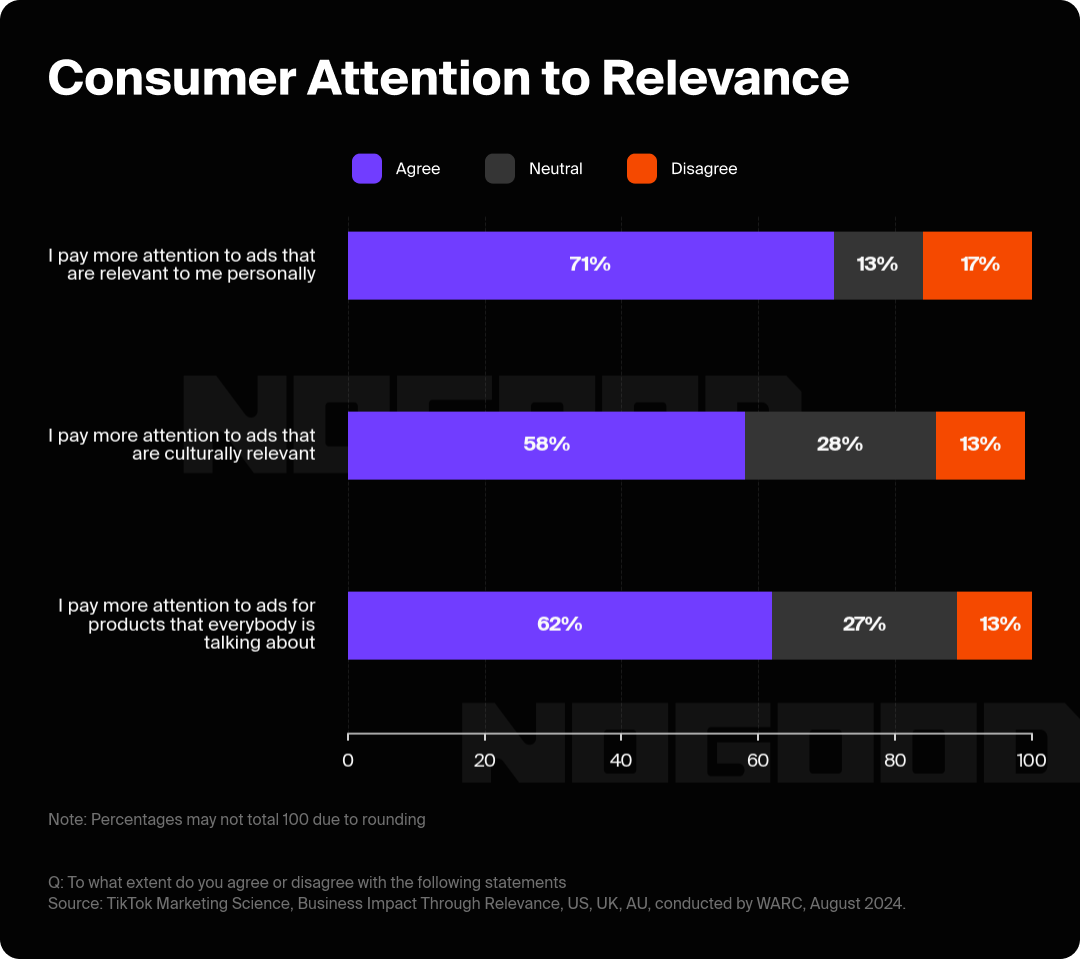
According to data from a TikTok Marketing Science report by WARC:
- Brands with high cultural relevance grow nearly 6x more than brands with low levels
- 71% of social and video platform users said their purchase likelihood would increase if the ads were personally relevant, and 58% felt the same if the ad was culturally relevant
Take Oura for example. The smart ring brand built cultural currency by creating a community that speaks a specific language: joking about readiness scores tanking after a night out, sharing relatable screenshots of sleep data, treating recovery metrics as both serious optimization tools and cultural memes.
Their social content walks the line between educational and entertaining, operating on two complementary frequencies simultaneously. On one level, they’re providing actionable health education about circadian rhythms, sleep stages, and HRV patterns. On another level, they’re speaking directly to the lived experience of being someone who tracks these things.
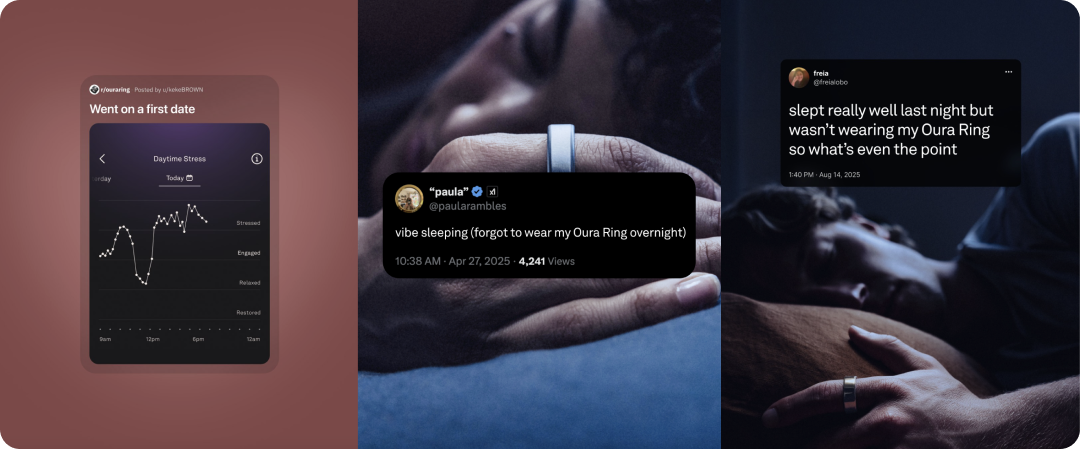
This is where the “IYKYK” dynamic becomes powerful. Oura’s content makes their audience feel seen in ways that generic wellness brands can’t replicate. This creates an in-group of people who speak Oura’s language, who understand the references, who get the inside jokes about “oh you had one drink” when your average sleep score decreases.
The brand then becomes a shared cultural reference point when people post about it online. Posting about your Oura Ring signals something: I take recovery seriously, I optimize intentionally, I’m part of a community that values data-driven self-improvement. Cultural currency translates directly into organic brand awareness, powered entirely by people who want to be associated with what the brand represents.
This kind of currency unlocks strategic flexibility and partnership opportunities that wouldn’t otherwise be so readily available. Cultural currency is what got Oura into collaborations with HBO for The Last of Us, with Paramount Plus for Mission: Impossible 8, and secured them the position as the official wearable for Team USA at the Olympics.
These partnerships identified a cultural fit that made sense because Oura had already established themselves as the wearable for people dedicated to performance and recovery. When elite athletes and fictional characters in high-stakes narratives are tied to the Oura Ring, it reinforces the brand’s positioning without feeling too much like an ad because it has the cultural currency to make sense within that context.

What makes cultural currency particularly valuable now is that traditional brand-building tactics have diminishing returns. Consumers are exhausted by being constantly advertised to, and they’ve developed sophisticated filters for what feels authentic versus what feels like a brand trying too hard.
Gen Z in particular has an extraordinary radar for performance versus participation. They can tell instantly when a brand is extracting value from a cultural moment instead of contributing to it, making it even more important for marketers to practice restraint and discernment when it comes to trend participation.
Traditionally, lifestyle brands in entertainment, fashion, and sport have been at the forefront of cultural participation (likely because it’s so much easier for them to tap into cultural spheres that are already adjacent to them). That being said, the desire for cultural currency should not be, and is not, limited to only lifestyle brands.
In fact, cultural currency matters just as much for the “unsexy” industries (B2B SaaS, Finance, Healthcare) because they can’t rely on any inherent aspiration or aesthetic appeal. Software and finance brands like Notion, Cash App, or Chase have to earn their cultural currency by demonstrating that they understand their audience’s frustrations and values beyond the product they’re selling.
Attention is the scarcest resource in marketing, and cultural currency is the most efficient way to earn it without having to rent it repeatedly. Picture showing up to a party where you have to introduce yourself to everyone, and then picture showing up to a party where people are genuinely excited that you’re there.
That difference is cultural currency, and every brand that understands the attention economy is trying to build it.
Value Generation Is the Prerequisite for Cultural Currency
Being the brand everyone wants to talk about comes with a price. The fee for maintaining that type of cultural currency is value generation, earned by consistently generating valuable content (branded or non-branded) that your audience actually wants to engage with. Brands that lead with entertainment, insight, utility, or shareability get rewarded with voluntary engagement and organic distribution.
This is why the most culturally fluent brands have stopped thinking like advertisers and more like publishers, creators, and storytellers. They understand that every piece of content is either adding value to the audience-brand relationship or withdrawing from it.
Notion understands this exchange rate better than most SaaS brands. Instead of pushing feature announcements or product demos, they’ve built an entire content ecosystem around showcasing how real people use Notion to bring their ideas to life:
Their Builders Series spotlights businesses like La Cabra Coffee, framing the story around La Cabra’s commitment to precision and intentionality rather than making it about the software itself. The content reads like a profile of a thoughtful brand scaling without losing its soul, with Notion positioned as the infrastructure enabling that vision.

This is an excellent example of value generation. The content is interesting whether or not you use Notion. It profiles a compelling business, explores how they maintain creative vision while scaling, and speaks to anyone who cares about craft, intentionality, and building something meaningful.
Notion’s product is relevant to the story, but the story isn’t an ad. The cultural currency comes from consistently creating content that their audience finds genuinely inspiring, useful, or thought-provoking. When creative professionals and startup teams share Notion content or advocate for the product, they are doing so to participate in a broader conversation about how to work better, think more clearly, and build systems that reflect personal values.
Value generation requires genuine generosity. You have to:
- Be willing to give away insights, entertainment, and utility without immediately demanding a transaction in return, even when there’s a real business outcome in mind.
- Trust that consistently showing up with something worth paying attention to will eventually translate into the cultural currency you seek.
This is uncomfortable for brands used to measuring every dollar spent against immediate ROI. Cultural currency compounds slowly, but it compounds reliably if you’re willing to play the long game and invest in brand world building.
The Trend Lifecycle & Game Theory in Action
Building cultural currency on organic social requires knowing which moments are yours to participate in, and which ones you should let pass. Not every trending sound, meme, or cultural reference is worth jumping on, lest you want to risk eroding cultural trust just for the sake of timeliness.
The appropriation of attention is so relentless that consumers have developed sophisticated filters for what feels authentic versus what feels extractive. Strategic selectivity matters more than speed, and restraint often signals a higher degree of cultural intelligence.
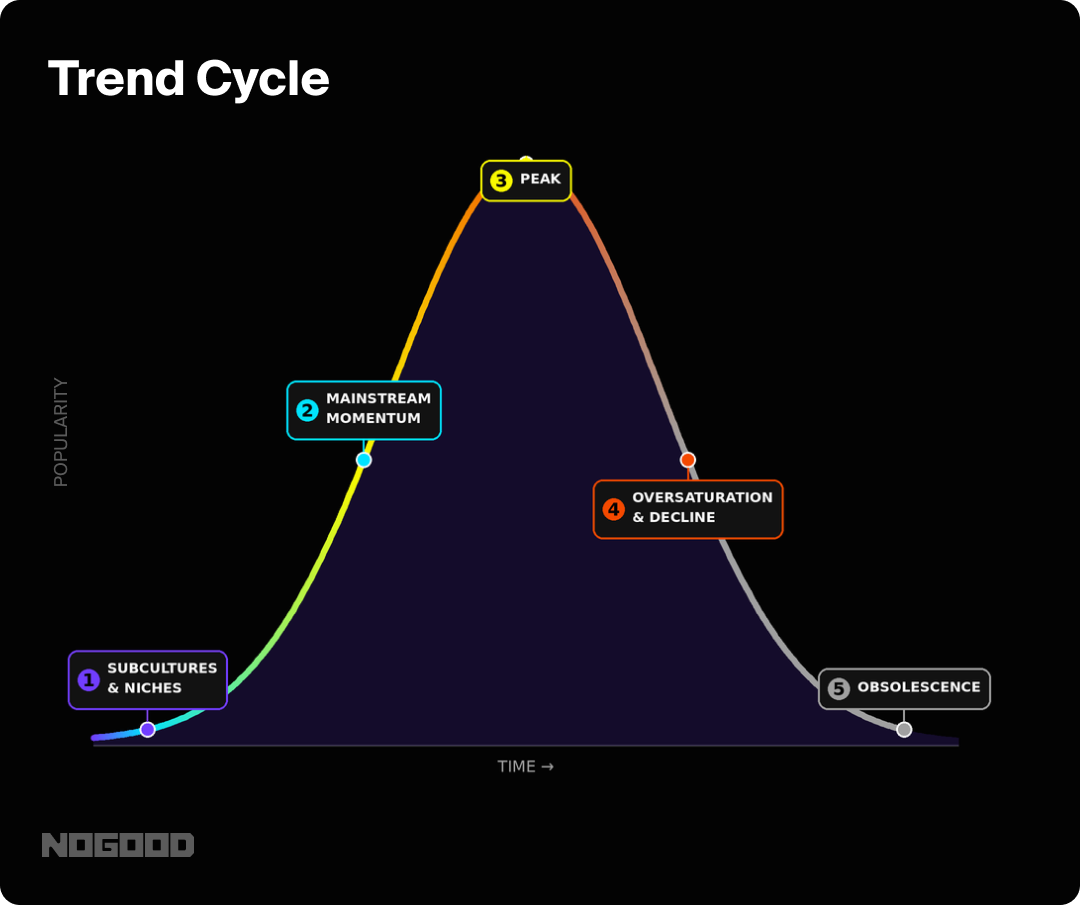
To help understand when it makes sense for your brand to participate in culture, we can take a look at the trend lifecycle and how culture moves through different subgroups. Trends generally move through predictable phases of rise and decline:
- They start in subcultures or niche communities where early adopters create something genuinely novel.
- The trend gains momentum as more people discover it and recognize its cultural value.
- Then brands notice. The first brand to participate often gets celebrated for being culturally aware and timely. The second brand might still land well.
- By the fifth or tenth brand jumping in, the trend has lost whatever made it culturally interesting in the first place.
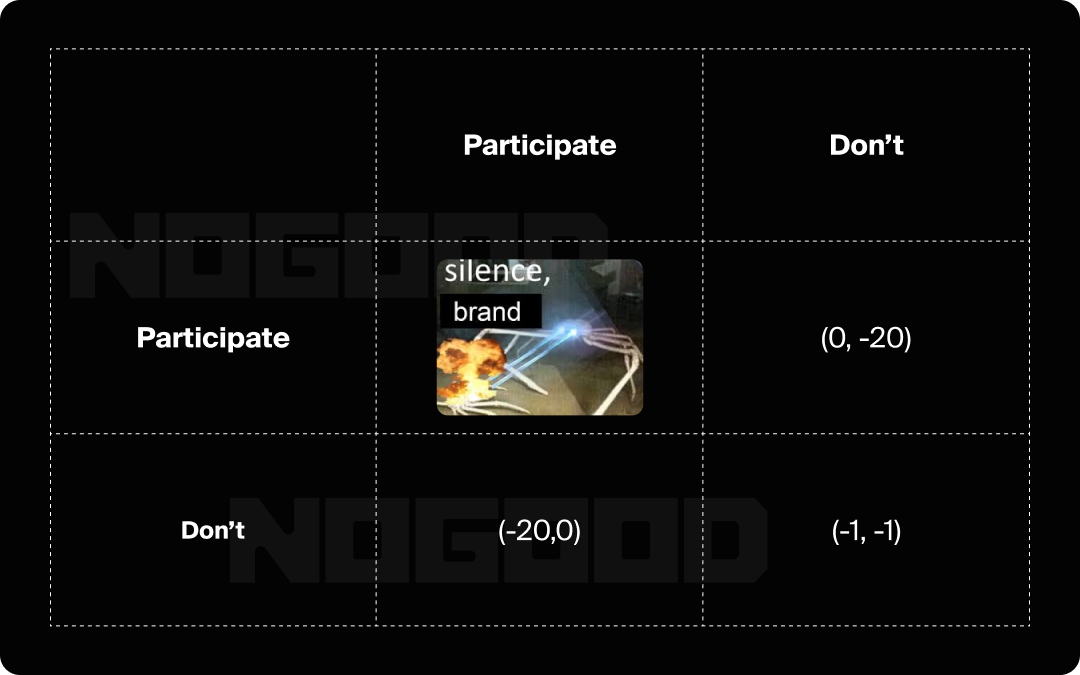
You can think about this in terms of game theory or the prisoner’s dilemma. When one brand does it, audiences find it fun (maybe even clever). When every brand does it, audiences feel exhausted and advertised to. The cultural value of a trend collapses the moment it becomes a vehicle for generating economic capital.
Audiences are acutely sensitive to this shift. Many can pinpoint the exact moment a trend stops being “theirs” and becomes co-opted by brands trying to extract attention. This is what gave rise to the “silence, brand” meme, where consumers are actively calling out brands for performative participation in cultural moments that have nothing to do with their products or values. The phrase became shorthand for collective fatigue with brands inserting themselves into conversations where they weren’t wanted or needed.
The message could not be more clear: your participation is not welcome, your presence is not adding value, and we can see through the attempt to capitalize on attention that wasn’t meant for you.
The meme also reflects a fundamental power shift that puts audiences in the driver’s seat of what does and doesn’t deserve attention. On social media in particular, users have developed the language and collective will to push back against intrusive marketing. “Silence, brand” represents consumers drawing boundaries and demanding that brands earn their place in conversations, rather than assuming they’re entitled to be there.
This is why being late to a trend is usually worse than not participating at all. When you show up after the cultural moment has peaked, you’re basically outing yourself as participating based on a delayed reaction rather than genuine cultural fluency. It comes off as scrambling to stay visible rather than having something meaningful to contribute.
This problem compounds when brands treat cultural participation as the entire strategy rather than a content pillar amongst others. If your entire social strategy revolves around hopping on trends, you’re not building cultural currency; you’re just reacting.
This is where value generation becomes the differentiator. If you’re going to participate in a cultural moment, you have to ask yourself:
- Are you adding value, entertainment, or insight? Or are you just adding noise?
- Are you contributing to the conversation in a way that makes it richer, or are you diluting what made it culturally interesting in the first place?
On the most fundamental level: you cannot be everywhere and still maintain credibility. The cost of trying to co-opt every trend is that you become culturally meaningless.
The Strategy: Talk Less, Listen More
So, what to do now? What if you just… listened to what your audiences are already saying?
Cultural currency cannot be manufactured, but it can be earned by using social listening as the infrastructure for understanding what your audience genuinely cares about, what frustrates them, and what cultural references they’re already using to communicate with each other. Social listening insights are an incredibly valuable source of content ideation because it’s rooted in real conversations that are already actively happening.
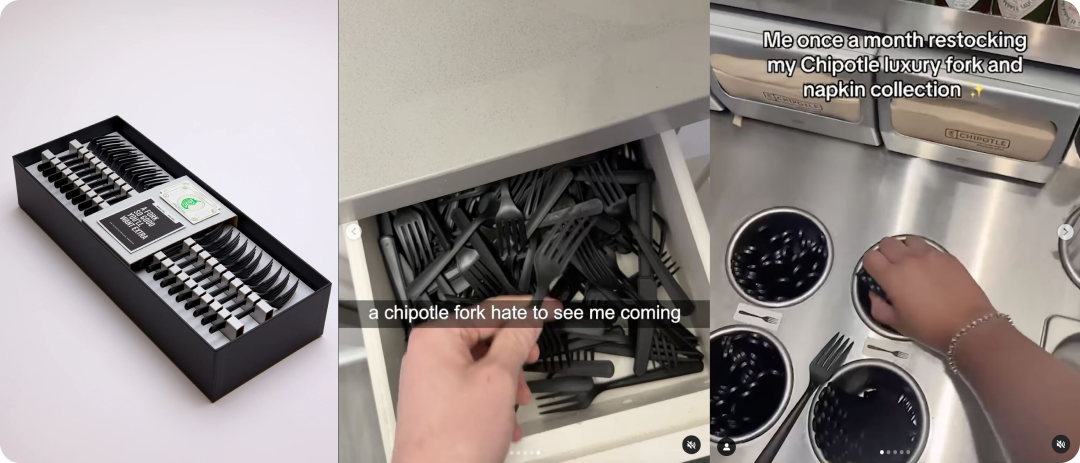
Chipotle is a good example of what’s possible when a brand actually pays attention. For National Fork Day, they sold out boxes of 53 black Chipotle forks for $30.
On the surface, this looks absurd. Why would anyone pay for plastic forks that are usually free? But this product launch was the direct result of Chipotle catching onto internet chatter across Reddit threads and TikTok videos where fans were calling their signature black fork a “flavor enhancer” and confessing to keeping personal stashes at home. The cultural conversation was already happening organically; the brand recognized it and created a product that celebrated what their community was expressing.
Social listening also reveals which cultural moments are actually yours to participate in. If your audience isn’t talking about a trending topic, and it’s not showing up in the communities where they congregate, that’s a clear signal to stay quiet.
Struggling with cultural relevance often stems from treating every viral moment as an opportunity, without first checking whether your audience even cares.
Social listening also means recognizing when communities are explicitly asking brands to step back. The rise of IRL clubs (run clubs, chess nights, and queer line dancing events) are all responses to a generation dealing with profound loneliness in an always-on digital world. These spaces weren’t designed as marketing opportunities; they were designed as antidotes to isolation.
But inevitably, when something becomes culturally meaningful, brands come knocking. As Sibling Studio’s “Post-Culture” newsletter observes: “It’s not that brands don’t belong in these spaces but if they want to be there, they have to show up in the right way. It’s not about slapping a logo on a flyer or flooding a run club with influencers. It’s about listening. Letting the people who built the community lead the way, rather than trying to retrofit it into a brand strategy. Sponsor the space, don’t try to own the spirit. Invest in consistency, not just campaigns. And above all, ask what the community actually needs. Support might look like funding, or kit, or covering venue costs. But it should never come at the expense of tone, energy or autonomy. Because if you’re not helping to sustain it in the long term, you’re not really supporting it, you’re just borrowing clout.”
“Brands aren’t unwelcome. But presence without sensitivity can crush the soul of what’s being built. Show up with humility. Stay behind the scenes. Let the culture lead and maybe then, you’ll be invited in.”
– Post Culture by Sibling Studio
This level of listening requires infrastructure that’s embedded into how your brand operates. Marketers need to monitor conversations daily, track sentiment shifts, identify emerging patterns, and flag moments where the brand could add value.
You need systems for aggregating insights from Reddit, X, TikTok, niche forums, and wherever else your audience actually hangs out. Cross-functional collaboration ensures that insights gathered by your social team can inform product development, campaign strategy, and content calendars.
Remember, Your Audience Holds the Cultural Power
I choose to see this as a good thing. For decades, brands controlled the narrative by deciding when and how to show up, while audiences were seen as passive recipients who either bought in or tuned out. Organic social as a brand channel flips that script so that audiences can now decide whether brand participation is welcome, thereby pushing brands to create content that truly adds value and earns the right to be part of their cultural conversations.
With social, brands operate in a space largely created by the users that make up the platform, shaped by codes and references that existed long before your brand decided to show up. You’re a guest in their world, not the other way around. The communities, inside jokes, shared language, and cultural touchstones that define these spaces belong to the people who built them.
This is why so many brands struggle with cultural relevance despite massive budgets and sophisticated strategies. Building cultural currency requires a level of humility that most corporate structures simply aren’t designed for. To a certain extent, it requires letting go of control and trusting that value generation will compound over time.
Show up where (and only where) you’re wanted. Cultural currency is the only marketing asset that your audience controls entirely. They decide if you have it, they decide if you keep it. Your job is to earn permission, maintain trust, and prove repeatedly that you understand what matters to them beyond what you’re trying to sell.
Cultural Currency: FAQs
What is cultural currency?
Cultural currency is the permission your audience grants you to participate in their world. It’s the accumulated trust, shared language, and cultural fluency that allows a brand to show up in conversations without feeling intrusive or extractive. Unlike brand awareness, which measures whether people know you exist, cultural currency measures whether people care that you’re part of the conversation.
What’s the difference between cultural currency and cultural capital?
Cultural capital refers to the knowledge, skills, and cultural experiences that individuals accumulate and leverage for social advantage. It’s personal; you build it through taste, education, and exposure. Cultural currency, by contrast, is relational and earned. It’s what happens when a brand demonstrates fluency in the codes, references, and values of the communities they’re trying to reach.
What is an example of cultural capital?
Cultural capital operates at the individual level. Knowing lots about Star Wars is cultural capital among Star Wars fans. Being fluent in art history gives you cultural capital in academic or creative circles.
Understanding niche music genres, having read certain books, or being able to discuss film theory; these are all forms of cultural capital that individuals use to signal belonging and gain status within specific communities. It’s about what you know and how you use that knowledge to navigate social contexts.
How long does it take to build cultural currency?
Cultural currency compounds slowly and requires sustained commitment. There’s no timeline where you can say “in six months we’ll have it.” Some brands stumble into cultural moments that accelerate the process, but most build it through years of consistent value generation, demonstrated cultural fluency, and proof that they genuinely understand their audience.
Can cultural currency be measured?
Cultural currency generally resists traditional metrics, but signals exist. Look at share of voice in organic conversations, sentiment analysis showing how people talk about you versus competitors, whether your content gets shared without prompting, if your audience creates content about you unprompted, and whether people reference your brand in contexts that have nothing to do with your product.
Quantifiable metrics like brand sentiment and share of voice help, but the qualitative signals matter more.
What’s the biggest mistake brands make when trying to build cultural currency?
Treating it as a campaign with a start and end date. Cultural currency isn’t something you build in Q2 and maintain in Q3. It’s an ongoing relationship that requires consistent attention, listening, and value generation. Brands also fail when they try to force relevance by jumping on every trend, when they prioritize visibility over value, or when they assume budget can substitute for genuine cultural understanding.
How is cultural currency different from influencer marketing?
Influencer marketing is a tactic where you pay someone with existing cultural currency to endorse your brand. Building your own cultural currency means earning that relationship directly with your audience. Influencer partnerships can help amplify your message, but they don’t transfer cultural currency to your brand. You still have to do the work of proving you understand and value the communities you’re trying to reach.
Can you lose cultural currency once you’ve built it?
Absolutely. Cultural currency is fragile and can be eroded faster than it was built. Brands lose it by making tone-deaf decisions, participating in cultural moments where they weren’t welcome, prioritizing short-term attention over long-term trust, or getting called out for values misalignment. Once your audience feels like you’re extracting value rather than contributing it, the permission they granted you gets revoked.