

The fantasy of Ffern marketing: how a perfume brand sells intimacy at scale, one sold-out season at a time.
In spring of 2013, Google announced Google Nose, the ability to search by smell. You could connect Adsense to search for flowers, sniff the smell of new books, and even enable Odor Detection through your Android.
To the Internet’s dismay, this fake feature was launched on April 1st… a prank. The brand’s practical joke hit on a surprisingly poignant question: how do you pass a scent through a screen?
British fragrance company Ffern seems to have found the answer. Through strong narrative-driven world-building and highly adept multi-channel storytelling, Ffern has been able to orchestrate a universe so visually and textually unified that their fragrance has sold out for seven consecutive years.
What follows is an investigation into the intersection of sensory worldbuilding and operational friction that Ffern uses to build and sell an intimate fantasy world, one season at a time.
What Is Ffern?
Ffern is a British natural fragrance house based in Somerset, England. It was founded in 2017 by Oxford graduate Owen Mears with the mission of reviving an artisan tradition: natural, seasonal, small-batch perfumery. Under the careful guidance of Head Noses François Robert and Elodie Durande, the brand released their first scent in December of 2018, on the Winter Solstice. All 150 bottles sold out within weeks.
Today, the brand releases one new fragrance per season, delivered on each solstice and equinox. But getting one is not so simple. To actually obtain a bottle, you must make it off of a waitlist and onto a ledger of members; that waitlist, however, is reportedly 500,000 names strong, with roughly 20,000 people joining every week.
The magic spell of Ffern has an accomplished caster: Owen Mears’ sister, Emily Cameron. Cameron joined Ffern as creative director in 2020. Four times a year, she directs a short film chasing an answer to the same deceptively simple question: how does a season feel? It’s certainly a bold subject to tackle. Do it poorly, and you get a cliché. But pull it off, and you get what Ffern has: a beautifully repeatable marketing engine that practically runs itself.
I should note: As much as my Meta ads may believe that I should purchase a bottle, I’m not exactly Ffern’s target audience. I tend to avoid long lines for the Hottest New Thing. But I understand why many participate in these kinds of experiences, and I understand why they’d be drawn to what Ffern has to offer.
So let’s get into it.
How do you buy a bottle of Ffern?
Trick question. You cannot simply *purchase* Ffern’s seasonal perfume.
Visit ffern.co and the first thing the site tells you is that availability is limited. If (ahem, when) you decide to close the banner without “registering”, you’ll quickly see the words, “Currently full.”

How their shopping experience works:
- You hit “Check availability,” put your number down, and it verifies you.
- You’re taken immediately to a quiz, in which you’re asked a series of questions: which ingredient is calling your name, what you’re seeking this summer, and whether or not you feel impacted by the changing of the seasons.
- You’re provided with an explanation of what’s in the box.
- You put your card down.
- If your name comes up in the drawing, they take the payment, and blend you a bottle of the season’s perfume.
After that, all that’s left to do is wait.
Anticipation and exclusivity have been well-studied as commodities used by luxury brands to manufacture demand. So what is it that makes Ffern’s waiting game stand out?
Natural Limitations
In psychology, anticipation is an emotional investment born directly from scarcity; we long for what is restricted, stretching the time between desire and possession until the wait itself becomes part of the luxury.
“Luxury has always been about what’s scarce, and in a world of infinite online exposure, genuine connection and unmediated experience have become the ultimate status symbols.”
– Nicole Li, Decoding Desire: Inside the Psychology of Luxury Brand Marketing
When a legacy luxury brand like Hermès makes a customer wait months for a Birkin bag, they are leveraging artificial scarcity; a deliberate corporate choice to cap production and control access. Streetwear giants like Supreme take a faster, more aggressive approach to the same strategy, weaponizing hyper-limited, manufactured “drops” to spark a frantic consumer rush. In both cases, the brand deliberately creates a bottleneck to trigger panic-driven FOMO.
Ffern’s scarcity, however, is grounded in the natural calendar. Because Ffern rejects synthetic chemicals in favor of natural ingredients harvested at specific times of the year, their production volume is dictated by nature’s clock. They are bound by physical land and seasonal crop yields; there are only four seasons a year, and no amount of sudden consumer demand can mint a fifth or force an orange blossom to bloom faster. By Ffern’s own telling, the ledger was built because batches kept selling out and longtime fans kept missing releases.
In deciding to release on a seasonal cadence, Ffern operates on true organic temporal scarcity. Because this constraint feels fundamentally legitimate rather than a corporate choice, it transforms the relationship between the brand and the consumer from an adversarial transaction into a shared alignment of values, setting the perfect stage for later strengthening narrative-driven brand positioning.
In-Group Validation
Exclusivity marketing in traditional luxury has long been defined by friction and intimidation. A legacy luxury brand like, say, Dior, would place a certain level of distance between the customer and the product through price and frigidity. They hide the product behind the glass, daring you to prove you belong.
Ffern, on the other hand, invites you in. They sit you down on a green velvet couch, bring you tea, and tell you, warmly, that there will be a bit of a wait.
At around $129 a bottle, Ffern sits firmly in a mid-tier price bracket (vastly more accessible than the $400 bottles protected by the icy prestige of elite luxury counters). Because they aren’t pricing out the average consumer, they must gatekeep by other means. They swap financial filtering for an attention filter, requiring you to trade your patience and presence instead of an exorbitant sum.
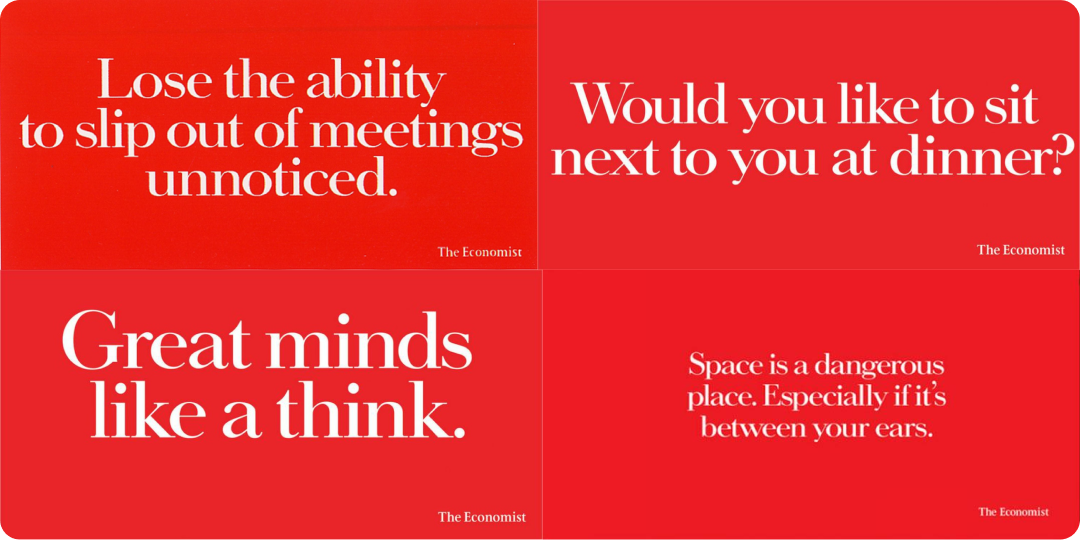
This welcoming posture serves a distinct psychological purpose, operating much like The Economist’s iconic “white out of red” ad campaigns. Those classic ads, with headlines like “Great minds like a think,” never pitched the actual product. Instead, they flattered the reader’s intellect, making them feel like they belonged to a rare, highly specific subset of people who were simply capable of appreciating a higher level of journalism.
Ffern adopts this approach, but swaps intellectual prestige for the ethos of slow living. By getting you to pause at the gate for a multi-step onboarding quiz—asking which raw ingredients call your name and how you are impacted by the shifting seasons—they are aestheticizing your existing values, transforming simple habits into an identity that seems rich and elite.
Where traditional luxury relies on the threat of rejection, Ffern’s version of exclusivity relies on alignment. By giving you an experiential taste of the brand before you buy, they substitute psychological intimidation for psychological validation, creating desire for a world you’re already a part of. You are the type of person who moves slowly enough to notice the changing of the seasons; you belong here, because you belong to a collective identity that values patience over instant consumption.
Ffern Brand Voice
Ffern ensures that the texture of their world reflects the slow, deliberate pace of its creation across every channel they touch. From the copy to the cinema, Ffern maintains a storybook-like feel that doubles as a clear display of their values.
If I had to bring a new writer into the Ffern Folk Foundation, I’d hand them a single printed page with three rules:
Rule #1: You Have a Minor in Design (That, or Extensive Experience With a Camera)
You understand what images mean, but you never fall into the fantasy-novel trap of purple prose, describing for description’s sake. Every image you conjure serves as a waypoint; you write every product description with precision and grace.
Take for example, the description of black tang seaweed, a key ingredient in the Winter ‘26 fragrance.
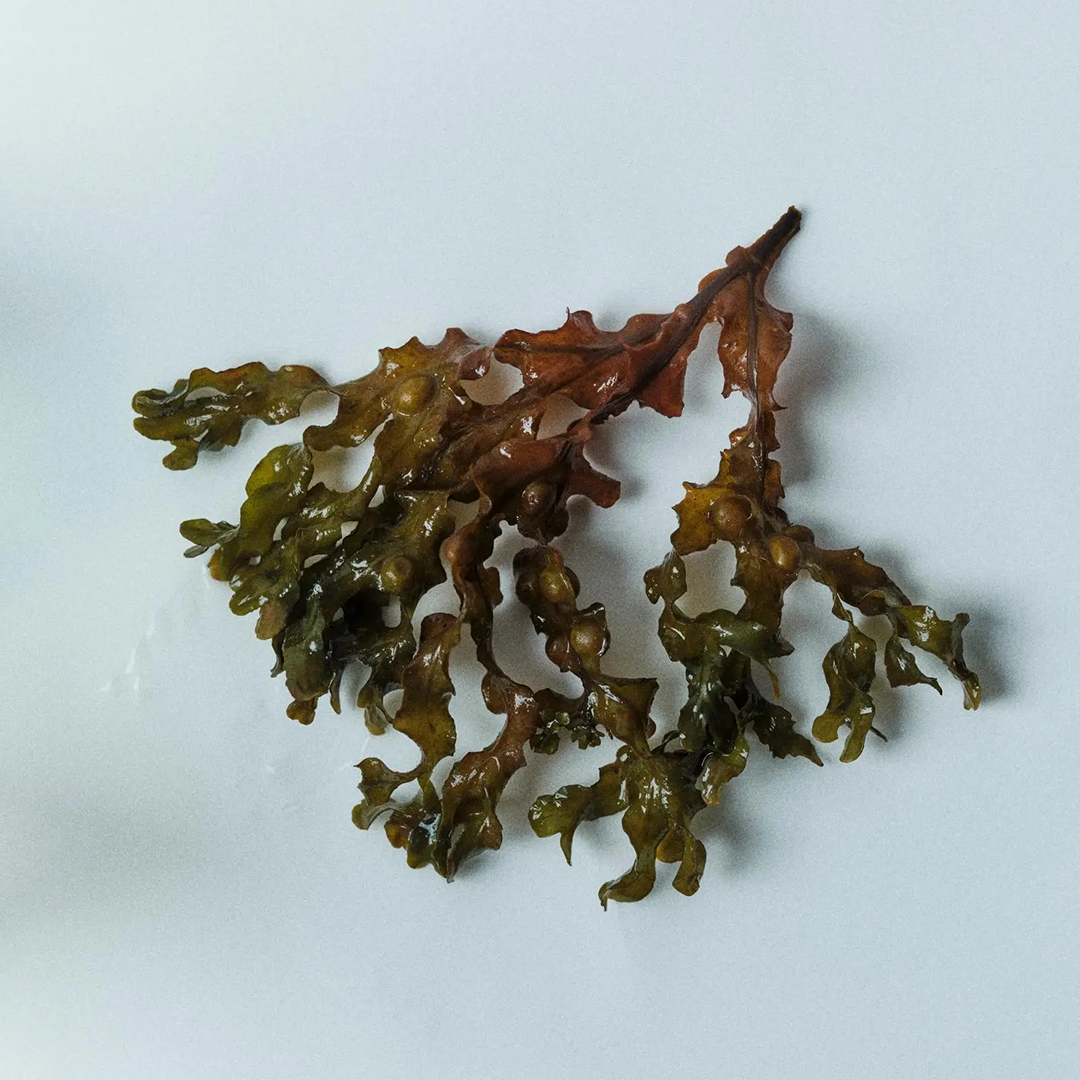
“Our black tang seaweed, often known as bladderwrack, is sustainably harvested from the pink granite rocks of Brittany in northern France. After harvesting, the seaweed is dried before being ground into a powder. This powder is then refined using a solvent extraction process to create the seaweed absolute. This unusual ingredient has a distinctive, almost umami facet. Here it calls to mind that essential rugged element of Britain’s coast.”
“Sustainably harvested”, “ground into a powder”, “refined”. Each verb is carefully chosen to center the labor in the process itself, all while making it feel like a bit of a quest. The “pink granite rocks of Brittany” remind you that the very gathering of ingredients was an adventure, and an adventure you fully intend your reader to accompany you on.
Rule #2: The Customer Is Part of Your Storybook World
You’re a narrator. Not a salesperson, specifically, a narrator. A salesperson addresses you; a narrator envelops you, making you feel safe by guiding you through treacherous terrain. (You also never, and I mean never, break character.)
The grandest adventures develop across vast expanses of time, a reality Ffern cements by transforming commercial copy into an immersive narrative journey. Consider the storytelling for its Winter ’26 release. Rather than pitching notes or listing factory-standard specifications, Ffern establishes an atmospheric landscape:
“With the wind we howl along the headland. Flicking pale sand from the beaches and salt spray from the waves… For Winter 26 we placed a lighthouse on that headland. Safe harbour in a storm, its bright light capable of changing fate. We began with the sea, reaching for its depths with oakmoss, spiced cardamom and cool violet leaf…”
By adopting the authoritative voice of an omniscient storyteller, Ffern alters the traditional dynamics of the consumer relationship. In place of an overt push toward a financial transaction, the customer is dropped into an ongoing chronicle. Once again framing labor as adventure, the story of finding Winter ‘26 charts an expedition.
The customer ceases to be a target audience and becomes a companion guided through a beautifully perilous, romantic terrain. In refusing to break character, the copy completely sanitizes the interaction of raw commercialism, making the customer forget they’re being sold to.
Rule #3: You Write From a Time That Predates the Invention of The Factory
The Industrial Revolution destroyed the “timelessness” of objects by introducing mass production, standardized time, and planned obsolescence. Instead of items being unique, locally made, and built to last generations, they became temporary, easily replaceable, and strictly dictated by fashion and the calendar.
You, however, have no concept of this. For you, life is tied to the slow, seasonal rhythms of nature. Goods are known by where they come from, time is kept by the sun, and there is no word in your vocabulary for “Shop Now.”*
*While merchants and town criers have always had to promote wares, the specialized “sales pitch” emerged in the early 20th century. This structured commercial argument, necessitated by mass production, is a post-Industrial phenomenon. Ffern’s decision to leave sales language out of the copywriting equation is incredibly on-brand.
Rule #3 is, in my opinion, most crucial to Ffern’s self presentation.
In the time between releases, Ffern packages a spell-binding reenactment of pre-industrial commerce: performed, with a straight face, through thoroughly industrial machinery. Bottles made to order, in batches sized to a ledger, delivered on the solstice calendar, all carry an echo of how all goods were made before factories. It’s an embodiment of the artisan craft they seek to restore, cleverly presented in the digital world.
Ffern (F)films
“We spend so long working out how to bring people into our world and to make them feel a part of it.” Emily Cameron for It’s Nice That
If the anticipation of the ledger wait sells you on the concept of time withheld, Ffern’s cinematic shorts (or “Ffilms”) sell you on the sheer weight of time spent.
A perfect distillation of this is their Autumn ’25 release film, Cloud Orchard: A Wild Apple Heist.
I sat down with NoGood designer Ankith Ratakonda to watch the short film. It went a little something like this:
On screen, choreographed figures cartwheel, stand on shoulders, and carry wooden ladders as they laugh and run their way into an orchard, the cameraman in tow. The characters dance through the trees, moving freely as the old man guarding the orchard sleeps under the sun. When the man awakens, the troupe breaks into a frantic, playful scramble; the characters dart away from this otherworldly landscape, leaving a pile of apples in their wake.
It takes about 12 seconds for Ankith to look at the screen and ask, “Why can’t that be how the world looks?”
“The apples are so bright, it feels crisp,” Ankith notes, tracking the visual details. “Every color is done well. For every frame. Intentional, even. I mean, even his shirt and his blue eyes. Come ON.”
It is incredibly fun, and deeply beautiful to watch. More importantly, however, the visuals act as a sensory bridge; you are quite literally getting the essence of the smell through the screen. By getting the details right, Ffern’s film transports the viewer away, immersing them in an entirely different physical atmosphere from the comfort of their room.
In the human brain, smell and memory are permanently intertwined. We evaluate a fragrance based on the emotional context we associate with it; maybe it smells like perfume samples from a magazine, or like the bottle your grandma would wear. It’s Homesick Candles’ entire business model: bottle the feeling. By letting you watch the cinematic heist and read the romantic mythology before you ever open the box, Ffern pre-programs your sensory response. They are giving you an intentional, curated memory that you want to relive.
As the film comes to a close, Ankith sighs. “AI could never do this.” His visceral reaction is revealing, and it’s correct. But why?
One answer comes in the form of “qualia,” a fancy term for the subjective, internal “what it is like” to actually have a conscious experience. Look at it this way: you can understand logically, through hearsay and data, that a stove burner is hot. But you don’t actually understand the qualia of that heat until you physically touch the metal, burn your skin, and your body registers a sharp flash of pain. That tiny, visceral “ow” creates a sensory memory. In that moment, you move from processing information to understanding “what it is like” to feel that heat in your bones.
Generative AI cannot experience qualia. An algorithm can scrape millions of data points about an autumn harvest, simulate high-definition pixels of apples, and predict exactly what a cinematic frame should look like. But it operates entirely without a body, an internal life, or a tactile relationship to the material world; it cannot feel the crunch of a leaf under a boot or the frantic adrenaline of a playful heist. Cloud Orchard, on the other hand, feels alive. It is a record of true human presence, real physical labor, and conscious creative collaboration.
Consumers remain deeply cynical of manufactured artifice. On its flip side lies authenticity, an accurate portrayal of what the “original” conscious experience was like. Ffern completely nails this authenticity of feeling. Even though their content is highly produced, meticulously color-graded, and strategically engineered to sell a luxury ledger, the core human emotion behind it remains entirely real.
In an internet era where digital content lives forever and can be cloned infinitely, this irreplicable human presence becomes the ultimate scarcity. True luxury is no longer just about high price tags; it is about the ephemeral. By capturing a fleeting, living moment in time that a machine can code but never truly live, Ffern elevates a simple short film into an act of luxury.
Ffern Social Media
There is almost no sharper contradiction to the whole *idea* of Ffern than social media marketing. Yet, Ffern pulls it off remarkably well, using the fast-paced nature of social media to actually highlight their slow-living philosophy.
It Takes Time to Touch Grass
On a feed that is usually loud, fast, and completely homogenous, a Ffern post immediately breaks your momentum. This Ffern Summer ‘26 stop-motion sequence of flower petals stands out because the format mirrors the message. These videos take time to make precisely because they represent things that take time to happen in nature.
It acts as a visual taste (or a scent proxy) of the season itself. By capturing the gradual journey of growth rather than just a flat end product, Ffern offers a moment of genuine relief from digital burnout.
Posts as Trailers
Ffern’s second style of execution is a highly stylized, playful “behind-the-scenes” starring actress Claire Foy. Ahead of the release of their Spring ’26 nature documentary, This Wild Land, Ffern posted a mock promotional series tracking Foy’s comedic journey as she prepares to voice the literal landscape.
The clip captures her playfully trying to get under the skin of the environment, satirizing the intense process of method acting by asking what a tuberose flower has for breakfast. Aside from being quite charming, this clip anchors the brand’s core mission directly into an Instagram feed. By showing the fictional “labor” behind her voiceover, Ffern frames understanding a season as a journey that requires time, attunement, and creative struggle.
This works as a brilliant promotional tool. It operates like a movie trailer; by the time you finally watch the official seasonal film, you are already emotionally invested in the narrative and looking forward to hearing the exact lines you watched Claire Voy record.
Once again, the underlying subtext is loud and clear: Look at how much care, thought, and time went into creating this world.
Platform-Native Contrast
By completely avoiding the flashy, hyper-optimized style of normal internet ads, Ffern’s social presence wins by choosing a journey over a sales pitch.
In an increasingly fragmented digital world, consumers rarely experience a brand’s campaign in a neat, linear line. Instead, we encounter businesses through a chaotic web of random entry points: a stray Instagram Reel, a spot in a Reddit thread, or a targeted ad. And every single one of these digital touchpoints now acts as an independent storefront. If a user stumbles into your world out of context, that lone post has to instantly communicate your entire brand soul.
Ffern pulls off this brutal standard of consistency because they master a crucial marketing trick: they take one core, cohesive narrative idea and skillfully divide it into digestible, platform-native pieces. Whether you are reading a text-heavy story in an email newsletter, watching a gorgeous stop-motion timelapse on your feed, or laughing at a playful mockumentary clip, you are always stepping into the exact same world. No matter which door you walk through, Ffern’s universe remains entirely unbroken.
Is Ffern worth it?
Well. Not everyone thinks so.
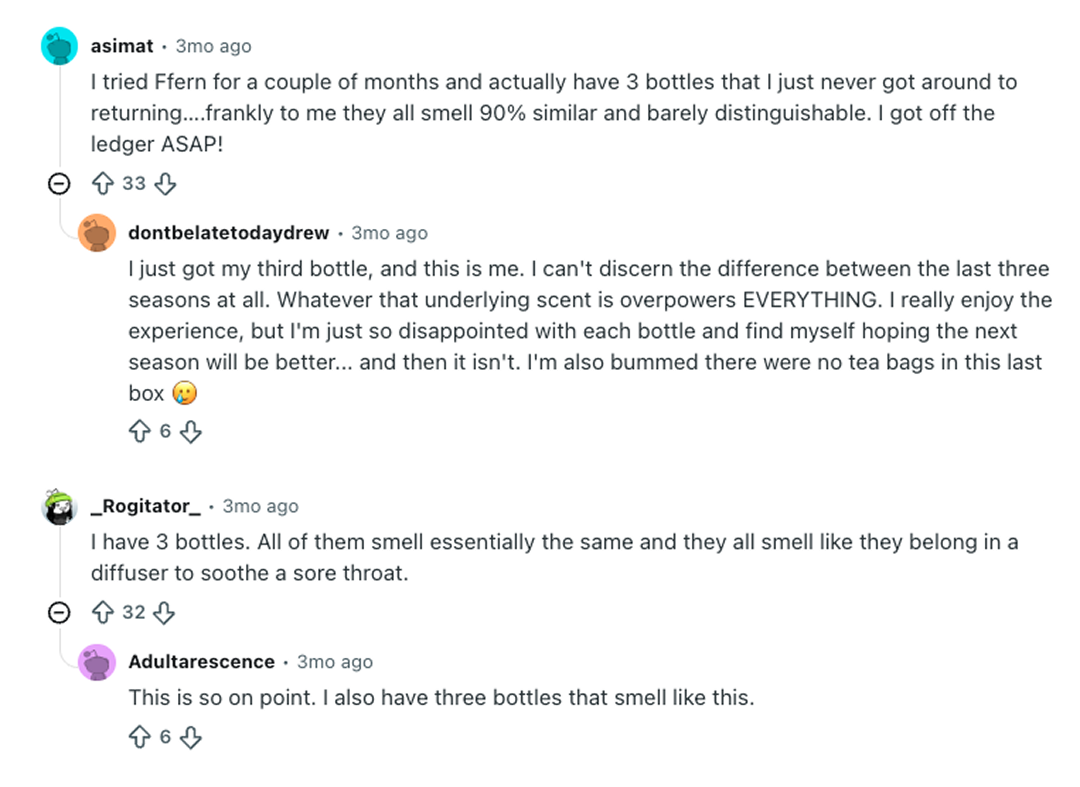
If you venture into r/fragrance, you’ll find a vocal contingent of users who feel tricked. There are complaints about the seasonal scents smelling virtually identical, and the term “scarcity marketing” appears a multitude of times on the page. One commenter even bitterly nicknamed the brand’s strategy “FfOMO.”
It is a fair charge to raise, especially when you look under the hood of their digital storefront. For all of Ffern’s talk about the slow, patient rhythms of nature, their checkout flow relies on the oldest eCommerce trick in the book: a countdown timer warning you that your bottle is only reserved for a strict, limited window of time. It is a jarring paradox. The copy tells you to move slowly, but the transaction engine forces you to buy quickly.
Because of this, critics argue that Ffern’s fine-wine philosophy is just an elaborate mask for artificial scarcity. The brand’s own FAQ insists on a more romantic interpretation: “Our approach has been described as that of a fine wine maker, rather than of a beauty company”. Co-founder Owen Mears put it even more plainly, stating they wanted fragrance to feel “less like a product on a shelf and more like a moment in time”. They openly tell you before you sign up that because these are small-batch, natural ingredients, every bottle will reflect the volatile nature of the harvest.
Read those lines before you join, and they read as refreshingly honest. Read them after your third consecutively citrusy bottle, however, and they start to feel closer to a legal alibi. The truth is, they are both. Candor doesn’t magically undo disappointment. But it does relocate the responsibility. After all, Ffern never promised that the physical fragrance would outperform the romantic fantasy.
Interestingly, the original poster who started the main Reddit critique thread led with this exact realization:
“Maybe that’s the point tho? They make it seem like a special little club so you want in…”
User hms81991, if you’re reading this, yes. Exactly. That is the point. Ffern is a club built on self-selection, but it’s a club almost everyone wants to join because we are all collectively exhausted by the same subway ads that promise to let you “ship faster.” The ads have reached a point of being parodied; they reduce human existence to a series of logistical problems to be solved, leaving us feeling completely disconnected from our surroundings and each other.
Ffern offers a refuge from that isolation by turning low inventory supply into a collective experience. After all, a line joined willingly is a community. Half a million people wanting the same four bottles a year aren’t “waiting in line”, so much as they’re attending something together.
For many niche fragrance labels, the product itself carries the entire weight of the brand. If the scent doesn’t land perfectly, the consumer relationship breaks down. But for Ffern, the physical juice occupies perhaps ten percent of their actual cultural surface area. The scent complaints on Reddit are merely small dents in comparison to the massive, enticing world they’ve built.
Why is Ffern so successful in 2026?
Because brand is so back.
More specifically, Integrated Marketing Communications (IMC) (the marketing jargon for “prioritize consistency across channels”) is so back.
For a good 20 years there, the digital marketing consensus claimed that unified worldbuilding was dead. The new rules were simple: treat everything as an isolated data point, track the clicks, and optimize for immediate conversion. Getting multiple siloed creative departments on the exact same page was dismissed as too difficult and ultimately irrelevant.
The pendulum is finally swinging back in the other direction. It is precisely because the internet has fractured our attention into a thousand random entry points, that a brand requires absolute consistency to survive.
Legacy institutions are waking up to digital fatigue. Famously, under Head of Editorial Content Chloe Malle, Vogue is deciding to shift away from its standard monthly print format toward larger, theme-driven collectible editions mapped out months in advance. Malle recognized that in a disposable digital landscape, consumers want keepsakes. They’re choosing the slow, intentional alignment of culture over the rapid-fire production line.
I’d argue Ffern is the clearest tell of that turn. In that sense, a bottle of Ffern functions less like a beauty product and more like a T-shirt from a concert merchandise booth: tangible evidence that you were there, and physical proof that you are part of something larger – whether or not the waft is worth the wait.