

I bet you’ve got a list of brands you follow on Instagram that you check up on religiously. Most likely, at some point you’ve probably asked yourself how they got there. And if you’re the one running a brand’s Instagram account, that question turns into something closer to panic: how do I do that myself?
Starting an account from zero is nerve-wracking — I’ve been there. And keeping one alive for years without losing momentum is worse. Then before you know it, you’re watching a competitor’s numbers double yours and the instinct kicks in fast: copy what they’re doing, chase the same formats, assume they cracked something you haven’t.
When situations like this arise, we almost always land on the same question: how do I beat the algorithm? That question is the whole problem. The algorithm was never the enemy. Something else has been running the show, and once you see what it actually is, the whole idea of finessing your way to growth stops making sense.
How Does The Instagram Algorithm Work?
The truth is, there’s no real way to “finesse” the algorithm. You can attempt to blame the algorithm all you want, but the majority of the time, you’re under the assumption that there’s only one unique algorithm. And that’s false. Instagram’s documentation reveals that “…each part of the app — Feed, Explore, Reels — has its own ranking system based on how you use it.” Each one plays by its own rules because you use each part of the app differently.
That’s the part so many strategists are letting fly over their heads. You’re not up against one opponent you can outsmart, but four different rooms, and succeeding in one doesn’t hand you the others for free.
Across all four, Adam Mosseri, head of Instagram, has confirmed three signals carry the most weight: watch time, sends, and likes per reach. Sends do the heaviest lifting, worth three to five times more than a like, because someone sending your content to a specific person is vouching for it in a way a single tap never will. And in his year-end memo, Mosseri went a step further, explaining that raw, real, human content is what’s getting rewarded through 2026, not the polished, AI-smoothed stuff clogging everyone’s feed.
None of this is good news for brands posting into the void and hoping the algorithm notices. The deal is, treat Instagram like a community hub. I encourage you to like, comment, and show up in your industry’s comment sections the same way you’d want people showing up in yours. Those engagement signals, especially the ones that turn into a DM share, are what put your brand in front of someone who’s never heard of you.
Instagram’s Current Platform Offerings
Now before you build an Instagram content strategy, you need to know what you’re working with. Think of this as a quick refresher, or a starting point if you’re building an account from scratch. Instagram gives brands a handful of core formats to work with, and each one does a different job. Here’s what’s on the table, and how to use it instead of just posting and hoping it’ll work.
Photo/Static/Carousel Posts
Instagram’s old faithful is its photos. Users can post pictures and share a caption on their profile grid. You can also tag or add someone as a collaborator on your post, and once accepted, it shows up on their profile grid too.
Carousels are becoming one of the most popular formats, especially since Instagram raised the limit to 20 photos per post. Both formats, carousels and single photos, help with channel discovery, especially when you add audio to the post.
Pro Tip: You can reorder or delete slides on a carousel after it’s published without losing your existing likes, comments, or saves. You still can’t add a new slide after the fact, so get the sequence right before you hit post, but it’s no longer a full repost if you want to swap your cover image.
Instagram Reels
Reels are short-form videos, often built around music (especially trending songs and audio clips), text, and effects. They’re made for creative expression and entertainment, giving users an easy way to show off personality or talent through quick editing.
The best reels combine two things: information and feeling. Tips, lifestyle content, anything digestible enough to watch in one sitting but sharp enough to teach or move someone. Digestible and concise wins.
Pro Tip: When adding captions to your videos, double-check that they’re inside the safety zones of the Reels formatting.

Instagram Stories
Instagram Stories are short-lived content that disappears after 24 hours. They’re a more casual, in-the-moment way to share snippets throughout the day, behind-the-scenes content, daily updates, announcements, and interactive engagement with your followers.
Users can share photos, videos, text, and interactive elements like polls, questions, countdowns, and quizzes. These gamified elements take low effort to set up but do a lot of work, building community while giving you a direct read on what your audience wants to see.
Pro Tip: If you don’t want to lose a Story after 24 hours, create Highlights on your profile to hold onto your favorites. The best approach is multiple Highlights organized by theme, so every piece of content has a home.
Instagram Broadcast Channels
An Instagram Broadcast Channel is a private group chat between a brand and their followers. It’s a way for brands to send messages directly to followers who’ve joined: texts, photos, polls, all of it. Technically, it’s a one-sided group chat; only the creator can send messages, but followers can react and long-press a message to reply directly without it showing up in the main log.
Brands typically use Broadcast Channels for announcements, behind-the-scenes content, recent posts, and questionnaires that let them hear directly from their audience. Some use the channel to give their community early access to product teasers or launches before anyone else sees them.
Pro Tip: Keep your broadcast messages short and sweet. Think of it like your notes app, a way to make your followers feel like insiders to your brand.
Instagram’s Biggest Platform Updates
The only way to keep up with Instagram is to keep up with its updates and use them. Or at least test them. The more current you are with Instagram’s features, the more savvy your channel looks, and the more you benefit from the wave of other brands testing the same things. Here are some of the most notable announcements this year, and what to do with them.
Edits
Edits is Instagram’s native editing app, similar in spirit to CapCut. Most brands still use their own editing tools before uploading, but Mosseri confirmed videos made in Edits get a small, temporary reach boost just for using the app. Do what you will with that information. Just remember the boost is temporary by design; Mosseri said as much himself, and the real driver of a successful video is still retention, engagement, and your hook.

Series Tab
Instagram is testing a Series tab, similar to TikTok’s playlist feature. It organizes your Reels into a dedicated hub on your profile, with chronological episodes instead of scattered posts, so viewers can find, follow, and pick up a storyline instead of hunting for the next installment buried in your grid. I’d keep an eye out for this, but Instagram did test this feature with creator Julia Broome!
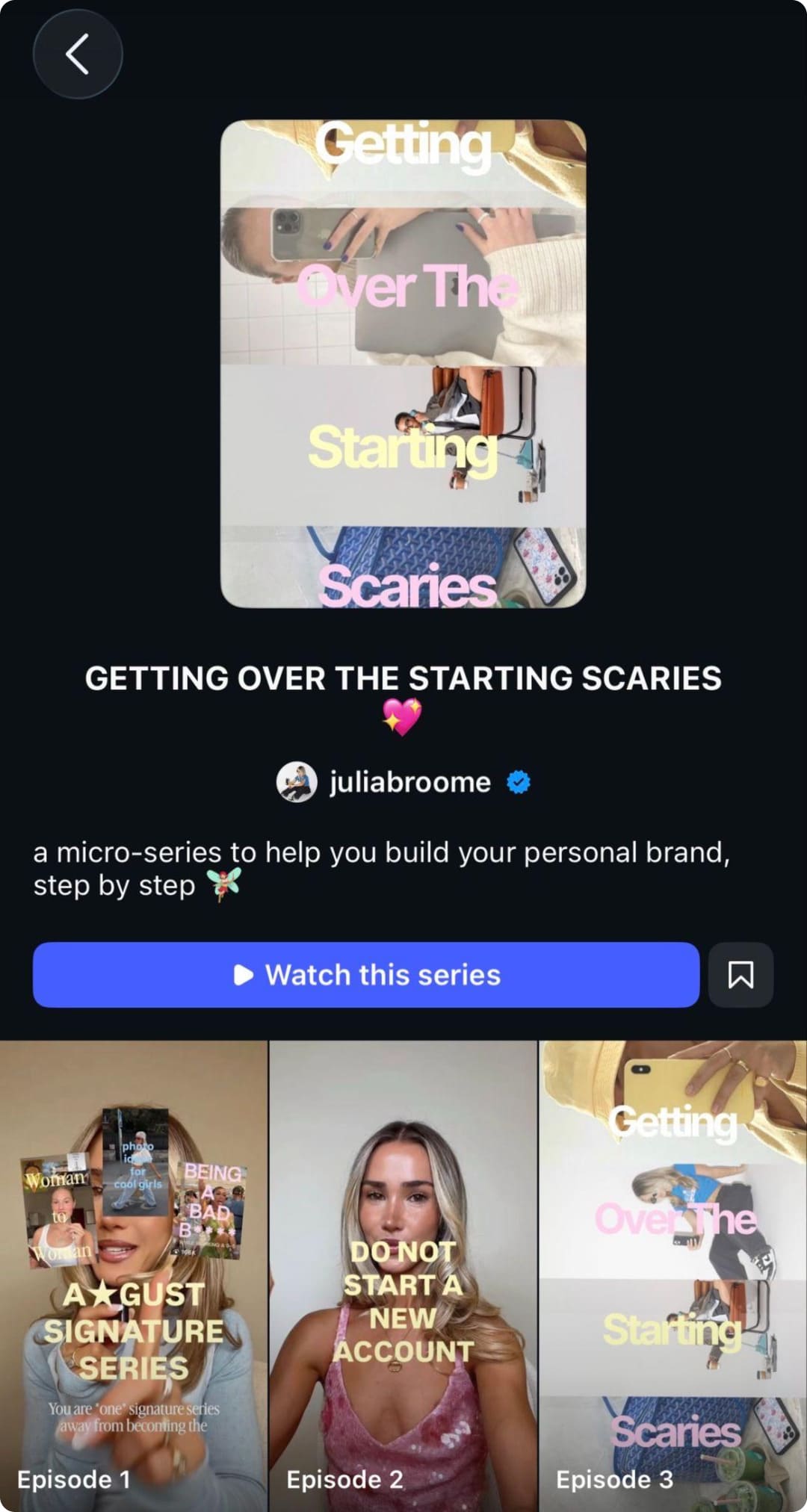
We’ve seen more brands lean into content series over the past two years, and some go as far as building separate accounts to keep a narrative distinct from the main brand feed. Bilt did this with Roomies and won a Webby for it. Separate accounts work for some brands, but companies like InStyle can use this feature to bring an existing series, like The Intern, over from TikTok instead of building a whole new account around it.
Reorganizing the Grid
Brands can use this feature for launches and campaigns that need a specific visual sequence. Whether it’s 3 photos, 6, or 9, pinned posts are no longer the only lever for controlling how your grid reads. You get control over how your page looks to anyone landing on it for the first time.
Swap Audio
Every social media manager knows the feeling of slapping the wrong audio on the wrong post. It’s embarrassing, there’s no undo button, and deleting and reuploading tanks your reach, so for years we just accepted it and moved on. Instagram fixed that (thank God); you can now swap the audio on a published post without losing your existing engagement, though I wouldn’t push your luck by swapping it more than once.
Multiple Captions for Carousel Posts
This one’s great for brands who want to post a more casual, low-lift carousel where each slide gets its own caption instead of one caption trying to cover everything. So is there an SEO benefit here? Maybe, but it’s not confirmed yet. If you’re testing this feature, I’d suggest being strategic about contextual keyword placement on every slide. That can mean more retention per slide, since users are taking the extra step to swipe through instead of skimming past.

Instagram Plus
Instagram Plus is Meta’s $3.99/month subscription, and outside of the initial rollout, most people still aren’t on it. It bundles 11 features across three buckets: getting closer to the people you care about, seeing previews and insights, and customizing your own experience. That includes Story Spotlight, Story Extend (48 hours instead of 24), multiple Story audience lists, and the option to post straight to your profile or Highlights without it hitting followers’ feeds.
One thing for you to keep in mind: none of these features touch your reach, algorithm treatment, or Explore and Reels distribution. That said, creators have found real use in the audience-grouping tools, and the anonymous Story viewing feature is worth keeping in mind if you’re vetting influencers and want a read on how they’re engaging with content on the platform, competitors included.
Is Organic Instagram Growth Still Possible in 2026?
Of course! The landscape is just more competitive now. You’re up against brands in your exact category with bigger budgets and sharper skill sets, and with AI slop flooding every feed, human-made content has never carried more weight. Establishing your own narrative, building a real community, and showing up for that community consistently – that’s on you now more than ever. No algorithm update replaces that work.
There’s also a shift most growth conversations still skip: Instagram isn’t just competing for attention inside its own app anymore. Since Google started indexing Instagram content in 2025, what you post can now surface in search results outside the platform entirely, reaching people who never would’ve found you through Explore or a follower’s feed. Growth and discoverability used to be two different games. They’re not anymore. If you want the deeper breakdown of what that means for your content, we covered it here.
So now that you know what Instagram offers, how do you actually use it? A few things to think through before you touch the strategies themselves:
- Visual Content Preference: Instagram is still a visual-first platform. Video or static, content needs to look intentional and match what your brand is all about.
- Community Over Performance: People are tired of brands that all sound the same. While it can be a bit difficult to stand out in an oversaturated industry, community engagement is the outlier because you get to build out a unique brand persona and communicate with audiences through that.
- Engagement and Interaction: Social listening across Stories, Broadcast Channels, and comment sections is how strategists can build an active community. But engagement isn’t only about replying to comments. A DM share is worth more than any like or comment, so the real question brands should ask themselves is if people are talking about me to someone else.
- Influencer Marketing: Spend on influencer marketing is going up, not down, but trust is cracking. Consumers distrust influencer marketing at more than double the rate they distrust regular ads. Be selective: choose influencers whose communities actually overlap with yours instead of chasing follower count.
- Data and Analytics: Use Instagram’s analytics tools to understand your audience, what’s landing, and what isn’t. That data should shape your hooks, your pacing, and how relatable your content feels.
Here’s where the five strategies come in, and where all of this gets tactical.
Top 5 Organic Instagram Growth Strategies
1. Quality Over Quantity
Forget the goldfish stat; it’s been repeated so many times it’s lost all meaning, and attention span was never really the point. What actually holds someone in place is quality: content that looks intentional, stays relevant to your brand, and doesn’t feel interchangeable with the ten other posts someone scrolled past to get to yours.
Every brand has a different voice, and some formats fit better than others. You find that out through trial and error, testing what performs and what tells your story best.
Here are a few formats worth testing:
- Educational: Use studies, articles, or research to teach your audience about your industry or a problem your product solves.
- Green Screens: A solid way to tell a story, as long as the image or clip behind you stays relevant to what you’re saying.
- Direct to Camera: A raw approach, someone speaking straight to camera, dressed up with pop-up graphics, sound effects, zooms, or b-roll to keep it moving.
- Skits: Humor is one of the most reliable ways to earn a share. Sketches built around a relatable moment tend to travel further than almost anything else on this list.
- Trends: Viral moments crafted into short videos, ideally under 15 seconds, show your brand is paying attention. The best reactive content feels like a natural extension of your brand, not a stretch. The moment it feels like a reach, it reads as cringe instead of clever.
- Customer Stories: Nothing builds trust and relatability faster than putting a real customer in the spotlight.
- Brand Series: Multi-part storytelling that leads with narrative and ties back to your brand’s mission without leaning on your logo to do the work.
The first question to ask before you make anything: how do I stop the scroll? A strong hook, visual or verbal, is what keeps someone watching to the end and coming back for the next one.
Once you’re past the hook, the content itself needs to look like it belongs to you. If you have brand colors, fonts, or music you gravitate toward, use them consistently. Your grid should be recognizable before someone even reads a caption.
Captions matter too; they’re not an afterthought; they’re the complement to whatever’s on screen. Keep them concise, let your brand’s voice come through, and make sure they add something instead of just restating the visual.
None of this works if you’re posting for volume instead of fit. A post that doesn’t align with your brand doesn’t become useful just because it fills a slot in your content calendar. Quality is what people remember, and what brings them back. Take the time to curate instead of just filling space.
Quality Over Quantity: In Action
Take a look at Starface’s Instagram. Their playful, fever-dream aesthetic holds up across every format they post in, proof that quality isn’t just about looking good; it’s about staying consistent enough that people recognize it’s you before they even see your name.
2. Turn Your Followers Into Insiders
Community should be top of mind when you’re thinking about organic social growth. Think about it this way: without a real community behind your brand, who’s actually going to invest in it?
Here are some ways to engage your audience that go beyond just posting:
- Start a Broadcast Channel: Gives your audience the inside scoop on what’s happening and lets you ask them questions directly. Followers who join can reply and take part in whatever you run through the channel, which builds a sense of insider access most of your audience won’t get anywhere else.
- Respond to Comments and Videos: Reply to comments on your posts, and to videos made about your brand elsewhere on the platform. It shows you’re paying attention and building relationships, not just posting and walking away. Staying responsive while a conversation about you is still happening matters, and the engagement itself signals to the algorithm that people are interacting with your content.
- Encourage UGC: UGC is one of the most effective tools for building community on Instagram, not just because it’s free content, but because it makes your followers feel valued instead of talked at. Encourage your audience to create content related to your brand, then feature it. You get content that doesn’t look manufactured, and they get to feel like part of the brand instead of just a customer.
- Post on Your Stories: Stories are an easy, low-lift way to run giveaways, polls, and let your followers get to know you as more than a feed. Bloopers, raw behind-the-scenes clips, and glimpses of company culture all work well here.
- Send PR to Non-Influencers: Influencers are useful for visibility, but PR sent to a real follower who tells their own story tends to land harder and feel less like an ad. It builds buzz differently, and it builds trust that’s harder to fake.
- Call and Response: Ask people to comment, play along with a Stories sticker, or tag you in their own UGC. It’s one of the simplest ways to get live feedback on what your audience wants to see, sometimes with content examples attached for free.
- Community Brand Trips: Invite a small group of loyal followers, not necessarily influencers, on a trip tied to your brand: a product launch, a factory tour, an experience that fits your niche. The content that comes out of it feels different from anything paid, because the people creating it chose to be there and have nothing to gain by performing.
Turn Your Followers Into Insiders: In Action
A woman went viral after her husband gave away a YSL makeup gift bag, meant for her, to a female coworker instead. The internet did what it does: everyone piled into the comments, tagging Yves Saint Laurent and demanding the brand send her a replacement. Someone on YSL’s social team saw it and did exactly that.
If your brand gets tagged into a moment like this, stay on top of it. You won’t always see a content opportunity like this coming, but when it lands in your notifications, you get a rare shot at making someone’s day, and the goodwill that comes back to you is worth more than most paid content ever earns.
3. Plan Strategic Collaborations
Influencer collaborations can still receive pretty impressive numbers, but the calculus has changed. We touched on this earlier: consumers are increasingly losing trust in influencer marketing, and that gap isn’t closing on its own. People have gotten good at spotting a cash grab within the first three seconds of a video, and once they clock it, the partnership stops working for both the brand and the creator.
That means picking the right partner matters more than it used to, and it’s no longer just about values and audience fit. Intent is what people are reading for now: does this collaboration exist because the partnership makes sense, or because the reach was available to buy?
Whether you go macro or micro, alignment matters more than raw reach.
| Micro | Macro |
|---|---|
| 1k-100k followers | 100K–1M+ followers |
| Leans toward niche, specific content | Leans toward aspirational, polished content |
| Lower collaboration rates | Higher collaboration rates |
| Smaller reach, but stronger interaction and impact | Wide reach, lower interaction rates |
| Reads as more relatable, provided the partnership feels earned | Can read as distant or transactional if the fit feels off |
The right choice comes down to your goal. Need reach? Macro works because of the built-in name recognition. Need impact? Micro usually wins; their communities are tighter and more likely to act on what they see.
To make a collaboration work, set clear expectations upfront: content type, deliverables, timeline, and the metrics you’ll use to measure it. Clear guidelines protect brand consistency without boxing the influencer out of their own style, and that balance is the difference between content that looks native to their feed and content that looks like an ad someone dropped into it.
Reposting or featuring influencer content adds real texture to your brand’s story, not because it’s authentic (that word’s been drained of meaning at this point), but because it shows real people using what you make. That’s a different kind of proof than anything your own content can produce on its own.
Done well, a collaboration doesn’t feel like an ad at all. It feels like two things that already made sense together, finally showing up in the same place.
Strategic Collaborations: In Action
Let’s compare three very different outcomes.
Starbucks partnered with creator Brandon Edelman (Bran Flakezz) for a Coachella activation, and the backlash was immediate, not because the content itself was bad, but because Starbucks was mid-boycott over a labor dispute with its own union at the time. Audiences read the timing as tone-deaf, and Edelman took heat right alongside the brand, since people don’t separate the creator from the check anymore.
Rhode’s story ran the opposite direction, and it didn’t start as a collaboration at all. Beauty creator Golloria George publicly called out Rhode’s Pocket Blush for looking ashy on deeper skin tones. Instead of getting defensive, Hailey Bieber and her team brought Golloria into the lab with their in-house chemist. The two shades that came out of it, Date Cake and Plum, became the brand’s redemption arc and she even helped launch the Rhode summer collection featuring inclusive highlighters and bronzers. The real lesson: responding to feedback with access beats a scripted partnership every time, whether or not you planned on collaborating with the person who called you out.
Then there’s Poppi, which skipped the traditional playbook entirely. When Love Island USA’s Amaya Espinal became a breakout moment, Poppi posted a joke, a fake can labeled “Amaya Papaya.” It became one of their most-liked posts ever; fans wouldn’t let it go, and a few months later Poppi turned the bit into a real limited-edition flavor, Amaya’s Island Colada. All it took was a brand paying enough attention to a cultural moment to know when to jump in.
4. Understand Your Insights
Instagram gives you analytics on your account overall, but also on every individual piece of content you post. A few ways to actually put that to use:
- Track Growth Patterns: Look at which content types are bringing in new followers, not just engaging your existing ones.
- Track Engagement: Comments and shares tell you more about what your audience wants than likes ever will.
- Analyze Shares and Saves: Instagram’s head, Adam Mosseri, has confirmed sends carry more weight than likes when it comes to getting discovered. It’s worth checking this number specifically every time you review a post.
- Refine Your Content Strategy: Use what you find to adjust your content calendar. An insight you don’t act on isn’t an insight, it’s just a number you looked at once.
The three insights worth checking most closely: watch time, view rate, and shares.
Watch time is your average watch duration as a percentage of your video’s total length. As a general benchmark, 50% or higher is considered solid, and the shorter your video, the higher that bar climbs; a 15-second Reel needs to hold attention more tightly than a 60-second one. If you’re consistently landing below 30%, shorten your formats before you do anything else. If you’re consistently above 50%, that’s your signal to test longer content; your audience is telling you they’re willing to stay.
View rate tracks the percentage of viewers who make it past your first three seconds, the exact window your hook is supposed to be working in. You can break this down by followers, non-followers, or both. A weak view rate means people are bouncing before your hook lands, and it’s worth comparing the underperformer against a similar post that did well. Was the hook weaker? Was the video longer? Off-topic for your brand? Even something as small as missing captions or trending audio can quietly tank a video’s numbers. Look at the whole picture before you write it off as a fluke.
Insights are also what tell you when to post, not a generic best-time chart, but your specific audience’s active hours. Timing still matters, it just won’t save weak content, and it won’t doom strong content either the way it used to. What it buys you is a faster first wave of engagement, and that early momentum is part of what tells the algorithm your post is worth pushing further.
Above all, discoverability comes down to shares. If you want to get in front of people who don’t already follow you, sends matter more than likes, full stop. The test worth running on everything you post: would I send this to a friend? The more shareable the content, the more likely it is to find its way to someone new.
Understanding Instagram’s Platform Analytics
Professional accounts also get access to traffic source data, which breaks down exactly where your viewers are finding you:
- Reels tab: traffic from the Reels tab
- Explore: traffic from the Explore page
- Feed: traffic from followers’ individual feeds
- Profile: traffic from people visiting your profile directly
- Stories: traffic from your Stories
- Search: traffic from Instagram search results
Pro tip: a Reels tab share above 60% is a strong signal you’re sitting on a top performer, especially if Explore is right behind it as your second-highest source.
That last category, Search, is worth paying attention to. It means people are finding your content the same way they’d find it on Google, by typing in what they’re looking for. That’s a different game than the algorithm, and it’s exactly what the next section covers.
5. Treat Instagram As A Search Engine
Google began indexing Instagram content in 2025, which means your posts, Reels, and carousels can now surface in search results the same way a webpage would. Here’s how to build for it.
- Do the keyword research first. Know what your audience is typing into that search bar before you write a single caption. “Best coffee in Bushwick” tells you more about intent than any hashtag ever will.
- Write captions for humans, keywords second. Three to five relevant keywords woven in naturally beats a caption stuffed with every term you can think of. Instagram’s algorithm reads for clarity, and so does your audience.
- Don’t skip alt text. It’s an extra layer of keywords most brands never touch, which makes it one of the easiest wins on this list – specifically for carousels and static posts.
- Always add subtitles. A meaningful share of people watch with the sound off, and subtitles are a natural way to work keywords into your content without it sounding like you’re reading a script.
- Keep hashtags niche. #nyccafes will do more for you than #coffee ever will. Specificity is what turns a hashtag into a keyword instead of noise.
- Tag your location. If you have a physical presence or you’re at an event, this is a fast way to show up in searches with real, local intent.
- Rewrite your bio like a pitch. A couple of well-chosen keywords here can be the difference between showing up in a search and not existing at all.
Treat your Instagram account like a landing page. Every post can rank, get indexed, and pull in someone who’s never opened the app and has no plans to. A follower already knows you exist. Someone finding you through search doesn’t. They just had a question, and your content happened to answer it better than whatever else came up.
Optimizing your account means being visible in enough places that someone can find you no matter how they got there. So treat every caption, every alt text field, every bio line as a chance to be found by someone who was never going to stumble onto you any other way.
This is the short version. Check out my full guide for more details.
What’s the TL;DR?
Here’s the short version, for when you’re back at your desk and need a recap. Make content worth stopping for. Give your community real access, not just posts aimed at them. Read your insights like they’re telling you something, because they are. Choose collaborators with intent, not just reach. And stop treating Instagram like it only exists inside the app, because it hasn’t for a while now.
None of this replaces the algorithm you were trying to outsmart back at the start of this piece. It replaces the need to. Growth was never really about beating the algorithm. It’s about giving people, and now search engines too, a real reason to stop scrolling and stick around.
FAQs: Organic Instagram Growth
Do hashtags still work for Instagram growth in 2026?
Yes, but not the way they used to. Hashtags aren’t a ranking factor on their own anymore, but niche, specific tags (#nyccafes instead of #coffee) still add context that helps the right people find your content in search and Explore. Instagram itself recommends sticking to 3-5 highly relevant tags rather than piling on generic ones.
How do keywords in captions affect Instagram reach?
Captions with 3-5 relevant, naturally placed keywords help your content show up in Instagram search, and since Google started indexing Instagram, in web search results too. The word that matters most there is naturally; stuffing a caption with every trending term makes it unreadable and won’t help you rank. Write for the person reading it first, and let the keywords fall into place around that.
What is save-worthy content and why does it matter?
Save-worthy content is anything someone wants to come back to: a recipe, a checklist, advice they’re not ready to act on yet. Saves are one of the strongest signals Instagram uses to gauge whether your content holds real value, right up there with watch time and shares. If people save your posts instead of just liking them, Instagram is telling you your content has a life beyond the initial scroll.
What is a good Instagram engagement rate in 2026?
It depends heavily on account size and niche, but as a general benchmark, accounts with 10,000 to 100,000 followers typically see 3-5% engagement, while smaller accounts under 10,000 often land higher, closer to 5-8%, since their communities are tighter. Entertainment and comedy content tends to outperform other niches, sometimes reaching 7-12%. Rather than chasing a universal number, track your own baseline over time and treat sudden dips or spikes as your real signal.
How often should you post on Instagram to grow?
Consistency matters more than volume. One high-quality feed post a day is a solid target. Posting three or more times a day often dilutes your own reach rather than multiplying it. Stories can run two to three times a day since they’re lower stakes, and two to three Reels a week is enough if each one earns its spot. Showing up on a schedule you can sustain will always beat a burst of content you can’t keep up.