


Generative Engine Optimization (GEO) is quickly becoming a core part of modern marketing (if you couldn’t tell by how much we talk about it on our website). AI search engines like ChatGPT, Gemini, and Perplexity are reshaping how people discover and evaluate information, with new features coming out seemingly every week. Today, visibility now means being cited inside AI answers, not just search results.
For marketers, that shift requires new tools and a new mindset. GEO sits at the intersection of SEO, content strategy, and AI, helping brands understand how large language models read, interpret, and reference their content.
At NoGood, we’ve spent the past two years testing how these models source, interpret, and surface content. This guide distills what we’ve learned: what GEO actually is, how to measure your performance, and which tools can help your brand stay discoverable in 2026 and beyond.
What Is Generative Engine Optimization (GEO)?
Generative Engine Optimization (GEO) is the practice of optimizing your content to appear in AI answers from platforms like ChatGPT, Google Gemini, and Perplexity.
Unlike traditional SEO, which focuses on ranking in search results, GEO is about influencing how large language models (LLMs) read, interpret, and cite your brand when responding to user prompts.
For marketers, GEO means adapting your content so AI systems see it as trustworthy, contextually accurate, and worth mentioning, whether that’s a direct citation, brand reference, or embedded example in an AI response.
How Is GEO Performance Measured?
GEO success isn’t just about whether your brand appears in AI answers; it’s about how often, how accurately, and how favorably it appears. Measuring that performance gives us marketers the data to understand where a brand stands and where to optimize next.
Here are the key metrics to track your generative engine optimization performance:
- AI Visibility Score: How frequently your brand or content appears in AI responses across engines like ChatGPT, Gemini, and Perplexity.
- Source Citations: The number of times AI models directly reference or link to your website or content.
- Share of Voice: Your percentage of mentions compared to competitors within a given category or topic.
- Sentiment Accuracy: Whether AI describes your brand positively and aligns with your intended messaging.
- Query Coverage: The breadth of prompts or topics where your brand is recognized or cited.
- Factual Alignment: Whether the details AI shares about your brand are factually correct and up to date.
Together, these metrics provide a clearer picture of how AI systems interpret and present your brand and whether that story reflects reality.
Methodology: How We Evaluated These GEO Tools
This guide was researched and compiled by the GEO team at NoGood that have actively been using various GEO tools and evaluating accordingly. We evaluated 30+ GEO platforms actively operating in 2026, narrowing to 10 based on five weighted criteria designed to separate tools that genuinely improve AI visibility from those that simply report on it.
- AI Engine Coverage & Monitoring Depth (25%): How many engines the platform tracks (ChatGPT, Gemini, Perplexity, Claude, Copilot, Grok, AI Overviews), update frequency, and whether monitoring is real-time or batch. Broader, faster coverage scored higher.
- Optimization vs. Monitoring Balance (25%): Whether the tool only reports on visibility or actively helps you improve it through schema recommendations, content guidance, prompt targeting, and entity optimization. Pure monitoring tools scored lower than those offering actionable improvement workflows.
- Accuracy & Attribution Capability (20%): Ability to detect hallucinations, track factual alignment, and connect AI visibility to downstream metrics like traffic and revenue. Tools with attribution workflows scored significantly higher.
- Usability & Scalability (15%): Interface quality, onboarding ease, integration options (GA4, GSC, CMS, BI tools), and ability to scale from SMB to enterprise without platform switching.
- Value & Market Validation (15%): Pricing relative to capability, independent recognition, YC or VC backing, and track record of customer outcomes. Newer tools with strong backing scored respectably; older tools with proven enterprise adoption scored higher.
Quick Comparison: Top 10 Generative Engine Optimization (GEO) Tools for 2026
|
Rank |
Tool |
Score |
Notable Features & Clients |
Best For |
|---|---|---|---|---|
|
1 |
Goodie AI |
95.5 |
|
Enterprises and scaling teams that need end-to-end GEO (monitoring, optimization, and attribution) in a single integrated platform |
|
2 |
Gauge |
78.5 |
|
Technically sophisticated teams that want research-driven prompt monitoring and an end-to-end workflow from tracking through content creation |
|
3 |
Ahrefs Brand Radar |
78.3 |
|
Teams already using Ahrefs for SEO who want to add AI visibility tracking without introducing a new platform into their stack |
|
4 |
Writesonic |
73.5 |
|
Agencies and enterprises that want to monitor AI visibility and immediately create or optimize content to close gaps (without switching tools) |
|
5 |
HubSpot AEO |
70.8 |
|
Marketers and small teams that want a free, instant baseline of their AI visibility before committing to a paid GEO platform |
|
6 |
OtterlyAI |
70.8 |
|
Startups and SMBs that want an affordable, user-friendly entry point for AI visibility monitoring with prompt-level insights |
|
7 |
Peec AI |
70.3 |
|
Agencies and mid-sized marketing teams managing multiple brands or clients who need clear benchmarking dashboards with exportable data |
|
8 |
RankPrompt |
69.8 |
|
Small teams and agencies that want affordable GEO monitoring with prescriptive optimization tips and no long-term enterprise commitment |
|
9 |
XFunnel |
69.5 |
|
Experimentation-driven marketing teams that want to run structured GEO tests and iteratively improve AI visibility rather than just monitor it |
|
10 |
Anvil |
67.5 |
|
Growth and marketing teams that want fast, visual reporting on AI visibility and competitive standing with a clear prompt gap analysis workflow |
The Best GEO Tools for 2026
Alright folks, here’s what you’ve been scrolling for.
We tested and analyzed dozens of emerging generative engine optimization (GEO) platforms to find which ones actually help brands monitor, optimize, and scale their AI search visibility. While the market is still evolving, a few players are already setting the standard for 2026.
1. Goodie AI
Founded: 2023 | Headquarters: New York City, USA | Pricing: Starting at $399/month
Goodie AI remains the most complete GEO platform on the market. It tracks how your brand appears across engines like ChatGPT, Gemini, Perplexity, Claude, Copilot, and DeepSeek and then pairs that visibility data with actionable optimization guidance.
Unlike SEO-first platforms experimenting with AI add-ons, Goodie AI was built for GEO from day one. It combines monitoring, optimization, attribution, and content intelligence in a single system.

Key Features:
- Real-time AI visibility tracking across 10+ major engines
- Optimization Hub that recommends schema, entity, and content updates
- Attribution workflows linking AI visibility to traffic and revenue impact
- Topic Explorer for identifying new prompt clusters and coverage gaps
- Multilingual and regional tracking for global brands
Best for: Enterprises or scaling teams serious about owning their narrative in AI search.
Pros:
- Most comprehensive monitoring and optimization stack
- Real-time updates and detailed reporting filters
- Built specifically for GEO and AEO (not retrofitted SEO tech)
Cons:
- Premium pricing; designed for teams ready to operationalize GEO fully
- Does not currently include traditional SEO modules
2. Gauge
Founded: 2024 | Headquarters: San Francisco, CA | Pricing: Starting at $300 / month
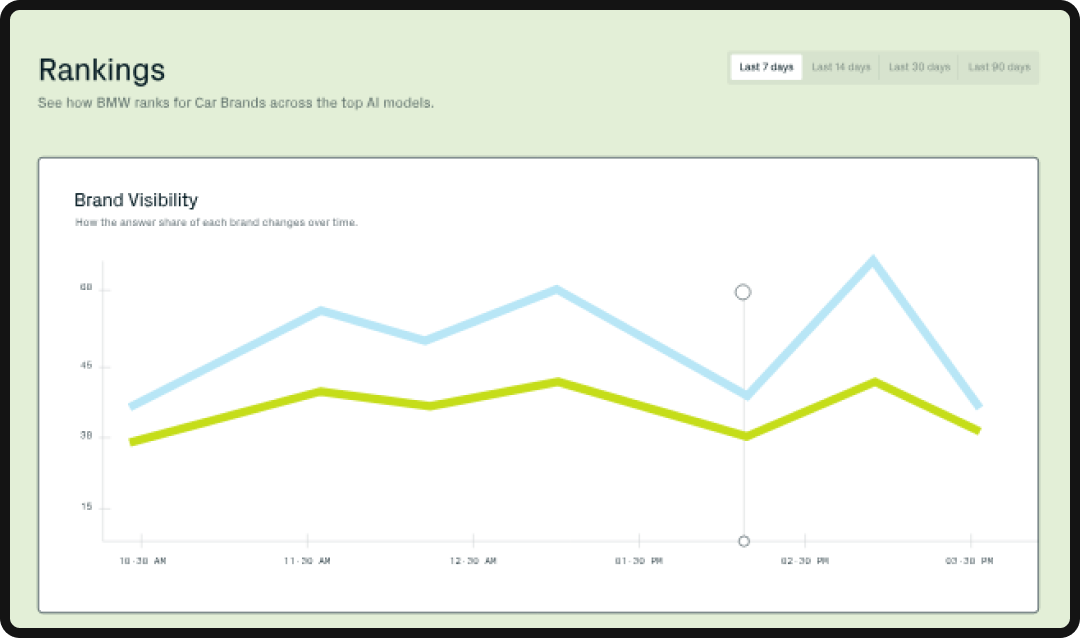
Gauge is an AI visibility platform for teams that want control over their brand presence in generative search. It monitors mentions and citations across ChatGPT, Claude, Gemini, Perplexity, and other engines, and goes beyond basic tracking to deliver gap analyses, competitor benchmarking, and recommendations for improving visibility.
Built by technical teams with deep data expertise, Gauge distinguishes itself through research-driven prompt selection that reflects real user search intent rather than generic “best X” queries. The platform offers an end-to-end workflow (from tracking and analysis to content creation and audit tools), making it ideal for brands that want both strategic insights and tactical execution support in one place.
Key Features:
- Track brand mentions and citations across ChatGPT, Claude, Gemini, Perplexity, CoPilot, and Google AI Overviews
- Identify where competitors appear in AI answers and where your brand is missing, with coverage comparisons and citation breakdowns
- Generate content recommendations and draft articles based on top-performing topics, plus audit tools for optimizing existing pages
Pros:
- Comprehensive end-to-end platform
- Research-driven prompts based on real user search intent
- Strong technical foundation with API access, GA4 integration, and S3 data exports
Cons:
- Requires demo booking (no self-serve onboarding or transparent pricing)
- Steeper learning curve with advanced features that may overwhelm smaller teams
- Newer platform with less established track record compared to enterprise competitors
3. Ahrefs (Brand Radar)
Founded: 2010 | Headquarters: Singapore | Pricing: Starting at $99/month
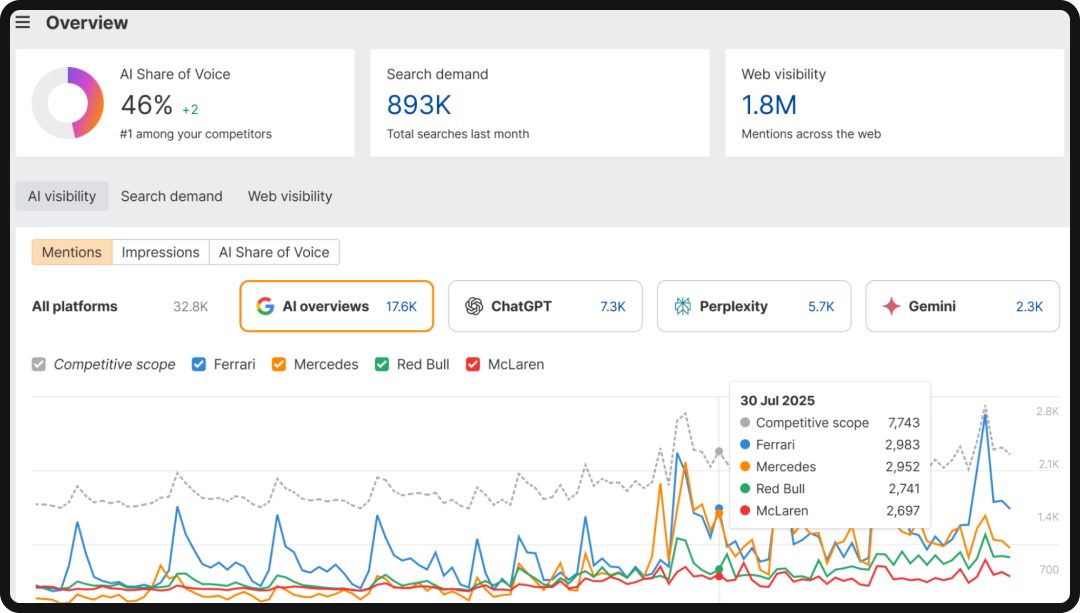
Ahrefs has entered the GEO landscape with its new Brand Radar and AI Visibility features, giving marketers a way to see how their brand is mentioned and ranked within AI-generated responses. Leveraging its extensive backlink, keyword, and content datasets, Ahrefs integrates AI visibility insights directly into the workflows many teams already rely on.
Brand Radar monitors how brands appear across AI assistants and Google’s AI Overviews, providing comparative visibility metrics and share-of-voice data. It’s still early in its GEO evolution, but Ahrefs’ scale and SEO credibility make it a safe, data-rich entry point for marketers exploring AI visibility.
Key Features:
- AI mention and citation tracking across ChatGPT and Google AI Overviews
- Brand Radar dashboard for visibility and sentiment insights
- Integration with Ahrefs’ backlink, content, and keyword data
- Share-of-voice metrics and prompt-level benchmarking
- AI-centric reporting layered onto existing SEO analytics
Best for: Teams already using Ahrefs who want to explore AI visibility insights alongside traditional SEO data.
Pros:
- Deep data ecosystem and reliable SEO infrastructure
- Intuitive interface for current Ahrefs users
- Combines AI visibility with backlink and content analytics
Cons:
- GEO features are new and still limited in scope
- Primarily focused on monitoring, not optimization
- Lacks cross-engine visibility outside Google’s ecosystem
4. WriteSonic

Founded: 2020 | Headquarters: San Francisco, USA | Pricing: Free plan available; paid plans start at $250/month
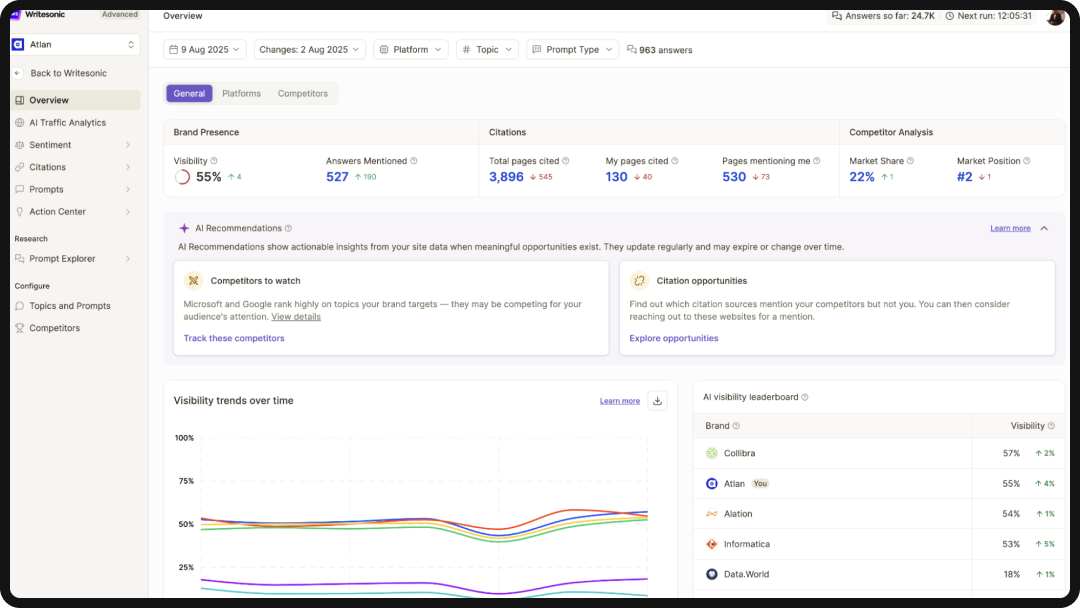
Writesonic is a GEO AI visibility platform that helps brands show up inside AI-generated answers, not just rank on Google. While it started as an AI content creation tool, Writesonic has evolved into a hybrid solution that combines content generation, AI visibility tracking, citation analysis, and brand monitoring in one workflow.
Teams can identify which queries trigger AI answers, see how often their brand is cited across platforms like ChatGPT, Gemini, and Claude, understand which sources AI systems trust, and then immediately optimize content to close visibility gaps all without switching tools.
Key Features:
- AI visibility and citation tracking across leading LLMs
- Query-level insights into what drives AI mentions and answer inclusion
- Built-in AI writing and optimization tools for fast GEO-focused content fixes
- AI Traffic Analytics to see which pages attract AI crawlers
- Action Center to uncover missed AI visibility opportunities
Best for: Agencies and enterprises looking to manage, optimize, and improve their brand visibility across AI-generated answers.
Pros:
- AI visibility tracking across LLMs
- Prompt tracking reveals which user questions trigger brand mentions across AI platforms
- Sentiment analysis shows how your brand is framed inside AI-generated answers (positive, neutral, or negative)
Cons:
- Engine coverage still expanding
- Custom pricing
5. HubSpot’s AEO

Founded: 2025 | Headquarters: Cambridge, Massachusetts, USA | Pricing: Free
HubSpot’s AI Search Grader offers an easy, no-cost way for marketers to understand how their brand appears in AI-generated search results. It scans engines like ChatGPT, Perplexity, and Gemini to evaluate how often your brand is mentioned, the tone of those mentions, and how you stack up against competitors.
While it’s not a full GEO platform, the Grader makes AI visibility tangible for marketing teams that want to get a baseline before investing in deeper tools. It’s particularly helpful for diagnosing whether your brand is being cited accurately or overlooked entirely.
Recently Hubspot acquired a GEO tool and release an AEO platform inside it’s larger marketing automation solution. The AEO module is only available to select mid market and enterprise plans. It’s only limited to visibility tracking at the moment.

Key Features:
- Free visibility snapshot across leading AI engines
- Share of voice and sentiment scoring
- Competitor benchmarking and positioning insights
- Narrative and theme mapping to show how AI describes your brand
- Simple, no-login interface for quick testing
Best for: Marketers or small teams looking to gauge their brand’s AI visibility without committing to an enterprise platform.
Pros:
- Completely free and easy to use
- Clear snapshot of AI visibility and sentiment
- Great entry point for teams new to GEO
Cons:
- Limited to snapshot insights (no ongoing tracking or alerts)
- Doesn’t provide prescriptive optimization recommendations
- Coverage currently focused on ChatGPT, Gemini, and Perplexity
6. Otterly AI
Founded: 2024 | Headquarters: Vienna, Austria | Pricing: Starting at $29/month
Otterly AI makes GEO accessible for small teams and startups with an intuitive dashboard that tracks when and how your brand appears in AI-generated answers. It monitors visibility across ChatGPT, Gemini, Perplexity, and other engines, giving marketers a clear sense of where they stand without overwhelming complexity.
Designed with usability in mind, Otterly translates prompt-level visibility data into digestible insights. While it doesn’t go as deep as enterprise platforms, it’s an excellent choice for marketers who want to understand their AI presence and identify early opportunities to improve it.

Key Features:
- Brand and citation tracking across major AI engines
- Prompt and keyword analysis to convert SEO insights into AI prompts
- Weekly visibility reports and alert notifications
- Link and domain citation breakdowns
- GEO audit tool for visibility health checks and gap detection
Best for: Startups and SMBs that want an affordable, easy way to monitor AI visibility and brand mentions.
Pros:
- Budget-friendly entry point for GEO tracking
- User-friendly dashboard with clear reporting
- Prompt-level insights to connect SEO and AI discovery
Cons:
- Limited optimization recommendations beyond visibility reports
- Prompt and data caps on lower-tier plans
- Visibility tracking can fluctuate as AI engines evolve
7. Peec AI

Founded: 2023 | Headquarters: Berlin, Germany | Pricing: Starting at €89/month (~$95 USD)
Peec AI helps marketing teams understand how their brand is mentioned, interpreted, and represented across AI-generated content. It’s built for visibility analytics, tracking citations, sentiment, and competitive presence across platforms like ChatGPT, Perplexity, and Gemini, without the heavy lift of an enterprise setup.
What sets Peec apart is its simplicity: it visualizes AI visibility trends over time, surfaces which pages or assets drive the most citations, and flags shifts in sentiment or competitor share of voice. It’s particularly well-suited for agencies or small teams managing multiple brands.

Key Features:
- Multi-engine visibility and sentiment tracking
- Citation frequency and position metrics (first mention vs. lower placements)
- Competitor benchmarking dashboards
- Alerts for visibility or sentiment changes
- API and CSV exports for reporting integration
Best for: Agencies and mid-sized marketing teams managing multiple brands or clients looking to benchmark AI visibility at scale.
Pros:
- Combines visibility, sentiment, and benchmarking in one tool
- Real-time tracking with exportable data
- Easy onboarding and lightweight UX
Cons:
- Lacks deep optimization recommendations
- Costs scale quickly with higher prompt volumes
- Regional refresh rates can vary by AI model coverage
8. RankPrompt

Founded: 2025 | Headquarters: Miami, Florida, USA | Pricing: Starting at $29/month
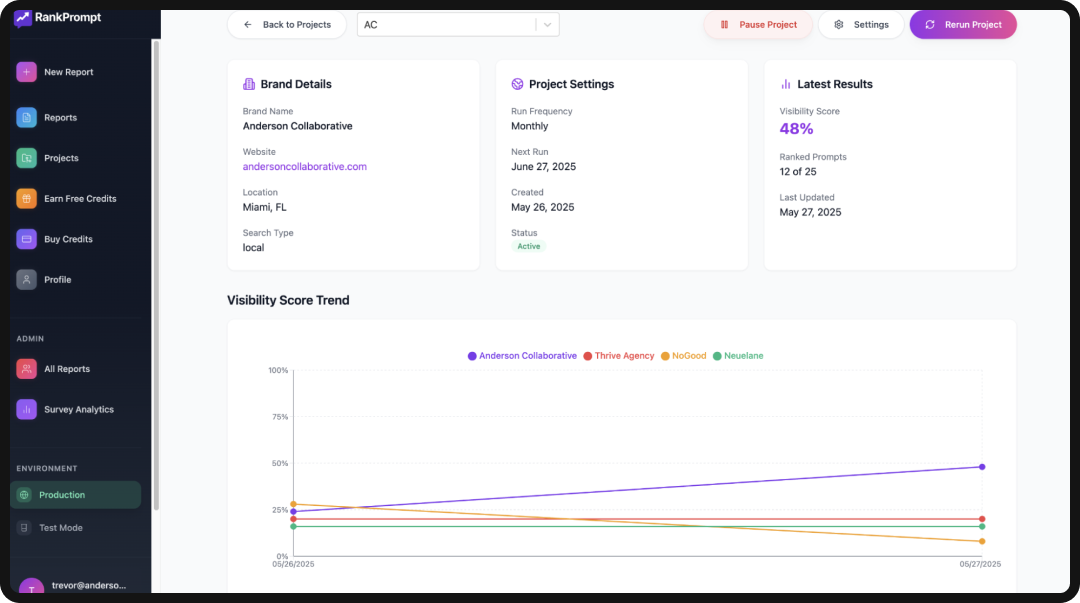
RankPrompt gives marketers visibility into how their brand appears in AI assistants like ChatGPT, Gemini, Grok, and Perplexity—along with actionable ways to improve those mentions. It blends monitoring and optimization, showing not only where your brand is cited but also why it appears (or doesn’t) in AI-generated responses.
The platform uses a credit-based model, allowing smaller teams to run visibility scans and competitor checks without long-term commitments. Its optimization tips focus on schema, structured data, and prompt alignment, helping bridge the gap between SEO and GEO.
Key Features:
- Prompt and citation tracking across multiple AI assistants
- Competitor benchmarking and trend reporting
- Optimization recommendations for schema and entity alignment
- Credit-based scanning model for flexible use
- Prompt performance insights and share-of-voice comparisons
Best for: Small teams and agencies that want prescriptive, affordable GEO insights without committing to enterprise pricing.
Pros:
- Accessible entry point with a pay-as-you-go structure
- Combines monitoring with actionable recommendations
- Multi-assistant tracking for well-rounded coverage
Cons:
- Limited scalability for large enterprises
- Credit caps can restrict high-volume tracking
- Optimization suggestions may require manual implementation
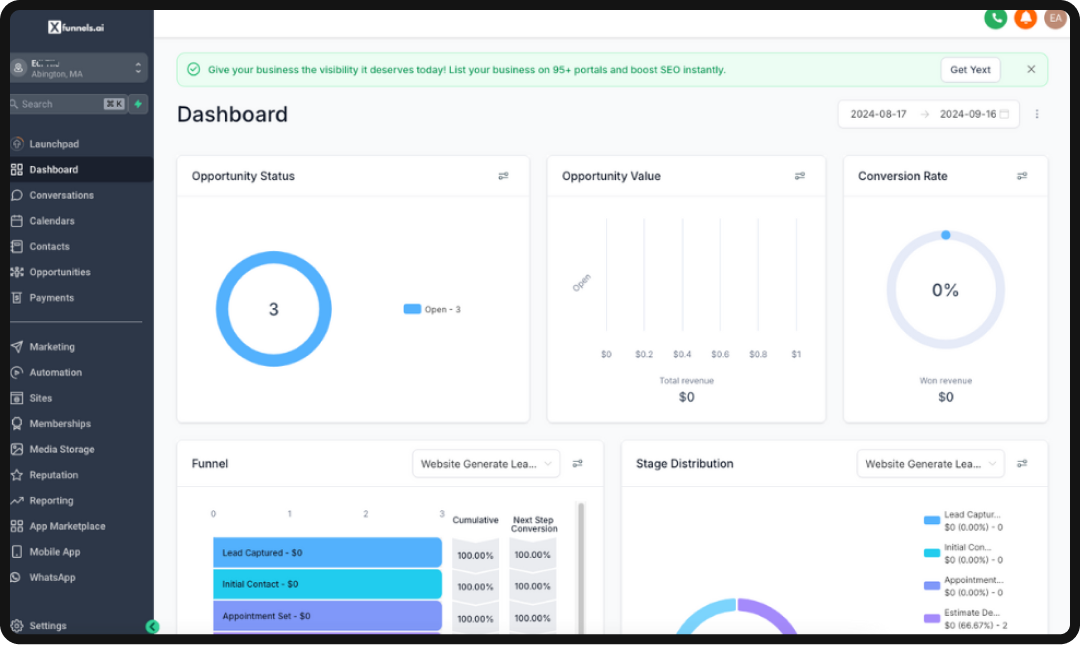
9. XFunnel

Founded: 2025 | Headquarters: New York City, USA | Pricing: Starting at $45/month
XFunnel is a newer GEO platform built for experimentation. Rather than just tracking visibility, it helps marketers test and improve how their brand appears in AI-generated answers. XFunnel blends visibility analytics with optimization playbooks and experiment tracking, making it one of the few tools focused on active GEO improvement, not just reporting.
Its emphasis on iterative testing sets it apart: users can identify underperforming prompts, run structured experiments, and measure visibility gains over time. For teams that like to move fast and validate their optimizations, XFunnel is an agile, data-driven option.
Key Features:
- Brand and citation tracking across ChatGPT, Gemini, Claude, and Perplexity
- Prompt analytics and query discovery by region or persona
- Optimization playbooks and experiment tracking
- Sentiment and tone analysis within AI answers
- Competitive benchmarking dashboards
Best for: Marketing teams that want to run structured GEO tests and improve visibility through ongoing experimentation.
Pros:
- Action-oriented platform focused on visibility improvement
- Built-in playbooks make GEO optimization repeatable
- Combines prompt analytics with measurable experiment outcomes
Cons:
- Still building depth in cross-engine coverage
- Limited long-term trend data compared to legacy platforms
- Experiment workflows require initial setup and strategy
10. Anvil

Founded: 2025 | Headquarters: New York City, USA | Pricing: Starting at $99/month
Anvil calls itself “the SEO platform for the AI era,” but it’s really a GEO visibility engine built for marketers who want to track, compare, and grow their presence in AI search. It monitors brand citations, ranks, and share of voice across engines like ChatGPT, Gemini, and Claude, giving users a clear picture of how often and how prominently their brand appears in AI-generated answers.
Backed by Y Combinator, Anvil moves fast and prioritizes actionable insights. Its query discovery and gap analysis tools help identify prompts where your brand is missing and suggest ways to close the visibility gap.

Key Features:
- Brand visibility tracking and rank measurement across AI engines
- Query discovery and coverage gap analysis
- Share-of-voice and competitive benchmarking
- Optimization suggestions for improving inclusion in AI answers
- Daily or weekly visibility trend reporting
Best for: Growth and marketing teams that want fast, visual reporting on AI visibility and competitive standing.
Pros:
- Clear dashboards and intuitive UX
- YC-backed with rapid feature development
- Great for identifying prompt gaps and missed visibility opportunities
Cons:
- Optimization recommendations remain surface-level
- No deep attribution or crawler analytics
- Prompt caps can limit large-scale enterprise tracking
Why GEO Matters for Businesses
AI search is changing how people discover and trust information. Instead of browsing through pages of results, users increasingly turn to tools like ChatGPT, Gemini, and Perplexity for direct, conversational answers.
That behavior is already influencing purchasing decisions: more than 60% of consumers have used conversational AI for shopping. Users are growing more comfortable asking AI what to buy, where to go, and which brands to trust, making visibility within those AI answers business-critical.
GEO helps brands stay part of that discovery process. It ensures your business is accurately represented in AI responses and positioned competitively among the sources these models most often reference. For marketers and business leaders, that means greater authority, sustained visibility, and a stronger voice in how AI engines describe your category.
How to Choose the Right GEO Tool for Your Business
The right GEO platform depends on your team’s size, goals, and how deeply you want to integrate AI visibility into your marketing stack. While some tools focus on simple monitoring, others go full circle, connecting visibility data to performance and optimization workflows.
Here’s what to consider before committing:
- Platform Coverage: Make sure the tool tracks across all major AI engines: ChatGPT, Gemini, Perplexity, Claude, Grok, and Google’s AI Overviews. The more engines covered, the clearer your true visibility picture.
- Real-Time Monitoring: AI search evolves daily. Look for tools that update frequently (ideally daily or weekly), with alerts when your visibility changes or a competitor overtakes you.
- Actionable Insights: Data without direction is just noise. Prioritize platforms that not only show where you stand, but recommend how to improve — schema updates, entity additions, prompt targeting, or content structure adjustments.
- Integration & Scalability: Your GEO stack should play nicely with your SEO and analytics tools — GA4, GSC, HubSpot, or BI dashboards — and scale as your brand grows.
- Accuracy & Hallucination Checks: This is a newer must-have. As AI engines sometimes “hallucinate” brand details, choose tools that track not just mentions, but whether those mentions are accurate and on-brand.
- Usability & Cost: A fancy dashboard means nothing if your team doesn’t actually use it. Look for clean interfaces, easy exports, and transparent pricing models that fit your workflow.
Closing Thoughts on The GEO Tools Market
GEO is clearly the next frontier of brand discovery for businesses. As AI search quickly becomes one of the default ways people discover information, your brand’s presence in those answers will determine its reach, reputation, and relevance.
Whether you’re just dipping your toes in the GEO waters with free tools like Hall and HubSpot’s AI Search Grader, or if you are an enterprise looking building a long-term strategy with Goodie AI, the key is to start measuring now. Every month you wait, AI models continue learning, and if they’re not learning from your content, they’re learning from someone else’s.
At NoGood, we’ve seen firsthand how early GEO adoption changes the game for brands. The companies leaning into AI visibility today are the ones setting the standard tomorrow.
Generative Engine Optimization (GEO) Tools: FAQs
What are GEO tools?
Generative Engine Optimization (GEO) tools help brands monitor and improve how they appear in AI search results: across platforms like ChatGPT, Gemini, Perplexity, Claude, and Copilot. Instead of tracking rankings like traditional SEO tools, GEO platforms measure citations, mentions, and visibility in AI responses.
How are GEO tools different from SEO tools?
SEO tools optimize for search engines like Google by improving rankings, backlinks, and keywords. GEO tools optimize for AI search engines, focusing on how AI models interpret and reference your brand in generated answers. Both are essential: SEO builds authority, GEO ensures AI recognizes and amplifies it.
Do I need both SEO and GEO?
Yes. SEO ensures discoverability in traditional search; GEO ensures visibility in conversational and generative search. They’re complementary strategies that work together to future-proof your brand’s presence across all search environments.
Which GEO tools are best for beginners?
If you’re just starting out, try Hall or HubSpot’s AI Search Grader. They offer free visibility reports and simple metrics without the complexity of enterprise dashboards.
How often should GEO visibility be tracked?
Weekly monitoring is ideal. AI search engines update continuously, and your brand’s visibility can fluctuate as new content and model versions roll out.
How do I get started with GEO?
Begin by checking your brand’s AI visibility with a free tool like Hall or HubSpot’s Grader. From there, benchmark competitors, set up regular tracking, and start integrating GEO insights into your content and SEO workflows.