

Search isn’t dead; it’s just smarter than us now (sorry SEOs, it’s true).
If you’ve been an SEO for longer than a couple of years, you’ve probably noticed that user behavior has been undergoing a pretty significant change. The era of Googling to find a quick answer is dying; users don’t search as much as they ask, and they sure as hell don’t want to sift through ten blue links when a chatbot that can instantly summarize it is at their fingertips.
In turn, this shift is rewriting the rules of search intent optimization: the art and science of understanding what a user really wants when they type (or speak, or prompt) a query, and ensuring your content matches it.
Without further ado, I’m going to break down how search intent optimization works across both traditional search and AI search (because, despite the fearmongering above, traditional search still very much exists), why the difference matters, and how you can future-proof your strategy for both.
What Is Search Intent Optimization?
Search intent optimization is the process of aligning your content not with the “what” behind a query (aka writing keyword-stuffed content to satisfy Google), but the “why” behind it. It’s not just what people are typing; it’s what they mean when they type it. Consider the following examples:
- When someone searches for the “best espresso machine”, they’re not looking for a monologue about the history of coffee brewing and why X company’s machine is definitively the best; they want a ranked list of several options, a vetted product recommendation, and they probably wouldn’t say no to a coupon, either.
- When they search “how to clean an espresso machine”, they need a tutorial (make that a video or a picture-heavy written guide if you really want to keep them engaged).
- When they search “espresso machine buzzing noise”, they expect the same level of easily digestible content, but more honed in on troubleshooting.
Do you see what I’m saying? Same product, but different intent; alas, you’ll need to create different content.
In good old SEO, search intent optimization has always been the backbone of ensuring you have a user-aligned content strategy. But with AI search on the rise, it’s become something bigger: the key to showing up where users are actually looking (whether that’s Google, ChatGPT, or TikTok).
The Four Types of Search Intent
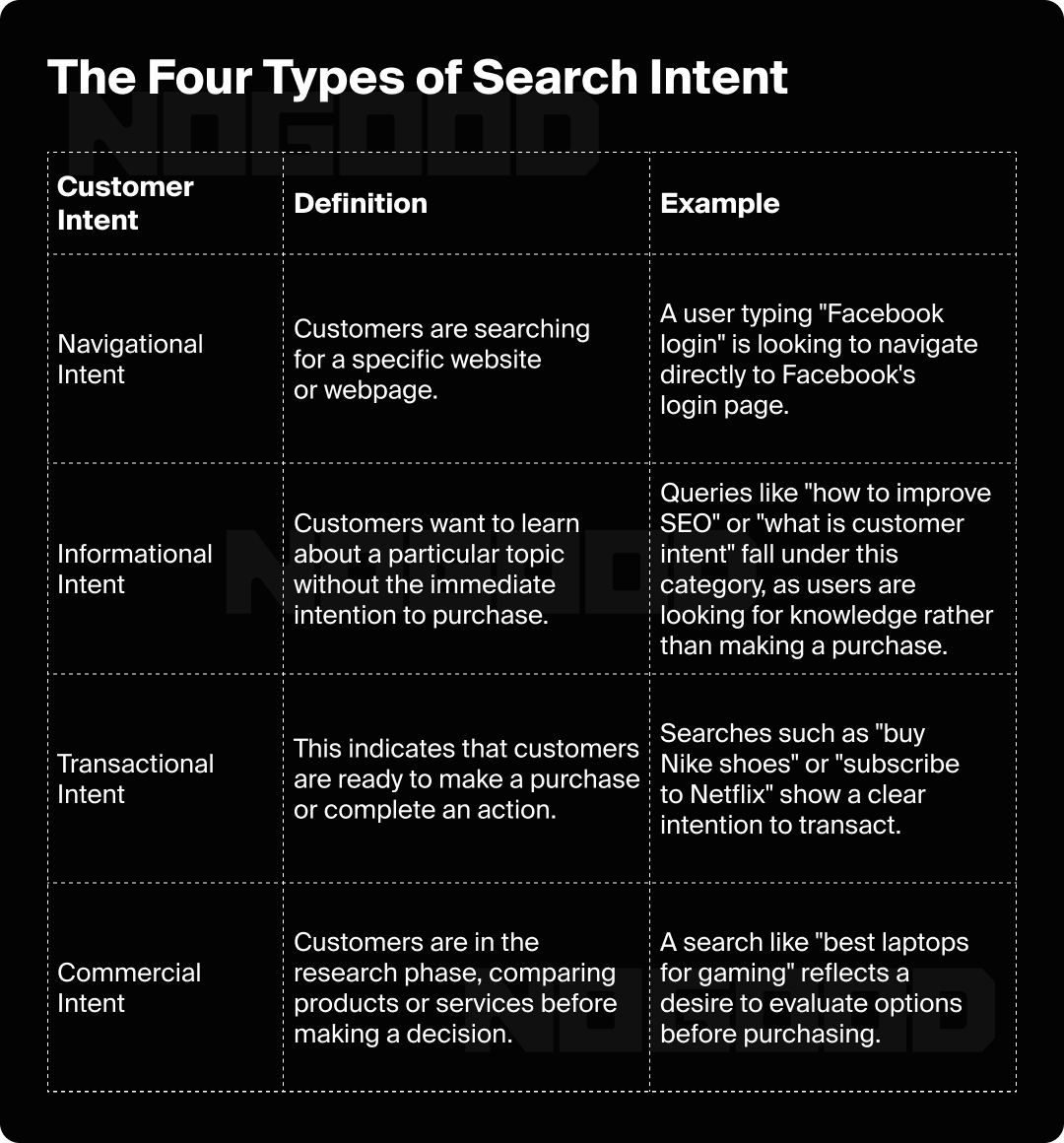
The taxonomy of search intent itself hasn’t changed; the way we interpret and prioritize it has. The four classic types of intent still apply across both traditional and AI search; let’s do a quick refresh on what each one means, the types of content that serve each intent best, and what the “secret sauce” is for AI search intent optimization for each:
Informational Intent
With informational intent, the user wants to learn something (e.g., “how to optimize for search intent”). This type of user intent is best served by blogs, how-tos, guides, videos, and infographics; think any type of material that quickly (but thoroughly) explains a subject.
🤖 The AI Twist: LLMs summarize informational intent instantly. To be parsed by LLMs, your content must be citable, concise, and semantically rich. This is also where you’ll want to employ the classic “answer the question right away and then give context and a longer-winded explanation.
Navigational Intent
When users search with navigational intent, the user already knows where they want to go; they’re just directing the search engine to a specific page on a website (e.g., “Ahrefs blog” or “NoGood SEO case studies”). While optimizing for navigational intent isn’t necessarily the best strategy to capture users who aren’t already familiar with your brand, it’s still a part of the ecosystem. It’s best served by optimized brand pages and consistent naming conventions (brand name, page titles, URL structures, etc.).
🤖 The AI Twist: Rather than locking in on optimizing particular pages one at a time (a lá search engine positioning), focus on brand awareness and authority signals (mentions, structured data, schema); those now determine whether your brand even gets surfaced.
Commercial (or Investigative) Intent
I think of this as the bridge between the top-of-funnel informational intent and bottom-of-funnel transactional intent; with commercial intent, the user is comparing options (e.g., “best SEO agencies for SaaS”). It’s best served by listicles, comparison guides, and UGC.
🤖 The AI Twist: AIn overviews love aggregated, trustworthy data. Don’t freak out, this one’s good news for you. Now, being mentioned (even without a link) is a credibility signal.
Transactional Intent
As the name suggests, transactional intent is when the user wants to act: buy a product, sign up for a course, book an appointment, or download a guide (to name a few examples). This one’s pretty cut and dry, so I won’t over-explain, but transactional intent is best served by landing pages, product pages, and service pages (if you’re dealing with one million product pages, don’t forget to check out my guide on faceted navigation).
🤖 The AI Twist: AI assistants can bypass your funnel entirely by recommending competitors. Clear product data, strong reviews, and conversion-optimized design are your new moat. We recently ran a study over on Goodie that goes over the specific visibility factors that impact what recommendations are made by LLMs for agentic commerce 👀
The 3 C’s of Search Intent Optimization Strategy
Now that we’ve covered the “intent” part of search engine optimization strategy, let’s go over the “strategy” part. One disclaimer: this applies more to traditional search intent optimization more than anything else (aka, before AI came along, content that matched search intent followed the 3 C’s):
- Content Type: what format best satisfies intent (will it be a blog, video, or product page?)
- Content Format: the structure of said content (is it a how-to, comparison, listicle, or long-form piece?)
- Content Angle: the unique perspective that the content will offer (is it going to be data-backed, expert, or beginner-friendly?)
Now, before you ask why we’re talking about this if AI made it a moot point, hear me out: AI didn’t kill the 3 C’s. It just added nuance (in the form of a fourth C).
That fourth C? It’s Context; after all, AI search engines prioritize relevance over rigidity. A well-structured “listicle” with great data may surface as a bullet summary in an AI Overview, even if it’s not “ranked” on page one.
So, how do we implement this in our search optimization strategy? The easiest way to recognize how AI has changed the state of things is to go over both types of search intent optimization.
Traditional Search Intent Optimization: The Human-Algorithm Era
In traditional SEO, intent optimization was about reverse-engineering Google’s brain. Here’s the process most of us grew up on:
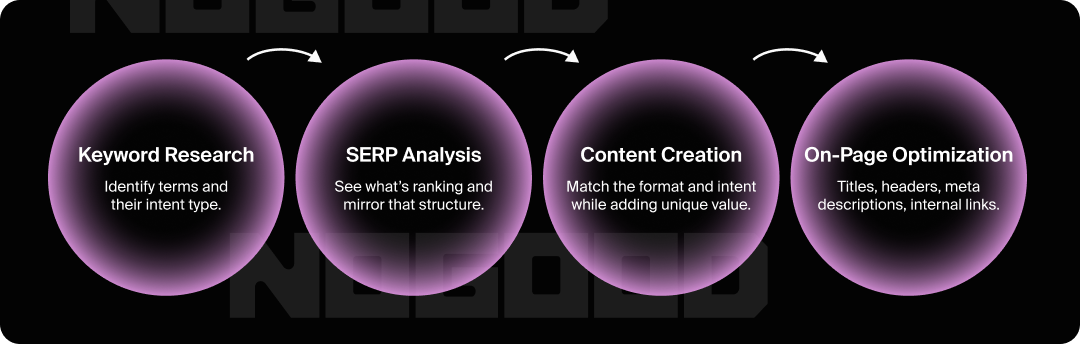
- Keyword Research → Identify terms and their intent type.
- SERP Analysis → See what’s ranking and mirror that structure.
- Content Creation → Match the format and intent while adding unique value.
- On-Page Optimization → Titles, headers, meta descriptions, internal links.
The good news for us SEOs is, this still works (mostly 😅). The trouble is that the user journey is now fragmented and nonlinear. Someone might discover your brand through an AI summary, but end up skipping your page entirely, and yet somehow end up buying from you later via branded search or social proof.
That’s the paradox (and the headache) that AI creates: visibility ≠ clicks, and intent ≠ funnel stage.
AI Search Intent Optimization: The Predictive Era
Here’s what to keep in mind when we talk about search intent optimization in the AI era: AI search doesn’t just react to queries, it predicts them. Tools like ChatGPT, Perplexity, and Gemini analyze patterns in how users phrase questions and then synthesize contextually relevant answers. They often don’t need to send the user anywhere else (hello, zero-click search).
So, what does this mean?
- Keywords matter less; semantic relationships matter more.
- Search engines should now be treated as answer engines.
- Your content is judged not just on keyword alignment, but on depth, credibility, and clarity.
Alright, I’ve led you through the maze of definitions. Let’s get into the meat of this article: how to optimize for AI search intent.
How to Optimize for AI Search Intent
There are five main steps for optimizing for AI search intent. Here’s the secret sauce:

- Write for Citability: AI models extract data and insights, not just text. For this reason, they favor precise language, clear claims, and supporting data (sounds like my statistics professor from college). The short of the long is, if your content can be quoted easily, it can be surfaced easily.
- Adopt Structured Semantics: Schema markup, FAQs, tables, and bullet-point summaries are no longer table stakes; they are 100% necessary in order to make your content machine-readable. If your content is easy for AI to parse, the more likely it’ll be used in answers.
- Be Concise (But Not Shallow): As I mentioned previously, AI prefers succinct, comprehensive answers. Not to get too corporate with it, but think “executive summary” energy: dense with information, light on fluff. You can still have personality and voice in your writing (otherwise, I would be out of a job), but make sure to answer the question right up front.
- Build Topical Authority: AI engines rely on trust networks; if your brand consistently ranks, earns traditional backlinks, and is mentioned in contextually relevant spaces, you’re more likely to be referenced across AI answers.
- Monitor LLM Visibility: Use emerging tools like Goodie, Perplexity Analytics, or BrightEdge Copilot to track mentions in AI summaries, even if they don’t link back. Citations without clicks still signal authority.
Traditional vs. AI Search Intent: What’s Actually Changing
|
Dimension |
Traditional Search |
AI Search |
|---|---|---|
|
User Behavior |
Queries → Clicks → Pages |
Prompts → Answers → Minimal clicks |
|
Content Discovery |
Indexed pages on Google |
Semantic associations given by AI answer engines |
|
Optimization Focus |
Keywords and backlinks |
Entities, context, and credibility |
|
Primary Output |
Blue links |
Synthesized summaries |
|
Conversion Path |
Linear (search → site → convert) |
Fragmented (search → mention → recall → convert) |
|
Metric of Success |
Rankings and traffic |
Mentions, visibility, engagement |
Search Intent in a Multimodal World
One other thing to remember is that search isn’t just text anymore. It started with technologies that, funny enough, sound archaic now (things like Google image search, Alexa, or Google Home voice search), and has now progressed to the multimodal capabilities of LLMs.
The reason I bring this up is that multimodal search is a factor in search intent optimization. To optimize for multimodal along with search intent, inject these into your strategy:
- Add video transcripts and alt text that describe context, not just visuals.
- Include voice-search-friendly phrasing (“how do I…” “what’s the best…”); this is where informational search intent is king 👑
- Make your metadata multimodal so AI can align it with user behavior patterns. Include graphics, tables, charts, video embeds, etc. etc. wherever semantically or contextually relevant throughout your content.
The Role of Real-Time Intent Analysis
The reason that semantics and context are playing such a big role in AI search optimization (or AEO, or GEO, or LLMO, or whatever you’ve decided to call it) is that AI models excel at pattern recognition. They can detect shifts in user intent in real time; something traditional SEO tools struggle to do.
Here’s how marketers can leverage that:
- AI Keyword Clustering: There are specialized tools being developed that use intent classification to organize keywords by semantic proximity, not just volume.
- Real-Time SERP Monitoring: As AI Overviews fluctuate, tracking intent volatility (which queries trigger AI summaries vs. traditional results) can inform content updates.
- Behavioral Analytics Integration: Marketers should be leveraging GA4’s engagement metrics and Clarity’s heatmaps to validate whether the content actually satisfies user intent post-click.
Intent optimization used to stop at publication; now, it’s an ongoing loop of analysis and iteration.
Common Mistakes in Search Intent Optimization (2026 Edition)
🚨 Sound the alarms 🚨Before you start running to your copywriters and telling them all about adding search intent optimization into your editorial strategy, here’s a word of caution (or four):
- Over-Segmenting Intent: Users don’t search in neat little boxes anymore. Don’t write four separate blogs for one topic just to hit each intent (that fragments authority).
- Ignoring AI-Specific Context: If you’re not testing how your content appears in AI Overviews or conversational search, you’re already behind (psst, we have a tool for that).
- Keyword Myopia: Loosen your grip on those precious keywords, SEOs (it was a big change for me, too, trust me). Focusing only on search terms instead of topics, entities, and semantics limits your visibility across both AI and traditional search.
- Assuming Clicks = Success: Zero-click doesn’t mean zero-value. Being cited or summarized by AI models builds brand recognition that often converts later.
How to Measure Search Intent Optimization in 2025
|
Traditional Metrics (Still Useful) |
Emerging AI Metrics |
|---|---|
|
CTR (how compelling is your metadata?) |
AI Presence (are you being referred to in AI search?) |
|
Engagement Rate (how well does your content match user expectations?) |
Semantic Visibility Score (how often does your brand appear in LLMs and in what context?) |
|
Conversion Rate (does user intent align with business outcomes?) |
User Recall Rate (is there a rise in branded search post AI visibility?) |
These may not yet live in Google Analytics, but they’re quickly becoming the new SEO KPIs.
Final Thoughts: Intent Is the New SEO
Search intent optimization has always served as the connective tissue between humans and algorithms; between what users want and what engines serve.
In traditional SEO, intent told you what to write. In AI search, intent tells you how to write it, where to distribute it, and why users might never click (but will still remember you).
Search Intent Optimization FAQs
What is search intent optimization?
Search intent optimization is the process of tailoring your content to match what users actually want when they perform a search. In the age of AI search, it also means ensuring your content is structured, contextual, and credible enough to be referenced by large language models and answer engines.
What are the 3 C’s of search intent?
The 3 C’s of search intent are:
- Content Type: The kind of content that best satisfies the user’s intent (blog post, product page, video, etc.).
- Content Format: The structure of that content (how-to, listicle, comparison, guide).
- Content Angle: The unique perspective or approach you take (data-driven, expert opinion, beginner-friendly).
Now, there’s an (unofficial) fourth C: Context. Since AI-driven search engines now prioritize meaning and relationships between concepts over literal keyword matches.
What are the four types of search intent?
The four types of search intent are informational intent, navigational intent, transactional intent, and commercial or investigative intent.
What are the four types of search engine optimization?
The four main types of SEO are:
- On-Page SEO: Optimizing individual pages through keyword targeting, meta tags, and content quality.
- Off-Page SEO: Building authority through backlinks, digital PR, and brand mentions.
- Technical SEO: Ensuring site speed, crawlability, Core Web Vitals, and structured data compliance.
- Local SEO: Optimizing your online presence for location-based searches (e.g., Google Business Profile, reviews, citations).
Together, they form the foundation that supports search experience optimization (where SEO and UX intersect to create seamless, user-first search experiences).