

Most companies don’t have a tool problem. They have an accountability problem that shows up as a tool problem.
The average company now runs 106 SaaS applications, down slightly from a 2022 peak near 130, but still triple what most GTM leaders assume when asked to guess. Gartner’s 2025 Marketing Technology Survey found that only 49% of MarTech capability actually gets used, and just 15% of organizations qualify as “high performers”; teams that meet strategic goals and can prove ROI on the stack they’ve built. The other 85% are paying full price for a system that works at half capacity.
This article lays out a GTM stack audit: a structured process for finding out what you actually have, what it actually does, and what you can cut without breaking revenue. It introduces two frameworks developed by NoGood: 1) the GTM Stack Maturity Model and 2) the Keep/Consolidate/Cut/Investigate (KCCI) Matrix, along with a step-by-step methodology, a real-world consolidation example, and an executive checklist you can run this quarter.
The goal isn’t fewer tools for the sake of a smaller invoice. It’s a system where every tool earns its place, every handoff has an owner, and revenue doesn’t depend on integrations nobody remembers building.
Why Most GTM Stacks Are Broken, Not Just Bloated
Most organizations don’t have too many GTM tools. They have too many disconnected decisions, made by different teams, in different budget cycles, with no one accountable for how the pieces fit together.
A sales team buys an enrichment tool to hit pipeline targets. Marketing layers on an ABM platform to justify a new campaign. RevOps inherits a CRM configured by three different admins, none of whom still work there. Eighteen months later, no one can say with confidence which tools are load-bearing and which are surviving purely on inertia and a renewal date nobody flagged.
That’s not a technology failure. It’s a governance failure that technology happens to make visible.
This distinction matters because it changes what an audit is for. A tech stack audit that only asks “what should we buy or cancel” will produce a shorter tool list and the same underlying dysfunction. A GTM stack audit that asks “who owns this decision, and does the system reflect that” produces something durable: a stack that stays consolidated instead of re-sprawling within a year.
For a deeper look at how the modern GTM stack should be architected, not just audited, see NoGood’s guide to what GTM engineering is and why every growth team needs one.
What Is a GTM Stack Audit?
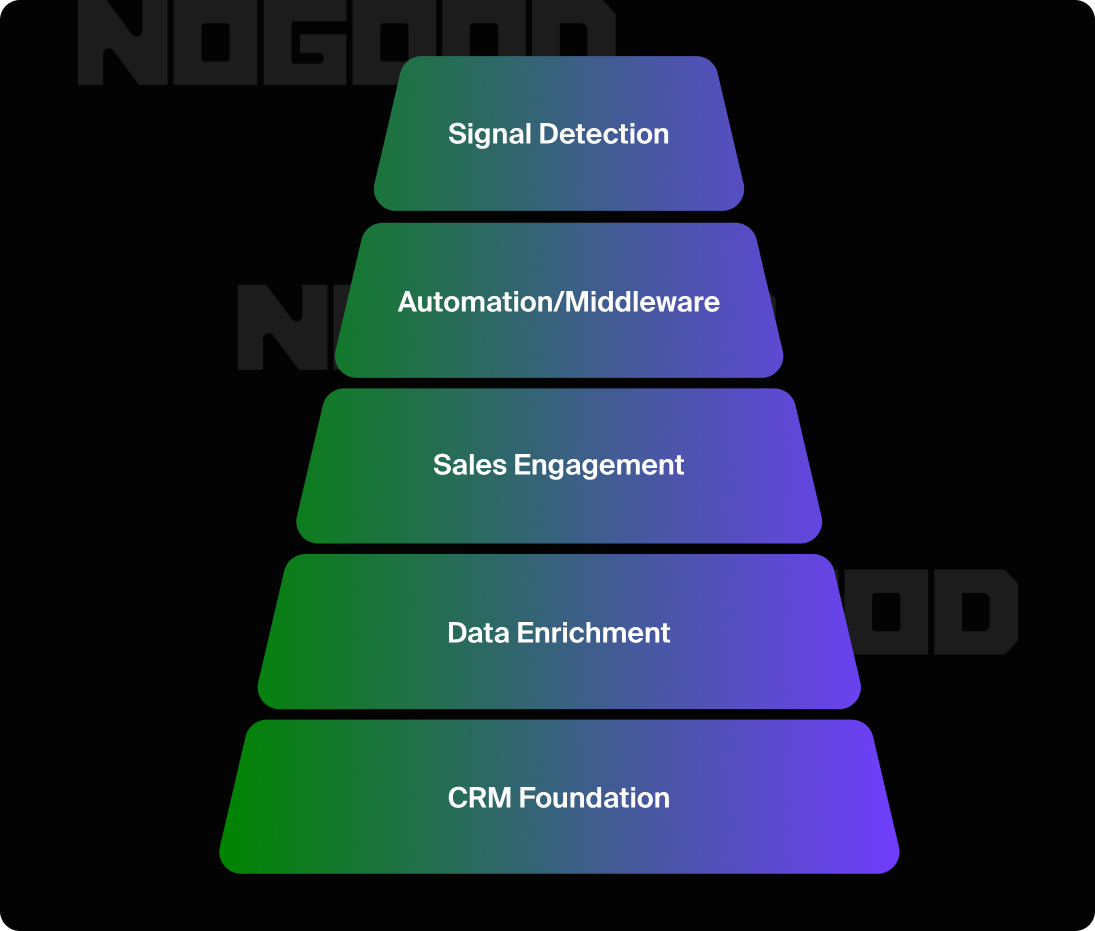
A GTM stack audit is a structured evaluation of every tool, integration, and workflow involved in generating and converting pipeline, assessed against actual usage, data quality, ownership, and strategic necessity, with the goal of consolidating overlapping systems into a smaller set of tools that the whole revenue org can trust.
It differs from a standard software audit in three ways:
- It’s revenue-scoped, not department-scoped. It follows a lead or account across marketing, sales, and customer success, not just within one team’s tool budget.
- It measures usage, not licensing. A tool with 40 seats and 6% weekly active use is not “adopted.” It’s shelfware with a login page.
- It ends in an architecture decision, not a spreadsheet. The deliverable is a target-state stack and a migration sequence, not a list of things to “look into.”
A GTM stack audit typically covers the same five layers NoGood outlines in its GTM engineering framework: CRM foundation, data intelligence and enrichment, sales engagement, workflow automation and middleware, and signal or intent detection. Sprawl rarely happens evenly across all five, it concentrates in one or two layers where buying was easiest and governance was weakest.
Why It Matters: The Real Cost of GTM Tool Sprawl
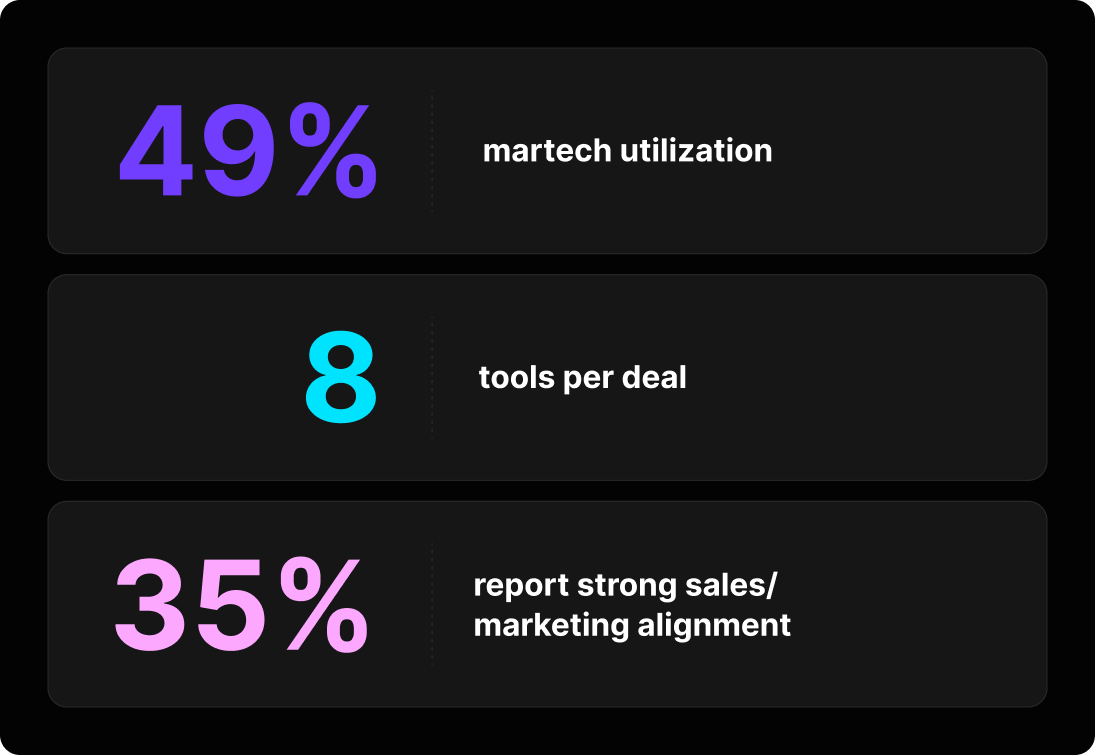
Tool sprawl doesn’t show up as a single line item, which is exactly why it survives budget reviews. It shows up as friction distributed across the entire revenue funnel.
- It shows up in speed to lead. Decades of lead-response research, originally from MIT and InsideSales, replicated repeatedly since, found that contacting a lead within five minutes makes a rep roughly 21 times more likely to qualify it than waiting 30 minutes, and up to 100 times more likely to reach the prospect at all. Yet a 2024 audit of 1,000 B2B SaaS companies by RevenueHero found that 63.5% never responded to a demo request at all. That’s not a discipline problem. It’s what happens when routing logic lives in three disconnected systems and no single tool owns the handoff.
- It shows up in rep productivity. Salesforce’s most recent State of Sales research found that reps spend only 28-30% of their week actually selling, use an average of 8 tools to close a single deal, and that 42% of sellers feel overwhelmed by the number of tools in their stack. Overwhelmed reps are 45% less likely to hit quota. The stack meant to make them faster is making them slower.
- It shows up in alignment. HubSpot’s State of Marketing research found that only 35% of marketers report strong alignment with sales, and just one in five say their marketing data is fully integrated with the tools they use daily. Eighty-two percent believe a single source of truth would meaningfully improve performance, they just don’t have one.
- It shows up in attribution. Every attribution model NoGood has evaluated breaks down at the same point: customer data scattered across analytics platforms, CRM records, and point tools that were never designed to talk to each other. (See NoGood’s guide to marketing attribution models for how this plays out in practice.)
- It shows up in the budget, eventually. Per Gartner’s 2026 CMO Spend Survey, martech’s share of the marketing budget has fallen from 26.6% in 2021 to roughly 19% today, a five-year low. But 62% of CMOs surveyed still planned to increase martech investment. Read together, those two numbers tell the real story: budgets aren’t shrinking, they’re being reallocated away from sprawl and toward tools that actually get used.
“You don’t fix sprawl by buying a platform. You fix it by deciding who’s allowed to buy anything at all.”
Common Mistakes Companies Make When Auditing Their Stack
Most consolidation efforts fail before they start, for one of these reasons:
| Mistake | Why It Fails |
| Auditing spend instead of usage | A tool can be fully paid for and 8% utilized. Finance sees a renewal; nobody sees the gap. |
| Letting the loudest team keep their tools | Political capital isn’t the same as strategic necessity. Sprawl survives audits when the audit is a negotiation. |
| Consolidating around a single “platform” too early | Suites solve integration problems but often reintroduce feature gaps that spawn a new round of point-solution buying within 18 months. |
| Skipping data migration planning | Cutting a tool without a plan for its historical data creates a reporting gap that takes longer to fix than the tool took to justify. |
| Treating the audit as a one-time event | Without governance, the stack re-sprawls. NoGood consistently sees re-sprawl begin within two to three quarters of an unowned consolidation. |
| Buying AI tools before fixing the data foundation | Gartner’s October 2025 survey of 413 MarTech leaders found 45% say vendor AI agents fail to meet promised performance, and half point to unready internal data and technical infrastructure as the reason. AI amplifies whatever foundation it’s built on, including a broken one. |
The pattern underneath all six: consolidation is treated as a procurement exercise instead of an operating model decision. Procurement fixes cost. Only an operating model fixes recurrence.
The Proprietary Methodology: NoGood’s GTM Stack Audit Framework
Every audit NoGood runs uses two tools together: a maturity model to diagnose where an organization sits, and a decision matrix to evaluate what to do with every individual tool inside the stack.
Framework 1: The GTM Stack Maturity Model
Most organizations can place themselves on this model within a single conversation.
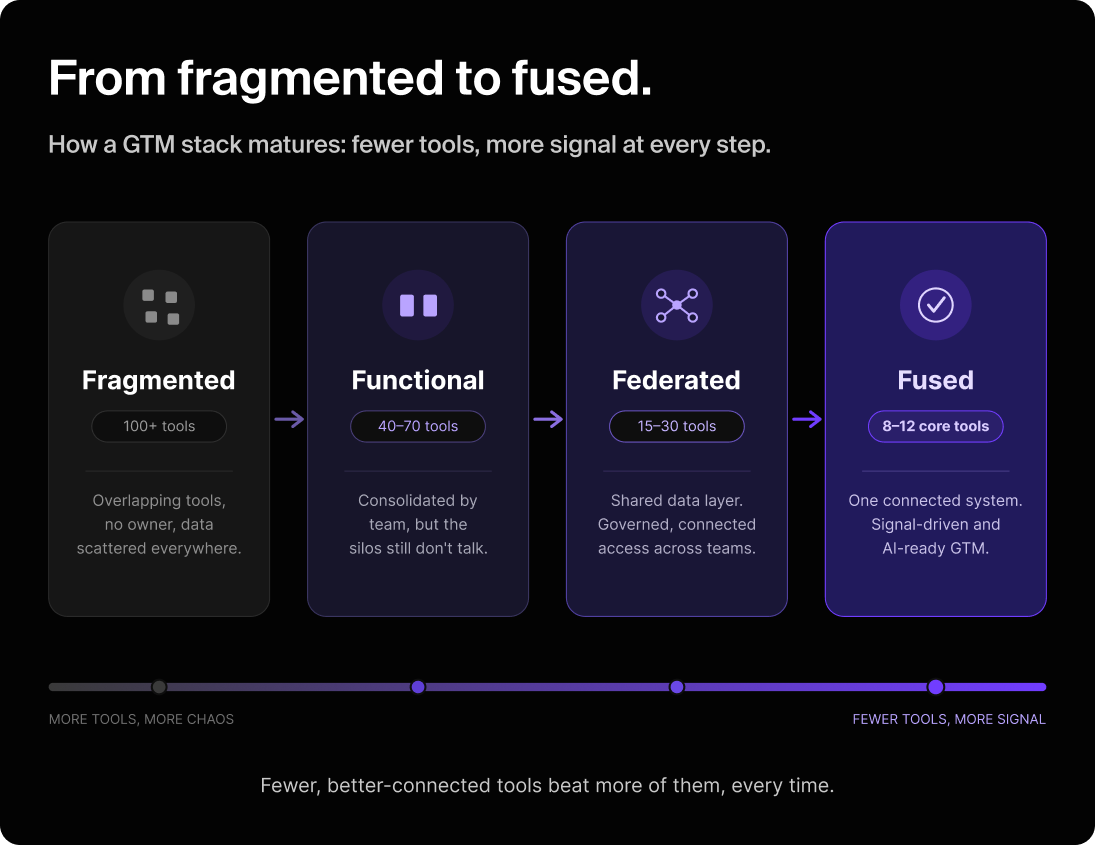
| Stage | Characteristics | Typical Tool Count |
| 1. Fragmented | Tools bought departmentally with no shared data model. No one owns the full stack. Reporting requires manual reconciliation. | 80-130+ |
| 2. Functional | Core systems (CRM, marketing automation) are standardized, but enrichment, engagement, and automation tools remain siloed by team. | 50-80 |
| 3. Federated | RevOps owns governance and a shared data model exists, but tool selection is still distributed across functional leads with loose oversight. | 25-50 |
| 4. Fused | A single team owns the full GTM architecture. Every tool maps to a defined layer, has a named owner, and is reviewed on a fixed cadence. | 15-30 |
Almost no organization skips a stage. The audit’s job is to identify precisely where a company sits today and what specifically is blocking the move to the next stage, usually a governance gap, not a technology gap.
Framework 2: The Keep / Consolidate / Cut / Investigate (KCCI) Matrix
Once you know where the organization sits on the maturity model, every individual tool gets scored against two axes: usage depth and strategic criticality.
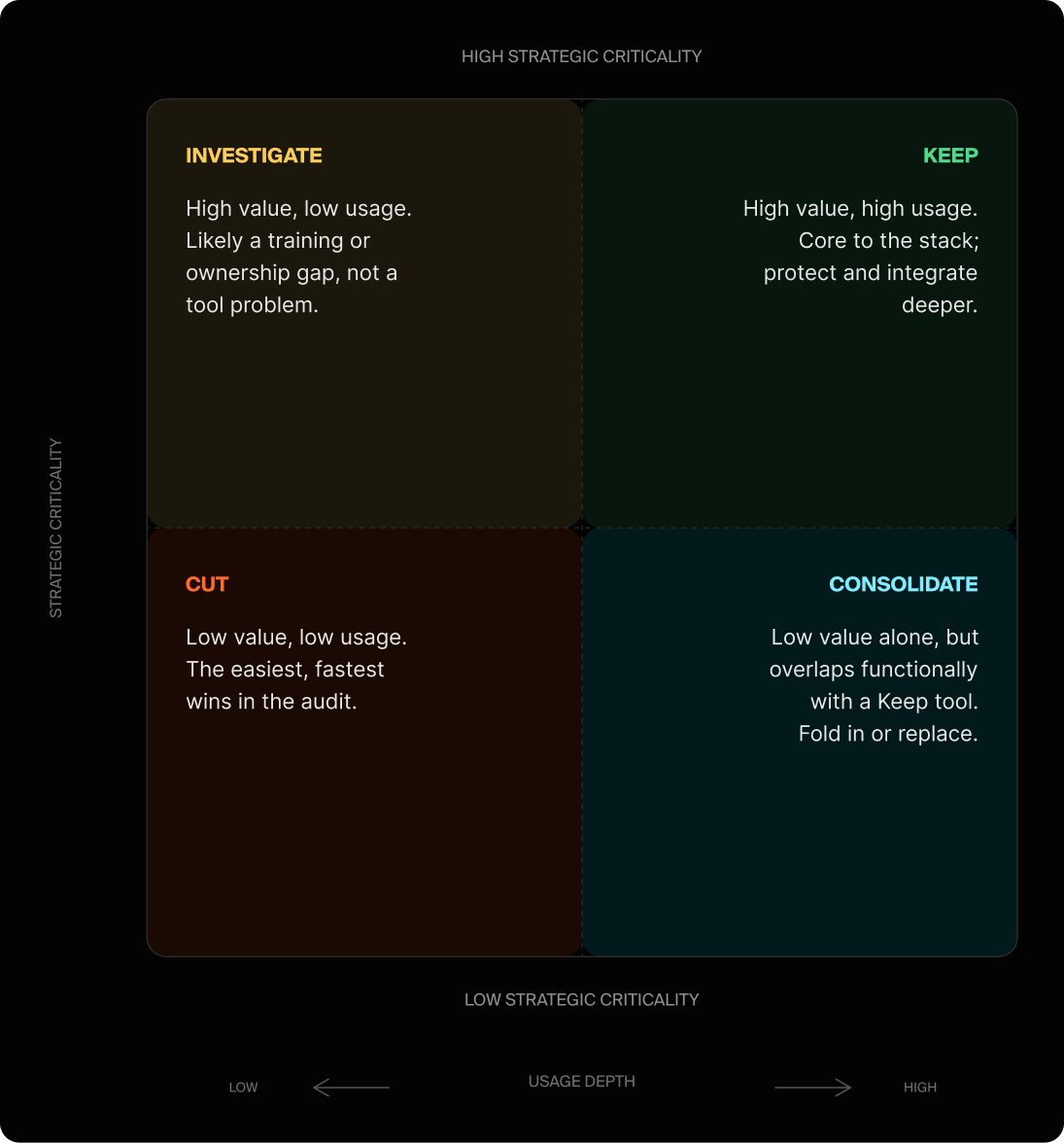
- Cut candidates are the fastest wins: any tool with under 50% feature adoption, no activity in the last 90 days, or a redundant integration already covered elsewhere.
- Consolidate candidates require more judgment: they may be well-used by one team but functionally duplicated by a tool another team already owns. The decision usually isn’t “which tool is better”, it’s “which tool should own this capability going forward.”
- Investigate is the quadrant most audits skip, and the one that matters most. A high-criticality tool with low usage isn’t automatically a Cut candidate. It might mean the team was never trained, the integration is broken, or ownership was never assigned after a reorg. Cutting it prematurely can remove capability the business still needs.
- Keep tools get the opposite treatment: instead of scrutiny, they get investment. Deeper integration, better data hygiene, and protection from the next round of point-solution buying.
Step-by-Step: How to Run a GTM Stack Audit
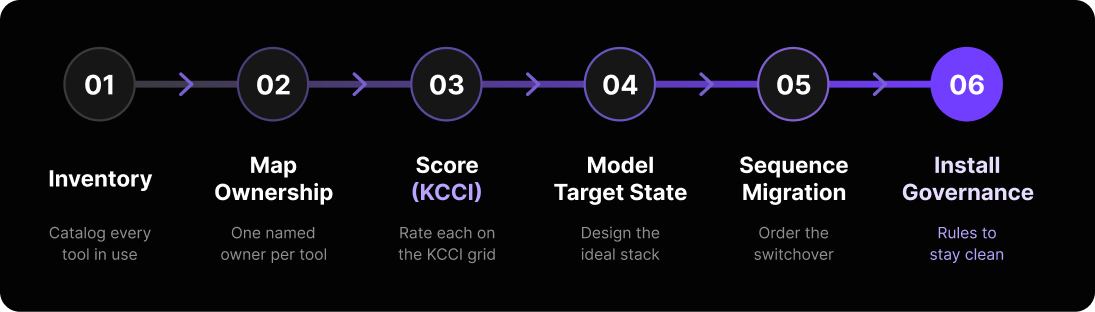
Step 1: Inventory Every Tool Actually In Use, Not What Finance Thinks You Have
Start with the expense report, but don’t stop there. Cross-reference SSO logs, browser extension usage, and card statements outside the main procurement system. Shadow IT, tools bought on a personal card and expensed later, is where the most invisible sprawl lives. Most companies find 15-30% more active tools than their procurement system shows.
Step 2: Map Ownership, Spend & Contract Terms
For every tool: who owns the relationship, what it costs annually, when it renews, and what happens to the data if it’s cancelled. This step alone surfaces tools with no clear owner, a strong early signal for the Cut or Consolidate quadrants.
Step 3: Score Usage & Criticality Using the KCCI Matrix
Pull actual usage data (i.e. logins, feature adoption, API call volume) rather than relying on self-reported importance. Interview the tool’s stated owner and at least one downstream user. The gap between what an owner claims and what usage data shows is often the most useful finding in the entire audit.
Step 4: Model the Target-State Architecture
Map every “Keep” tool to one of the five GTM stack layers (CRM foundation, data intelligence, sales engagement, automation/middleware, signal detection). Gaps in coverage, not tool count, determine what, if anything, needs to be added back in.
Step 5: Sequence the Migration by Risk & Pain, Not by Contract Expiration
Start with Cut-quadrant tools with no data dependencies. These build momentum with minimal risk. Save Consolidate-quadrant migrations that touch historical CRM data or active sales sequences for last, and plan a parallel-run period before fully decommissioning anything customer-facing.
Step 6: Install Governance Before You Declare the Audit Finished
This is the step almost everyone skips, and the reason most consolidations don’t last. At minimum: a named stack owner (usually RevOps), a standing quarterly review of usage against the KCCI Matrix, and a purchasing gate that requires new tool requests to map to a specific gap in the five-layer architecture before approval.
Real-World Example: A Composite B2B SaaS Consolidation
The following is an anonymized composite based on patterns NoGood has observed across multiple B2B SaaS engagements, not a single client engagement.
Before: A ~450-person B2B SaaS company with roughly $60M in ARR had grown its GTM stack from 12 tools to 118 over five years, largely through departmental purchasing during three consecutive growth-stage funding rounds. No single team owned the full stack. Sales, marketing, and CS each maintained separate views of the same accounts.
The Challenge: Pipeline reporting required a weekly manual reconciliation between four systems, took a RevOps analyst roughly a day and a half to complete, and was frequently out of date by the time it reached leadership. Lead response time averaged 11 hours. Two enrichment tools and three engagement platforms were running in parallel with no clear ownership of which fed which.
The Solution: A GTM stack audit placed the company at Stage 1 (Fragmented) on the maturity model. Applying the KCCI Matrix across all 118 tools identified 41 Cut candidates (average usage under 20%), 23 Consolidate candidates clustered mainly in the enrichment and sales-engagement layers, 6 Investigate candidates tied to a recent reorg that had orphaned tool ownership, and 48 Keep tools that were mapped cleanly to the five-layer architecture. RevOps was named the standing owner of the consolidated stack, with a quarterly review cadence built into the operating rhythm.
Outcome: The company moved from 118 tools to 34 over two quarters. Manual pipeline reconciliation was eliminated entirely by consolidating reporting into a single source of truth. Lead response time dropped from 11 hours to under 20 minutes once routing logic was centralized in one engagement platform instead of split across three.
Lessons Learned: The biggest resistance came not from the Cut quadrant (those conversations were straightforward once usage data was on the table) but from Consolidate. Teams that had built workflows around a specific tool experienced the migration as a loss of control, regardless of the data showing overlap. The lesson: sequence Consolidate migrations with the affected team’s input on which surviving tool it will use going forward. Consolidation that feels imposed gets quietly undermined; consolidation that feels chosen gets adopted.
Executive Checklist: Is Your GTM Stack Ready for an Audit?
Use this checklist to gauge urgency. Three or more “no” answers indicates active tool sprawl with measurable revenue impact.
- Can you name every tool in your GTM stack without checking an expense report?
- Does every tool have a single, named owner accountable for its usage and ROI?
- Can you produce a pipeline report without manually reconciling data across systems?
- Is your average lead response time under 15 minutes?
- Does marketing consider its data “fully integrated” with sales’ systems?
- Has any tool in your stack gone unused for 90+ days without being flagged for cancellation?
- Is there a defined process a team must follow before purchasing a new GTM tool?
- Could you map every tool you own to one of the five GTM stack layers today?
- Has your tool count grown faster than your headcount in the last 12 months?
- Do you have a standing quarterly review of stack usage and cost?
Where to Start This Quarter
Don’t start by canceling tools. Start by finding out what you actually have.
Pull your full SaaS expense report, cross-reference it against SSO login activity, and get an honest usage number for every tool with an active seat. That single exercise (before any framework, before any vendor conversation) will surface more sprawl than most executives expect, and it will tell you immediately whether your organization sits at Stage 1 or Stage 3 on the maturity model above.
From there, the KCCI Matrix gives you a defensible, data-backed way to make the Keep, Consolidate, and Cut decisions without turning the process into a political negotiation between department heads.
If you want a structured, outside-in version of this process, one that includes usage benchmarking, a five-layer architecture map, and a governance model built for your specific org chart, that’s the engagement NoGood runs with GTM and RevOps leaders directly. Talk to NoGood about a GTM stack audit or start by reviewing how a modern GTM tech stack should be architected in NoGood’s guide to GTM engineering.
GTM Stack Audit FAQs
What is a GTM stack audit?
A GTM stack audit is a structured review of every tool, integration, and workflow used across marketing, sales, and customer success to generate and convert pipeline, evaluated by actual usage and strategic necessity, not licensing cost alone, with the goal of consolidating redundant systems into a smaller, better-governed stack.
How many tools should a B2B SaaS company have in its GTM stack?
There’s no universal number, but as a benchmark: early-stage companies typically run 10-20 tools, mid-market companies 25-50, and enterprises 60 or more. The right number is whatever fully supports your five GTM stack layers without duplication, not the smallest number possible.
How long does a full GTM stack audit take?
For a mid-market organization with 50-120 tools, a thorough audit typically takes four to six weeks: inventory and ownership mapping in weeks one and two, usage scoring and the KCCI Matrix in weeks three and four, and target-state architecture and migration sequencing in weeks five and six.
What’s the difference between a tech stack audit and a GTM stack audit?
A tech stack audit is often scoped to a single department’s software budget. A GTM stack audit follows the lead or account journey across marketing, sales, and customer success, and evaluates tools by their role in that shared journey rather than by which team’s budget they sit in.
Should we consolidate onto a single all-in-one platform?
Sometimes, but not by default. Suites reduce integration overhead but frequently reintroduce feature gaps that trigger a new round of point-solution buying within 12-18 months. The audit should determine consolidation targets based on the KCCI Matrix, not on a predetermined preference for one platform over many.
Who should own the GTM stack after consolidation?
In the large majority of organizations NoGood works with, RevOps is best positioned to own the consolidated stack, since it sits structurally between marketing, sales, and customer success. Ownership matters more than which specific team holds it, the stack re-sprawls whenever there’s no accountable owner at all.