

As an engineer who became fascinated by growth marketing, my instinct is to always build complex models for everything. But the deeper I dove into performance marketing, the more I learned that simplicity is often the thing that drives better incrementality.
What Is Incrementality?
Let’s take a step back and explore what I really mean when I say incrementality. In marketing, incrementality measures the true impact each channel has on your business; think about diagnosing what would happen if you removed that channel entirely. I visualize incrementality like diagnosing a water leak: you turn off one valve at a time until you’re certain you’ve found the source.
Strong growth marketers should prioritize developing the intuition to know which channels actually affect the business and to what extent spending can be reduced while maintaining results. A compelling example is Airbnb’s bold move in 2020, when they cut performance marketing spend by 28%, yet overall traffic to the platform only dropped by 5%. Before you rush to slash your marketing budget, understand what allowed Airbnb to do this: they relied on a foundation of exceptionally strong brand equity, giving them this flexibility.
The key to incrementality is to step back and ask yourself the following at every business milestone:
- Am I spending too much?
- Are all business wins directly proportional to performance marketing spending, or not?
These questions will elevate your overall efficiency, leading to less cash burn and better metrics.
Different Types of Attribution Models
Referencing my earlier anecdote of treating incrementality like diagnosing a water leak (by turning valves on and off), testing incrementality by pausing spend isn’t always practical. This is where attribution models become essential; different attribution models help you understand channel impact without risking your entire budget.
Let’s review the six most common types of attribution and what they’re best used for:
1. First-Click Attribution
First-click attribution gives 100% credit to the first ad that a user clicks, regardless of subsequent interactions.
- Example: A user sees your ad on Meta and clicks it but does not convert; they later see your ad on TikTok and do convert. In first-click attribution, Meta receives full credit.
- Best For: New businesses who are wanting to identify which channels spark initial interest and drive discovery.

2. Last-Click Attribution
As the name suggests, last-click attribution is the exact opposite of first-click attribution: the final ad clicked before conversion receives 100% of the credit.
- Example: A user sees multiple ads across different platforms (Meta, TikTok, etc.), but only converts after clicking your Google ad. With last-click attribution, Google receives full credit for the conversion.
- Best For: eCommerce and DTC brands who are focused on understanding which ads directly cause conversions.

3. Linear Attribution
In linear attribution, each touchpoint receives equal credit, regardless of its position in (or the order of) the customer interaction journey.
- Example: A user interacts with your LinkedIn ad, clicks your YouTube ad a few days later, and then finally converts after receiving your remarketing email. With linear attribution, all three touchpoints will receive 33.3% credit each.
- Best For: Businesses with long sales cycles or high-ticket items, where each touchpoint plays an important role in moving prospects toward purchase.

4. Time-Decay Attribution
In time-decay attribution, touchpoints closer to the conversion receive more credit, with weight decaying as you move backwards in the customer journey.
- Example: In a four-touchpoint journey, the last interaction receives 50% of the credit, the second-to-last receives 25%, and so on, with the first touchpoint receiving the least credit.
- Best For: Businesses with long consideration periods, such as real estate agencies where the most recent property viewings have the most influence on final buying decisions.

5. U-Shaped (Position-Based) Attribution
U-shaped (also called position-based) attribution balances first-click and last-click models by giving the highest weight to both the first and last touchpoints (typically 40% each), with the remaining 20% distributed equally among the middle touchpoints.
- Example: A customer interacts with an Instagram ad, sees two more ads for your product over the next week, and finally converts after clicking a TikTok ad.
- Best For: Businesses valuing both customer acquisition (first touch) and conversion (last touch).

6. Data-Driven (Dynamic) Attribution
Data-driven (also called dynamic) attribution is the most sophisticated model; it uses machine learning to dynamically assign weight to each touchpoint based on its actual impact on conversion probability.
- Example: A customer sees a YouTube ad, then an Instagram ad, then a TikTok ad, then clicks a Google ad and converts from your website. Data-driven attribution uses machine learning to analyze the customer’s path and attributes credit to all touchpoints accordingly.
- Best For: Businesses who are already advertising on many channels, and have sufficient data volume to train the model effectively.

Attribution Models: Quick Reference Guide
|
Type of Attribution |
Definition |
Example |
Best For |
|---|---|---|---|
|
First-Click |
Gives 100% credit to the first ad that a user clicks, regardless of subsequent interactions |
A user clicks a Meta ad but doesn’t convert; later clicks a TikTok ad and converts (Meta receives full credit). |
New businesses wanting to identify which channels spark initial interest and drive discovery. |
|
Last-Click |
The final ad clicked before conversion receives 100% of the credit |
A user sees multiple ads across platforms but only converts after clicking a Google ad (Google receives full credit). |
eCommerce and DTC brands focused on understanding which ads directly cause conversions. |
|
Linear |
Each touchpoint receives equal credit, regardless of its position in the customer journey |
A user interacts with LinkedIn, clicks YouTube, then converts via remarketing email (all three touchpoints receive 33.3% credit each). |
Businesses with long sales cycles or high-ticket items, where each touchpoint plays an important role. |
|
Time-Decay |
Touchpoints closer to conversion receive more credit, with weight decaying backwards in the journey |
In a four-touchpoint journey, the last interaction receives 50% credit, second-to-last receives 25%, with decreasing credit for earlier touchpoints. |
Businesses with long consideration periods (e.g., real estate) where recent interactions have the most influence. |
|
U-Shaped (Position-Based) |
Gives highest weight to first and last touchpoints (typically 40% each), with remaining 20% distributed equally among middle touchpoints |
Customer sees Instagram ad, two more ads over a week, then converts after clicking TikTok ad. First and last touchpoints get 40% each. |
Businesses valuing both customer acquisition (first-touch) and conversion (last-touch). |
|
Data-Driven (Dynamic) |
Uses machine learning algorithms and data to assign weight to each touchpoint based on its actual impact on conversion probability |
Customer sees YouTube, Instagram, TikTok ads, then clicks a Google ad and converts. ML analyzes the path and attributes credit accordingly. |
Businesses advertising on many channels with sufficient data volume to train the model effectively. |
How to Choose the Right Attribution Model
As with many other areas of marketing, attribution is a gray area; in other words, there is no universally “right” or “wrong” attribution model. Rather, your choice should be based on:
- The length and complexity of your customer journey
- The number of channels you’re advertising on
- Your business goals (awareness vs. conversion)
- The volume of available data
Where & How to Implement Attribution Models
“You should always use the most sophisticated tool to get the best results!”
Though my engineering brain would like to agree (and I would have had you asked me a few years ago), not quite. Always assess what’s best for your current business stage and choose accordingly. Here are the main approaches:
1. Build Your Own (DIY Model)
If you have sufficient technical resources, you can build a custom attribution model using Python. This provides maximum flexibility in adjusting attribution models and conversion windows.
Critical considerations:
- Industry Standards: Avoid over or underestimating certain channels
- Technical Ecosystem: Your ability to capture user-level data (IDFA, GAID, Click ID, IP)
- Engineering Resources: Requires ongoing maintenance and expertise
💡 Note: Custom attribution requires significant engineering investment. Most businesses should use established tools unless they have unique requirements that off-the-shelf solutions can’t address.
2. Analytics Tools
Platforms like Google Analytics 4 (GA4) have built-in attribution models. Simply install their pixels / SDKs on your website or app (using Firebase for apps), and they handle the rest.
Pros:
- Easy implementation
- Pre-built reports
- Free (for GA4)
Cons:
- Limited to web and basic app tracking
- Less sophisticated for multi-channel mobile attribution
- Limited customization
3. Mobile Measurement Platforms (MMPs)
MMPs like Adjust, Branch, AppsFlyer, and Kochava were purpose-built for app marketing attribution. Many are now expanding to support web attribution as well.
Why MMPs Are Different: Most MMPs use dynamic attribution models. Let’s take a second to dive deep into how they actually work, using Adjust’s Waterfall Attribution Model as an example.
Adjust Waterfall Attribution: How It Works
The model executes attribution checks in this specific order, stopping when a match is found:
Step 1: Device ID Matching (Deterministic)
What it is:
- Matches the advertising ID on click with the advertising ID on install
- Uses IDFA (iOS) or GAID (Android)
How it works:
- User clicks ad → MMP records: Click from Facebook, IDFA-12345, timestamp
- User installs app → SDK sends: IDFA-12345 on first open
- MMP matches IDs → Attribution confirmed
Accuracy: Highest (deterministic)
Step 2: Click ID Matching
What it is:
- Unique identifier passed through the click URL
- Click ID stored and sent back to MMP during install
How it works:
- User clicks ad with click_id: fb_click_xyz789
- Click ID stored via clipboard or redirect
- User installs app → App reads click ID and sends to MMP
- Match made based on click ID
Accuracy: High (deterministic)
Step 3: Probabilistic Matching (Fingerprinting)
What it is:
- Creates a “fingerprint” using device attributes
- Matches fingerprint on click with fingerprint on install
How it works:
- User clicks ad → MMP records fingerprint: {IP: 1.2.3.4, iPhone 14, iOS 17.1, T-Mobile}
- User installs within attribution window
- SDK sends same fingerprint on open
- MMP finds matching fingerprint from recent clicks
- Attribution made with confidence score
Accuracy: Moderate (probabilistic)
Used When: Device IDs are unavailable (iOS 14.5+ ATT opt-out)
Step 4: Self-Attributing Networks (SANs)
What they are:
- Ad networks that report conversions directly to MMPs
- Examples: Google, Facebook, Apple Search Ads, TikTok, Snapchat
- Don’t share raw click data due to privacy policies
How they work:
- User clicks ad on Facebook
- User installs app → MMP SDK sends install event
- MMP queries Facebook API: “Do you have a click for this user?”
- Facebook responds: “Yes, this user clicked campaign XYZ at [timestamp]”
- MMP attributes install to Facebook based on timestamp priority
Note: SANs maintain their own attribution logic and only share the result with the MMP.
Step 5: Organic Attribution
What it is:
- No marketing touchpoint found
- User discovered app through organic means
Scenarios:
- User searches “meditation app” in App Store
- User types app name directly after hearing about it
- Referred by friend (without tracking link)
- No matching click within attribution window
Attribution Waterfall Summary
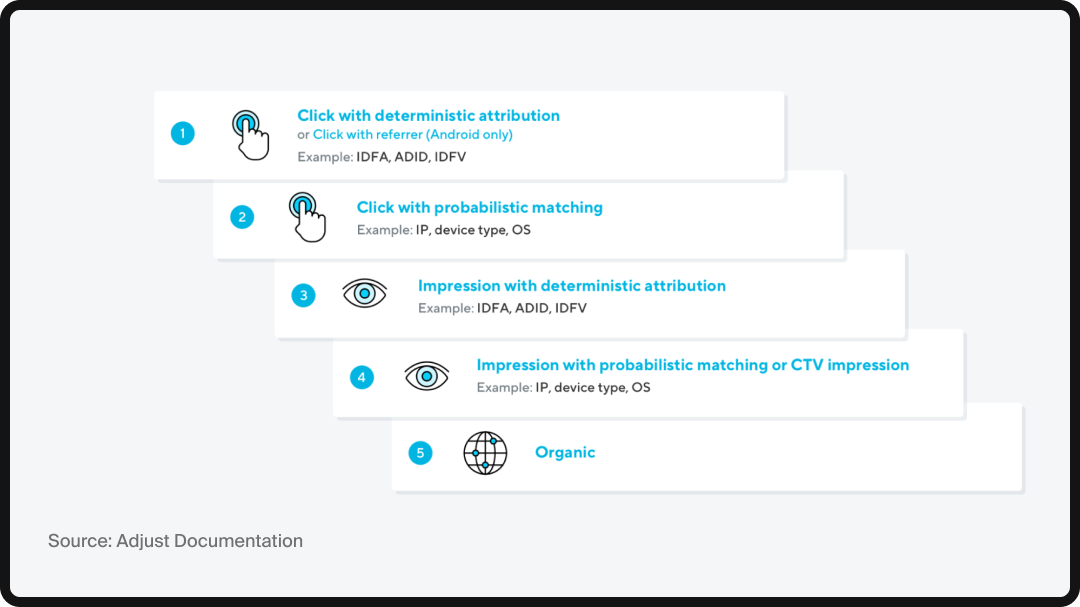
The waterfall stops at the first successful match, prioritizing accuracy and moving from deterministic to probabilistic methods.
Important MMP Settings to Understand
When reviewing performance numbers in Adjust or any MMP, always check these settings:
1. Attribution Status
Identifies whether users are new or reattributed. Reattribution occurs when a previously installed user clicks a new campaign link and reinstalls or reopens the app after the reattribution window expires.
This helps distinguish between new user acquisition (first-time installs), retargeting lapsed users (those who have stopped using your app), and active users (those you shouldn’t be spending on).
2. Attribution Type (Click vs. Impression)
Specifies whether the report includes:
- Click-based attribution only: More reliable, user actively engaged
- Impression-based attribution (view-through): Less certain, user only viewed ad
- Both: Combined view with impression credit window (typically 24 hours)
Note: Click-based uses deterministic matching when possible. Impression-based often relies more on probabilistic matching.
3. Attribution Source
Determines how conversions are credited over a user’s lifetime:
- First Source: All activity attributed to original install source (shows true LTV of acquisition)
- Dynamic Source: Each activity attributed to the most recent touchpoint (shows re-engagement effectiveness)
4. Platform-Native SDKs & Pixels
This approach installs pixels (web) or SDKs (app) native to each advertising platform:
- Facebook Pixel / Facebook SDK
- Google Ads Tag / Google SDK
- TikTok Pixel / TikTok SDK
How it works: Each platform tracks its own conversions independently.
Limitations:
- No unified view across channels
- Attribution overlap, where multiple platforms claim the same conversion
- Over-reporting conversions (can exceed 100% of actual conversions)
- Cannot optimize budget allocation across platforms
When to use: Only suitable when advertising on a single platform.
5. Hybrid Model (CDP + MMP)
This approach combines a Customer Data Platform (CDP) with a Mobile Measurement Platform (MMP) for streamlined data collection while maintaining proper attribution.
Architecture:
- CDP / Analytics SDK (e.g., RudderStack, Segment, mParticle) installed in app instead of MMP SDK
- CDP collects install and event data from the app
- CDP sends this data TO the MMP (Branch, Adjust, AppsFlyer)
- MMP maintains direct connections to ad platforms (Facebook, Google, TikTok) for click and impression data
- MMP performs attribution by matching both datasets
Benefits:
- Single SDK: One CDP SDK instead of multiple tool SDKs (Branch, Amplitude, Mixpanel, etc.)
- Centralized Control: Manage all data routing from CDP dashboard
- Tool Flexibility: Easy to switch MMPs without app changes
- Data Governance: Apply filters, transformations, privacy rules centrally
- Consistent Taxonomy: Define events once, route to multiple tools
Critical Note: The MMP still requires direct connections to advertising platforms for click and impression data. The CDP only replaces the app-side tracking (MMP SDK), not the ad platform integrations.
Use Case: Companies using multiple analytics tools who want simplified SDK management while maintaining proper multi-channel attribution.
Connecting Growth Hacking Activities to Performance Marketing Conversions
Another challenge on the marketing side is avoiding double-counting conversions. We shouldn’t combine app activity conversions (CRM wins) with MMP or performance marketing campaign conversions due to significant overlap. To address this:
- Report them separately and clearly identify which user segments we’re targeting through performance marketing versus CRM (while accepting a small percentage of overlap)
- Use the MMP as the single source of truth by implementing trackable deeplinks generated from the MMP in all app campaigns
What About OOH & Brand Activities?
The Attribution Challenge
Not all marketing can be tracked with digital attribution. OOH billboards, TV ads, brand campaigns, and sponsorships don’t generate trackable clicks or installs… yet they clearly drive awareness and conversions.
Why Traditional Attribution Falls Short
Performance marketing attribution (MMP and analytics) only measures activities with digital touchpoints. This creates blind spots for:
- Offline advertising (OOH, TV, radio, print)
- Brand-building activities
- Word-of-mouth and organic uplift
- Indirect effects of marketing
- Sponsorships and events
Where Marketing Mix Modeling (MMM) Comes In
Marketing Mix Modeling (MMM) uses statistical analysis of historical data (typically 2-3 years worth) to measure the incremental impact of all marketing activities (both online and offline) on business outcomes like revenue, conversions, and app installs.
How it works:
- Analyzes correlation between marketing spend and business results across all channels
- Controls for external factors (seasonality, competitor activity, economic conditions, holidays)
- Measures incrementality: “What would have happened without this campaign?”
- Provides directional guidance on relative channel effectiveness
The key insight on incrementality:
- MMM answers: “Did this billboard cause 100 extra conversions, or would they have happened anyway?”
- This differs from attribution, which asks: “Which touchpoint gets credit for this conversion?”
How MMM Reveals Hidden Value
Let’s take a real-world example where a mobile app company is running an integrated campaign that includes both digital touchpoints and physical touchpoints.
What MMP tracks:
- Facebook ads: 500 installs, $25 CPI
- Google ads: 300 installs, $30 CPI
- Clear, accurate, real-time data
What MMP misses:
- Subway ads campaign running this month
- Billboard presence in key markets
- Brand awareness from TV spots
What MMM reveals:
- During subway campaign: +800 additional installs (appear as “organic”)
- Billboard lift: +15% baseline increase in all channels
- Combined effect: TV + OOH = 30% of total growth
Without MMM, these would be unexplained or falsely credited as organic.
MMM Limitations
Understanding limitations helps set realistic expectations:
- Data Requirements: 18-24+ months of historical data minimum (2-3 years ideal)
- Precision: Less precise than digital attribution; works at aggregate level
- Granularity: Works at channel/campaign level, not user-level
- Timeliness: Results lag by weeks/months (not real-time)
- Accuracy: Directionally accurate, not exact
- Cost: Requires specialized vendors or data science expertise ($50K-$500K+ depending on complexity)
The Reality: You Need Both
Modern marketing requires a dual approach:
|
Aspect |
MMP or Digital Attribution |
Marketing Mix Modeling (MMM) |
|---|---|---|
|
Purpose |
Performance marketing optimization |
Total marketing effectiveness measurement |
|
Speed |
Real-time, daily optimization |
Strategic quarterly and annual planning |
|
Granularity |
User-level, event-level |
Aggregate, channel-level |
|
Use For |
Tactical decisions, campaign optimization, ROAS calculations |
Budget allocation, brand impact, incrementality testing |
Together, MMP and MMM give you the complete marketing picture, combining tactical execution with strategic planning.
Modern Attribution Challenges
All of this being said, the attribution landscape has evolved significantly with privacy regulations and platform changes (as have many other areas of growth marketing):
Privacy & Data Limitations
- iOS 14.5+ ATT Framework: Limits IDFA availability (60-85% of users opt out)
- GDPR & CCPA Regulations: Restrict data collection and storage
- Third-Party Cookie Deprecation: Impacts web tracking
- Probabilistic Matching Becoming Critical: As deterministic matching decreases
- Consent Management Platforms (CMPs): Now required for compliance
Impact on Attribution
- Greater reliance on probabilistic modeling
- Shorter attribution windows
- Aggregated reporting (SKAdNetwork on iOS)
- First-party data becoming more valuable
- Server-side tracking gaining importance
Key Takeaways
- Incrementality matters more than attribution models: Focus on true business impact, not just which channel gets credit.
- No single attribution model is “best”: Choose based on your customer journey, business stage, and goals.
- Avoid attribution overlap: Don’t add platform-native conversions together; use unified measurement.
- MMP + MMM = Complete picture: Digital attribution for tactics, MMM for strategy.
- Privacy-first future: Adapt to probabilistic methods and first-party data strategies.
- Test and validate: Use incrementality tests (geo holdouts, conversion lifts) to validate attribution.
- Simplicity often wins: Complex doesn’t always mean better; start simple and scale.
Decision Framework: Choosing Your Attribution Approach

Marketing Attribution: Final Thoughts
Attribution is a means to an end, not the end itself. The goal isn’t perfect measurement; it’s making better marketing decisions that drive real business growth.
Focus on:
- Understanding true incrementality
- Eliminating wasted spend
- Optimizing channels that matter
- Building sustainable growth engines
In 2026, growth marketers who master the balance between sophisticated measurement and actionable simplicity will win.
Stop shooting in the dark. Start measuring what matters.