

Your GTM stack is probably on fire right now. Not literally. But consider this: the average B2B company runs 106 SaaS applications. Marketing has their tools. Sales has theirs. RevOps has a spreadsheet somewhere that’s fighting for its life trying to bridge the gap. Data lives in six places at once, and half of it is wrong.
Reps spend over 70% of their time on non-selling activity such as manual research, data entry, updating the CRM, and copy-pasting between platforms. And despite pouring budget into tools, most outbound sequences still generate a 2-3% reply rate because nobody built the system to make them actually work.
This is the exact problem that GTM engineering exists to solve.
Over the last two years, a new role has quietly become one of the most valuable hires a growth team can make. It’s not a VP of Sales. It’s not another demand gen manager. It’s a GTM engineer; and if you don’t have one (or a team doing this work), you’re already behind.
What Is GTM Engineering?
GTM engineering is the discipline of designing, building, and automating the systems that power a company’s go-to-market motion, from lead generation and data enrichment through outreach, pipeline management, and revenue operations.
It applies engineering principles (modularity, scalability, testability, automation) to the commercial side of the business. A GTM engineer architects the infrastructure that campaigns and tools run on.
Where a traditional sales or marketing operator asks “how do we get more leads?” a GTM engineer asks “how do we build a system that continuously generates, qualifies, and routes the right leads with minimal manual intervention?”
Clay, the platform most credited with defining and popularizing this discipline, put it directly when announcing their $100M Series C: GTM engineers “combine growth acumen with AI and automation to build revenue engines.” The framing isn’t accidental. These are builders operating in a commercial context; writing the logic, not just pulling the levers.
In simple words, GTM engineering is the difference between a team of 10 BDRs manually grinding through leads, and one engineer who builds the system that does it better, faster, and indefinitely.
Why GTM Engineering Is Exploding Right Now
This role didn’t exist in any meaningful way three years ago. Now it’s one of the fastest-growing titles in B2B tech. According to Bloomberry’s analysis of 1,000+ job postings, GTM engineering job postings grew 205% year-over-year from 2024 to 2025, with over 3,000 LinkedIn listings active as of early 2026.
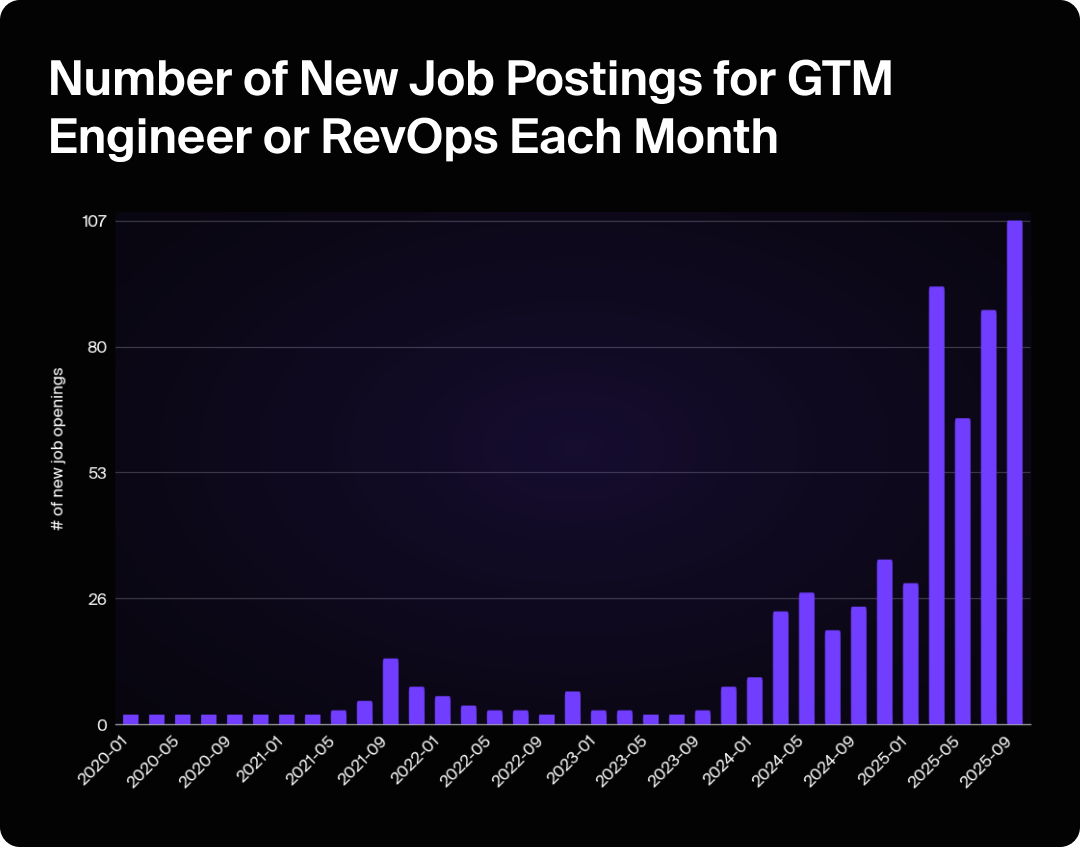
Three forces converged to make this inevitable.
- AI and automation matured at exactly the right moment. What required custom engineering two years ago (scraping signals, enriching data across multiple providers, personalizing outreach at scale) is now accessible through no-code and low-code platforms. The capability gap closed. The skills gap didn’t. GTM engineers are the people who can actually use these tools at a system level.
- Tech stack complexity hit a breaking point. Forrester projects that 75% of technology decision-makers will face moderate or severe technical debt by 2026. The average growth team has accumulated tools that don’t talk to each other, pipelines that leak, and data that decays at 25-35% annually. GTM engineering brings architecture to the chaos.
- Economic pressure changed the calculus on headcount. When the funding environment tightened in 2022 and 2023, the playbook of “hire more SDRs” stopped working. The new playbook: one GTM engineer paired with a strong AE can generate more pipeline than a ten-person BDR team (and at a fraction of the cost, too).
Capital markets have noticed. Clay raised $100M at a $3.1B valuation in August 2025 with CapitalG (Alphabet’s growth fund) leading, explicitly betting on GTM engineering as a category-defining shift. CapitalG partner Jane Alexander spent 18 months evaluating the space before investing.
What Does a GTM Engineer Actually Do?
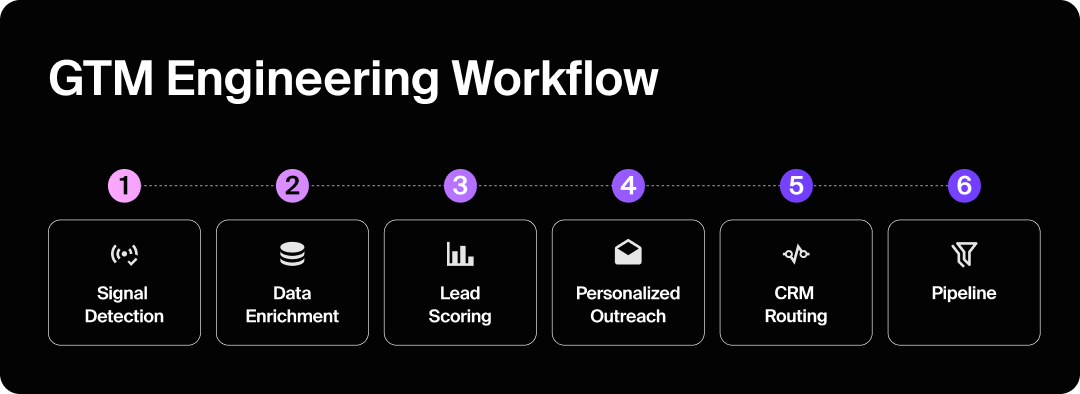
This is where most articles get vague. So let’s be specific.
A GTM engineer’s core function is to build automated revenue systems, the technical infrastructure that enables a go-to-market motion to run at scale without proportional human labor.
In practice, that looks like:
- Building outbound infrastructure: Designing and automating prospecting workflows, from pulling a list of target accounts, enriching each record with relevant firmographic and behavioral signals, writing personalized messaging logic based on those signals, and routing leads to the right rep automatically
- Owning the data layer: Managing data enrichment pipelines (waterfall enrichment across Apollo, ZoomInfo, Clay, Clearbit), cleaning CRM data, enforcing data quality standards, and building the scoring models reps actually trust
- Integrating the tech stack: Building the connections between CRM, engagement platforms, enrichment tools, intent data, and analytics, so data flows where it needs to go without manual intervention
- Automating handoffs: Designing the logic that determines when a prospect moves from marketing-qualified to sales-qualified to outreach to pipeline, and making sure that transition happens automatically and correctly
- Running systems experiments: A/B testing messaging frameworks, outreach timing, ICP segment targeting, enrichment waterfalls, and building the reporting to know what’s working
Day-to-day, a GTM engineer could be:
- Triaging automated workflow alerts
- Debugging a broken Zapier sequence
- Building a Clay table that pulls hiring signals from job boards, enriches those companies, identifies the right buyer, and writes a first-line personalization
- Reviewing reply rate data and adjusting the messaging logic
- Sitting in the weekly sales meeting to understand what reps are struggling with, and leaving with a list of things to automate.
GTM Engineer vs. RevOps: The Question Everyone’s Asking
The most common pushback is fair: “Isn’t this just RevOps with a rebrand?”
The honest answer? There’s meaningful overlap, but they’re not the same thing, and the distinction matters for how you staff your team. Research finds that 9 out of 10 responsibilities overlap with RevOps; so we can say that the roles are adjacent.
But the distinction in orientation and output is real: RevOps engineers what already exists; GTM engineers build what’s missing.
|
GTM Engineer |
RevOps |
|
|---|---|---|
|
Primary Orientation |
Builder |
Manager / Optimizer |
|
Core Output |
Net-new automated systems |
Process improvement and forecasting |
|
Technical Depth |
SQL, Python, APIs, automation platforms |
CRM admin, reporting, process docs |
|
Scope |
Full funnel; marketing through retention |
Often departmentally siloed |
|
Mindset |
“What system do we need to build?” |
“How do we make this process work better?” |
|
Time Horizon |
Builds for scale |
Optimizes for now |
Another way to think about it: RevOps sets the rules. GTM engineering builds the machine that runs them.
Other Comparisons Worth Knowing
- GTM Engineer vs. Sales Engineer: Essentially no overlap. Sales engineers are customer-facing technical specialists who accelerate deals. GTM engineers never talk to customers. They build the infrastructure that generates deals in the first place.
- GTM Engineer vs. Growth Marketer: A growth marketer designs the campaign. A GTM engineer builds the automated system that runs it, routes the leads, and reports back. Same goal, completely different execution layer.
The GTM Tech Stack: What These Engineers Actually Build With
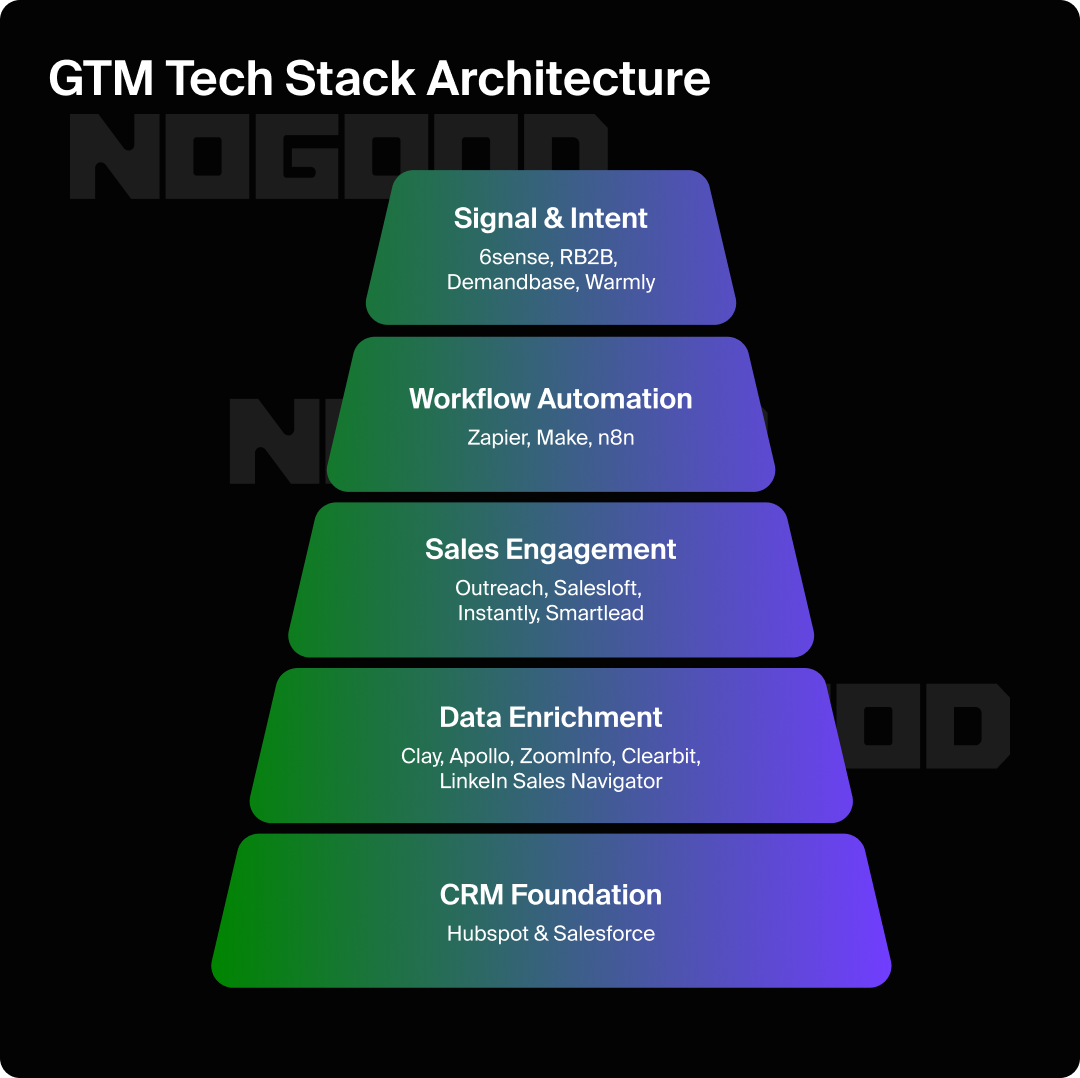
GTM engineering is tool-agnostic by nature. The best engineers pick the right tool for the job rather than defaulting to whatever’s popular. That said, there’s a de facto modern stack that most teams converge on.
The architecture has five layers:
1. CRM Foundation
Your CRM is the system of record that everything flows into and out of. Most GTM engineering work is ultimately about making the CRM accurate, fast, and connected. HubSpot (52% of job postings) and Salesforce (45%) dominate. Your choice dictates significant downstream infrastructure decisions.
2. Data Intelligence & Enrichment
This is the engine. Without clean, rich data, no system works. Clay has become the dominant platform. It functions as a logic engine pulling from 50+ enrichment providers in waterfall sequences, applying AI personalization, and feeding downstream tools. Apollo, ZoomInfo, Clearbit, and LinkedIn Sales Navigator round out the enrichment layer.
3. Sales Engagement
Where automated outreach executes. Outreach (49% of postings), Salesloft, Instantly, and Smartlead handle sequencing, deliverability management, and reply detection.
4. Workflow Automation / Middleware
The connective tissue. Zapier (39%), Make, and n8n (28%) are the workhorses, translating triggers from one tool into actions in another, routing data between platforms, and running the conditional logic that makes systems dynamic rather than static.
5. Signal & Intent Detection
The intelligence layer that makes outreach timely rather than arbitrary. 6sense, RB2B, Demandbase, and Warmly surface intent signals, website visits, job changes, technology installs, competitor research, that trigger automated workflows.
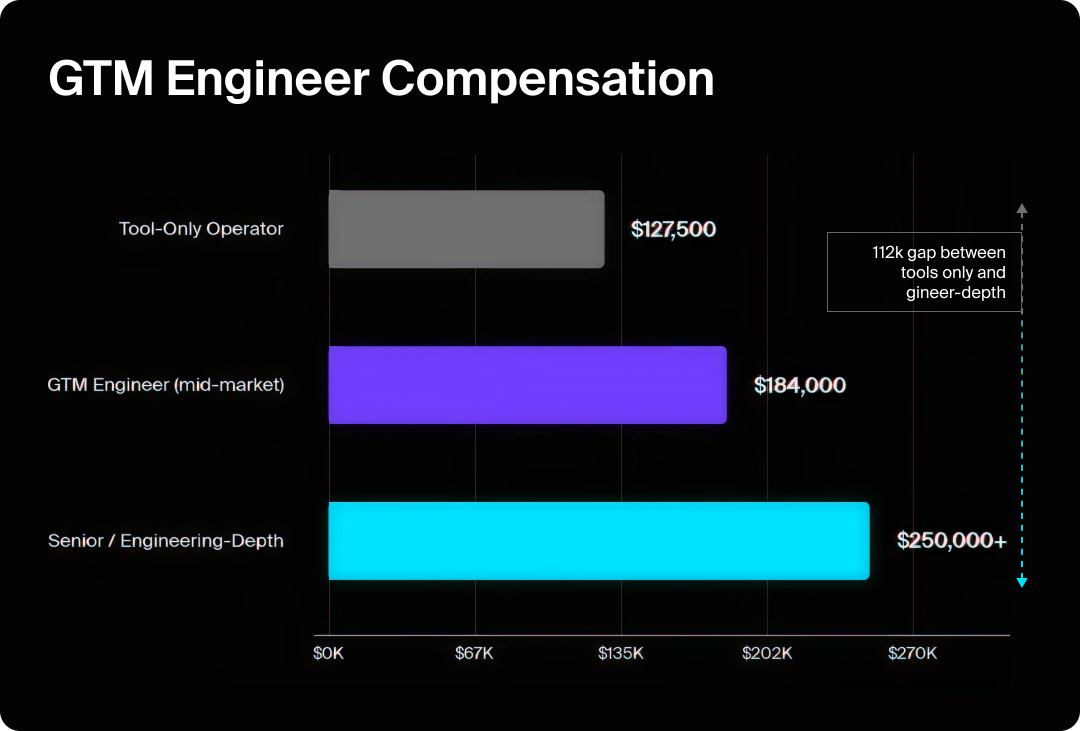
The emerging pattern: The most effective GTM engineers write custom integrations with Python, build data pipelines with SQL, and use APIs to create infrastructure that no off-the-shelf tool provides. According to Cognism, engineers who can code earn $112,000 more on average than tool-only operators.
The Business Case: Why Every Growth Team Needs a GTM Engineer
The ROI of GTM engineering is unusually measurable compared to most marketing investments. These systems generate pipeline directly, and you can instrument them to know exactly what’s working.
The force multiplier argument is the strongest one. One GTM engineer, properly resourced, can amplify the output of an entire sales team. OpenAI used Clay and GTM engineering principles to build 1,500 qualified leads from social listening signals for DALLE-2, reducing manual research time by 95%+.
- Rippling’s automated outbound achieves a 60% open rate and 10% reply rate by using hiring signals to trigger precise, timely outreach. The industry cold email average is 2-3%.
- ZoomInfo’s internal data shows SMB and midmarket companies using AI-powered GTM intelligence see a 31% reduction in customer acquisition cost. Enterprise teams see 42%.
What you’re really paying for is compound returns. An automated workflow keeps generating pipeline after the engineer has moved on to building the next one. Each system gets smarter over time as AI feedback loops improve personalization and targeting. The infrastructure you build in Q1 is still working in Q4.
The hiring math has flipped. Before GTM engineering, scaling pipeline meant hiring more BDRs. A linear, expensive model with high turnover and ramp time. The new model is: hire one GTM engineer, build systems that do the manual work, and let your AEs close.
In short, the companies compounding advantage right now aren’t the ones with the biggest teams. They’re the ones with the best infrastructure.”
What Happens to Teams Without GTM Engineering?
The costs of not having this function are real and measurable.
Generic outbound destroys your domain reputation. Email deliverability algorithms now penalize low-engagement sending. If you’re blasting thousands of contacts with templated sequences and getting 0.3% reply rates, you’re actively damaging your ability to reach anyone’s inbox.
Bad data is a silent killer. B2B data decays at 25-35% per year. Without a data enrichment infrastructure, your CRM is increasingly fiction. Without a data enrichment infrastructure, your CRM is increasingly fiction. Research from ZoomInfo found that sales reps waste 27.3% of their time chasing bad data. That’s more than a day per week per rep.
Tool sprawl without systems thinking creates expensive chaos. The average organization runs 106 SaaS applications. Without someone architecting how these tools connect, you have data trapped in silos, manual processes filling the integration gaps, and no way to measure what’s actually driving revenue.
You’re competing against companies that have this. OpenAI, Rippling, Canva, Notion, Webflow, and Ramp all have GTM engineers. The State of GTM Engineering 2026 Benchmark Report confirms early adopters are compounding significant GTM advantages over competitors without this capability.
How to Know If You’re Ready to Hire (or Build) This Capability
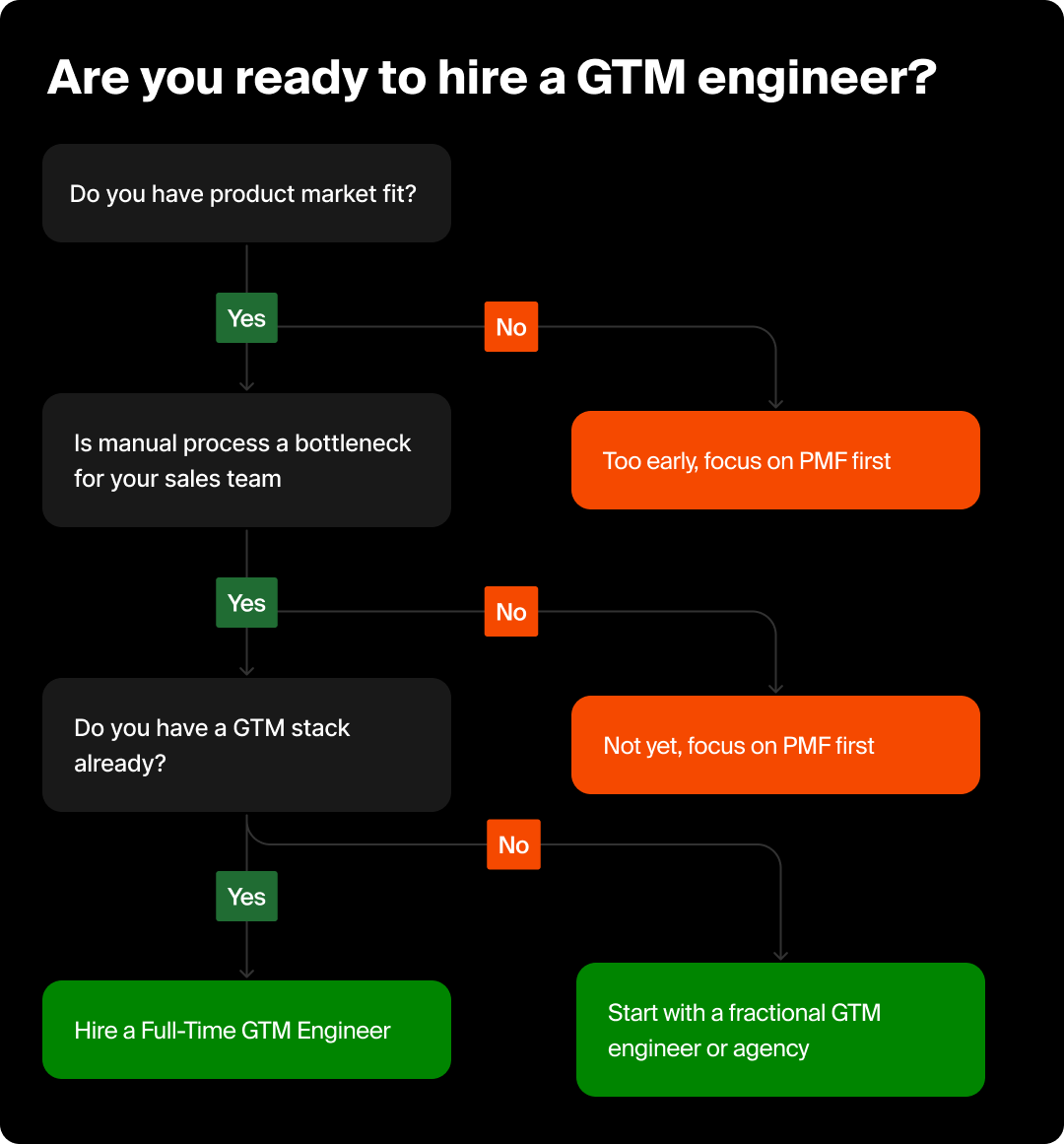
Not every company needs a full-time GTM engineer on day one. Here’s a framework for where you are:
Hire a GTM engineer if:
- You have product-market fit and need to scale pipeline without scaling headcount proportionally
- Your sales team is growing and manual processes are becoming the bottleneck
- You have a GTM tech stack but no one with the technical skills to connect and optimize it
- You’re spending significant budget on outbound with mediocre reply rates
Start with a fractional GTM engineer or agency if:
- You’re pre-Series A and need GTM infrastructure built but can’t justify a $150K+ hire
- You need to run one high-impact campaign and want systems built around it
- You want to audit what’s possible before committing to the headcount
What to look for in a hire:
- Hands-on experience with your CRM (Salesforce or HubSpot) and at least two enrichment/automation platforms
- SQL proficiency. Non-negotiable for any serious data work
- Demonstrated examples of systems they’ve built, not just tools they’ve used
- Commercial curiosity: do they understand ICPs, sales cycles, and pipeline metrics?
According to Bloomberry’s job analysis, the average GTM engineer has 4.1 years of experience and commands a base salary of $127,500-$184,000 depending on technical depth. Top-of-market roles at companies like Vercel and OpenAI pay $250K+.
Real-World GTM Engineering in Action
Rippling: Signal-Based Outbound
Rippling built workflows that monitor job postings for “HR Manager” and “IT Admin” titles; strong signals that a company is scaling and needs Rippling’s platform. Clay enriches those company records, identifies the right decision-maker, and fires a sequence within hours of the signal. Result: 60% open rate, 10% reply rate.
OpenAI: Creator Outreach at Scale
For DALLE-2, the team used social listening to identify creators actively discussing AI art on Twitter and LinkedIn, enriched their profiles through Clay, and used GPT-4 to write genuinely personalized opening lines referencing their recent work. 1,500 qualified leads generated. 95%+ reduction in manual research time.
StackOptimise: Agency as Proof of Concept
StackOptimise used their own GTM engineering playbooks to generate £1.1M in revenue and £5.4M in pipeline in nine months, demonstrating that the methodology works even when you’re selling GTM engineering services.
The pattern across every successful implementation: targeted signals → clean data → timely, personalized outreach → automated routing → continuous measurement. GTM engineering is the function that builds and maintains that entire chain.
The Bottom Line With GTM Engineering
GTM engineering isn’t a trend. It’s what happens when the tools for automating revenue operations finally became powerful enough that someone needed to specialize in deploying them.
The companies winning right now are those that treated their go-to-market motion like an engineering problem. They built systems. They instrument everything. They compound their advantage with every workflow shipped.
If you’re running a growth team and the phrase “GTM engineering” is new to you, the gap between you and your most technically advanced competitors is already meaningful. The good news: the infrastructure is buildable. The playbooks exist. The tools are accessible.
The only question is whether you have someone on your team who knows how to build it, or whether you find one before your competitors do.
GTM Engineering: Frequently Asked Questions
What is GTM engineering?
GTM engineering is the discipline of designing, building, and automating the systems that power a company’s go-to-market motion, including lead generation, data enrichment, outbound automation, pipeline routing, and revenue operations infrastructure.
Is GTM engineering the same as RevOps?
They’re adjacent but distinct. RevOps manages and optimizes existing processes; GTM engineering builds new systems from scratch. RevOps tends to focus on CRM hygiene, forecasting, and process governance.
GTM engineers focus on automation architecture, data pipelines, and building the technical infrastructure that scales pipeline.
What does a GTM engineer do day-to-day?
GTM engineers build and maintain automated revenue workflows, from prospecting and data enrichment through outreach sequencing, lead routing, and CRM integration. On any given day, they might be building a Clay workflow, debugging an n8n automation, analyzing reply rate data, or writing a Python script to pull intent signals from a new source.
What tools do GTM engineers use?
The core stack typically includes:
- A CRM (HubSpot or Salesforce)
- A data enrichment platform (Clay, Apollo, ZoomInfo)
- A sales engagement tool (Outreach, Instantly)
- A workflow automation layer (Zapier, Make, n8n)
- Intent and signal detection tools (6sense, RB2B, Warmly)
The best engineers also write custom code in Python and SQL.
How much does a GTM Engineer make?
Compensation varies significantly based on technical depth. Median base salary from job postings is around $127,500; Glassdoor reports an average of $184,000. Top-of-market roles at companies like OpenAI and Vercel pay $250K+. Engineers who can write code command a $112,000 premium over tool-only operators.
When should I hire a GTM engineer?
Once you have product-market fit and need to scale pipeline without scaling headcount proportionally, typically Series A and beyond. Pre-PMF, the priority is learning, not systematizing. After PMF, GTM engineering compounds your advantage at every stage.