

Our 2024 version of B2B social trends predicted a few major developments: the importance of B2B influencer marketing, employee advocacy, and social listening. Since our last report, social has grown into one of the most productive distribution channels in digital marketing. Here’s what happened.
In 2024, B2B social was about engagement. In 2026, social has become a primary source of information and a gold mine for AI retrievability.
We’ve noticed two structural changes that make this particularly urgent:
- Social is becoming a research and search ecosystem (known as social search). B2B buyers are increasingly turning to social feeds for the most relevant and timely information.
- AI search has significantly supplemented the buying journey, and it is pulling increasingly from social content your brand creates and earns.
One study found 70-80% of the B2B purchase journey happens before any sales engagement. So, where is it happening? In Slack channels and private communities crowdsourcing and sharing social posts, X and LinkedIn comment sections, and Reddit threads. That’s dark social.
Here are the hottest trends we’re seeing in B2B social media marketing, and particularly, which are game changers for AI visibility (showing up in AI Overviews, ChatGPT, Claude, Perplexity, etc.).
- Trend 1: B2B creators are the new thought leaders and brand advocates
- Trend 2: Social as a multimodal discovery tool (and AI’s best friend)
- Trend 3: Video is dominating, but it’s now a spectrum
- Trend 4: Threads marketing and the art of the comment
- Trend 5: Employee advocacy, but bigger, bolder, and better
- Trend 6: Maturing is realizing we’ve outgrown engagement metrics

Trend 1: B2B Creators Are the New Thought Leaders & Brand Advocates
The hottest trend on our list is the growing prominence of B2B creators and influencers. Historically, B2B brands have had a much smaller emphasis on branding, since buyers make purchasing decisions based on people and budgets, not brand affinity. In simple terms this is about returning to the basics: word-of-mouth marketing.
When your brand is recommended by a prominent creator, or your own founder and employees establish themselves as genuine thought leaders, the more individual voices you have advocating for your brand across the social ecosystem.
B2B Creators, Influencers & Thought Leaders
An important distinction to recognize is how the creator role is positioned in B2B contexts compared to D2C influencers. Typically the content creator vs. influencer debate boils down to what the individual’s intent:
- “Content creators” usually produce content across various mediums to be repurposed on different channels with a focus on engagement and education via quality content.
- “Influencers” typically build a niche audience on a specific platform (TikTok, Instagram, YouTube, X) and can use that audience to influence actions, interests, or purchases.
- “Thought leaders” is another term commonly thrown around in B2B contexts to describe someone with deep expert knowledge, typically more than influencers, that frequently publish research and ideas to advance their respective industry.
*We believe the subtle rise of B2B content creators and thought leaders in particular will be powerful brand advocates because their content tends to be less promotional and more value-driven.
How to Partner with B2B Creators
Once you’ve identified the right voices to partner with, collaboration can take several forms:
- Original Insights & Data: Creators and influencers can share out your unique data insights and link back to your original studies and site.
- Sponsored Content: Creators and influencers can create content that subtly or unsubtly features your products or services with their followers.
- Product Reviews: Creators and influencers can review your products or services and share their honest opinions with their followers.
- Webinars, Podcasts & Events: Creators and influencers can collaborate with you on webinars and podcast episodes hosted by either party. You could also consider sponsoring a creator to attend and create content at an event.
There’s also a GEO/AEO dimension to this worth noting: AI systems like ChatGPT and Perplexity show a strong preference for citing individual creators and third-party sources over owned brand pages. So social partnerships can drive visibility and trust with AI systems just as much as humans.
Trend 2: Social as a Multimodal Discovery Tool (& AI’s Best Friend)
Since 2024, Gen Z and Millennials have made up 71% of B2B purchasing teams. This demographic is also largely AI-natives and undeniably the largest pool of users on social. They might research a given tool or software by querying an AI model or reading Google’s AI Overviews, but they are starting their day on X, LinkedIn, Reddit, and other social channels to get the most up-to-date information for the day.
More importantly, our research shows these two channels, AI and social search, reinforce each other. Social platforms are integrating AI summaries while AI platforms are trying to close deals with Reddit and YouTube for access to vast user sentiment and multimodal UGC.
Strong original social content builds trust with human audiences and trains AI systems to recognize your brand as authoritative. But the retrievability of your content by an LLM depends on additional factors; check out Goodie’s AEO Periodic Table to learn more.
Trend 3: Video Is Dominating, but It’s Now a Spectrum
Every B2B social trends piece of the last three years has said some version of the same thing: short-form video is king, lean into TikTok-style hooks, keep it concise. While this strategy is valuable, it is becoming increasingly incomplete.
What we’re seeing in 2026 is that video has matured into a spectrum, and where a piece of video content sits on that spectrum should be a deliberate choice.

Short-Form Video
LinkedIn-native clips, Instagram Reels, and YouTube Shorts remain the best formats for stopping the scroll and introducing an idea to someone who doesn’t know you yet. The algorithm rewards it, the format fits how people consume content on a feed, and production costs have dropped enough that there’s no longer an excuse not to experiment.
The unpolished, talking-head clip from a founder or practitioner consistently outperforms slick brand video. People can feel the difference between “the marketing department made this” and “a real person is telling me something useful.”
Long-Form Video
Long-form video, on the other hand, is having a quiet comeback. A 20-minute podcast, an in-depth article on Substack, a recorded walkthrough of a case study: these are the formats that help a social creator establish genuine credibility by providing value beyond soundbites.
Audiences are responding to this positively, craving engagement with longer forms of content, fatigued by the era of short-form. And in an age where AI systems look for topical authority and net information gain, long-form earns the trust that converts.
The most effective B2B video strategies in 2026 use a combination of both short-form and long-form across various social channels to ensure your content sticks.
Trend 4: Community Marketing & the Art of the Comment
Community marketing is about being active in reddit communities, comment sections, and industry conversations in a conversational, helpful way. To learn more, check out our more comprehensive guide to community marketing.
Commenting on platforms like Reddit is particularly gaining traction in the B2B space as a means to self-promote and monitor real pain points for your target audience. However, Reddit is built to squash any and all promotional content, so marketers must tread very lightly; we recommend spending a month to first observe threads related to your niche, then focus on purely adding value for several months before you ever post a promotional piece of content. Be sure to also check the guidelines of specific subreddits and avoid being shadowbanned (when your posts and comments are removed by content moderators).
To use commenting as an effective social strategy:
- Monitoring threads in your category: not just brand mentions, but conversations where their expertise is relevant, even if they’re not tagged.
- Add your unique POV and perspective: the comment that says “great post!” contributes nothing; the comment that adds a counterpoint, a stat, or a real example creates value.
- Post discussion and question threads: some of the most viral B2B content on LinkedIn in 2026 started as a comment that got more engagement than the original post.
Trend 5: Employee Advocacy, but Bigger, Bolder & Better
Your employees are your brand’s most authentic ambassadors. By encouraging employees to share company-related content and industry insights on their individual LinkedIn or X accounts, you can boost brand awareness, generate leads, and build relationships with customers.

Steps to Create an Effective Employee Advocacy Program
- Identify talented creators within your organization. These are employees who are passionate about the company and its products or services, and might have a knack for storytelling.
- Foster this interest, if it exists, and give them the resources needed to create content and grow their social media presence.
- It’s also important to acknowledge and reward employees for their contributions to the company. This could be done through public recognition, such as shout-outs in company newsletters or on social media, or through more tangible rewards, such as gift cards or bonuses.
By implementing an effective employee advocacy program, businesses can leverage the power of their employees’ social networks to reach a wider audience, build relationships with customers, and ultimately drive business growth.
Trend 6: Maturing Is Realizing We’ve Outgrown Engagement Metrics
Our sixth and final trend is about how to measure the success of your B2B social strategy. It’s no secret that businesses run on outcomes and metrics as a way to allocate time, budgets, and people. However, the metrics have shifted: impressions, likes, and reach are far less important to track than they were just two years ago.
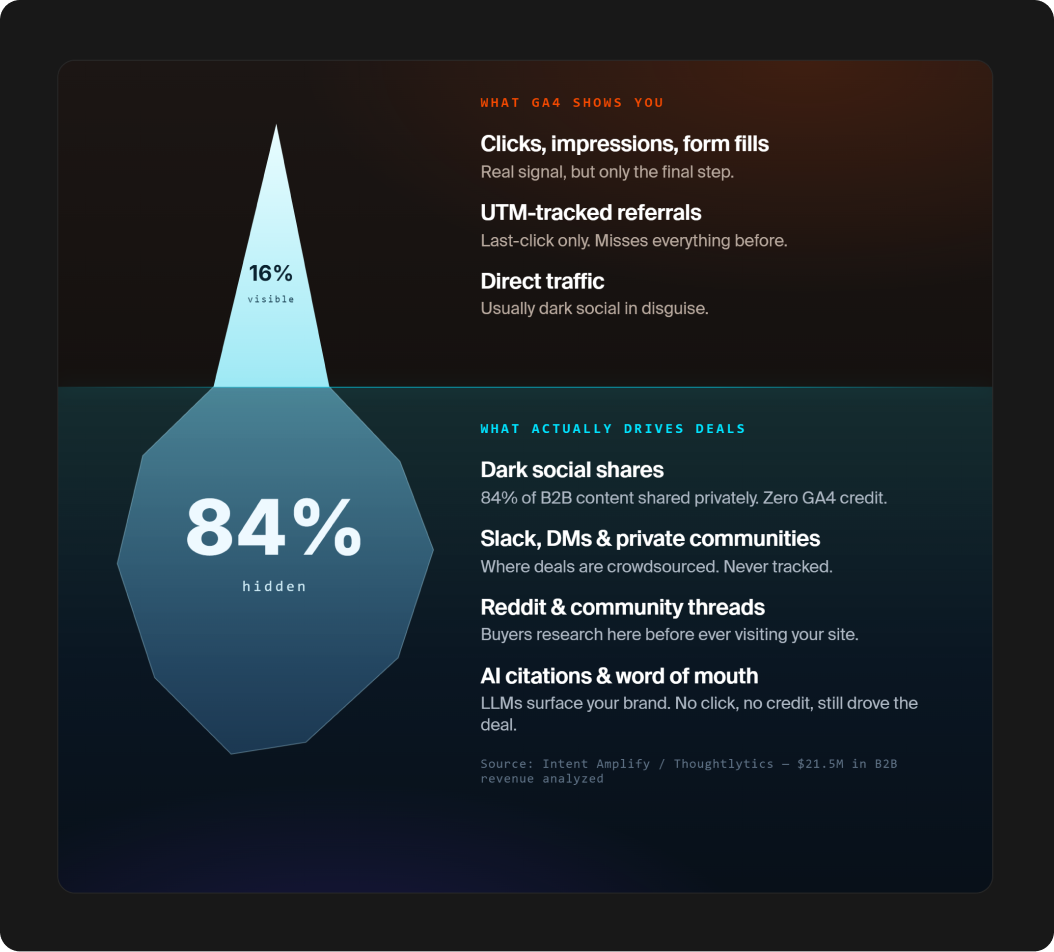
Research suggests that up to 84% of B2B content sharing happens through private channels, and we know those channels move the needle in purchasing decisions.
So what are ways you can work towards an iterative and successful social strategy without perfect measurement?
- Track qualitative signals in addition to quantitative ones: Comments and replies that contain genuine reactions such as someone tagging a colleague, sharing a strong opinion, or asking a follow-up question, tells you how a piece of content lands and with what audience.
- Use monitoring tools that track content retrievability across SERPs and AI systems: Tools like Goodie are great GEO/AEO monitoring and optimization tools that can track specifically what social content is getting cited in brand-related queries.
- Track patterns across who is visiting your social pages: When multiple people from the same company start engaging with your content within a short window, that could signal an early interest or intent to engage. Social and Sales teams should share insights like these more frequently.
- Stop defunding channels because they’re hard to attribute: The most common mistake brands make with social is that they stop investing in thought leadership, podcasts, and community engagement because these channels don’t show up cleanly in attribution models or fast enough. However, many channels, like Reddit, take time to see outcomes. Let’s look at the numbers:
- Thoughtlytics analysis of $21.5 million in B2B revenue found that channels recording 0% attribution in GA4 were driving the majority of actual revenue when self-reported data was factored in.
- Ensure your teams and managers have an understanding that the payout of genuine community engagement is not linear, rather exponential when done right.
Final Thoughts
Needless to say, the B2B social media landscape is in a perpetual state of flux, which means brands need to remain vigilant and adaptable to the ever-shifting trends. By incorporating these emerging trends into your B2B social media strategy, you position your business for success, driving engagement, fostering growth, and ultimately achieving your overarching business objectives.
Embrace innovation, think a few steps ahead (and outside of the box), and leverage the power of real voices on social media to connect with your target audience, build meaningful relationships, and drive business growth.
B2B Social Media Marketing in 2026: FAQs
What are the biggest B2B social media trends in 2026?
The six trends shaping B2B social in 2026 are B2B creator and thought leader partnerships, social platforms doubling as AI-reinforced discovery channels, video strategy maturing into a deliberate short-to-long-form spectrum, community marketing through comments and Reddit, employee advocacy at scale, and moving past vanity metrics toward signals that reflect real business impact.
Why does B2B social media matter more than ever in 2026?
Most of the B2B buying journey happens before a prospect ever talks to sales, and that research is playing out on LinkedIn, Reddit, and in private channels sharing social content. Social now shapes both human discovery and what AI systems surface when buyers are doing their homework.
What is a B2B creator, and how is it different from an influencer?
B2B creators focus on education and multi-format content, influencers build platform-specific audiences and drive action through reach, and thought leaders publish original research and ideas that move an industry forward. In B2B, thought leaders and creators tend to outperform traditional influencers because their content is less promotional, which also happens to be what AI systems prefer to cite.
Should B2B brands prioritize short-form or long-form video?
Short-form video is still the best format for reach and introducing ideas to a cold audience. Long-form, like 20-minute podcasts or deep-dive case study walkthroughs, builds the topical authority that earns AI citations and converts. The strongest B2B video strategies use both, intentionally, for different stages of the funnel.
What is B2B community marketing?
Community marketing means showing up in Reddit threads, LinkedIn comment sections, and niche industry conversations with genuine perspective rather than promotion. The bar is high: a comment with a real counterpoint or a useful data point will outperform one hundred “great post!” replies, and on Reddit, brands should spend months building credibility before posting anything promotional.
How should B2B brands measure social media success?
The most useful signals in 2026 are qualitative ones: comments that tag colleagues, spark debate, or ask follow-up questions tell you more than impressions ever will. Layering in AI retrievability tracking and watching for account-level engagement clusters rounds out a measurement approach that reflects how B2B buying actually works.