

As a marketer, one of the scariest things you could hear is someone asking for you to “make me go viral”. To be clear, it’s not because that’s inherently unachievable or particularly costly, but because it signals a fundamental misunderstanding of what virality can provide. Here’s the uncomfortable truth: viral attention is the marketing equivalent of a one-night stand. Thrilling in the moment, gone by morning, and a genuine toss-up as to whether or not they remember your name.
The false promise of viral attention assumes that you own the viral attention that you garner. The truth is, you’re renting attention from algorithms that owe you nothing and can revoke access without explanation.
This is where brands get trapped playing someone else’s game. The platform wants engagement metrics because engagement keeps users scrolling and generates ad revenue, but what you’re really after are business outcomes, like qualified leads or brand affinity. When you chase virality, you’re working toward the platform’s goals, not your own.
Understanding why this matters requires looking at how we got here and what virality actually costs when you get it.
A Brief History of Viral Marketing
The concept of viral marketing predates the platforms we associate with it today. Media critic Douglas Rushkoff wrote about viral marketing on the internet in 1994, describing how ideas could spread through networks like biological viruses. The field that developed around this notion, memetics, peaked in popularity in the 1990s, attempting to apply evolutionary principles to the spread of cultural information. Marketers saw the potential, and the concept of “virality” took on a life of its own within this context.
Early viral marketing relied on people as the primary distribution mechanism; email forwards, word-of-mouth, and eventually message boards became the infrastructure for spread. The strategy was simple: create something compelling enough that people would share it voluntarily. But the spread was still linear, constrained by how many people each person could realistically reach through their personal networks.
YouTube fundamentally altered the equation when it launched in 2005. Suddenly, virality became more infinitely shareable across websites. The platform’s recommendation algorithm began surfacing content beyond a user’s subscription feed, but the core mechanic still required discovery. Videos went viral because people deliberately shared them, embedded them on blogs, or they slowly accumulated views through search and recommendations.
Facebook’s News Feed, Twitter’s retweet function, and Instagram’s Explore page each added new distribution layers, but they maintained a crucial element: social graph-based virality. Content spread through networks of connections, and virality still maintained a crucial social component.
Then TikTok’s For You Page rewrote the rules of virality entirely. The FYP doesn’t care about your follower count, nor does it prioritize content from accounts you follow. Instead, it serves an endless stream of content selected by algorithm. You could have zero followers and reach a million people with your first video. The democratization of reach came with a complete destabilization of what having an audience meant.
Pre-FYP virality was something that happened to content as it moved through social networks.
Post-FYP virality is something the algorithm decides to make happen.
The platform chooses what goes viral based on engagement signals, watch time, and retention metrics that creators and brands can influence, but never fully control. The For You Page model has since been adopted by Instagram Reels, YouTube Shorts, and virtually every social platform trying to compete for attention. The result is an environment where reach is simultaneously more accessible and more unstable than ever before.
This is the environment brands operate in now. Viral marketing used to require building an audience first, then creating something that audience would amplify. Today’s viral marketing requires creating content that an algorithm deems worthy of amplification to people who’ve never heard of you. The mechanics of spread have been automated, industrialized, and the power has almost entirely shifted from human networks to algorithms.

Virality in the Context of AI Search & Visibility
With the popularization of AI search, the rules of virality are changing again. AI search engines like ChatGPT, Perplexity, and Google’s AI Overviews are fundamentally altering how information spreads and how brands get discovered. The shift from traditional search to AI answer engines introduces a new question: can virality even exist when there’s no feed to dominate?
Instead of surfacing your content for users to engage with, AI models synthesize information from multiple sources and present a single answer. Your viral moment gets referenced, summarized, or ignored entirely depending on whether the AI decides your content is authoritative enough to cite.
But here’s where it gets more complicated: in 2026, we’re seeing AI answer engines start to pull from social platforms in ways that blur the line between virality and authority. According to a study from Goodie, Reddit, LinkedIn, and YouTube are already major sources for AI-generated answers. TikTok and Instagram are starting to climb in citations as well. This means social signals do matter, but not in the way brands traditionally think about them.
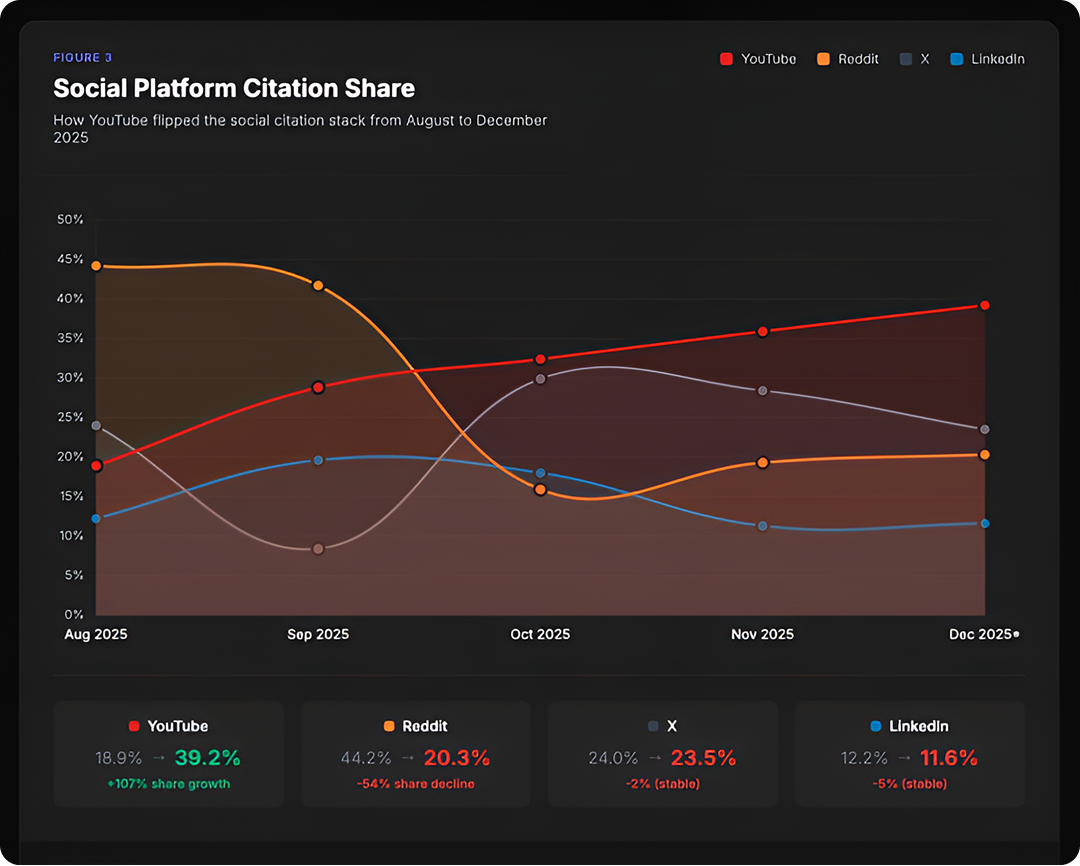
This creates a paradox for brands chasing viral attention:
- A piece of content might rack up millions of views on TikTok, but if it doesn’t get indexed, cited, or referenced by AI search engines, it effectively doesn’t exist in the new discovery layer that’s rapidly becoming how people find information.
- Conversely, content that never goes viral in the traditional sense can become the authoritative source that AI models consistently reference, driving compounding value over time.
The cultural currency of virality is starting to decouple from actual discoverability. Going viral on social platforms creates a moment, but being the answer AI search provides is more important for creating ongoing presence. One is rented attention, the other is closer to owned authority, though even that comes with caveats since you still don’t control whether or how AI models cite you.
To summarize, the attention economy is fragmenting:
- Social feeds still matter, but they’re no longer the only, or even the primary, way people discover information.
- AI search is creating a parallel system where traditional virality metrics don’t translate directly, but social authority increasingly does.
You can’t “go viral” in ChatGPT the way you can on TikTok. But you can build a presence across platforms that AI models recognize as valuable enough, authoritative enough, and well-cited enough to surface when someone asks a question you should be the answer to.
Advantages & Disadvantages of Viral Marketing: Two Sides of the Same Coin
The principle of viral marketing sounds simple in theory: exponential growth, at minimal cost, and all of a sudden everyone’s talking about you… who wouldn’t want that? But in an attention economy where genuine engagement is seen as a scarce resource, it’s easy to mistake scaling viewership for credibility and growth.
Millions of views can mean something incredibly valuable, particularly when the conditions for virality are so unpredictable. A well-timed viral moment can introduce your brand to audiences you’d never reach through paid media, breaking through demographic and geographic barriers that traditional marketing struggles with. There’s also a certain cultural capital and social proof that comes with being part of the conversation. It can generate earned media, sparking conversations across platforms (and sometimes even traditional press coverage).
For startups and emerging brands, a single viral hit can provide the market validation and visibility that would otherwise require millions in advertising spend.
Here’s where the coin flips. The same breakthrough viewership also comes with inevitable trade-offs as content spreads beyond your direct control. We assume that credibility increases as viewership grows, and while in certain cases that can be true, credibility and trust can also paradoxically decrease with virality because you start to control less and less of the outcome and public reception.
As viral content spreads, so does the public interpretation of it. Brand messages can be remixed, quoted out of context, or become a meme template that holds a meaning that was never intended.
The truth about virality is that your content is being perceived in millions of different ways, most of which you’ll never see or influence. The further your content travels from its original context, the less control you have over what it actually means to the people seeing it.
Audience targeting (or the lack thereof) plays a big part of this unpredictability. Performance marketing lets you define your audience: demographics, interests, behaviors, purchase intent, but organic virality does not enjoy that same targeting precision. This means that content could go viral because it’s being shared amongst the wrong audience, leading to a flat or potentially even negative impact on your brand.
|
Advantages |
Disadvantages |
|---|---|
|
Massive reach with no (or low) cost |
No targeting precision |
|
Compressed brand building timeline |
Temporary impact |
|
Cultural capital and conversation dominance |
Loss of narrative control |
|
Market validation for emerging brands |
Attention without loyalty |
|
Democratized access to reach |
Algorithmic dependency |
Notable Examples of Viral Marketing: Engineered vs. Organic Virality
There’s no guaranteed formula to making something go viral, although there are common traits shared between viral content, namely:
- High-arousal emotional triggers
- Strong relatability
- Built-in shareability
That being said, identifying these traits and successfully executing them are two different things. Some brands engineer their viral moments with careful planning and strategic design, while others stumble into virality through authentic cultural participation or sheer accident.
Spotify Wrapped: Engineered Virality Done Right
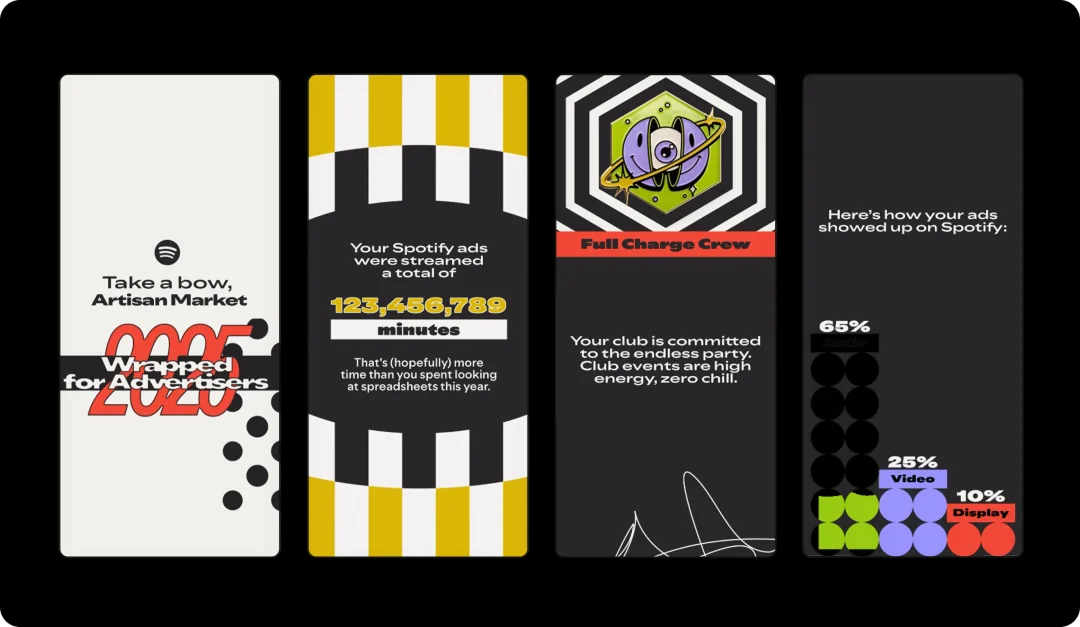
Spotify Wrapped is an annual tradition that gives users personalized, shareable content that doubles as brand marketing. Spotify created a format so compelling that millions of people willingly become brand ambassadors every December. Every creative and UX decision is reverse-engineered for social sharing:
- 9:16 vertical slides optimized for Instagram Stories and TikTok
- Bite-sized, scrollable content that mirrors natural consumption patterns
- Prominently placed share buttons that encourage posting
By reframing listening habits as “your soundtrack” and “your musical identity,” Spotify also satisfies the psychological tension between belonging (participating in a collective cultural moment) and individuality (showcasing unique taste).
The result is a repeatable viral mechanism that generates over 200 million engaged users within 24 hours; not to mention, Wrapped has become so culturally embedded that people actively predict and look forward to when it’s going to drop every year.
The Anthropologie Rock: How They Leaned Into Organic Virality
The Anthropologie rock incident represents organic virality that brands can’t manufacture. It started as a TikTok prank by a woman named Phoebe Adams, who told her boyfriend she bought a $150 rock from Anthropologie.
The joke took off, and people started unboxing rocks from outside their homes, calling them fancy home decor pieces from Anthropologie, and pranking their friends and family with the bit. Anthropologie took note of the trend, and instead of ignoring the trend or issuing some corporate statement about brand integrity, they leaned in.
They created a mock “rock collection” display in stores with fake price tags and discount signs. People loved it because it felt human. The brand became part of the community conversation instead of trying to control it or shut it down. They weren’t selling through the trend. They were participating in the culture that their customers had already organically created.
These examples show different paths to virality, but they share a common thread: the most successful ones had a clear relationship between the viral moment and the brand’s long-term positioning.
Newsflash: virality without strategy is just noise:
- Spotify Wrapped works because it’s repeatable and tied to product usage.
- Anthropologie won because it chose to amplify an organic moment from the community rather than taking over control.
The brands that win are the ones who understand that viral moments are opportunities to deepen relationships, not just rack up views.
The Rage Bait Problem
In 2026, viral content increasingly relies on rage bait: intentionally provocative takes designed to generate anger (and therefore engagement). It works beautifully for algorithm optimization because controversy drives comments, shares, and positive engagement signals for platforms to amplify the content further.
But rage bait corrodes brand equity. When your strategy relies on making people angry enough to engage, you’re training your audience to associate negative emotions or values with your brand.
The Sydney Sweeney x American Eagle and e.l.f. x Matt Rife collaborations became some of the most controversial campaigns of 2025. Both campaigns generated massive attention through rage bait.
While the e.l.f. x Matt Rife collaboration fell flat, American Eagle’s stocks actually went up by 29% after debuting the “Sydney Sweeney Has Great Jeans” campaign; their brand sentiment, however, fell short. By attaching themselves to controversial figures who have little correlation to a brand’s identity, American Eagle and e.l.f. risked looking like attention seekers rather than brands with something to say.
The more important question is this: do you actually have something valuable to add to the conversation? Rage bait optimizes for visibility without requiring substance. It’s the marketing equivalent of yelling in a crowded room. Sure, people turn to look, but they’re not listening. They’re wondering why you’re yelling.
This should (hopefully) resolve the fundamental confusion in how brands approach virality. Most aren’t actually chasing virality. They’re chasing what they think virality will bring them: growth, customers, revenue, market share.
But virality and growth aren’t the same thing:
- Virality is a distribution outcome
- Growth is a business outcome
The two occasionally overlap, but conflating them leads to strategies that optimize for the wrong metrics entirely.
Are You Truly “Breaking the Noise” or Just Adding to It?
The phrase “breaking through the noise” assumes that noise is the problem, but in 2026, there are a thousand viral moments happening simultaneously across platforms. Noise is just the default environment we’re all operating in.
This doesn’t mean viral moments are worthless; they’re just not the strategy. Virality can often be the outcome of doing something genuinely remarkable, culturally resonant, or strategically differentiated, but chasing virality is essentially putting the cart before the horse. Build something worth paying attention to, and the right attention will follow.
So before you ask a marketer to “make you go viral,” ask yourself what you’re really trying to build. If the answer is sustainable growth, brand loyalty, and customers who’ll stick around, virality might be the wrong metric entirely.
Viral Marketing: FAQs
What exactly is viral marketing?
Viral marketing is a strategy where content spreads rapidly through networks of people sharing it. Originally, this happened through email forwards and word-of-mouth, but today it’s largely driven by social media algorithms that decide what content gets amplified to millions of users.
The key difference now is that virality isn’t just about creating shareable content; it’s about creating content that algorithms deem worthy of distribution to people who’ve never heard of you.
Does viral marketing actually work?
Viral marketing can generate massive reach and visibility at minimal cost, but it’s temporary attention rather than sustainable growth (you’re renting, not owning). A viral moment might introduce your brand to millions of people, but without a strategy to convert that attention into lasting relationships, it disappears as quickly as it arrived.
The brands that succeed with virality are those who use it as an opportunity to deepen relationships and build authority, not just rack up vanity metrics.
Is viral marketing expensive?
Viral marketing itself is often low-cost or even free in terms of media spend, since you’re relying on organic sharing and algorithmic amplification rather than paid advertising. This can make it a seemingly attractive marketing tactic (on the surface, at least).
However, the hidden costs come in the form of lost control over your message, potential misinterpretation as content spreads, and the risk of attracting the wrong audience with no targeting precision.
Some icons and visual assets used in this post, as well as in previously published and future blog posts, are licensed under the MIT License, Apache License 2.0, and Creative Commons Attribution 4.0.
https://opensource.org/licenses/MIT