

Go-to-market strategies used to have long legs. A proven channel that could run for years. A strong playbook could scale across teams. But today, the shelf life of a GTM tactic is shrinking, from years, to quarters, to weeks. AI makes groundbreaking growth every week, software catches up, data becomes commoditized, competitors copy what works, and buyers wise up to patterns they’ve seen a hundred times.
Clay hit $100M ARR without a traditional playbook. No massive ad spend. No aggressive cold outbound. No growth hacking through established channels. Instead, they built their go-to-market strategy around a single insight: in 2024, tactics expire faster than companies can scale them.
While other GTM platforms focused on optimizing the existing playbook with better databases, faster automation, and cleaner workflows, Clay built something different. They created an operating system for teams who need to experiment their way to competitive advantage, introducing a philosophy they call GTM Alpha: the ability to continuously find new tactics, test creative plays, and maintain a permanent edge before the market catches up.
CFOs are scrutinizing every dollar. AI is reshaping how buyers research and engage. Traditional GTM strategies are breaking under the weight of saturation and sophistication. And in this reality, Clay positioned itself beyond a better tool, as the infrastructure for building strategies that competitors can’t copy.
Clay’s marketing strategy reveals what happens when you design everything around the assumption that tactics expire, creativity compounds, and the only sustainable edge is the ability to keep finding new ones.
Here’s how they did it.
What Is Clay?
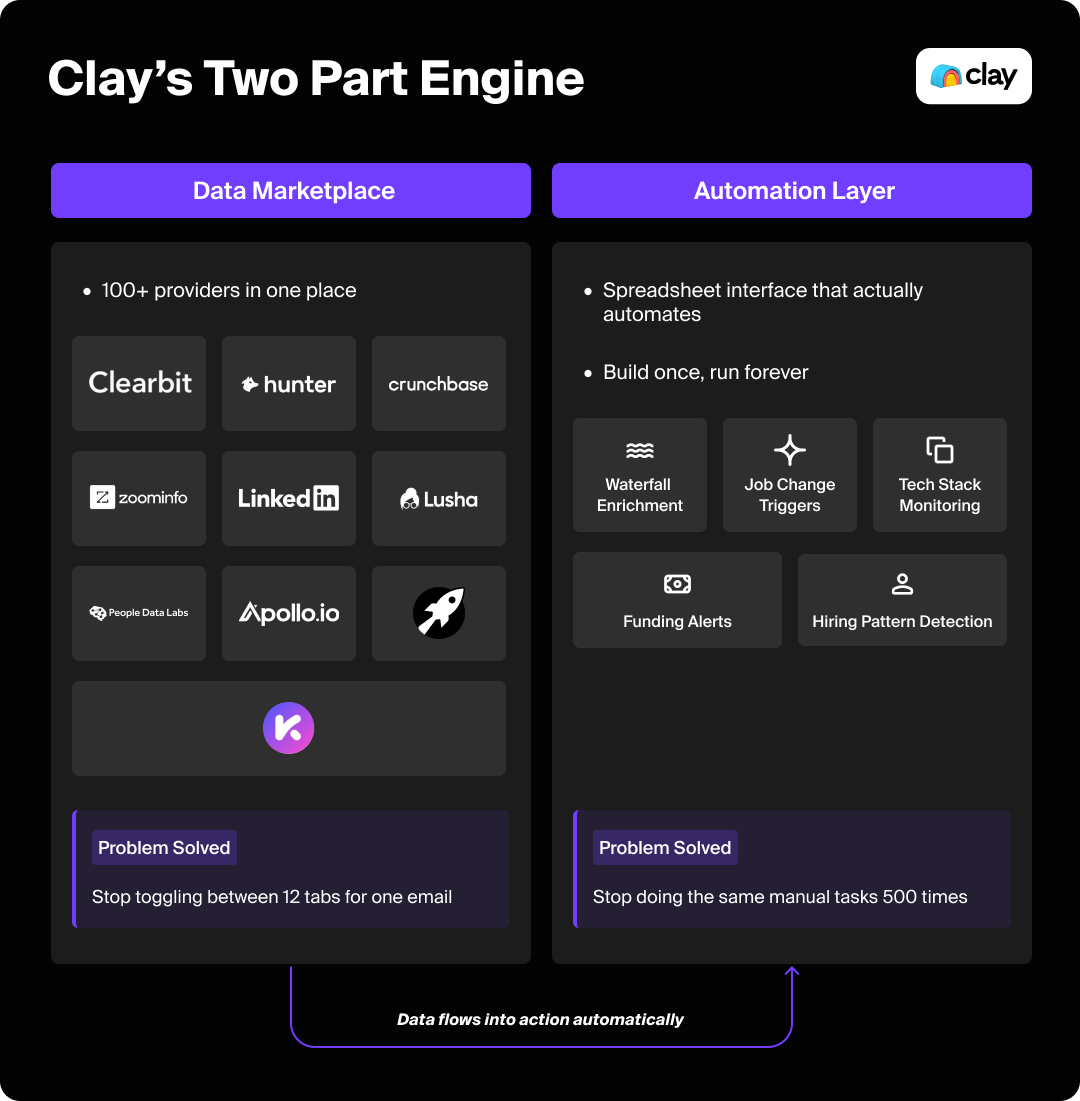
Clay operates on a simple idea: GTM teams shouldn’t have to choose between data quality and workflow speed. Rather, they built a platform that handles both.
At its foundation, Clay is a data marketplace connected to over 100 providers with contact databases, revenue intelligence platforms, social data tools, enrichment services, all in one interface. Teams waterfall across multiple sources to fill gaps, verify accuracy, or update records faster than any single provider could manage.
The second piece pairs that data access with a spreadsheet-style automation builder. Teams pull in data and create workflows that run at scale: prospecting sequences, account-based marketing campaigns, and signals-based outreach, all without code.
This solves a workflow problem that has given GTM teams headaches for years. Reps burned hours daily on manual tasks like sourcing accounts, hunting contact info, verifying data, writing messages.
In short, Clay automates the repetitive work while preserving flexibility to build campaigns that differentiate.
Some workflows are universal. Every company needs accurate employee counts, clean account hierarchies, verified emails, tracked job changes. Clay provides templates for these because they’re table stakes, not competitive advantages to set one apart.
The platform’s real value shows up in what comes after. Teams build experimental plays specific to their business. Campaigns designed around unique signals, unusual data combinations, or creative targeting that only works for their ICP. Work that can’t be copied because it’s built from first principles rather than borrowed from a playbook.
Their dual structure allows data and workflow to become something more valuable than efficiency. But infrastructure alone doesn’t win markets. This dual structure enables what Clay calls GTM Engineering, a role that’s part data analyst, part automation builder, part creative strategist. These aren’t reps executing tasks. They’re people automating entire workflows so reps can focus on conversations that actually close deals.
Clay positions itself as infrastructure for competitive advantage, not just operational efficiency. How teams use it is where Clay’s approach to go-to-market gets interesting.
What Is a Go-To-Market Strategy & Why Is It Breaking?
Go-to-market strategy defines how companies bring products to market and acquire customers. Think sales, marketing, and product alignment working together to identify an ideal customer profile, craft messaging that resonates, and execute across channels that actually convert.
For years, this playbook felt stable. Teams ran cold email campaigns, built LinkedIn outreach sequences, layered in personalization tokens, and scaled what worked. The process was repeatable. Channels delivered consistent returns. Tactics had legs.
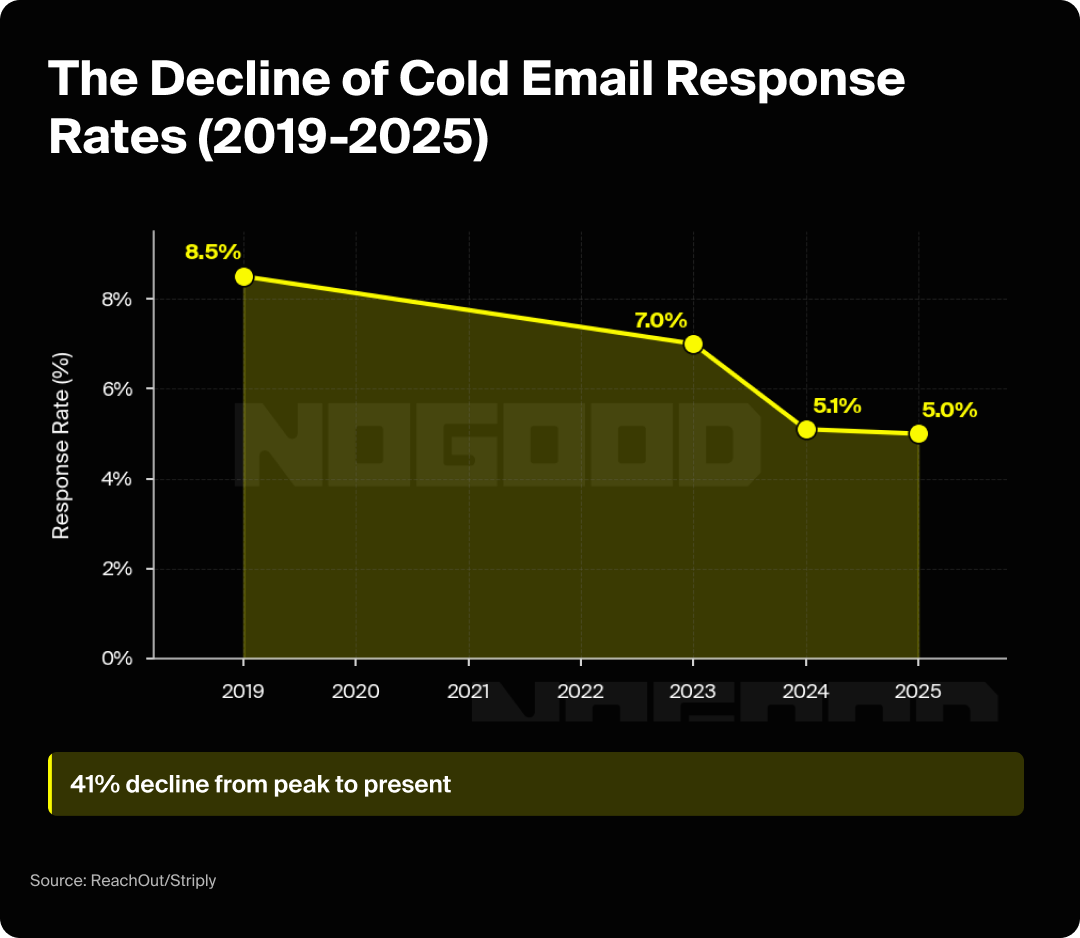
The cold email generated an 8.5% response rate; but that was also in 2019. What worked then doesn’t work now. Take it a step further and spot the largest drop: when AI went mainstream and buyers fatigue grew.
The alma mater personalization play illustrates the problem. A few years ago, referencing a prospect’s college in an email felt personal, like a rep took the time to research. Today, buyers know that AI wrote it.The tactic is expiring. 61.4% of consumers now report they can spot AI-generated content, while 52% say they’d be less engaged if they suspected content came from automation.
Traditional GTM assumed that these tactics had staying power. You’d find a channel, optimize it, scale it, and ride it for quarters or years. But three forces collapsed that model:
Software caught up. What used to require custom builds now comes pre-packaged. Every team has access to the same automation tools, enrichment databases, and AI personalization engines. When everyone can execute the same play, no one has an edge.
Data became commoditized. Contact information, firmographics, intent signals are all available through dozens of providers. The advantage shifted from having data to using it creatively.
Buyers got sophisticated. They’ve long seen every template, every LinkedIn request, every “just checking in” follow-up. 86% of B2B buyers say they’re more likely to purchase when companies understand their goals, yet 59% say reps don’t take time to understand their business.
The bar for relevance keeps rising, and generic outreach gets ignored faster than ever.
Now, 95% of cold emails never even get a response. Entire channels are saturating in real-time, and the shelf life of any single approach keeps shrinking. The traditional GTM playbook of find what works, scale it, repeat… breaks… when “what works” expires faster than you can build a process around it.
This is the GTM reality that Clay entered. Not as another tool to optimize the old playbook, but as infrastructure for teams who needed to build new ones, constantly.
The GTM Alpha: Clay’s Marketing Philosophy
As discussed, current day GTM works this quarter loses effectiveness next quarter. The channel that drove 30% of the pipeline six months ago is now saturating. The personalization technique that used to feel clever becomes rings hollow the moment everyone else adopts it.
Clay deems this a shelf life problem, and rather than fighting it, they built their entire philosophy around it.
Enter GTM Alpha, a term borrowed from finance, where “alpha” refers to returns that beat the market. In Clay’s world, it means the ability to continuously find new tactics, experiment relentlessly, and maintain a permanent edge before competitors catch up. Not by executing the same playbook better, but by building new playbooks faster.
Here’s why tactics expire: Software catches up. What required custom development last year ships as a feature this year. Data catches up. The signal you discovered becomes available to everyone through a new provider. And the market saturates. Once a tactic scales, buyers recognize the pattern and tune it out.
The alma mater email is the perfect example. Even 5-8 years ago, mentioning a prospect’s college felt personal. “Hey, did you ever see Bevo up close?” (that’s UT Austin’s longhorn mascot) followed by a pitch. Buyers assumed the rep did the research. It felt thoughtful. But today everyone knows an AI wrote it. The tactic didn’t stop working because it was bad. It expired because it became recognizable.
How does Clay practice what they preach?
Everett Barry, Clay’s Head of GTM Engineering, found a X account called “Arfur Rock” that leaks funding rounds before they’re publicly announced. Companies raising money months before the press release hits. For Clay, a company raising capital signals growth, hiring, and budget, the perfect ICP fit. So Everett set up a Clay table that pulls those posts directly into their demand gen Slack channel and tags the account owners. Removing the need to manually check and wait for a TechCrunch article. A simplified, direct feed of qualified signals that most competitors don’t know exists.
That is GTM Alpha in action. Not a best practice pulled from a college course or blog post. A creative play built from a unique signal that only works because it’s not obvious yet. It’s instinctive to the core. And when that account disappears or becomes mainstream? They’ll find the next one.
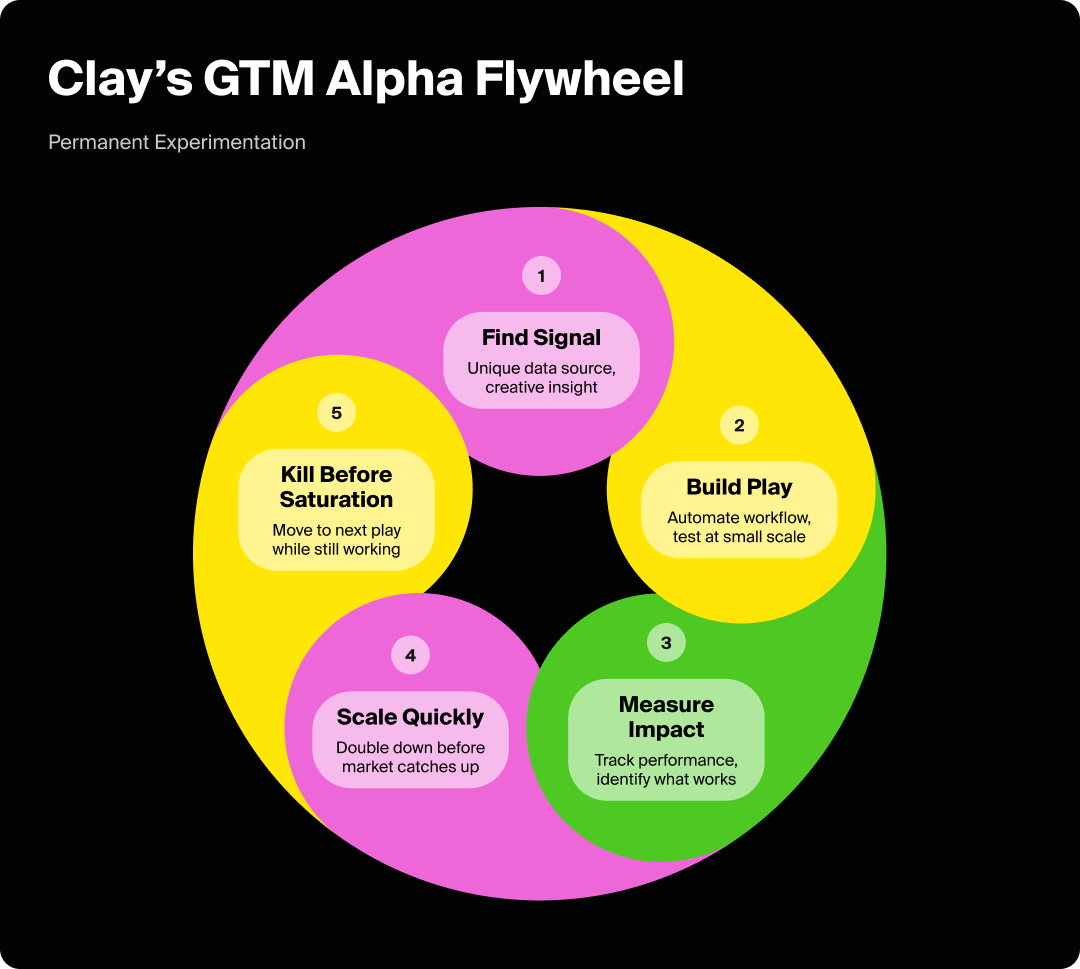
This Alpha mindset only works if you and your team have the muscle to experiment. Without a team that’s comfortable being wrong, testing weird ideas, and going all in on what works, GTM Alpha becomes just another dry framework. Clay’s approach requires both the tools to move fast (their platform) and the mindset to move often (the willingness to pivot and pivot again) and kill tactics before they’re fully saturated.
This philosophy matters even more for AI-powered GTM companies. Buyers are increasingly sophisticated. They’ve seen every AI-generated email template. They recognize patterns faster. And as 61% of consumers can now spot AI-generated content, tactics have shorter shelf lives than ever. The window between “creative play” and “saturated tactic” keeps shrinking.
Clay’s answer to this is building infrastructure that lets teams iterate faster than tactics expire. Give them access to 100+ data sources, automation that eliminates manual work, and the flexibility to test plays most competitors won’t even think of. The only sustainable competitive edge is the ability to find new ones, constantly.
In-Person as Growth Strategy
For Clay’s first few years, the go-to-market function was lean by design. They had just enough to keep customers onboarded and the pipeline moving. Events weren’t on the radar.
That changed when a customer made a simple request: “Can we just come to your office and build these workflows with you?”
The Clay team said yes. The customer showed up with a list of automation ideas for their SDR team. In a few hours, they knocked out what would’ve taken weeks through back-and-forth Zoom calls and async Slack threads. Workflows were alive in real life. The customer left with their systems running. And Clay realized they’d stumbled onto something.
Hackathons became their main top-of-funnel strategy.
Now, Clay’s GTM engineering team travels constantly to customer offices across the country. They show up with laptops, build tables, and solve problems on the spot. The format is simple: bring your GTM challenges, we’ll automate them together for a few hours. Customers walk away with working campaigns. Clay walks away with engaged customers spending credits and seeing value immediately.
The efficiency gain works both ways. Instead of scheduling a 30-minute discovery call, then another 30-minute build review, then a follow-up to troubleshoot, then another to optimize, stretched across weeks, Clay compresses that entire cycle into a single afternoon. Face to face. Customers get momentum. Clay gets clarity on what actually matters to their customers.
Everett Barry still does table builds himself. He was building workflows the morning of a conference talk. That hands-on commitment signals something to both the team and customers: this is a partnership where Clay gets in the weeds with you.
Clay’s approach here proves that in-person isn’t siloed for enterprise sales or conferences. It’s a growth engine. Hackathons don’t have to just be for customer success theater. They’re demand generation. They’re product education. They’re proof that the platform works. And they’re repeatable: build the workflow once, show other customers the same template, iterate based on what you learn.
This strategy scales because it’s built on a foundation Clay controls: a team of 30 people who can build live, a product flexible enough to solve problems in real time, and a philosophy that creative work happens faster when you’re in the room together. Zoom still has its place for discovery calls and executive alignment. But when it’s time to design a GTM motion, test a new signal, or build a competitive play, face-to-face wins.
The marketing payoff here compounds beyond the immediate engagement. When workflows work, customers spend more credits and retention locks in. But the real growth engine is when customers become evangelists. They post workflow screenshots, share meeting stats, and demo their creative plays publicly. Clay doesn’t ask for this, it’s the natural outcome of building someone’s competitive edge with them, not just selling them a tool. The collaboration becomes the story customers want to tell.
Organic Social Strategy: Practicing GTM Alpha
Clay’s social presence looks different depending where you find them. LinkedIn is their main education hub with longer posts breaking down GTM Engineering concepts, workflow tutorials, and thought leadership from leadership and experts within Clay. Twitter/X moves faster: signal sharing, real-time campaign ideas, and community conversations with founders and operators experimenting with new tactics.
While the branded channels do publish high-quality value, that’s not the only medium of Clay philosophy out. A lot of their thought leadership is employee-led. GTM engineers post table builds, automation breakdowns, and solutions to real customer problems. They’re not overly polished branded marketing assets. They’re working examples: “Here’s how we built a funding signal tracker in 20 minutes.” That authenticity does two things; it proves the product works and it builds trust with an audience tired of promotional, vague theater.
Everett Barry’s personal brand on Linkedin has become inseparable from Clay’s positioning. He’s teaching GTM Alpha at conferences, posting frameworks on LinkedIn, and showing up in the comments of customer posts as a professional with a perspective. He’s not selling Clay directly, he’s simply showing what he works on. And by doing so, he’s building a movement around a new way to think about go-to-market. The product becomes the natural infrastructure for his professional philosophy as a leader within the company.
While you may skim Clay’s socials and not see heavy push of “community” content in feeds, their community-first approach shows up in how they engage. Clay’s team responds to questions in their comment threads, in competitor threads, amplifies customer wins, and builds in public. When someone shares a creative workflow, Clay retweets it. When a prospect asks a technical question, a GTM engineer answers within hours. They encourage questions that lead to conversations.
Their education-heavy social strategy demonstrates the product and receives the most traction. Live table builds, automation showcases, creative signal discoveries, these posts show what’s possible. They’re teaching moments that highlight capability.
Product Education vs. Category Creation
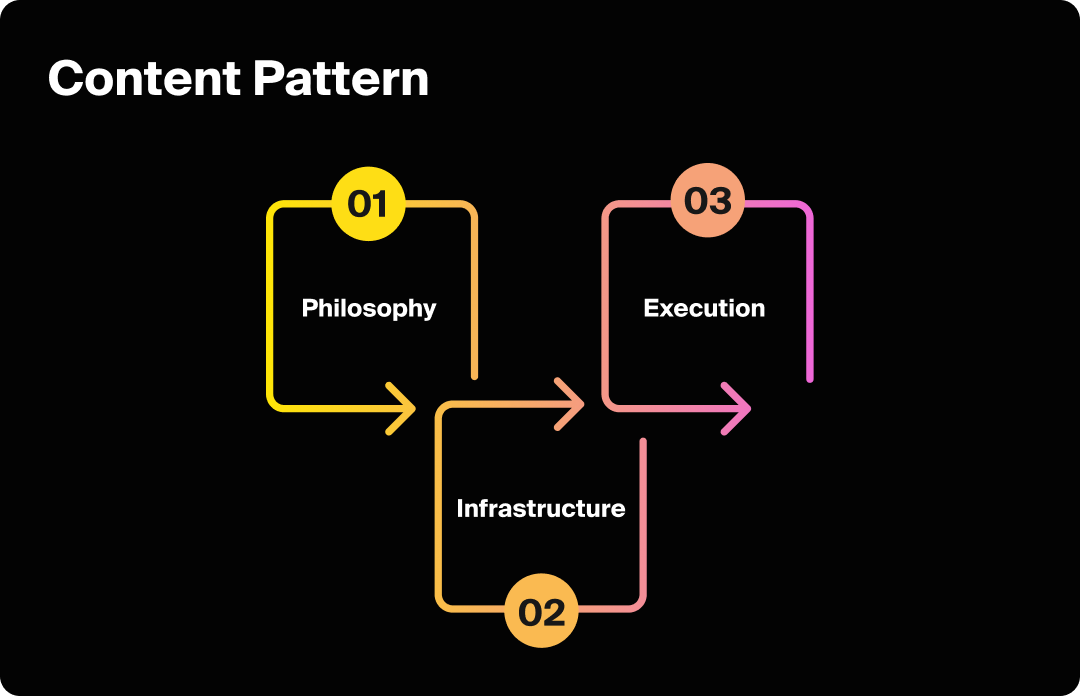
Clay does more than explain the product. They’re actively reframing how the market thinks about go-to-market. The content pattern follows a deliberate sequence: lead with the problem (“GTM is changing, here’s why traditional playbooks are breaking”), introduce the infrastructure needed to keep up, then anchor everything in proof. Philosophy, then infrastructure, then execution.
Tone & Personality
Clay leads with authority without leaning on corporate polish. Personality is present, humor surfaces occasionally, but never at credibility’s expense. They’re not memeing their way to virality. The goal is trust, not clout. The vibe, if you had to put it in a sentence: serious about the work, not serious about themselves. Educational without being preachy. Confident without being arrogant. That’s a narrow lane to operate in, and Clay stays in it consistently.
Competitive Positioning
The philosophical pulse behind the brand separates Clay from competitors taking a different path. While platforms like Apollo expand into all-in-one suites, adding CRM features, outbound tools, unified workflows, Clay bets on depth over breadth. The logic lingers on when everyone has access to the same all-in-one platform, no one has competitive advantage. Tools become commodities. But methodology is defensible.
Clay builds infrastructure that lets teams create plays competitors can’t see, rather than features anyone can access with a subscription. On social, that positioning shows up through respectful differentiation rather than direct attacks. Competitive mentions are rare. When they happen, the framing stays on what Clay does differently, not what anyone else does wrong. They believe in winning by being better, not by being louder.
User-Generated Content as Social Proof
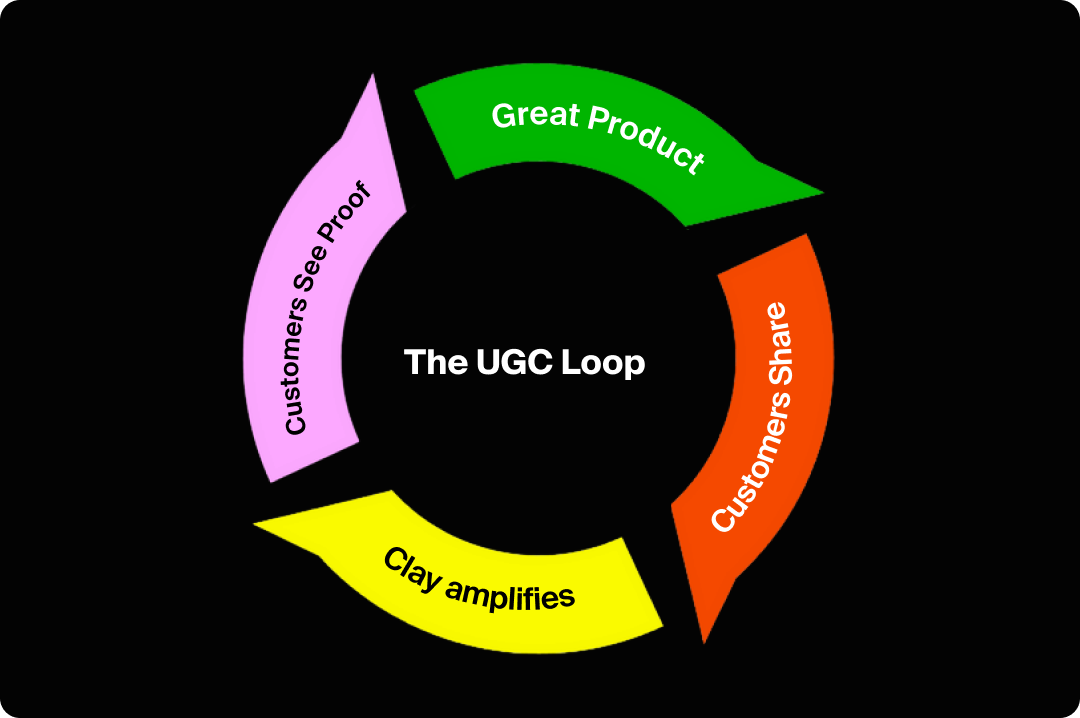
UGC doesn’t happen by accident. It’s the downstream effect of Clay’s customer collaboration model. GTM engineers show up to offices, build workflows together, and co-create competitive advantage in real time. When customers walk away with automation that generates meetings, they want to share it. The in-person hackathon becomes a social media post and becomes proof for the next prospect.
Customers do the real selling. Workflow screenshots, meeting stats, and campaign breakdowns get shared organically. Clay amplifies these wins without needing to prompt them. Customer success becomes the most credible marketing asset they have.
The Meta-Layer: Practicing What They Preach
Here’s what makes Clay’s social strategy genuinely different from most B2B brands running content programs: it mirrors the philosophy they’re selling. GTM Alpha is built on continuous experimentation. Their content reflects that. New formats get tested. Platforms get evaluated. Engagement data informs the next move. The social feed functions like a living case study, proof that the brand operates by the same principles it advocates for.
That’s the meta-layer. Clay’s organic social material goes beyond product education, brand awareness, or generating pipeline. It’s a real-time demonstration of the core belief behind the company. If you follow their content long enough, you understand their worldview. And when you understand their worldview, the product feels inevitable.
Lessons for Marketing AI GTM Platforms
If Clay’s strategy proves anything, it’s that marketing a technical product in an emerging category requires more than a cool design and paid ad money. Here’s what to take with you:
- Build a movement, not just a product. GTM Engineering as a category didn’t exist before Clay started talking about it. Category creation is the only moat that compounds.
- Turn customers into collaborators. Hackathons and forward-deployed teams are a service offering and incredible marketing engine. When customers build with you, they sell for you.
- Practice your philosophy. If you’re preaching experimentation, your content and campaigns need to reflect that. Clay’s feeds look like a living case study because they are one.
- Create tools for builders, rather than buyers. Templates should spark ideas, not dictate execution. The goal is capability.
- Invest in human connection. When everyone else is scaling through automation, showing up in person is a differentiator.
- Focus on edge creation. Efficiency is table stakes. Helping customers build competitive advantage is what earns loyalty.
- Hire people who understand the customer’s world. Cultural fluency with your buyer isn’t a soft skill, it’s what makes everything above actually work.
Final Thoughts: Marketing in the Age of Expiring Tactics
Every marketing tactic has a shelf life. The playbook that drove your first 1,000 customers rarely survives contact with your next 10,000. Channels saturate. Signals dull. And technology moves faster than we can comprehend. What worked last quarter gets copied, commoditized, and eventually ignored. This is the core tension every GTM team is navigating right now and it’s exactly the problem Clay was built to solve.
Their answer isn’t necessarily a better feature set. It’s a better mental model. Give teams the infrastructure and the mindset to constantly iterate, and the tactics take care of themselves. That’s GTM Alpha in practice and the capacity for building new ones faster than anyone else can steal them.
The meta-lesson here goes beyond Clay. The most credible marketing strategy for any technical product is one that embodies the product’s own promise. If you’re selling experimentation, you’d better be experimenting. If you’re selling competitive edge, your customers better be winning. Clay’s social content, its in-person programs, its employee thought leadership all of it reflects the same philosophy the product is built on. That alignment is what makes the brand feel lived out rather than manufactured.
And when you help customers carve out an actual edge, they evangelize. They post the workflow. They bring you into the next meeting. They become the proof that attracts the next customer. That’s the growth loop Clay has spent years engineering, and it’s the clearest signal that their marketing strategy and their product strategy are, at this point, the same thing.