

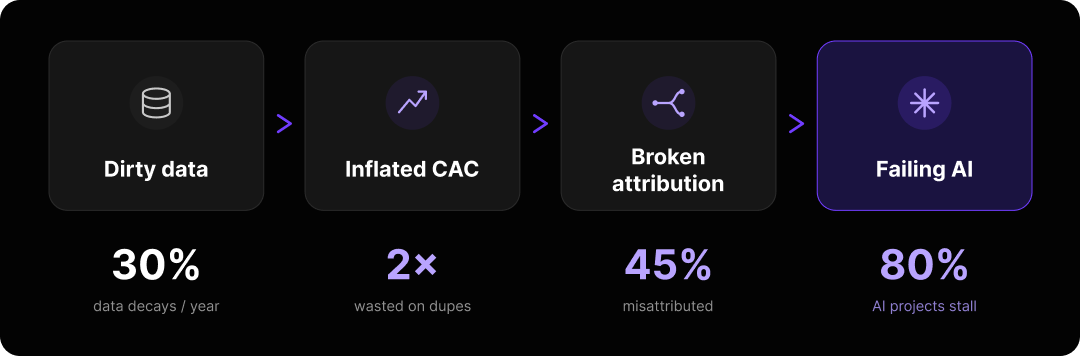
Most companies treat data hygiene as an IT hygiene problem, a backlog item for RevOps to clean up “when there’s time.” That framing is costing them growth.
Gartner estimates poor data quality costs the average organization $12.9 million a year. Redman’s research for MIT Sloan puts the revenue impact at 15-25% for most companies. And in the AI era, the stakes have compounded: Gartner projects 60% of organizations will abandon AI initiatives through 2026 due to a lack of AI-ready data, while MIT’s 2025 GenAI Divide study found 95% of enterprise generative AI pilots delivered no measurable P&L impact.
The common root cause isn’t the algorithm, the ad platform, or the CRM vendor. It’s the data feeding all three.
This article breaks down exactly how dirty data inflates customer acquisition cost (CAC), corrupts attribution, and quietly disables AI performance, and introduces the Data Hygiene Maturity Model, a proprietary framework NoGood uses to diagnose and fix the problem before it shows up in the board deck.
Most organizations don’t have an acquisition problem. They have a data problem wearing an acquisition problem’s clothes.
Marketing leaders chase CAC efficiency by testing new channels, rewriting creative, and renegotiating media rates, while duplicate leads, mismatched identities, and stale records quietly tax every dollar spent before optimization even begins. The math is unforgiving: you cannot optimize a system that is measuring itself incorrectly.
This gets more expensive with every AI system a company adopts. Predictive lead scoring, AI-driven bidding, and agentic sales tools don’t fix bad data. They act on it, at machine speed, with full confidence, across every downstream system simultaneously. A human rep who dials a wrong number eventually updates the record. An AI agent scores it, routes it, and emails it a hundred more times.
This is especially consequential for teams deploying conversational AI for sales, where AI handles outreach, qualification, and follow-up at scale.
Data hygiene isn’t a compliance checkbox. It’s the foundation your CAC, your attribution model, and your entire AI stack are built on.
What Is Data Hygiene? (& Why It’s Bigger Than “Clean CRM Fields”)
Data hygiene is the ongoing practice of ensuring an organization’s customer and prospect data is accurate, complete, consistent, deduplicated, and current across every system it touches; CRM, marketing automation, ad platforms, and data warehouses alike.
It is not a one-time cleanup project. It’s an operating discipline, governed by the same six dimensions the data management field (DAMA-DMBOK) uses to define quality:
| Dimension | What It Means in Practice |
| Accuracy | The data reflects reality (correct email, title, company) |
| Completeness | Required fields aren’t blank or defaulted |
| Consistency | The same customer looks the same across every system |
| Timeliness | Records reflect current, not historical, reality |
| Validity | Data conforms to defined formats and business rules |
| Uniqueness | No duplicate records fragmenting a single customer’s history |
Experian’s data management research suggests organizations believe roughly a third of their customer data is inaccurate, and only about half consider their CRM data clean enough to fully leverage. That’s the starting condition most growth strategies are quietly built on top of.
Why It Matters: The Cost Is Bigger Than You Think
Poor data quality isn’t a soft cost. It shows up in three specific, measurable places:
- It inflates CAC directly. Duplicate leads mean paying to acquire the same person twice. Stale audience data means ad platforms optimize toward people who no longer match your ICP. Sales teams routinely find 20-35% of “new” leads are existing contacts re-entering through a different channel, meaning marketing is functionally bidding against itself.
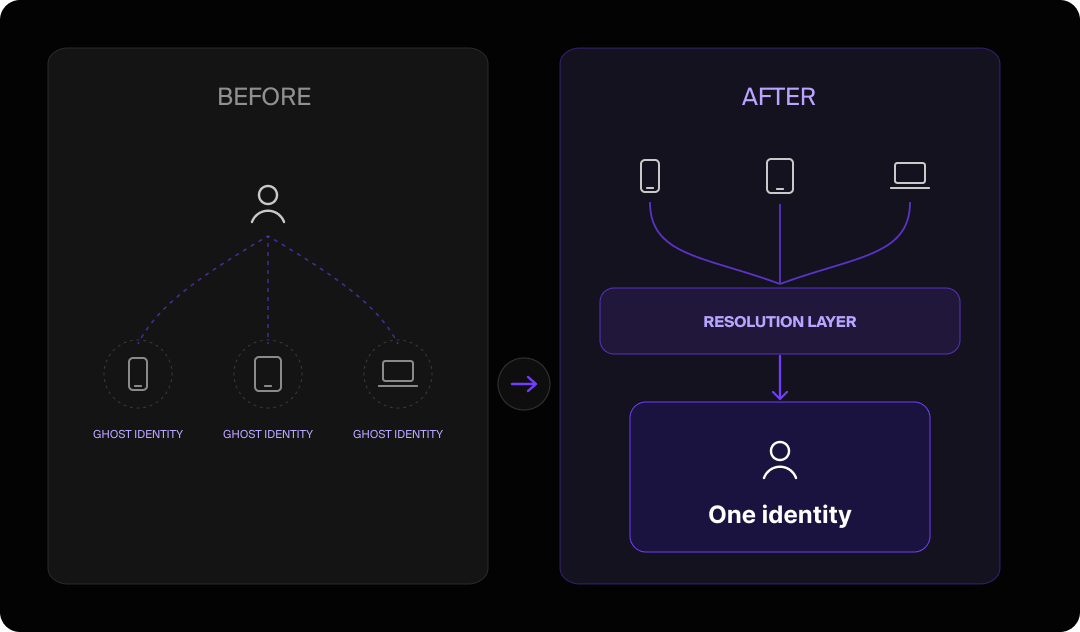
- It corrupts attribution. When a buyer’s identity fragments across devices and systems, multi-touch attribution assigns credit to the wrong channels, and budget follows the wrong signal.
- It disables AI. Every predictive model, every AI bidding algorithm, every agentic workflow inherits the data quality it’s built on. Gartner’s own analysis puts it plainly: a lack of AI-ready data is now the single largest risk to enterprise AI initiatives.
McKinsey’s research on personalization, which depends entirely on clean, unified customer data, found that companies doing it well can reduce acquisition costs by as much as 50%, while lifting revenue 5-15% and marketing ROI 10-30%. The inverse is just as true: without clean data, personalization, predictive scoring, and AI-driven bidding all degrade toward noise.
The Most Common Data Hygiene Mistakes
Executives rarely see these mistakes directly. They see the symptoms (rising CAC, inconsistent reporting, an AI pilot that quietly underdelivers). The causes are almost always the same five:
- Treating deduplication as a one-time project instead of an ongoing process enforced at the point of entry
- Letting each platform own its own “truth”. CRM, ad platform, and data warehouse all disagree, and no one reconciles them
- Measuring attribution without identity resolution, so the same buyer is counted as three different people across devices
- Feeding AI tools unvalidated historical data and assuming the model will “figure it out”
- Assigning data quality to IT instead of making it a shared RevOps, marketing, and sales accountability
Each of these is fixable. None of them are fixed by buying another tool.
The NoGood Data Hygiene Maturity Model
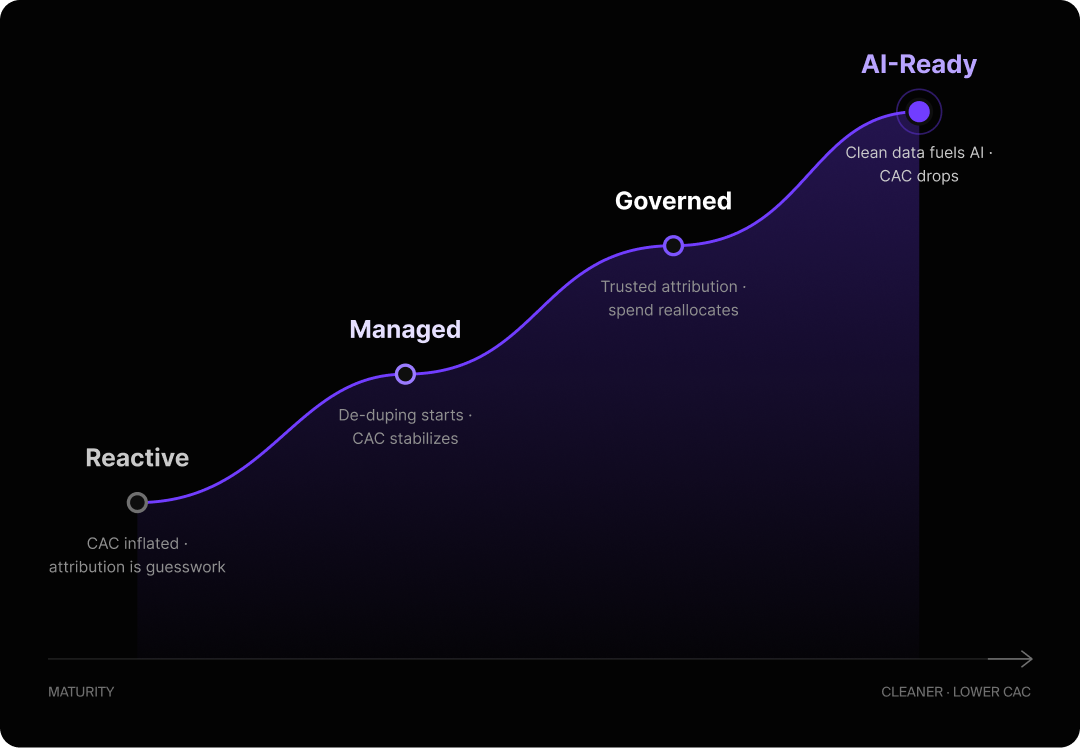
Most data quality frameworks (DAMA-DMBOK, Gartner’s data quality dimensions) describe what clean data looks like. Growth leaders need to know where they stand and what to fix first. That’s the gap this framework closes.
The Data Hygiene Maturity Model scores an organization across four stages, mapped against the systems that matter most for growth: CRM, ad platforms, and AI tooling.
| Stage | Characteristics | CAC / Attribution Impact |
| 1. Reactive | Data cleaned only when something breaks; no dedup rules; manual reconciliation | CAC inflated 20%+; attribution unreliable below the channel level |
| 2. Managed | Basic validation at entry; scheduled dedup; single source of truth for core fields | CAC stabilizing; attribution reliable at channel level only |
| 3. Governed | Identity resolution across devices/systems; documented data ownership; automated quality monitoring | Attribution reliable at campaign level; AI pilots show early signal |
| 4. AI-Ready | Continuous data quality scoring; validated, structured, and current data feeding every model; governance tied to business outcomes | CAC optimization compounds; AI tools perform at or above benchmark |
Most mid-market and enterprise organizations we assess sit at Stage 1 or 2, and are attempting to run Stage 4 initiatives (predictive scoring, AI agents, automated bidding) on top of Stage 1 data. That mismatch, not the technology itself, is why so many AI pilots stall. It’s consistent with what MIT’s 2025 GenAI Divide research found: the overwhelming majority of enterprise generative AI pilots fail to produce measurable business return, and the gap is rarely the model.
Step-by-Step: Implementing a Data Hygiene Program
- Audit before you act. Quantify duplicate rate, field completeness, and identity fragmentation across CRM and ad platforms before choosing a fix.
- Fix ingestion first. Validate email, phone, and company data at the point of entry such as form fills, imports, and integrations. This is cheaper than fixing it later; SiriusDecisions’ well-known 1-10-100 rule holds that it costs roughly $1 to verify a record at entry, $10 to fix it after the fact, and $100 (or more) if it’s left unaddressed.
- Establish one identity graph. Resolve customer identity across devices and systems before trusting attribution data.
- Assign ownership. Data quality needs a named owner (typically RevOps) with authority across marketing, sales, and CS systems.
- Automate monitoring, not just cleanup. Build ongoing quality scoring so degradation is caught before it reaches an AI model or ad platform.
- Gate AI adoption on data readiness. Don’t deploy predictive scoring or agentic tools until the underlying data has been assessed against the maturity model above.
Case Study: From Reactive to Governed
Before: A mid-market B2B SaaS company was spending aggressively on paid acquisition while CAC crept upward each quarter. Its CRM held three years of unreconciled lead data across two marketing automation migrations.
Challenge: An audit found 31% of “new” leads were duplicates of existing contacts, and multi-touch attribution was crediting a lead-gen channel that, once identity-resolved, was actually re-engaging existing pipeline, not generating net-new demand.
Solution: The team implemented entry-point validation, ran a one-time deduplication pass, and stood up an identity resolution layer connecting the CRM, ad platforms, and product analytics into a single source of truth. Ownership moved from “whoever notices the problem” to a dedicated RevOps function.
Outcome: Within two quarters, reported CAC dropped as duplicate acquisition spend was eliminated, and attribution modeling shifted meaningfully more credit toward mid-funnel content, a channel the team had previously been prepared to cut. A predictive lead-scoring pilot that had stalled for a year with unreliable input data was relaunched on the cleaned dataset and began outperforming the team’s manual qualification process within six weeks.
Lesson: The AI tool hadn’t been the problem the first time. The data was. Nothing about the model changed between the failed pilot and the successful one.
Clean data doesn’t announce itself as a growth lever. It shows up quietly, in the CAC number that finally makes sense, the attribution model a CFO can actually defend, and the AI pilot that produces results instead of another line item written off after a proof of concept. The organizations winning right now aren’t the ones with the most advanced models. They’re the ones that fixed the foundation before they built on it. That’s the whole argument in one sentence: you don’t need better AI. You need data your AI can trust. The companies still treating data hygiene as a cleanup project will keep paying for it in acquisition cost, in bad attribution, and in AI investments that quietly underdeliver. The companies that treat it as infrastructure will be the ones still standing when the next wave of tooling arrives, because their foundation was never the problem.
Want a structured audit of where your data stands? NoGood’s growth and RevOps teams can benchmark your CRM, attribution, and AI-readiness against this framework and build the roadmap to close the gap.
Data Hygiene as Growth Strategy: FAQs
What is data hygiene in marketing?
Data hygiene is the ongoing practice of keeping customer and prospect data accurate, deduplicated, consistent, and current across CRM, marketing, and advertising systems, as opposed to a one-time cleanup effort.
How does data hygiene affect CAC?
Dirty data inflates CAC by causing duplicate outreach, misdirected ad targeting, and inaccurate attribution that misallocates budget toward underperforming channels.
Why do AI marketing tools fail without clean data?
Predictive models, AI bidding systems, and agentic workflows inherit whatever data quality they’re trained and operated on. Gartner and Forrester both identify data readiness, not model capability, as the primary factor limiting enterprise AI performance today.
How often should a company audit its data hygiene?
Quarterly, at minimum, for CRM deduplication and field completeness, with continuous, automated monitoring for organizations running AI or predictive tools on top of that data.
What’s the difference between data governance and data hygiene?
Data governance defines the policies, ownership, and standards for how data should be managed. Data hygiene is the operational execution of those standards, the actual state of the data day to day.