

Hey you! Yes you! Do you want to make thousands of dollars a month by using AI to make viral social media content while you do absolutely nothing?

Then this article… isn’t for you.
However, if you’re a content creator, marketer, or business owner who is looking to amplify your creative process without losing the human touch that makes your content authentic, you’re in the right place.
Reality Check: Why Most AI Content Fails
Behind all the grifting “buy my course” bros and videos from high school dropouts who supposedly sit on their phone all day making thousands of dollars letting AI generate content for them, there are two undeniable truths they are trying to hide from you.
- Audiences can easily spot AI generated content
- Audiences do not like AI generated content

There’s a reason why AI-generated content is always getting cooked in the comments, and it’s not only because it is AI-generated… but by that nature, it lacks any meaningful effort to make a human connection.
That’s why, if you are going to do content creation with AI, it’s important to understand AI’s actual role. AI’s role isn’t to cosplay creativity; it’s a tool that helps you streamline time-draining tasks that hold you back from executing on the creative end.
Which AI Is Best for Content Creation?
The best AI tools don’t attempt to replace you, your expertise, or your creativity. They help you streamline your creative workflow and amplify your existing capabilities.
And the gold standard of AI that amplifies is Adobe.

Adobe didn’t earn this designation by accident. They’ve spent decades now proving that the best creative tools are the ones that enable human creativity; not emulate it. Adobe’s approach with their Sensei AI features is a blueprint that every “AI creative tool maker” should follow.
Content-Aware Fill in Photoshop handles tedious object removal/filling. Auto-Transcription in Premiere Pro streamlines captioning, saving you hours of tedious work. Smart Cropping automatically adjusts your graphic dimensions to fit different social media platform specifications. Enhance Speech helps clean up and restore audio tracks.
These tools all share a clear commonality: they are built to handle tasks that waste your time… not tasks that rely on your creative decision-making.
How Do I Create AI Generated Content? (The Right Way)
So, how do I do this? It’s funny, because you likely have already been using the right tools; you’re just using them wrong. And to help illustrate this distinction, here are several sentences written in AI’s favorite structure: “It’s not this, it’s that”. Maybe a little too meta, but we ball.

ChatGPT isn’t for writing your scripts, it’s a brainstorming partner. The creative strategy and messaging is still all on you. But if you’re dealing with writer’s block, or need a springboard to bounce your thoughts off of, it’s an invaluable resource.
Runway ML and Google Veo 3 aren’t for AI generating your video, they are for supplementation. If your creative vision requires expensive equipment to execute or isn’t practically filmable, these tools can help fill those gaps. There is a difference between using AI to generate your entire video, and using it to supplement physical restrictions.
…So on and so forth.
The 80-20 Rule
You should aim for 80% human input (at least), and 20% AI assistance (at most). The strategy, voice, expertise, and creative decisions should all be rooted in human input. Leave AI to handle tasks that are time-consuming and repetitive.
If you are publishing AI-generated content as-is… you’re doing it wrong.

You should always…
- Root your content in personal insights and experiences
- Have verified facts that aren’t reliant on AI
- Ensure the tone matches your brand voice
Quality Over Quantity (Always)
Just because you can create content faster doesn’t always mean you should. You should only be leveraging AI to elevate your human-made content. The moment you start relying on AI and pumping out slop, you are using it wrong.
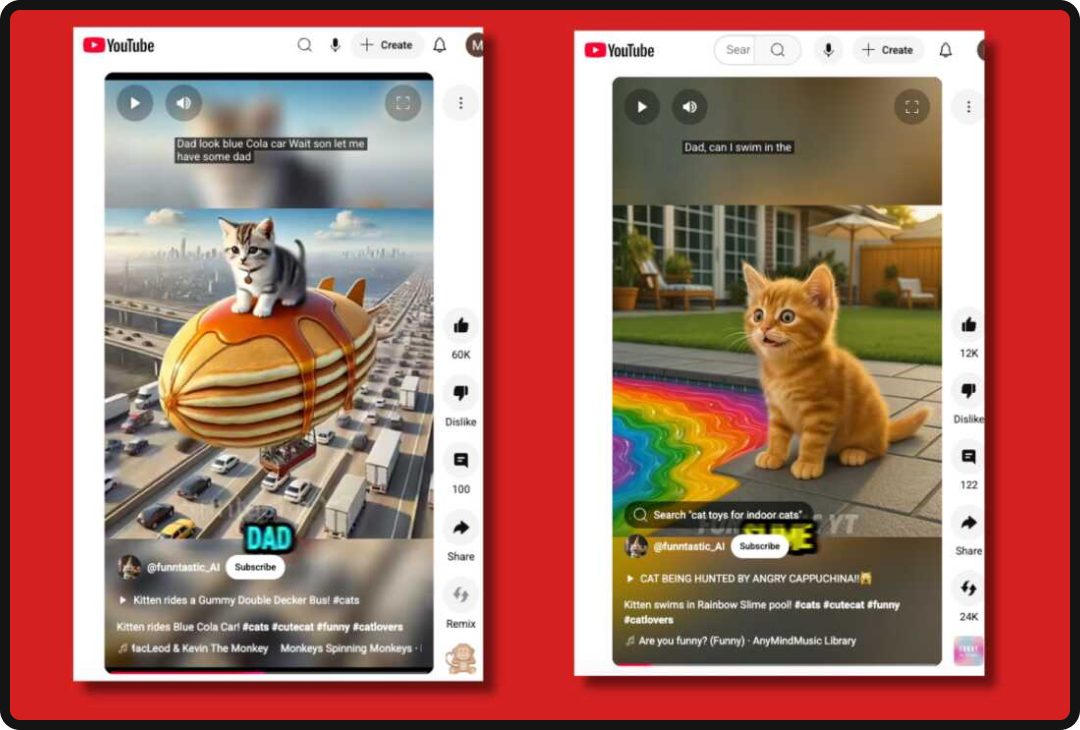
This is what will separate you from your competition as AI grows. Content creators who acknowledge and leverage AI as a collaborative tool will be the ones that succeed. AI will only replace the creators who try to force-fit it as a creative replacement.
Can I Make Money from AI Generated Content?
The short answer? Yes.
BUT not by churning out generic AI slop content. Platforms are starting to crack down on generative AI content, which makes the long-term viability of this content questionable.
The creators making real money with AI are the ones who understand AI’s value is in eliminating time-draining tasks while making human-made content. When you use AI to cut out those time-draining tasks, you can invest more time into creating additional content and the strategy behind your content.
The Sustainable Revenue Model
Every hour you spend on repetitive tasks is an hour you could be spending maximizing revenue-generation.

You should consider using AI to…
- Reformat content for different platforms
- Generate transcripts
- Clean up audio
- Support initial research
By offloading these tasks to AI tools, allowing you to direct more focus to your strategic and creative decisions.
Making money with AI has significantly more long-term viability than making money from AI. Successful creators use AI as a tool in their workflow, rather than the workflow itself.
Building Your AI-Enhanced Workflow
Here’s how you can amplify your content creation workflow by using AI, without turning into a generic content farm.
Identify Your Biggest Time-Drains
Start by auditing your current workflow. Identify which repetitive tasks eat up your time, but don’t add any creative value.
Common time drains that AI can help with are…
- Formatting content for multiple platforms
- Basic audio cleanup
- Surface-level research and competitor analysis
- Post scheduling
Integrating AI
Don’t jump straight into overhauling your entire workflow overnight. If you want to experiment with AI as a creative partner, start small.
- Identify your biggest time-draining tasks: What repetitive tasks exist within your current workflow that hold you back?
- Experiment with one tool at a time: Slowly integrate AI tools as you narrow in on areas that require optimization.
- Maintain your creation standards: Don’t let AI drive your creativity, but use it as a helpful tool. Your expertise should still stand as the primary pillar of your content.
- Track your efficiency gains: Monitor how the AI tools you integrate are impacting your productivity and the quality of your content output.
Maintain Your Creative Standards
As you are testing different AI tools within your workflow, you should keep a clear benchmark for quality in mind. Define your quality standards, and do not sacrifice or compromise just because AI makes it faster to produce content.

Every piece of content you post should meet those standards. If you’re ever worried your audience will be able to tell the content was AI-assisted, that is a telltale sign that you are not meeting your standards.
Track These Two Metrics
Monitor your efficiency gains AND audience engagement. This is a delicate give-and-take. A more efficient workflow isn’t worth it if your engagement drops.
Pay attention to…
- Time saved on repetitive tasks
- Content output
- Audience feedback and sentiment
- Content performance compared to pre-AI benchmarks (engagement rate, comments, etc.)
Common AI Pitfalls
As you are experimenting with these new tools, make sure you are cognizant of and avoid the following pitfalls.
- Full Automation: As we’ve already discussed, “content automation” is not built to succeed long-term. Don’t trust the AI bros and course grifters who sell anything other than this truth.
- Trading Value for Volume: More content =/= better results. Focus on creating BETTER content more efficiently, rather than flooding the algorithm with a bunch of mediocre posts.
- Losing Your Brand Voice: AI tools can quickly dilute your brand’s voice and messaging. You need to keep a prying eye on any AI-assisted aspects of your content to make sure your voice isn’t being shut out.
Ethical AI Content Creation
Time to address the elephant in the room…

A lot of the discussion surrounding AI in content creation revolves around whether it’s ethical or not. And the truth of the matter is, this is not a black and white debate. There are clear ethical issues with AI content, but at the same time, there are ways to leverage AI without sacrificing ethics.
Transparency Builds Trust
Now, I am not saying that you need to disclose every single time you use AI and every basic task you use it for. Nobody cares if you use it for things like spell-checking or formatting. But if AI plays a significant role in your content, being upfront about it will build credibility with your viewers.
And even if you try to hide it, chances are they will still be able to tell.
Respect & Follow Copyright Law
There are a lot of ongoing lawsuits with generative AI and copyright law, which is why it’s more important than ever to be informed about which tools are/aren’t following copyright laws.

It may seem like I’m glazing Adobe in this article (I promise, it’s not intentional), tools like Adobe Firefly are great for this because they are only trained on licensed content.
This expands past generative AI too. If you use AI to help research or gather information, always make sure you verify your sources and provide proper attribution. Don’t let AI’s speed bypass your responsibility to copyright law.
The Human Element Matters
The determining factor behind whether your AI usage is or isn’t ethical comes down to this: are you using AI to enable your creativity, or fake it?
If you are a chef using AI to resize recipe photos, that’s enabling. If you are using AI to write recipes for dishes you’ve never cooked, you’re faking it.
The Future of AI-Amplified Content Creation
The creators who succeed at leveraging AI will be the ones who lean into human-AI collaboration. They will use AI to handle the repetitive and time-consuming aspects of content creation, while focusing their energy on the strategic and creative aspects of their content.

AI is not here to replace your human expertise, but it also isn’t here to help you fake it till you make it. When you learn how to leverage it as a collaborative tool, it will help you save hours of your time and be more efficient in the tasks only a human can do right.
AI Winners vs. AI Losers
AI Winners: Use AI to free up time and focus more on strategic and creative work
AI Losers: Use AI to avoid doing strategic and creative work
AI Winners: Keep a prying eye on any and all AI outputs
AI Losers: Pump out AI slop without any quality control
AI Winners: Maintain their authentic tone of voice across all content
AI Losers: Let AI dilute their voice in favor of higher content quantity
Your Next Steps
If you are ready to start amplifying your content creation process with AI, here is where you should start…
- Audit your time-drains: What repetitive tasks are currently eating into your creative time?
- Start with one tool: Choose the AI tool that addresses your biggest time-drain, and slowly start integrating it into your workflow
- Set quality standards: Set a bar for your content, and don’t compromise on it
- Test and measure: Track both your efficiency gains and audience response
- Stay human-first: If a tool starts trying to make creative decisions for you, ditch it. Remember the 80/20 rule.
- Scale integrations gradually: Continue to slowly stack tools that eliminate repetitive tasks, only after mastering previously additions
AI Is Your Partner, Not Your Replacement
Ultimately, your ability to create and strategize content is more valuable to the creator economy now than ever before. And the creators who have these skillsets can leverage AI to maximize their creative capacity by eliminating time wastes.
The future of AI in content creation isn’t AI content creation, it’s AI amplifying content creation.