

If you aren’t treating social media as the new landing page, it’s time to start. In practice, that means your profile now functions like a homepage: clear positioning, social proof, consistent messaging, and recent active content all shape whether someone keeps exploring or drops off immediately.
The more pressing question as a result is, if organic social has bigger shoes to fill for your brand, how do you know if it’s stepping up to the plate?
Most brands are still grading social on a rubric that was built five years ago: impressions, follower growth, and likes. Those metrics were designed for a version of social where the goal was attention.
What matters more now, is how trusted and discoverable you are. In 2026, your brand has to fight that much harder to be seen, let alone remembered. According to Hootsuite, Facebook’s average organic reach has dropped to 1-2% for most pages, Instagram’s fell 12% year over year, and LinkedIn saw a 34% slide. Now is when intention, strategy, and creativity are your best friends.
Now that you’re up to speed, let’s get into it.
Why Vanity Metrics No Longer Tell The Full Story
The biggest shift happening in organic social media right now is that measurement is moving away from pure visibility metrics and toward intent and trust signals. Five years ago, success on social media was largely about reach: how many people saw your content, liked it, or followed your account.
Today, the more meaningful question is whether people actually care enough to remember, save, share, search for, or talk about your brand after seeing it. USA Today reports that 88% of consumers say trust is just as important as cost and product quality when choosing a brand, indicating that visibility still matters, but intent and trust are what move people through the customer journey on social media.
Before we dive in, I want to be clear that we’re not here to reinvent the wheel, vanity metrics still have a place in your reporting. However, the hierarchy should shift from headline to baseline as you begin to prioritize advanced metrics. Let’s start with the former and dive into why they’re no longer enough:
|
Social Metric |
What It Tells You |
What It Doesn’t Tell You |
|---|---|---|
|
Impressions |
How many times your content appeared on a screen |
Whether anyone cared, remembered, or took an action as a result of your post |
|
Follower Count |
Tells you how many people decided to “opt into” your brand |
Why someone chose to follow you or if they’re still paying attention |
|
Likes |
The digital equivalent of a polite nod, an immediate emotional resonance (fleeting) |
Whether people actually watched or absorbed the content; a like is passive |
Can you sense a pattern? Vanity metrics can give you a picture of your brand’s overall health, but they don’t give you the meat, the why, which is the most valuable information for any marketer.
There’s also a piece of the puzzle that most brands aren’t accounting for at all: dark social. A significant portion of how your content actually travels, whether that be through screenshots, group chat links, and word of mouth etc., never shows up in your native analytics. So, if you’re only measuring what the platform hands you, you’re working with an incomplete picture by default.
The smartest brands are asking better questions of their data, demanding a bigger story that goes deeper than the surface level; And that starts with knowing which metrics are actually worth tracking.
7 Advanced Metrics Worth Tracking
1. Share of Voice
Share of voice answers a question that impressions alone never could: out of every conversation happening in your category right now, how much of it is yours? It’s a competitive metric at its core. Share of voice can be tricky because it’s not as black and white as traditional vanity metrics, but that’s the beauty of it. There’s a level of nuance you have to consider before coming to a conclusion. Some questions I like to ask myself are:
- What’s happening from a cultural perspective?
- How are the platforms themselves changing?
- How is my brand changing?
- Where is the majority of volume coming from?
As you’ll notice with all of these advanced metrics, you get out of it what you put into it. Yes, vanity metrics are easier to understand, but they are also equally limiting.
With share of voice for example, you have to go a level deeper as a strategist to consider the bigger picture before you get an insight worth writing home about. I.e. You could be growing consistently month over month and still be losing ground if your competitors are dominating the conversation. Share of voice gives you that context. Because of this, I like to think it matters less how many followers you have or how long your brand has been around which hopefully gives smaller brands equal opportunity of being noticed as bigger brands. Niche is the new black!
In a nutshell, share of voice is the difference between knowing you showed up and knowing whether anyone noticed, relative to everyone else in the same room.
2. Citations & LLM Visibility
Integrating AI and Answer Engine Optimization (AEO) search with organic social is newer territory for a lot of us, which makes it a prime opportunity to get acquainted while we’re still in the testing phase.
As AI search becomes a primary discovery tool, the question moves past “how do you rank on Google?” and becomes much more specific, “does ChatGPT, Perplexity, or Gemini cite you when someone asks a relevant question?” Those are two very different kinds of visibility, and if your brand is only tracking the former, this is a friendly wakeup call that your organic social channels can’t afford for you to not consider AI citations and visibility as part of your strategy.
If we think about it from a consumer perspective, it makes perfect sense. Someone types “best everyday running shoes” into ChatGPT. The model pulls from everything it knows and surfaces a handful of brands by name. If yours isn’t one of them, you don’t exist in that moment. What’s more, is that these LLMs are not only pulling sources from other web browsers, but organic social mentions too. Another reason why what you post and what other people post about you matter; While different AI systems source information differently, public social conversations increasingly influence what surfaces in AI-generated recommendations and citations. A study from Position Digital reports that YouTube and Reddit combined account for 78.2% of AI social media citations.
Whether you like it or not, part of the success story of your brand’s social media strategy now lives in AI citations. Your social content, and what others say about you on social media, feeds directly into how frequently your brand surfaces in AI search. The two are no longer separate conversations. Where social media meets AEO is exactly the gap that Goodie was built to close. Goodie is an end-to-end AEO platform that monitors, measures, and helps improve your brand’s visibility across every major AI search surface, from ChatGPT, Gemini, and Perplexity etc. If you want to know whether your brand is showing up in the conversations that matter, you know where to find us.
3. Saves
In my humble opinion, saves might be the most underrated metric on social media. A save is an intentional, deliberate action. Someone saw your content, decided it was worth coming back to, and tucked it away. If you think about social as a landing page, a save is the closest thing to a bookmark. It means your content did its job and provided something relevant for both the present and the future (can you tell it’s my favorite metric).
High save rates are a strong signal that your content is useful on top of scroll-stopping. There’s a difference between content that grabs attention in the moment and content that people actually want to return to.
When you factor in everything about marketing in today’s age, passive attention isn’t worth chasing, but earned, active attention through strong content is. Think about it, can you remember one ad from the 2026 Super Bowl? Probably not, but it’s not like there was a shortage of content and LinkedInfluencers sharing their top 5 Super Bowl ads, or AdWeek articles about brands changing the game (literally)! What I’m hoping to convey is that winning social media is no longer about getting the most attention. Don’t get me wrong, attention still matters, but attention without retention, intent, or trust is increasingly hollow. However, saves can indicate that your brand has some semblance of permanence in people’s minds. Saving content = I want to remember you for more than 30 seconds.

4. Shares
If saves are the bookmark, think of shares as word of mouth. When someone shares your brand’s post, it signals your content is worth passing along, whether that’s to their entire following or directly to a friend. Both matter, but they mean different things. A public share extends your reach organically and signals that your content is worth amplifying. A DM share is more intimate, it means your content resonated enough that someone thought of a specific person when they saw it. Ideally, the goal is for your posts to both hit on a global and a personable level, which admittedly is not an easy feat.
One thing to keep in mind is that a chunk of shares happen in places you can’t directly track. For example, if someone shows your post to a friend sitting next to them versus literally sharing it with them on dm. This is an important consideration when it comes to reporting on organic performance because not all shares show up in places you can easily point to and say ‘see! Our strategy is working!’ Alas, no one metric is enough to support or negate an entire social strategy; it’s our responsibility as marketers to use all of the tools in our toolbox to piece the puzzle together.
5. Comment Quality
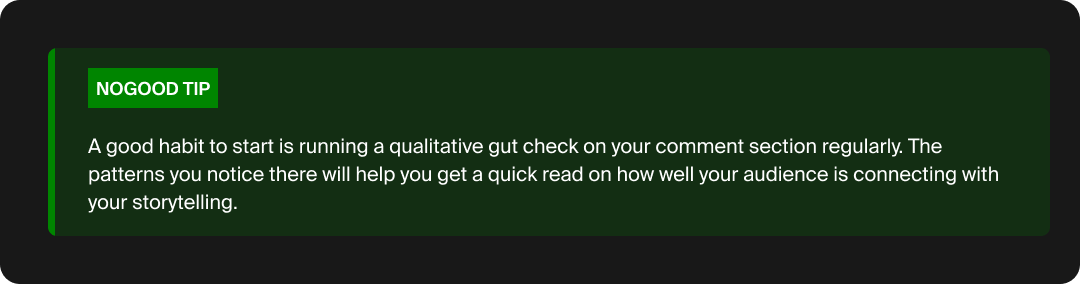
Your comment section is where all the action happens. If you know how to read yours, it can be useful for audience sentiment, market research, community building, social proof and even crisis detection.
Let’s say you have a post that received 200 comments, but they’re all emojis or one word responses. That shows high engagement, but the quality of each comment is low, meaning you’ve captured your audience’s attention for a fleeting moment. Now, imagine you have a post with 20 comments but this time they feature unique and thoughtful responses. Though this is a significantly lower volume of comments, each one makes a deliberate connection to your brand. Of course it’s not a perfect comparison because there are always a multitude of factors to consider, but the overarching sentiment here is that comment quality is a much better proxy for community health than straight up comment count. The next time you scroll through your brand’s comment section, ask yourself the following:
- Are people asking questions?
- Are people tagging friends?
- Are new conversations started?
- Are people sharing their own experiences with my brand?
Rather than volume alone, these are the more subtle signs worth paying attention to. The flip side is also worth noting. A comment section full of one word responses or worse, crickets, tells you something too. In this case, all information is good information. Don’t let a silent comment section defeat you, it’s all a matter of tinkering until you find the right combination. For example, your hook style, imagery, caption, and time of day can all be factors that impact the likelihood of a poppin’ comment section. You can start by testing one of those items and go from there.
6. Watch & Video Completion Rate
For measuring ROI on video content, completion rate and/or engaged views is king. If you work in marketing, my guess is video content is likely a part of your social media strategy. A good way to measure how your video content is performing is with watch rate, video completion rate, or by looking at engaged views. Wath rate is the number of viewers who watch an entire video, divided by the total number of viewers, multiplied by 100.
A higher video completion rate is a good indication that you’re creating quality content that your followers are excited to watch. On the flipside, if you notice your completion rates are low, consider playing around with video length, hook style, editing style, and of course content.
Remember,the algorithm rewards completion, meaning the more people watch your video all the way through, the more the platform pushes it to new audiences. It’s a compounding effect! An easy way to visualize this is as follows, on TikTok, a 5,000-follower account with a 90% completion rate gets more distribution than a 500,000-follower account with a 30% rate. I.e. High engagement isn’t always a direct result of having a lot of followers.
Low completion rates are also one of the most useful diagnostic tools you have. If people are dropping off at the 5 second mark, your hook isn’t working. If they’re dropping off halfway through, you’ve lost the thread somewhere in the middle. The data tells you exactly where you’re losing people, which means you know exactly where to fix it.
7. Brand Sentiment
Not every metric of success on social comes down to numbers, and brand sentiment is the perfect example of that. Brand sentiment is less about the numbers at a glance and more about how people feel about your brand, also known as cultural currency.
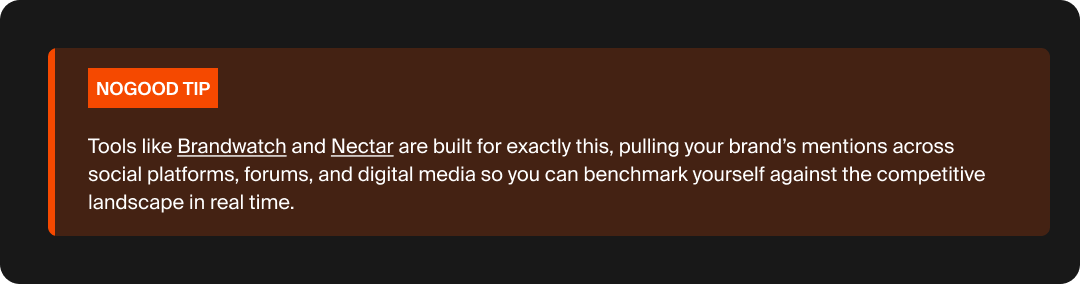
Social media management tools make this easier by tracking specific words across your comments, mentions, and reviews to help you understand the general trends and moods surrounding your brand. Think of it as decoding your brand’s reputation in real time, where your actions on social media directly shape sentiment.
If you want to be seen as a trusted voice in your space, treat your social media like the brand ambassador final boss; Respond to comments, engage with your community, and make it obvious that there’s a real person behind the account. According to Sprout Social‘s Q2 2025 Pulse Survey, 58% of social media users believe that audience interactions are more important for brands to prioritize than the content they post.
And if negative comments come your way, don’t panic right away. They’re actually an opportunity to demonstrate your customer service chops in public, which can do more for your brand perception than a hundred positive comments ever could. Measuring brand sentiment is not only limited to your brand’s own socials, but extends to your wider network including how you show up on social media in terms of creator content, competitor mentions, and across conversations.
What a Healthy Scorecard Looks Like in 2026
The metrics you prioritize should reflect where your audience is in their journey with your brand, and your goals for organic social. Here’s what that looks like in practice:
|
Goal |
Metrics to Track |
|---|---|
|
Awareness & Discoverability |
Share of voice, LLM citations, brand sentiment |
|
Consideration & Trust Building |
Saves, shares, comment quality, watch time, completion rate |
The goal isn’t to track everything at once. It’s to know which metrics belong to which stage so you’re asking the right questions at the right time. Context matters: a save means something different at the top of the funnel than it does at the bottom. It might be helpful to build a dashboard that pulls your data together in an easily viewable format.
Marketer to marketer, a friendly piece of advice: make your life easier by creating a repeatable practice that actually suits the way you like to read data. As we know, tools are only helpful if you enjoy using them, so set yourself up for success and create one hub that houses all of your data like a dashboard, or an excel spreadsheet tracker so you can easily access metrics in a way that makes sense to you.
You can have access to all the data in the world, but if you don’t have a repeatable process on how you interpret and process it, it can’t do anything for you.
What This Means for Social Teams
As social media evolves from an awareness channel into a discovery and trust-building engine, the way teams measure success has to evolve too. The brands that win on social in 2026 won’t necessarily be the ones with the biggest audiences, but the ones creating the strongest signals of intent, relevance, and trust.
That shift requires social teams to rethink what they prioritize internally. Instead of optimizing exclusively for reach and impressions, teams should start focusing on the metrics that indicate deeper audience connection and long-term brand impact.
5 practical shifts worth making on your social media strategy in 2026:
- Prioritize depth over reach. A smaller audience that saves, shares, and meaningfully engages with your content is often more valuable than passive visibility at scale.
- Build reporting around intent signals. Saves, shares, comment quality, profile visits, and branded search behavior tell a more complete story than impressions alone.
- Monitor AI visibility alongside traditional search visibility. Increasingly, your brand’s discoverability depends not just on Google rankings, but on whether AI platforms surface your brand in relevant conversations and recommendations.
- Blend quantitative and qualitative analysis. The numbers matter, but so does the context behind them. A thoughtful comment section or a surge in positive sentiment can reveal insights that dashboards alone miss.
- Optimize for retention, not just attention. Anyone can capture a view for a few seconds. The stronger challenge is creating content people remember, revisit, and associate with your brand over time.
Ultimately, the goal isn’t to abandon traditional vanity metrics altogether. It’s to build a more complete measurement framework that reflects how people actually discover, evaluate, and build trust with brands on social media today.
Organic Social Measurement FAQs
What are vanity metrics?
Vanity metrics are surface-level engagement indicators like impressions, follower count, and likes that show visibility but not necessarily meaningful audience connection, trust, or conversion intent.
What are advanced social media metrics?
Advanced social media metrics measure deeper audience behavior and brand impact, including Share of voice, citations and LLM visibility, brand sentiment, saves, shares, comment quality, and watch time and video completion rate.
How do you measure brand sentiment on social media?
Brand sentiment can be measured by analyzing patterns in comments, mentions, reviews, creator discussions, and audience interactions to determine whether conversations around your brand are positive, negative, or neutral.
How does social media impact AI search visibility?
Social media content and brand mentions increasingly influence how AI search engines and LLMs surface brands in tools like Perplexity, Grok, Gemini, ChatGPT, etc. generating roughly 2.5 times more AI citations than owned brand pages.