


AI search isn’t a future problem anymore, and frankly, brands need to get with it if they want to be visible in the leading AI search engines like ChatGPT, Perplexity, Claude, Gemini, and the like. Enterprise brands are already being summarized, compared, and recommended by AI systems, often without a single click ever happening.
Another thing this shift does is break a lot of the assumptions that traditional SEO tools were built on. Rankings matter less, links disappear, and attribution is getting a bit fuzzy. Now visibility is about whether AI systems trust, cite, or even recognize your brand at all.
This is where Answer Engine Optimization (AEO) tools come in. Not just AI writing tools or SEO platforms with a fresh coat of AI paint on it (you know who you are). We’re talking about tools that are specifically designed to monitor, analyze, and improve how brands are surfaced inside AI search engines.
Selecting an enterprise AEO tool is not an easy task. What works for a small business, wouldn’t necessarily work for enterprises. Scale, performance, security and having a solution tailored for the enterprise needs is what this post is about to explore.
For enterprise teams, that distinction matters. You need tools that can operate at scale, track visibility across multiple AI platforms, surface competitive dynamics, and (ideally) turn insight into action. You also want clarity on how these tools differ, because not all “AI visibility” platforms solve the same problem.
Below, we’ve ranked the 10 best AEO tools for enterprise brands, based on real-world capability, focus, and maturity. Some act as full systems of record. Others specialize in monitoring, brand perception, or AI interpretation. Together, they represent the current AEO landscape.
This list was put together by our AEO experts who evaluated and used these various tools and put together this list to help other AEO buyers to evaluate and assess from first hand experience from experts.
Best AEO Tools for Enterprise Brands At a Glance
|
Rank |
Tool |
Primary Focus |
What It’s Best At |
Ideal For |
Pricing Model |
|---|---|---|---|---|---|
|
1 |
Goodie AI |
End-to-end AEO (intelligence + execution) |
Executing AEO across content, authority, visibility, and attribution with expert support |
Enterprise brands treating AEO as a core growth channel |
From $399/month |
|
2 |
Vismore |
Action-oriented AI visibility analytics |
Turning AI visibility insights into concrete AEO decisions |
Teams that need guidance on “what to do next” |
Enterprise / custom |
|
3 |
xSeek |
AI answer monitoring |
Direct observation of where brands appear in AI answers vs. competitors |
Teams focused on clean, unbiased monitoring |
Tiered + enterprise |
|
4 |
Scrunch AI |
AI brand perception |
Understanding how AI systems describe, frame, and position brands |
Brand, comms, and narrative-focused teams |
Tiered + enterprise |
|
5 |
Profound |
AI visibility intelligence |
Understanding AI trust, authority, and competitive positioning at a market level |
Large enterprises and exec-facing teams |
Tiered + enterprise |
|
6 |
Bluefish AI |
AI interpretation and trust analysis |
Diagnosing how AI systems reason about sources and brands |
Regulated or high-stakes industries |
Enterprise / custom |
|
7 |
Semrush (AI Visibility Tool) |
AI visibility within SEO workflows |
Extending SEO reporting into AI-powered search results |
SEO teams already using Semrush |
Add-on / per domain |
|
8 |
Ahrefs (Brand Radar) |
Brand mention and narrative monitoring |
Tracking brand awareness and context in AI answers |
PR and brand monitoring teams |
Per platform |
|
9 |
Peec AI |
Lightweight AEO visibility |
Quickly validating if and where a brand appears in AI answers |
SaaS and mid-market teams |
Tiered |
|
10 |
Otterly AI |
Entry-level AI monitoring |
Basic AI search visibility tracking |
Teams new to AEO |
Tiered |
How We Evaluated These AEO Tools
Not all AEO tools are built to solve the same problem, which is why this list isn’t ranked by popularity or price. Instead, we evaluated each platform based on how well it supports real-world AEO needs at the enterprise level.
Specifically, we looked at:
- AEO focus: Whether the tool is purpose-built for AI search visibility or adapted from traditional SEO tooling
- Breadth of AI platform coverage: Support across LLMs, AI Overviews, and chat-based answer engines
- Depth of insight: Visibility into citations, brand presence, sentiment, trust signals, and competitive dynamics
- Actionability: Whether insights translate into clear next steps, not just dashboards
- Enterprise readiness: Ability to operate at scale, support multiple teams, and report at an executive level
Rankings reflect overall capability and maturity, not feature count alone. Some tools excel as systems of record, others as monitoring layers or brand intelligence platforms. The order reflects how comprehensive each solution is for enterprise AEO, not which one fits every use case.
Best Enterprise AEO Tools Breakdown
1. Goodie AI
End-to-end Enterprise AEO platform that combines AI visibility intelligence, execution, and expert guidance to help brands earn trust, citations, and visibility across AI search.
Pricing: Plans start at $399/month. Final costs scale based on prompt volume, topics, and brand scale.
Goodie AI is a full-spectrum AEO platform designed to help enterprise brands understand how AI systems surface information and actively improve how often, where, and why they’re chosen in AI answers.
Unlike most tools that focus solely on monitoring visibility, Goodie AI spans the entire AEO lifecycle: research, intelligence, execution, optimization, and measurement. It treats AI search as a new discovery ecosystem and gives teams both the data and the mechanisms to act on it.
Key Features
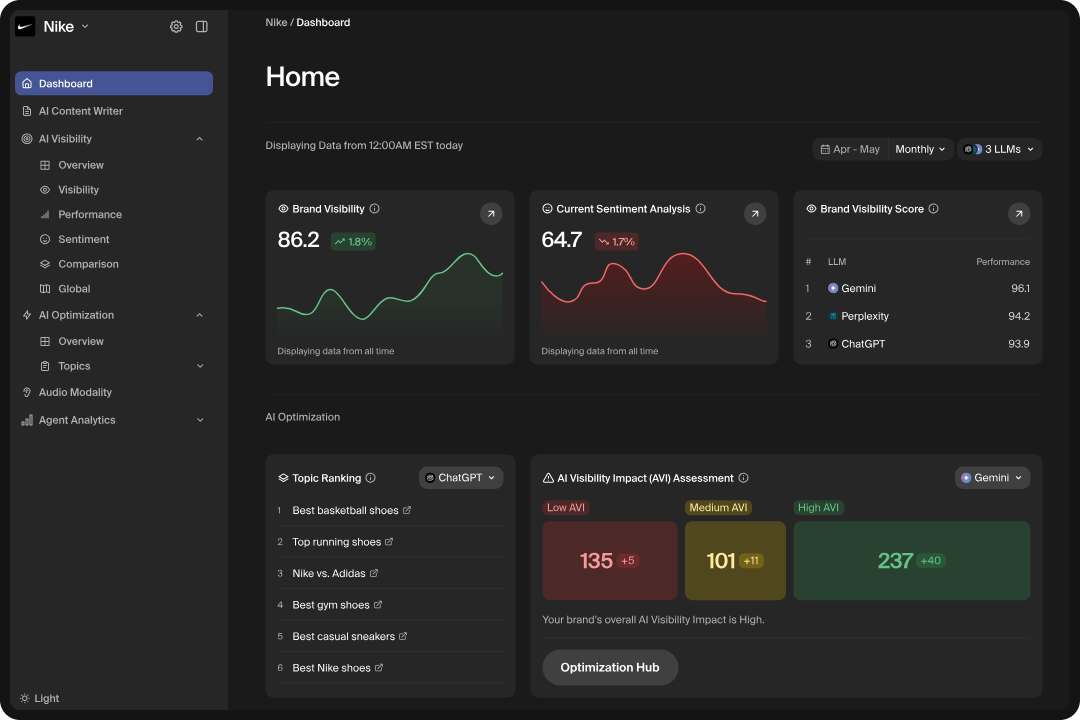
- AI Visibility & Citation Tracking: Monitors brand, topic, and content visibility across AI-generated answers, including citation presence and competitive context.
- Topic & Entity Intelligence: Identifies high-impact topics within a brand’s niche, uncovers emerging AI-driven opportunities, and maps where authority is forming or missing.
- Actionable Page-Level Recommendations: Provides specific guidance for optimizing existing pages to improve AI visibility, going beyond generic “content gaps” to concrete next steps.
- AEO-Fueled Content Creation: Supports writing and structuring content explicitly designed for AI answer selection, grounded in observed AI behavior.
- Off-Page & Authority Signals (PR-Like Execution): Enables execution beyond on-site content, including off-page mentions and authority signals that influence how AI systems assess trust and credibility.
- AEO + Performance Measurement: Combines AEO-native metrics (brand visibility, topic visibility, sentiment analysis) with traffic and attribution insights to connect AI visibility to business outcomes.
What Makes It Different
Goodie AI is the only tool on this list that functions as both an AEO intelligence platform and an execution engine.
Most tools answer one of these questions:
- Are we visible?
- Where do we show up?
- How does AI describe us?
Goodie AI answers all of them, and then goes further:
Here’s what AI systems are doing, why they’re doing it, and exactly what to change to improve outcomes.
On top of the platform itself, Goodie AI pairs enterprise teams with hands-on AEO support, ensuring recommendations are understood, prioritized, and acted on, rather than leaving teams alone with unfamiliar metrics.
Best For
- Enterprise brands treating AEO as a strategic growth channel
- SEO, content, PR, and brand teams needing a single AEO system of record
- Organizations that want execution-ready guidance, not just dashboards
- Teams that need to connect AI visibility to real performance and attribution
Limitations & Considerations
- Designed for teams ready to actively invest in AEO, not passive monitoring
- Broader scope than point solutions, which may be more than some teams need
- Best suited for organizations looking for a long-term AI search advantage, not quick experimentation
2. Vismore
AI visibility analytics platform designed to help brands understand how they appear in generative AI answers and translate those insights into concrete AEO decisions.

Pricing: Enterprise and custom pricing (varies based on scope, coverage, and usage).
Vismore is an AI visibility platform built specifically for generative search environments, focusing on how brands are mentioned, cited, and positioned inside AI answers. Rather than treating AI as an extension of SEO, Vismore treats AI answers as a distinct discovery layer and measures visibility accordingly.
Its core value lies in helping teams understand where AI systems choose their brand, where competitors win instead, and why those outcomes occur, making AI visibility measurable and actionable at scale.
Key Features
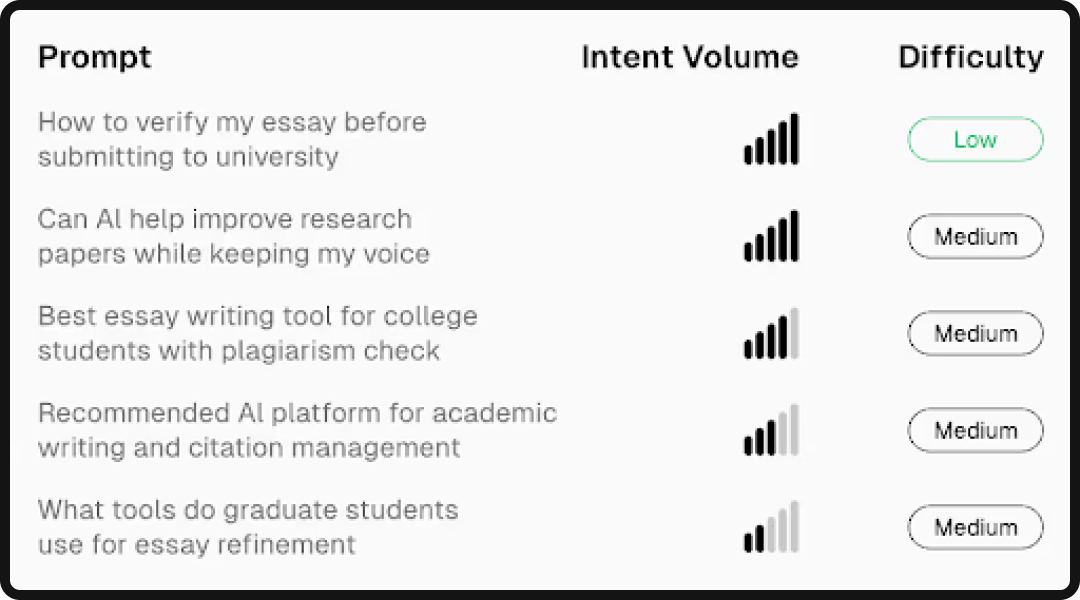
- AI Answer Visibility Tracking: Monitors brand mentions and citations within AI responses, shifting measurement from rankings to presence inside answers.
- Competitive AI Share of Voice: Benchmarks brand visibility against competitors across AI-driven queries and topics.
- Reverse-Engineering AI Answers: Analyzes AI responses to identify recurring citation patterns, trusted sources, and content angles that AI systems reward.
- Topic & Coverage Gap Identification: Surfaces frequently cited but under-covered topics, helping teams prioritize where to invest next.
- Longitudinal Monitoring: Tracks changes in AI visibility over time to measure the impact of content, authority, and brand initiatives.
What Makes It Different
Vismore positions itself as execution-first. The focus is on shortening the gap between insight and action so teams can answer both “are we visible?” and “what should we do next to increase our chances of being cited?” An especially compelling offering for teams that are newer to AI search and need specific direction.
Best For
- Enterprise and mid-market brands investing in AEO
- SEO, growth, and brand teams measuring performance in AI answer environments
- Competitive categories where AI citations meaningfully influence discovery
- Organizations looking to turn AI visibility insights into clear strategic decisions
Limitations & Considerations
- Not a content creation, publishing, or workflow tool
- Requires existing execution resources to act on insights
- Coverage depth may vary by AI model, topic, and query type
- Best used as a visibility and decision-intelligence layer, not a standalone AEO solution
3. xSeek
AI visibility monitoring platform focused on tracking brand presence, citations, and competitive positioning across generative AI answers.
Pricing:
- Visibility Plan: $99.99/mo
- Growth Plan: $249/mo
- Enterprise Pan: Custom pricing
Read more here.
xSeek, another AI visibility monitoring tool, reveals where and how brands appear inside AI answers. Rather than relying on traditional SEO proxies, it focuses on observing generative AI systems directly, tracking brand mentions, citations, and comparative visibility. Overall, xSeek provides brands with visibility into how AI systems surface, prioritize, and reference information across queries and topics.
Key Features
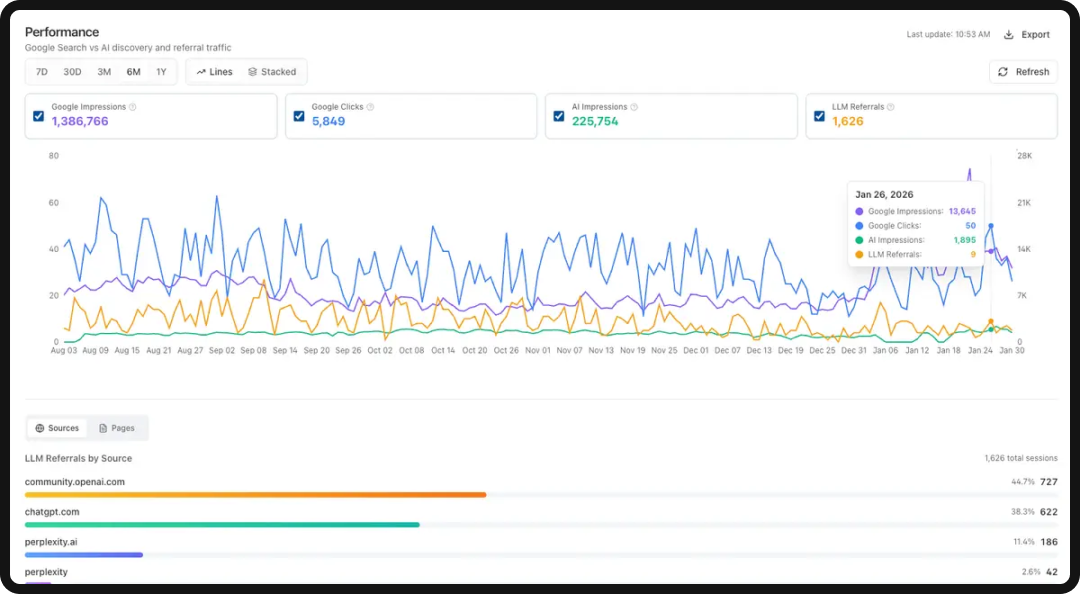
- AI Answer Monitoring: Tracks brand mentions and citations within AI-generated responses, helping teams understand presence inside answer engines rather than SERPs.
- Competitive Visibility Analysis: Compares brand presence against competitors to reveal who AI systems favor for specific topics or questions.
- Query- and Topic-Level Insights: Visibility analysis tied to themes, prompts, or categories, allowing teams to pinpoint where AI exposure is strong or missing.
- Change Detection Over Time: Monitors shifts in AI visibility, helping teams understand how updates, new content, or external signals affect answer selection.
What Makes It Different
xSeek’s strength is its focus on direct observation of AI answers, without drifting into content generation or SEO tooling. Rather than attempting to optimize content itself, the platform concentrates on measuring real-world AI behavior and surfacing competitive insights from those answers.
This makes xSeek especially useful for teams that want a clear, unfiltered view of AI-driven discovery, without mixing in keyword rankings or traditional SEO metrics.
Best For
- Enterprise and mid-market brands formalizing AEO measurement
- Teams that need visibility into competitive AI answer landscapes
- Marketing and SEO teams tracking AI-era brand presence
- Organizations validating whether AI systems recognize and reference their brand
Limitations & Considerations
- Not a content creation or optimization platform
- Does not execute changes; insights must be acted on elsewhere
- Depth of visibility can vary by AI model and query type
- Best used as a monitoring and insight layer, not a full AEO stack replacement
4. Scrunch AI
AI brand visibility platform focused on how generative AI systems understand, describe, and represent brands in answers.

Pricing:
- Explorer Plan: $100/mo
- Growth Plan: $500/mo
- Enterprise Plan: Custom pricing available
Get more pricing information here.
Scrunch AI is a visibility platform built around brand perception, not page performance. Instead of asking whether a specific URL is cited, Scrunch focuses on how AI systems talk about brands, which attributes they associate with them, and which competitors are mentioned in the same breath.
From an AEO perspective, Scrunch helps teams understand brand-level visibility and positioning inside AI answers, especially in environments where citations are inconsistent or absent altogether.
Key Features

- AI Brand Mention Tracking: Monitors when and how brands appear in AI-generated answers, even without direct citations.
- Brand Attribute & Positioning Analysis: Analyzes the language AI systems use to describe a brand, what it’s known for, associated strengths, and contextual framing.
- Competitive Brand Landscape: Surfaces which competitors are mentioned alongside or instead of your brand in AI answers.
- AI Perception Monitoring Over Time: Tracks how brand narratives shift as content, authority, or external signals change.
What Makes It Different
Scrunch AI’s key differentiator is that it treats brand understanding as the unit of optimization, not URLs or keywords.
While many AEO tools focus on:
- Which page is cited
- How often a domain appears
Scrunch focuses on:
- Whether the brand is recognized at all
- What AI believes the brand stands for
This makes it especially valuable in AI answer environments where summarization replaces linking, and brand recall becomes more important than page-level attribution.
Best For
- Enterprise brand, comms, and marketing teams
- Companies competing in categories where AI summarizes brands rather than linking out
- Organizations concerned with AI-driven brand narrative and perception
- Teams looking to complement citation-focused AEO tools with brand-level insight
Limitations & Considerations
- Not designed for URL-level citation optimization
- Less tactical for SEO or content execution teams
- Does not replace answer- or citation-tracking AEO platforms
- Best used alongside tools focused on where and why citations occur
5. Profound
Enterprise AI visibility intelligence platform built to help brands understand, measure, and influence how they are surfaced and trusted across generative AI systems.

Pricing:
- Starter Plan: $99/mo
- Growth Plan: $399/mo
- Enterprise Plan: Custom pricing
Get more pricing information here.
Profound is an enterprise-grade AI visibility intelligence platform designed to monitor how brands appear, are cited, and are positioned across generative AI answers with a strong emphasis on competitive context and decision-grade insight.
From an AEO perspective, Profound treats AI search platforms as opinionated gatekeepers, not neutral search tools. Its goal is to help enterprises understand which brands AI systems trust, why they’re trusted, and how that trust shifts over time.
Key Features
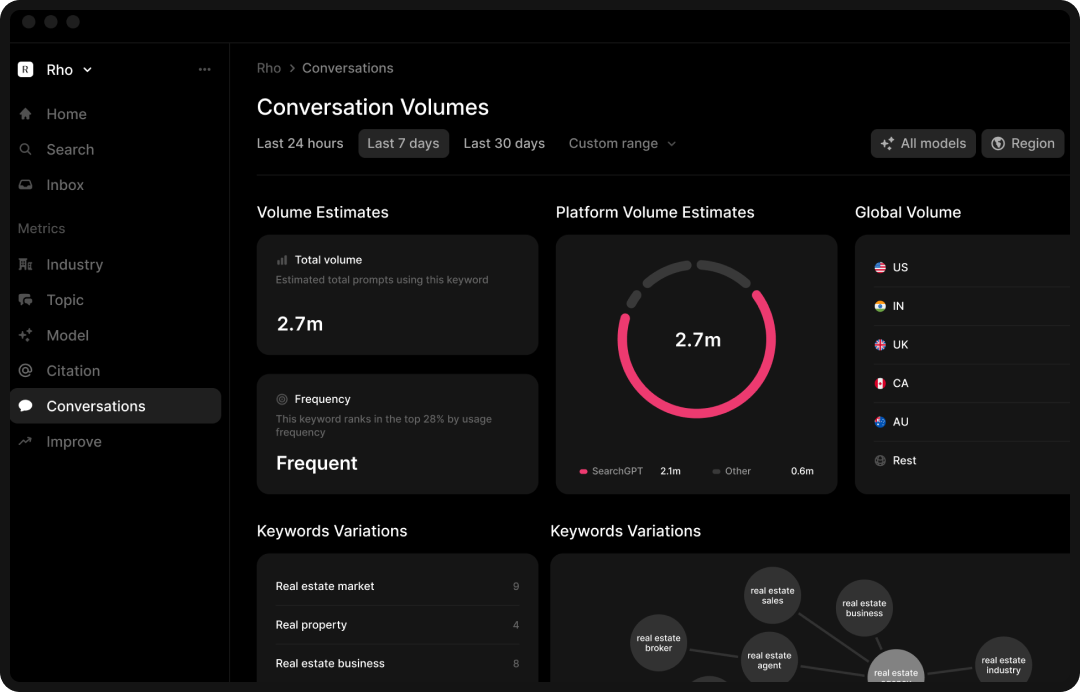
- AI Answer & Citation Monitoring: Tracks brand presence and citations across AI-generated responses, focusing on visibility within answers rather than rankings.
- Competitive AI Intelligence: Benchmarks brand visibility against competitors to surface who AI systems consistently favor for specific topics or categories.
- Topic- and Entity-Level Analysis: Maps AI visibility to themes, entities, and concepts, helping teams understand where authority is strong or missing.
- Enterprise-Ready Reporting: Designed for leadership-facing insights, enabling teams to communicate AI visibility as a strategic KPI.
What Makes It Different
Profound’s differentiation lies in its intelligence-first orientation. While many AEO tools answer “Are we visible?”, Profound focuses on:
- Who AI systems consistently trust
- Which brands dominate entire topic spaces
- How AI-driven authority compounds over time
It’s less about tactical monitoring and more about strategic AI market positioning, making it particularly compelling for large brands operating in competitive, high-stakes categories.
Best For
- Large enterprise brands formalizing AEO as a strategic function
- SEO, growth, and strategy teams reporting to executive stakeholders
- Competitive markets where AI answers influence consideration and trust
- Organizations looking for decision-grade AI visibility intelligence
Limitations & Considerations
- Not a content creation or publishing platform
- Requires organizational maturity to fully leverage insights
- Less suited for lightweight or exploratory AEO use cases
- Best used as a system of intelligence, not an execution tool
6. Bluefish AI
AI visibility intelligence platform focused on understanding how generative AI systems interpret, reference, and contextualize brands and content.
Pricing: Request a demo for pricing details
Bluefish AI is more of an AI visibility intelligence platform that helps businesses unveil how AI consumes, interprets, and surfaces information in search. It doesn’t lean into rankings or traffic and instead emphasizes how answers are formed, what signals they rely on, and how brands and content are represented within those answers.
Bluefish operates closer to an AI interpretation and trust analysis than traditional SEO-style monitoring, which feels especially relevant for teams who want to understand why AI behaves the way it does and form a strategy around that.
Key Features
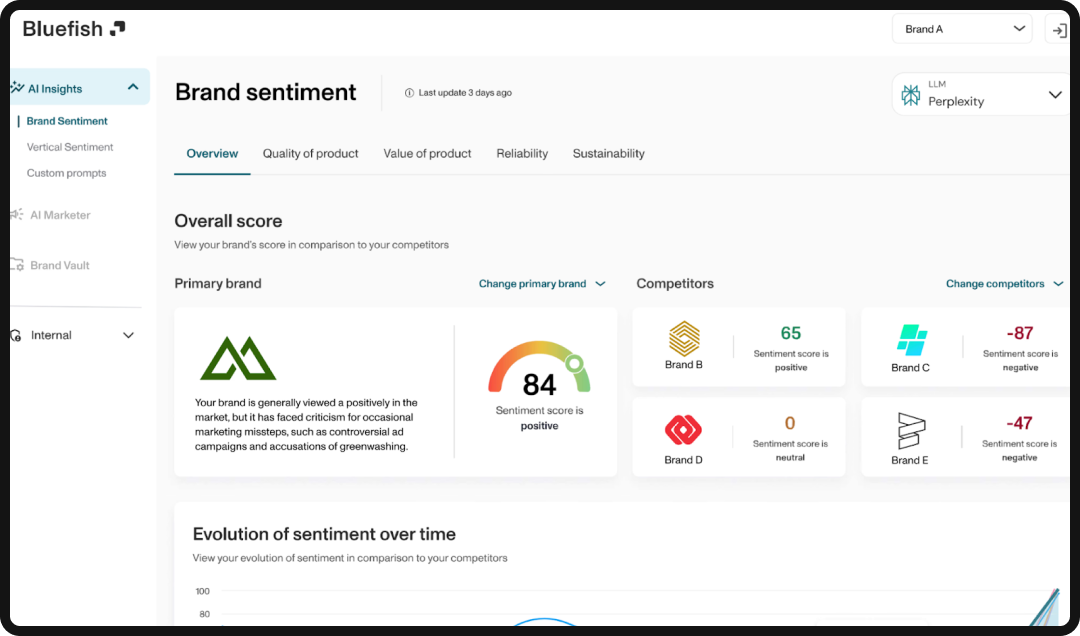
- AI Answer & Interpretation Analysis: Examines how AI systems summarize, contextualize, and reference brands and topics within generated responses.
- Source & Signal Evaluation: Helps teams understand which types of sources, signals, or content patterns AI systems appear to rely on.
- Brand & Topic Visibility Insights: Surfaces how brands and subject matter are represented inside AI-generated narratives, not just whether they’re cited.
- Comparative AI Perception Analysis: Enables comparison between brands or topics to identify differences in AI treatment and framing.
What Makes It Different
Bluefish AI’s differentiating feature is that it’s less focused on surface-level visibility metrics (like frequency of mentions) and more focused on AI interpretation and reasoning signals.
If many tools ask: “Are we visible?” Bluefish asks: “How does AI understand and explain us?”
This is valuable for teams concerned with credibility, trust, and narrative accuracy inside AI search.
Best For
- Enterprise brands focused on AI-driven trust and credibility
- Marketing, comms, and strategy teams monitoring AI interpretation of brand narratives
- Regulated or high-stakes industries where AI misrepresentation matters
- Organizations seeking deeper insight into AI reasoning and source influence
Limitations & Considerations
- Not a content creation, optimization, or publishing tool
- Less tactical than citation-focused AEO platforms
- May require interpretation by experienced teams to act on insights
- Best used as an intelligence and diagnostic layer, not a standalone execution solution
7. Semrush AI Visibility Tool
AI visibility monitoring tool designed to track brand presence across multiple AI-powered search and answer engines, including Google AI Overviews and chat-based AI models.
Pricing: $99/month per domain
Semrush’s AI Visibility Toolkit helps brands monitor how and where they appear inside AI-generated answers across a growing set of AI platforms. In addition to Google AI Overviews, the tool also tracks visibility across chat-based AI environments such as ChatGPT, Gemini, and Perplexity through prompt-level monitoring.
From an AEO perspective, Semrush positions AI answers as an extension of search discovery, allowing teams to observe how brand visibility shifts as AI results increasingly replace traditional SERP features
Key Features
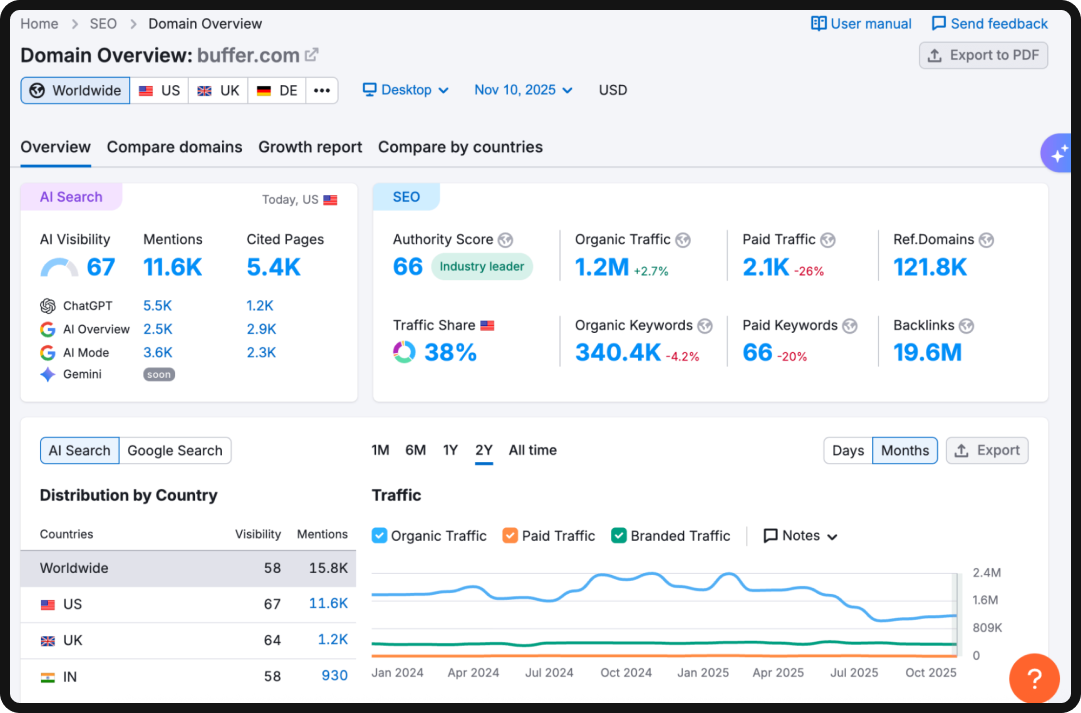
- Multi-Platform AI Visibility Tracking: Monitors brand presence across AI-powered search and answer engines, including Google AI Overviews and select chat-based AI models.
- Prompt-Level Monitoring: Tracks brand mentions and visibility based on defined prompts or queries used within AI systems.
- Competitive AI Visibility Benchmarking: Compares AI visibility against competing domains or brands to understand relative presence.
- Trend & Change Detection: Surfaces changes in AI visibility over time as prompts, content, or AI systems evolve.
- SEO + AI Visibility Context: Connects AI visibility insights with broader SEO data for teams already operating inside the Semrush ecosystem.
What Makes It Different
Semrush’s key differentiator is ecosystem integration. Rather than operating as a standalone AEO platform, its AI Visibility Tool is embedded within a broader SEO and digital marketing suite. This makes it easier for enterprise SEO teams to incorporate AI visibility signals into existing reporting and workflows without adopting a new system of record.
However, its AI visibility insights are still largely prompt- and keyword-anchored, reflecting its SEO-native foundation.
Best For
- Enterprise SEO teams already using Semrush
- Brands prioritizing Google AI Overviews and AI SERP features
- Teams beginning to formalize AEO measurement
- Organizations that want cross-platform AI visibility signals within an existing SEO stack
Limitations & Considerations
- AI visibility is primarily prompt-driven, not full answer-engine modeling
- Limited depth compared to AEO-native systems built exclusively for AI monitoring
- Less focus on citation mechanics, trust signals, or answer selection logic
- Best suited for extension of SEO reporting, not as a standalone AEO system of record
8. Ahrefs Brand Radar
An AI-era brand monitoring tool focused on tracking how brands are mentioned, discussed, and referenced across AI responses and the broader web.
Pricing:
- Individual platforms: $199/mo per index
- All AI Platforms: $699/mo
Ahrefs Brand Radar is a brand visibility and mention-tracking tool built to help teams understand how their brand shows up across AI-generated answers and online conversations, rather than how individual pages rank or get cited.
From an AEO perspective, Brand Radar is less about winning specific answers and more about monitoring brand presence, narrative, and competitive awareness as AI systems increasingly summarize the web instead of linking to it.
Key Features
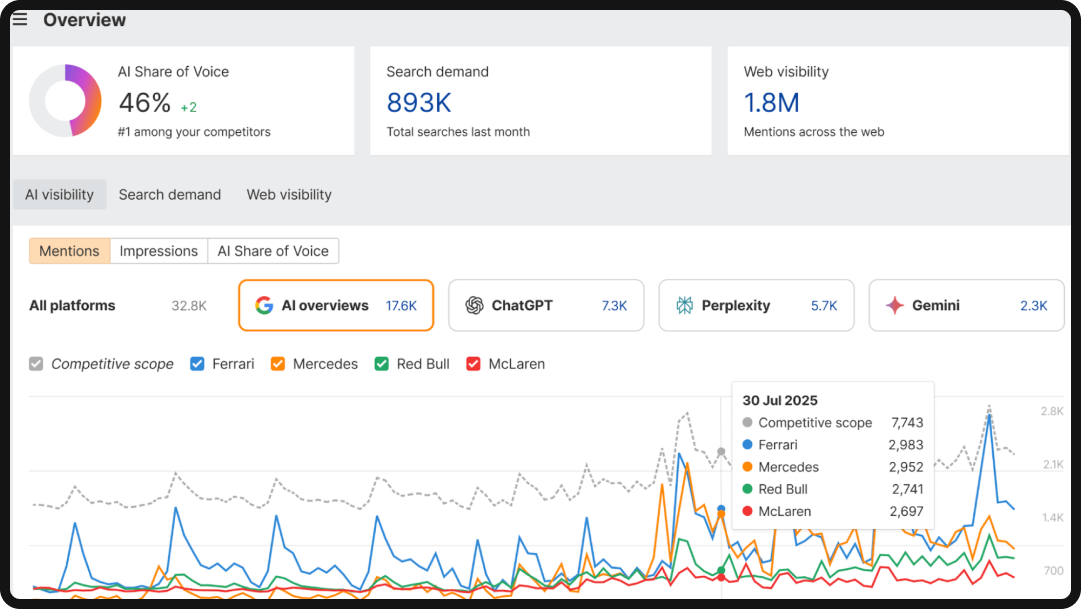
- AI Brand Mention Tracking: Monitors whether and how a brand is mentioned in AI-generated responses, even when no direct citation is present.
- Narrative & Context Analysis: Surfaces the surrounding language AI systems use when referencing a brand, helping teams understand positioning and perception.
- Competitive Brand Comparison: Compares brand mention frequency and visibility against competitors across AI-driven outputs.
- Web + AI Signal Blending: Connects AI brand mentions with broader online visibility signals to show how web presence influences AI summaries.
What Makes It Different
Most AI visibility tools focus on answers and citations. Brand Radar focuses on brand awareness and narrative.
That makes it fundamentally different:
- It’s brand-first, not page-first
- It captures implicit visibility (mentions without links or citations)
- It’s better at answering “Are we known?” than “Which URL is winning?”
This makes Brand Radar especially valuable in AI environments where citations are inconsistent or absent, but brand recall still shapes outcomes.
Best For
- Enterprise brand, comms, and PR teams
- Marketing teams tracking brand awareness in AI-generated content
- Competitive categories where AI summarizes brands without linking
- Organizations concerned with AI-driven brand perception, not just traffic
Limitations & Considerations
- Not designed for URL-level citation or page optimization
- Limited insight into why specific sources are selected
- Less actionable for content or SEO execution teams
- Best used for brand monitoring, not answer-level optimization
9. Peec AI
AEO-native visibility monitoring platform designed to help brands track how often and in what contexts they appear in AI-generated answers.
Pricing:
- Starter Plan: €89/mo
- Pro Plan: €199/mo
- Custom Plan: Custom Pricing
See more pricing details here.
Peec AI is an AEO-first visibility platform focused on monitoring brand mentions and presence in AI responses, particularly within chat-based platforms. Peec AI’s framing doesn’t extend existing SEO metrics into AI visibility metrics and instead treats AI search itself as the primary object of measurement.
From an AEO perspective, Peec AI’s foundational question is, are we showing up at all? And how do we compare to competitors?
Key Features
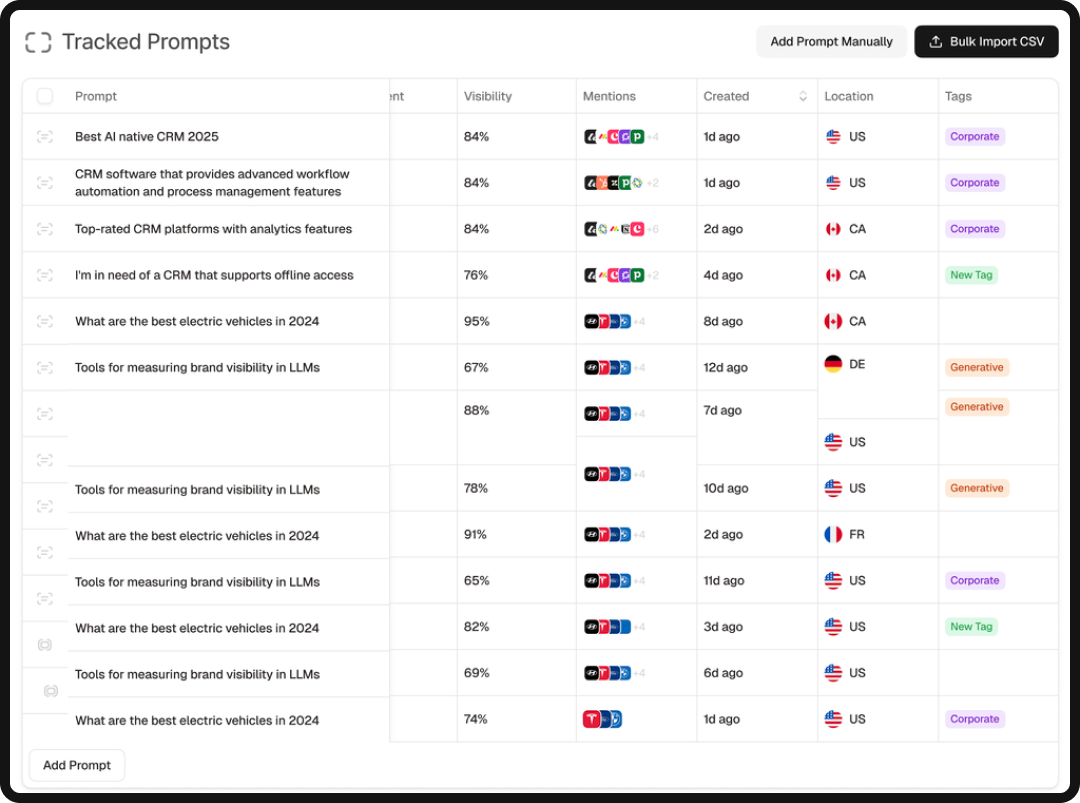
- AI Answer Monitoring: Tracks brand mentions across AI responses, with a focus on visibility rather than rankings or traffic.
- Competitive Brand Visibility: Compares how often your brand appears in AI answers relative to competitors for similar topics or prompts.
- Prompt-Driven Analysis: Visibility insights tied to defined prompts or questions, helping teams understand exposure across use cases.
- Change Tracking Over Time: Monitors visibility trends as AI models, prompts, or brand signals evolve.
What Makes It Different
Peec’s biggest differentiator is its clarity of scope. It doesn’t try to be:
- an SEO platform
- a content optimization tool
- a workflow or execution engine
Peec AI focuses squarely on AI answer visibility as a standalone problem. The result is a simpler, more accessible tool that helps teams quickly understand whether their brand is being surfaced by AI systems and where it’s being crowded out.
This makes Peec especially useful for teams early in formal AEO measurement or those who want a lightweight visibility layer alongside heavier enterprise platforms.
Best For
- SaaS and mid-market brands investing in AEO
- Teams validating early AI visibility and brand presence
- Organizations that want clear, fast answers about AI exposure
- Marketing teams that don’t need enterprise-heavy infrastructure
Limitations & Considerations
- Less depth than enterprise systems built as AEO “systems of record.”
- Limited prescriptive guidance compared to execution-oriented platforms
- Not designed for content optimization or publishing workflows
- Best used as a visibility signal, not a full AEO stack option
10. Otterly AI
Lightweight AI search monitoring tool designed to track brand and content visibility across AI search results.
Pricing:
- Lite Plan: $29/mo
- Standard Plan: $189/mo
- Premium Plan: $489/mo
See more pricing information here.
Otterly AI is an AI search monitoring solution that helps teams observe how brands and URLs appear inside LLMs. It tracks visibility across generative search interfaces and is one of the earlier tools aimed specifically at AI-era discovery.
From an AEO POV, Otterly is about visibility detection, not deep analysis or execution. It helps teams see if and where they show up in AI results.
Key Features

- AI Search Visibility Tracking: Monitors brand and URL presence in AI-generated search responses.
- Prompt & Query Monitoring: Tracks visibility for defined prompts or questions used in AI search environments.
- Basic Competitive Comparison: Provides directional insight into how often competitors appear relative to your brand.
- Change Monitoring Over Time: Flags shifts in AI visibility as AI systems or prompts evolve.
What Makes It Different
Otterly AI’s key differentiator is simplicity. It doesn’t try to be an enterprise system of record or an execution platform. Instead, it offers a straightforward way to monitor AI search visibility without the complexity or overhead of larger AEO platforms.
That makes Otterly especially useful for teams that want quick signal detection rather than deep diagnostic insight.
Best For
- Small to mid-sized teams exploring AEO
- Brands looking for early visibility into AI search performance
- Marketing teams that want simple monitoring without heavy setup
- Organizations validating whether AI discovery is impacting them
Limitations & Considerations
- Limited depth compared to enterprise AEO platforms
- Less focus on citation mechanics or AI reasoning signals
- Minimal prescriptive guidance on what actions to take
- Not designed for large-scale or multi-brand monitoring
Closing Thoughts
AI search is already reshaping how enterprise brands are discovered, compared, and trusted without users ever visiting a website. That makes AEO less about chasing rankings and more about earning presence inside the answers themselves.
What this list makes clear is that there’s no single “best” approach to AEO, only tools designed for different stages of maturity. Some platforms focus on visibility and monitoring. Others emphasize brand perception or AI interpretation. A few are built for decision intelligence. And at the top end, there are tools that combine insight with execution to help teams actively influence outcomes.
For enterprise brands, the real challenge is choosing the right one for where your business is today and where it needs to be next. If you’re just validating AI visibility, lightweight monitoring may be enough. If AI search is already impacting consideration, trust, or revenue, you’ll need deeper intelligence and clearer paths to action.
One thing is certain: AI answers aren’t a side channel anymore. They’re becoming the interface. The brands that win won’t be the ones reacting to AI search after the fact, they’ll be the ones measuring it, understanding it, and optimizing for it intentionally.
AEO Tools for Enterprise Brands: FAQs
What is an AEO tool?
An AEO (Answer Engine Optimization) tool helps brands understand and improve how they appear inside AI-generated answers from platforms like ChatGPT, Gemini, Perplexity, and Google AI Overviews. Unlike SEO tools, AEO tools focus on mentions, citations, brand visibility, sentiment, and trust inside AI responses, not just rankings or clicks.
How are AEO tools different from traditional SEO tools?
SEO tools are built to optimize for search engine rankings and traffic. AEO tools are built to monitor and influence how AI systems summarize, cite, and recommend information, often in zero-click environments where no link is shown at all.
Do I need an AEO tool if I already use SEO platforms like Semrush or Ahrefs?
It depends on your goals. SEO platforms can provide early or partial AI visibility signals, especially within Google’s ecosystem. But they don’t replace tools designed specifically to track AI answer behavior across multiple models, analyze brand perception, or measure AI-specific visibility metrics.
Are AI writing tools considered AEO tools?
No. AI writing tools help create content faster, but they don’t tell you whether that content is being chosen, cited, or trusted by AI systems. AEO tools focus on measurement, insight, and optimization of AI visibility, not content generation alone.
What metrics do AEO tools typically track?
Common AEO metrics include:
- Brand and topic visibility in AI answers
- Citations and mentions
- Competitive share of AI answers
- Sentiment and narrative context
- Changes in visibility over time
Some platforms also connect these metrics to traffic, attribution, or business impact.