

If you’re well-versed in Fintech marketing, you know that the industry poses its own set of challenges: regulatory hurdles, intense competition, and the need to build and maintain user trust in a security-conscious market.
A highly intentional marketing strategy, though, can be an effective way to circumvent and address these challenges without risking financial, legal, or reputational penalties. This includes a solid Fintech SEO strategy that builds trust, addresses user needs, and ultimately drives conversions.
At NoGood, we’ve worked with some of the most innovative brands in Fintech, like Merlin, Intuit, and Chime, so we understand the nuances and unique pain points of marketing in a regulated industry. In this blog, we’ll cover some of our top Fintech SEO strategies, driven by our own experiments and results.
Why SEO Matters for Fintech
As mentioned, SEO is a good way to generate visibility for Fintech brands because it helps build brand equity, credibility, and trust.
Let’s let the numbers speak for themselves: organic search accounts for 19.3% of the website traffic Fintech companies receive on average; a solid SEO strategy will likely outperform that, helping you show up at the top of the SERP without paying for expensive PPC ads.
With the rise of AI, having a set organic search strategy becomes even more imperative. Good SEO is the foundation of Answer Engine Optimization (AEO), the practice of optimizing your content so that it gets mentioned and cited in LLMs and AI Overviews.
Something special to keep in mind about Fintech topics is that they typically fall under the Your Money, Your Life (YMYL) category for Google. This type of content is characterized by Google as having the potential to impact the health, financial stability, or safety of people, or the welfare or well-being of society, making H-E-E-A-T (Helpfulness, Experience, Expertise, Authoritativeness, and Trustworthiness) all the more important.
This means that Fintech companies have to truly commit to publishing website content that is accurate, true, and helpful if they want to rank highly on the SERP.
The key takeaway is this: while bad SEO has the potential to hurt your Fintech brand, good SEO could transform your brand’s visibility and increase conversions.
While high-quality content production is one way to do successful Fintech SEO, you can position your brand as an authoritative source in your niche while building trust and brand recognition with your target customers.
7 Fintech SEO Strategies to Drive Conversions
Now that we’ve discussed why it’s important for Fintech brands to do SEO, let’s dive into some strategies that you can take to create high-quality content for search engines and LLMs.
1. Write High-Quality H-E-E-A-T Content
Fintech brands face serious competition in an overcrowded market, with North America holding over 12,000 Fintech companies alone, which is why creating high-quality, authoritative content is so important.
This type of content helps you communicate to search engines, AI engines, and your target audience that you’re a trustworthy source for financial information. By continuously showing up in finance-related queries with valuable information, you’ll remain top of mind when customers are ready to choose a financial partner to entrust with their earnings.
The key to high-quality SEO content is to follow the H-E-E-A-T framework and ask yourself the following questions:
- Helpfulness: Does the information presented truly answer the user’s query?
- Expertise: Does the content demonstrate that the author has significant knowledge of the subject?
- Experience: Does the content contain examples of first-hand experiences or knowledge obtained through experience?
- Authority: Does the content demonstrate reliability by citing other reputable sources?
Trustworthiness: Does the content contain information that is reliable and factual?

For all blog content and FAQs, focus on providing direct, clear answers to user questions and pain points. When applicable, you can share examples of how your company approaches certain financial concerns to give customers full transparency and build trust.
For a financial blog in particular, it might be helpful to position your content in a relatable light; instead of a rigid, step-by-step guide with a corporate (therefore potentially condescending) tone of voice, consider positioning the topic in a more conversational light, as if it were a friend speaking to them. This also helps with AEO, as LLMs prefer conversational language that mirrors how people prompt AI.
2. Niche Keyword Research Without Duplicate Content
When creating content on topics like banking and credit cards, it can be difficult to target niche keywords without creating duplicate content.
For example, a Fintech company that offers a variety of savings accounts might create separate pages targeting these keywords:
- “high-yield savings account”
- “best online savings account”
- “savings account with no fees”
The challenge here is that the features and benefits of these accounts, like interest rates, online access, and security features, are largely the same. If the content on each page is only slightly reworded, it could be marked as duplicate by a search engine.
This can lead to keyword cannibalization, where these pages compete against each other for the same or similar search terms, ultimately hurting their ranking performance (both individually and collectively).
A great way to avoid this is by prioritizing long-tail keywords. They’re usually easier to rank for, and their specificity can help you avoid duplicate content issues by making your blogs more specific. The catch is that when keywords are easier to rank for, they are usually lower search volume, so that’s something you want to keep in mind when you’re doing keyword research.
Here are some ways we’d transform the keywords we just listed that would be difficult to rank for.
- “high-yield savings account” → “how to open a high-yield savings account online”
- “best online savings account” → “best online business savings account”
- “savings account with no fees” → “banks with no savings account fees”
This is a great approach not only because it helps you avoid keyword cannibalization, but also because it encourages you to build more unique content, helping you stand out from competitors by pushing your content to the top of the SERP and within AI answers.
3. Optimize for Zero-Click Search
Now, many top-of-funnel queries are being satisfied in AI Overviews and LLMs, which is what the industry’s calling the zero-click search phenomenon. The zero-click search phenomenon is when users find their answer directly on the SERP (due to AI Overviews and other SERP features) or LLMs without clicking out to any sites, because the content covers their query and any potential follow up queries comprehensively.
For Fintech in particular, informational, top-of-funnel content is a safe bet because financial literacy has always been a necessary topic to write for, with about half of Americans being financially illiterate.
The main goal is this: Positioning your brand as a go-to source for as many searches related to your niche as possible to capture visibility in AI Overviews and LLMs as well as the traditional SERP.
Your first step is to pinpoint which keywords trigger AI Overviews. You can do this in Ahrefs or Semrush by filtering for specific SERP features and selecting “AI Overview” (which all plans can filter for). Make a list of the keywords in your niche with an AI Overview, then focus on creating content to target them.

Keep in mind AI Overviews are extremely dynamic. Search results are always changing, so tools like Ahrefs and Semrush don’t always provide the most up-to-date information about keywords with AI Overviews.
If you do want fresher data, consider using Goodie, which monitors and tracks your brand’s visibility in AI Overviews and other LLMs for prompts that our team custom-builds for your brand.
The other thing to note is that ranking on the first page of the SERP might help you appear in the AI Overview for that query, as 76% of AI Overviews pull from the top 10 results on the SERP. This means prioritizing the strategies we listed here.
Here are some more strategies you can use to optimize for AI Overviews (and LLMs):
- Use question-based headers that align with user queries.
- Answer user questions directly and concisely underneath each question-based header.
- Format content in lists, tables, and short paragraphs for better machine parsability.
- Enter your keyword into Google, read the AI Overview, and ensure your content answers all of the questions the AI Overview provides information for, as well as any potential follow-up questions users may have
- Target questions from the People Also Ask SERP feature to differentiate and deepen the scope of your blog topic.
4. Implement a PR Strategy for Top Finance Domains
A key part of ensuring your brand is truly visible is to make sure you’re being mentioned in the right places; this means going beyond the SERP and its features to targeting LLMs like ChatGPT, Gemini, and Claude.
Why is it so important to be mentioned in generative AI answers? Because 62% of Americans interact with AI multiple times a week, with 66% of them have used it for financial advice. That’s also why Goodie put together a list of the most cited domains by AI in Finance. Targeting websites like these has the potential to increase your visibility in AI, but also the traditional SERP, as they are highly trusted names in the industry.
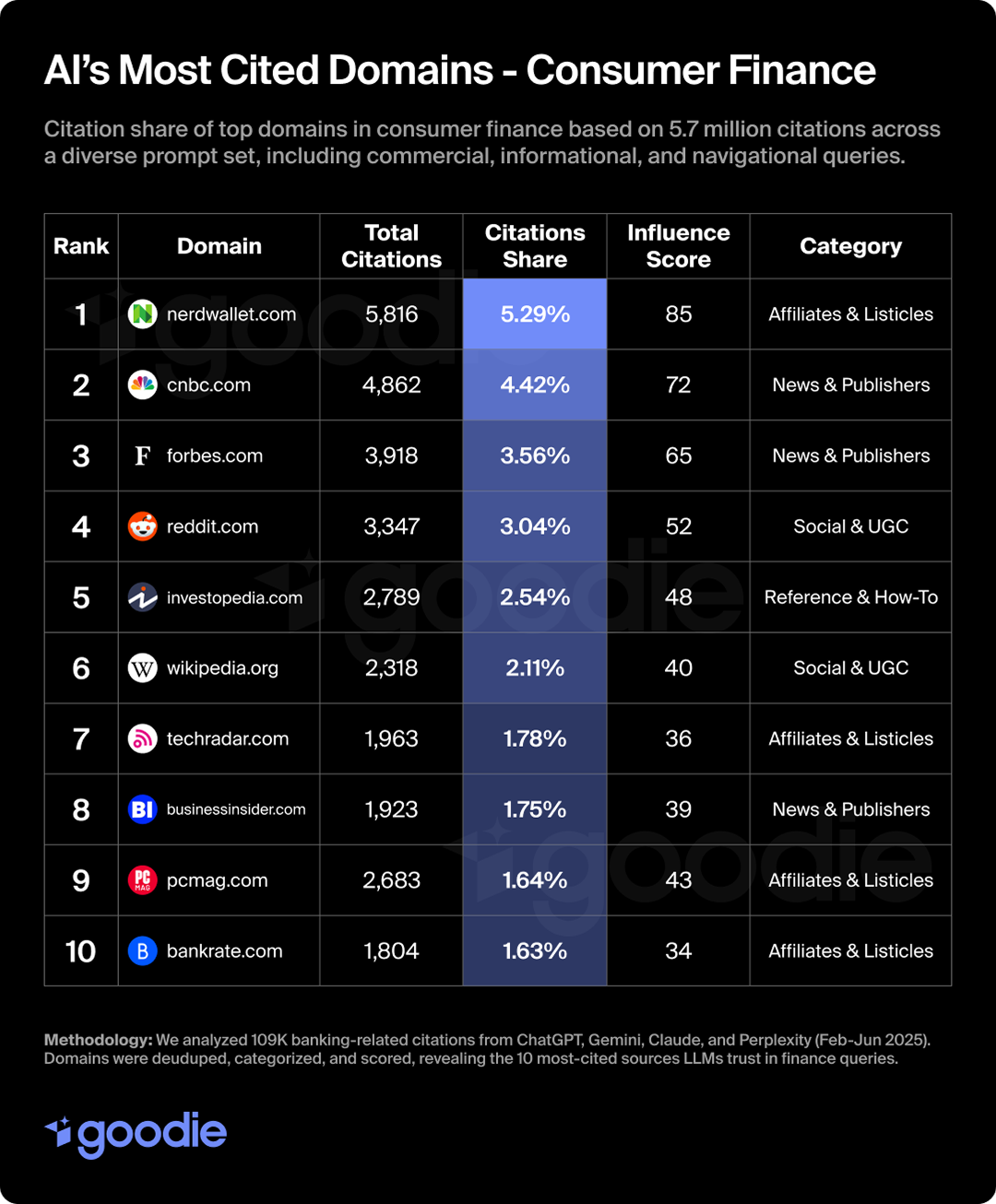
Here’s a breakdown of these domains and why earning mentions from them can boost your visibility as a Fintech company:
- NerdWallet & Bankrate: These sites are consistently cited by AI models and rank highly in traditional search. They’re high-authority machines as a result of their in-depth, evergreen guides, comparison tools, and calculators for a wide range of financial topics, which are a prime place to get your brand cited in.
- Major Media Outlets: Publications like Forbes, The Wall Street Journal, and Business Insider are highly influential and trusted in the finance space, boosting your brand sentiment.
- User-Generated Content (UGC) Platforms: While this may seem to contradict the need for H-E-E-A-T, platforms like Reddit are frequently cited by AI for conversational content. This highlights the importance of not just being a source of information but also being an active participant in community discussions, which can build a brand presence.
5. Perform Technical SEO
Conducting technical SEO ensures your website is fast, secure, mobile-friendly, and easily crawlable by search engines; all aspects of good technical SEO.
Imagine a customer navigates to your website and is met with a page that takes forever to load, doesn’t have a security certificate that ensures safe transactions and browsing (HTTPS), and the content is misaligned on mobile. Do you think they’d open a bank account or credit card with you?
These optimizations are key in the Fintech industry, where trust, compliance, and user experience (UX) are top priorities.
Here are some strategies to make sure your site is technically optimized:
Improve Website Speed
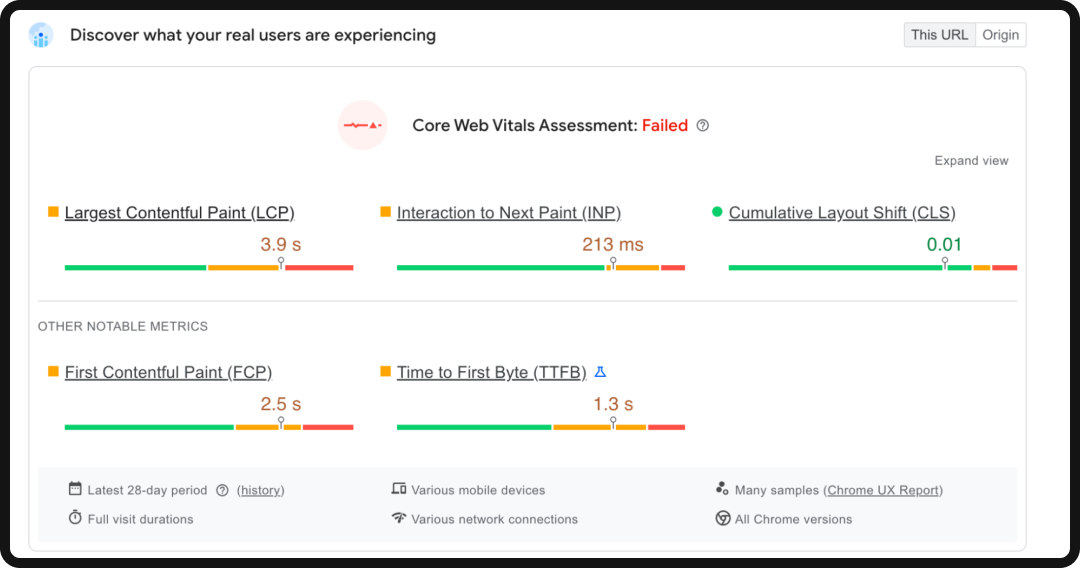
People visiting fintech websites expect fast-loading websites, and so do crawlers. Delays can not only lead to fewer engaged sessions, but also less visibility in the SERP and AI.
- Use tools like PageSpeed Insights to identify performance issues.
- Compress images and enable browser caching.
- Minimize HTTP requests and reduce unnecessary code.
Implement a Content Delivery Network (CDN) to improve load times globally.
Ensure Mobile Responsiveness
With over 60% of global web traffic coming from mobile devices, Fintech websites need to provide seamless mobile experiences.
- Use responsive design frameworks to ensure your website adapts to all screen sizes.
- Test mobile usability with Bing’s Mobile Friendliness Test tool.
- Consider Accelerated Mobile Pages (AMP) for faster mobile load times.
Strengthen Website Security
Security is critical for Fintech brands handling sensitive financial data; if your website is not secure, you can kiss a chunk of those engaged sessions and conversions goodbye. Google also prioritizes HTTPS sites in rankings.
- Install an SSL certificate for HTTPS encryption.
- Regularly update software and plugins to prevent vulnerabilities.
- Implement two-factor authentication (2FA) for user accounts.
Implement Schema Markup
Schema helps search engines understand your content better, increasing your chances of ranking highly or appearing in an AI Overview. It also increases your chances of being featured in voice search results.
- Add schema for financial services, customer reviews, FAQs, and events, where applicable.
- Use tools like Google’s Structured Data Markup Helper for implementation.
- Test schema with Google’s Rich Results Test.
6. Perform On-Page Optimizations
On-page optimizations involve improving the readability, UX, and helpfulness of your content. You should already be following H-E-E-A-T guidelines, so this is about formatting content in a way that makes it easier for users and machines to read and understand it. The impact of these changes can not only be felt on the traditional SERP, but also in AI Overviews and LLMs.
Here are some strategies to get you started with on-page optimizations:
Enhance Readability
People are searching for Fintech topics because they want something readable and engaging; if you throw a wall of text at them, they’re definitely not going to stick around.
These strategies also enhance your chances of getting cited in AI Overviews and LLMs, as clear and organized content improves readability for users and helps crawlers understand your page.
- Use short sentences and paragraphs with simple language; remember, the people searching for this information have different levels of knowledge, so make sure you know your audience.
- Simple Language (B2C/General Audience): Use short sentences and paragraphs with simple, straightforward language when writing for a general consumer audience (B2C) or non-experts. The goal is to quickly explain a concept like “What is a 401k?” in a simple way.
- Technical Depth (B2B/Expert Audience): Use precise terminology and complex, in-depth analysis when the audience is highly specialized, such as product documentation aimed at engineers integrating your API, or technical white papers for financial analysts. The goal here is accuracy and completeness for a knowledgeable reader.
- Include visuals like infographics or charts to explain complex concepts. With proper alt text implemented, this gives you a chance to rank in the images feature that shows up on the SERP sometimes.
- Use a single H1 tag per page with the primary keyword, and incorporate other keywords into H2s, H3s, and H4s throughout page content.
Ensure Interlinking
Internal links help distribute link equity across your site and improve navigation for users. A strong internal linking strategy allows you to gain more visibility in search results by outranking competitors.
- Link relevant blog posts, product pages, or resources within your content.
- Use descriptive anchor text that includes keywords naturally; this means don’t put “Click here” for a blog post.
External links (also known as outbound links) are links from your site to other websites. Linking strategically to relevant sources is essential for establishing your H-E-E-A-T for search engines and readers.
- Link to recognized experts, official government (.gov), or educational (.edu) sites to back up your claims.
- Only link to outside resources that genuinely support the specific point you are making in your content; don’t just throw links in there to check off a box.
Add FAQs to Blogs & Landing Pages
FAQs directly address user questions, are often featured in AI Overviews and LLM answers, and are able to be easily read aloud in voice search results.
This is also a great opportunity to build trust with your customers by showcasing your expertise in the finance industry.
- Pull questions from the People Also Ask section on the SERP and incorporate those into your FAQ.
- Use structured data markup (FAQ schema) to make these questions eligible for AI Overviews and LLM answers.

Optimize Metadata
Title tags and meta descriptions are how people see your page on Google, and are the first elements users see in search results, directly influencing click-through rates (CTR). Optimizing your title tags and meta descriptions provides an opportunity to persuade users to click your website over one of your Fintech competitors.
- Include primary keywords in title tags and meta descriptions.
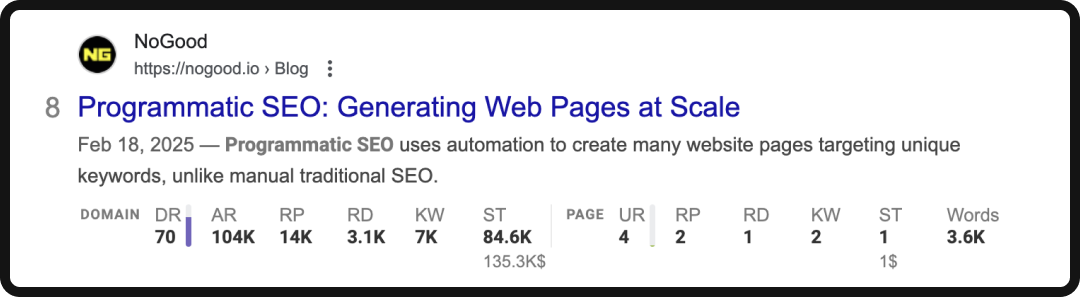
- Keep title tags under 60 characters and meta descriptions under 160 characters, otherwise they may be truncated.
- Make metadata compelling and accurate to the page’s content. Here’s an example of what you should do:
Here’s a weaker example:
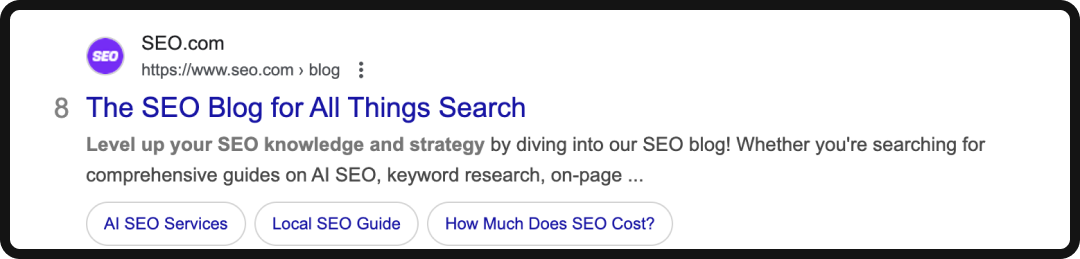
“The SEO Blog for All Things Search” isn’t truncated, but it doesn’t tell us much. The meta description is cut-off, though, which looks sloppy; and is very ironic for an SEO blog.
7. Optimize for Bottom-of-Funnel Topics
Once you’ve started the strategies above to build authority and brand awareness (remember that this is an ongoing effort), you can micro-optimize your landing pages for bottom-of-funnel conversions. This is especially important nowadays, with top-of-funnel content driving fewer impressions and clicks (though still valuable).
We’ll break down how to optimize for these conversions on your landing page.
The first screen of your landing page should have a short, easy-to-read description of your key offerings with a clear call-to-action to sign up or get more information about your product.

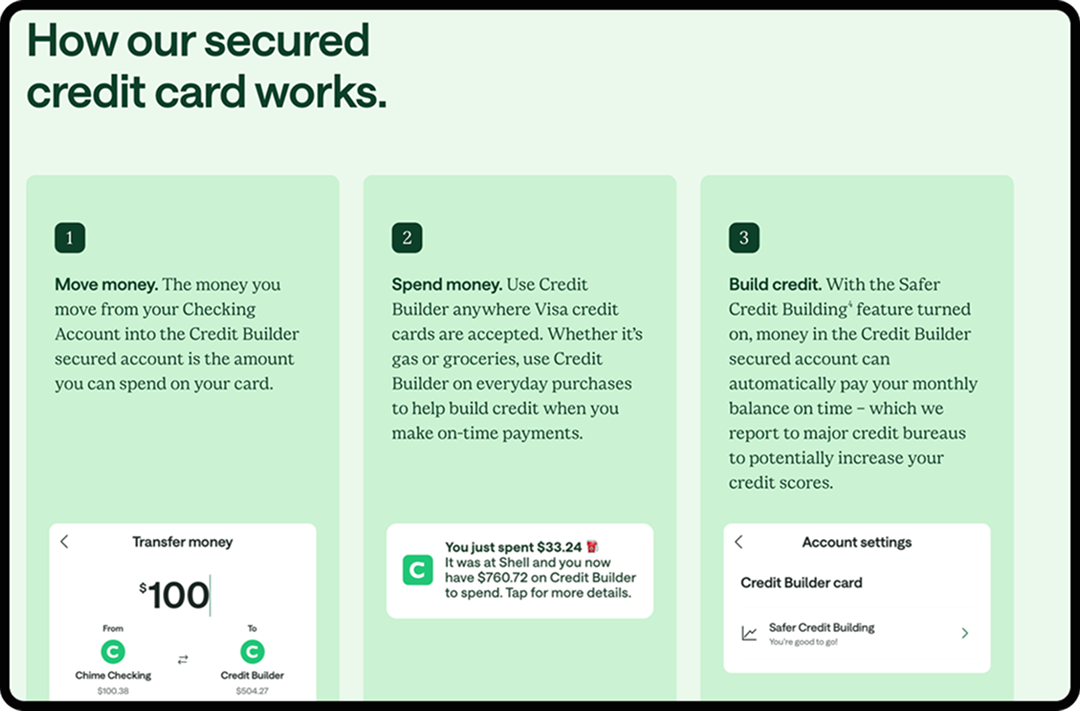
Next, you’ll provide information about how your product works, the results customers can achieve by using your product, and why they should choose your product over competitors. Make your descriptions concise, yet informative, and include keywords strategically placed throughout each paragraph.
The most important thing here is to demonstrate a clear value proposition and make sure you’re positioning your brand as the best solution to the customer’s problem. Highlight what makes your product unique.
Additionally, make sure this page is comprehensive. The more questions you can answer for users up front, the more they will place trust in you and consider your brand.
Keep in mind that the user journey doesn’t always end with the main body of your content. To make sure you’ve answered all your readers’ questions (a key way to get cited as a comprehensive source), put an FAQ section at the very bottom of the page, and keep the following in mind:
- Capture Long-Tail Searches: By anticipating follow-up questions related to your Fintech niche, you can integrate relevant keywords and phrases into the H2s and H3s that draw in users looking for specific answers.
- Build Confidence: Addressing common concerns in a clear Q&A format helps eliminate friction, builds trust, and smoothly guides the user toward conversion.
Measuring SEO Performance for Fintech
Google SERPs are evolving to give users faster answers directly on the page, fundamentally altering how we gather data and measure success.
Despite these changes, measuring your organic search efforts remains critical because it is the clearest way to understand your customers and align your content with their unique, financial challenges; it’s just that it’s gotten harder.
Here are the key shifts that have made data gathering more difficult:
- Rise of Zero-Click Search: More users are getting their answers directly from SERP Features like Featured Snippets, People Also Ask boxes, and AI Overviews, likely decreasing clicks.
- Data Visibility Changes (removal of num=100): Google has removed the ability to force the SERP to show 100 organic results per page (using the &num=100 URL parameter). This change significantly impacted SEOs, as it makes large-scale data collection for competitor analysis and keyword research more complex and reliant on dedicated third-party tools.
Key Metrics for Tracking SEO Performance
- AI Visibility: To see how often you’re getting mentioned in AI Overviews and LLMs, use a tool like Goodie to keep track of key opportunities for building brand awareness.
- AI Search Traffic: With so many people using LLMs, you need to be tracking this traffic source. You can track it in GA4, which we explain how to do in our recent blog about changes in the SEO world.
- Branded Traffic: Branded traffic is when people are navigating to your page through queries that include your brand name. This means that people have probably seen your brand name somewhere (namely, AI) and are Googling it.
- Conversions: GA4 can track form submissions, sign-ups, or purchases. You should then compare your conversion rates to Fintech industry benchmarks.
- Engaged Sessions & Scroll Depth: Longer engaged sessions (and scroll depth) indicate your content is truly helpful for your audience, boosting H-E-E-A-T signals.
|
What It Is |
SEO Value |
Business Value |
|
|---|---|---|---|
|
Engaged Sessions |
A session lasting 10 seconds or longer, or one with 1+ conversion event, or 2+ page/screen views. |
Indicates high Helpfulness; reduces bounce rate; confirms search intent match. |
Shows your content is successfully capturing and holding the audience’s attention. |
|
Scroll Depth |
A metric that tracks how far down a page a user scrolls before leaving, measured in percentage (e.g., 25%, 50%, 75%). |
Confirms high Expertise and Authoritativeness through thorough content consumption. |
Proves that complex, long-form content is being read, justifying the investment in its creation. |
Fintech SEO Is a Continuous Process
Now, your optimization efforts shouldn’t just be focused on the SERP; you should also actively be competing for visibility in AI Overviews and LLM answers, otherwise you’re being completely shut out of a quickly growing platform.
The best way to do this is by staying informed about industry trends, regularly analyzing your SEO performance, and proactively adjusting your strategies. Because great SEO is the foundation of AEO, these efforts shouldn’t be overlooked; and if you’ve been neglecting SEO, it’s time to renew your effort in this discipline.
By committing to this strategy proactively, you can maintain a competitive edge and ensure your Fintech brand grows and engages your target audience effectively. If you still need help refining your Fintech Strategy, though, our growth experts can help.