

Search behavior has changed to mimic a conversational format, akin to two individuals asking each other a question. Users are no longer changing their phrasing to match how search understands their query. Instead, they expect search to understand their way of asking questions as if seamlessly fitting into a conversation with a friend or colleague.
For search marketers and SEOs, this poses an uncomfortable problem: SEO used to mean hunting down the right keywords, targeting them, and wedging them into content. We wrote for algorithms, not people, and we got pretty decent at it. But now, instead of algorithms being in charge, the new format is conversational queries. Users are taking back search.
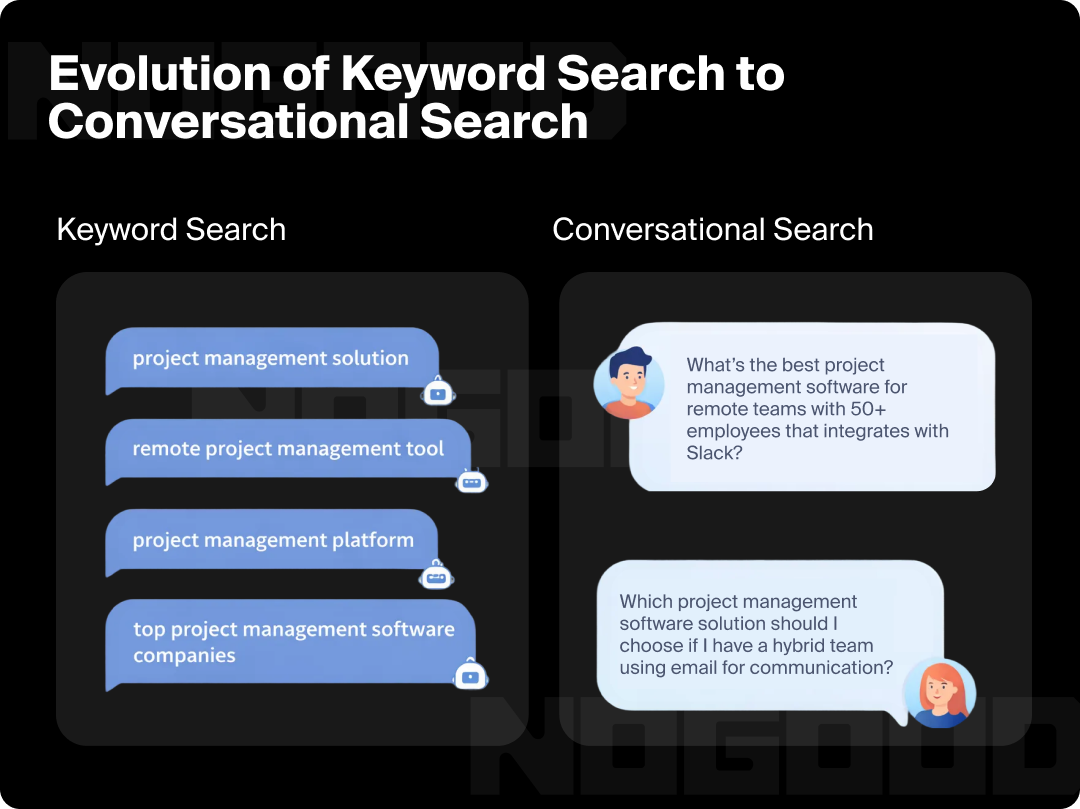
Shoppers aren’t just typing “best running shoes 2026” into search bars anymore. They’re asking complete questions that can squeeze a whole buying journey into one conversation, or even a single query.
“What are the best running shoes for a beginner with flat feet who runs mostly on pavement?”
Users are having conversations, whether they’re typing into Google, asking ChatGPT, or using a chatbot on your website. And if your content is still built around a list of 3-5 word phrases and keywords, it’s going to be replaced with content that does understand the new user journey.
Conversational search optimization isn’t a buzzword. Instead, it’s a shift in how we as SEO and AEO experts structure information. The goal is to answer a string of queries all along the buyer journey instead of answering the first question a user might ask. Every potential question in the funnel needs to be anticipated and answered.
This guide shows you how to turn your static content into a dialogue, ready for AI assistants, search engines, and conversational interfaces.
What Is Conversational Search?
It doesn’t take a genius to deduce what conversational search is: it’s a dialogue with a search platform. Whether it be Google, AI Overview, ChatGPT, Gemini, or any other search tool, user search phrasing has changed. Instead of guessing the magic combination of keywords that a machine wants (we call this “speaking the language of Google”), the machine is now smart enough to understand how you actually talk.
It’s the difference between typing “paris weather” and asking, “Will I need a jacket in Paris this weekend?” The first is a command. The second is a conversation.
This leap is powered by Natural Language Processing (NLP), the AI technology that gives computers the ability to understand, interpret, and generate human language. It’s the engine behind Google’s AI Overviews, ChatGPT, Perplexity, Claude, and the chatbots you find on websites. These systems don’t just match keywords. They parse grammar, understand synonyms, identify intent, and remember the context of your previous questions to deliver better answers.
The shift is happening everywhere. Users are typing complete questions into Google and asking ChatGPT for recommendations. They’re having multi-turn conversations with customer service chatbots. The input method doesn’t matter; instead, what matters is that search has become conversational across every platform.
Why Conversational Search Optimization Matters Now
At this point, I’m sure your own search behavior has changed, too, so it’s pretty evident that this is the current reality of search. It’s about meeting your audience where they already are (they’re not coming to you anymore because they don’t need to).
User expectations have been completely rewired by AI. Having experienced sophisticated AI assistants in their daily lives, users now expect every search interface to understand them just as naturally. When they land on your site and the search functionality can’t understand a simple question, it feels broken.
Getting this right means you’re not just ranking for a keyword. You’re becoming the definitive answer across multiple platforms and interfaces.
Foundational Content Readiness: Preparing for a Dialogue
Before you can think about advanced conversational structures, you need to get the basics right. You can’t build a conversational search optimization strategy on a foundation of messy, low-quality content.
Remember, even the most advanced conversational AI can only be as good as the content it draws from. An AI isn’t a magician. It’s an amplifier.
Use Clean, Semantic HTML
Use your headings (H1, H2, H3) to create a logical hierarchy. Use actual HTML heading tags, not just bigger text. Use ordered and unordered lists of bullets and numbers. This provides a structural map that search engines and AI crawlers use to understand your content.
Comprehensive Metadata
This part of SEO lives on: your page titles and meta descriptions are still incredibly important. Make them descriptive and accurate. Fill out your image alt tags as they tell search engines what an image is about.
Write Like a Human
Ditch the corporate jargon and dense prose. Write in a natural, accessible tone. If you wouldn’t say it to a colleague in a conversation, don’t write it on your website.
Prioritize Content Freshness
Outdated information is a trust killer. Regularly review your content to remove or update anything that’s no longer accurate. When optimizing content for freshness make sure you’re not just changing the date, but actually adding new relevant information to improve content quality.
Checklist: The 4 Foundational Elements of Conversational Search
- Clean HTML & Schema Markup
- Comprehensive Metadata
- Human Writing
- Content Freshness
How to Structure Content to Answer Direct Questions
With a clean foundation in place, you can start with the first layer of conversational optimization: answering the direct, initial query. This is about providing a clear, concise, and immediate answer to a user’s first question.
Step 1: Identify Core User Questions & Intent
You can’t answer questions if you don’t know what they are. This step is about getting out of your own head and into the mind of your audience.
Use tools like Ahrefs, Semrush, or Google’s “People Also Ask” section to see the exact questions people are typing into search engines. Look at your own site search data. Check forums like Reddit or Quora (or wherever your audience hangs out). Pay attention to the questions people are asking ChatGPT and other AI platforms about your industry.
As you gather these questions, group them by intent:
- Informational: “How does X work?” “What is the difference between Y and Z?”
- Commercial: “Where can I buy X?” “How much does Y service cost?”
- Navigational: “Log in to my X account.” “Contact Y support.”
Step 2: Create Self-Contained Answer Snippets
Once you have your questions, write the answers. Just don’t bury the answer in a 2,000-word article. For direct queries, you need to create parsable answer snippets.
An answer snippet is a small, self-contained block of text that directly and completely answers a single question. Here’s how to write an answer snippet the right way:
- Keep It Concise: Aim for 40-60 words. This is the sweet spot for AI overviews and featured snippets.
- Front-Load the Answer: The very first sentence should contain the most critical information. Don’t start with a long preamble.
- Structure Them Clearly: Each snippet should be a distinct paragraph or an item in a bulleted or numbered list.
Step 3: Use Question-Based Headings & Subheadings
This is one of the simplest and most effective tactics you can implement. Structure your content by framing your H2 and H3 tags as the actual questions your users are asking.
Instead of a heading like: The Benefits of Schema Markup
Use a heading like: How Does Schema Markup Improve SEO?
This helps human users scan the page and find the exact answer they’re looking for immediately. It also sends a massive signal to search engines and AI systems. You’re telling them: that question a user just asked? The answer is right here, directly below this heading.
Step 4: Build Comprehensive FAQ & How-To Pages
Consolidating related questions into dedicated FAQ pages is a classic for a reason. These pages are naturally conversational. Their entire structure is a series of questions and answers, making them a prime target for AI overview and featured snippets.
Similarly, how-to guides are golden. They answer the question “How do I do X?” in a clear, sequential format. Using ordered lists with distinct steps for each action creates a logical flow that’s easy for both users and machines to follow.
Designing Content for Context & Follow-Up Queries
Answering the first question well is just the start; great conversational content anticipates the next question(s), too.
Group related sub-topics under a broader pillar page; don’t forget that site architecture, technical SEO, and AEO also matter. The pillar page gives a high-level overview, then links out to detailed cluster pages that dive deep into specific aspects of the topic.
The Technical Layer: Leveraging Structured Data for AI
While great content and logical structure are the heart of conversational SEO, there’s a technical layer that can take it to the next level: structured data.
Structured data, most commonly implemented using Schema.org vocabulary, is a standardized format for providing explicit information about a page and classifying its content. Think of it as a set of labels you can add to your content that tell search engines and AI systems what type of content it is.
Here are a few examples:
- By adding FAQPage schema to a page, you’re telling LLMs that a block of text isn’t just text; rather, it’s an answer to a question
- Adding HowTo schema to a comprehensive article you’ve created helps search engines and AI engines classify that content as a step-by-step guide, not just a list of items
Schema markup provides unambiguous context that machines can understand. Without it, the AI has to infer the meaning and purpose of your content (remember, these systems aren’t actually reading what you’re writing). With schema, you’re spelling it out.
This drastically increases the chances that your content will be used to generate content in AI Overviews, appear in knowledge panels, be cited by ChatGPT or Perplexity, and be selected as the definitive answer for conversational queries. In fact, Agent Experience (AX) was found to be the 8th most important factor for AEO dominance in this Goodie study.
Key Schema Types for Conversational Search
|
Schema Type |
Definition |
When to Add |
|---|---|---|
|
FAQPage |
A dedicated page with multiple questions and answers on a single topic. Key properties include mainEntity which contains an array of Question types, each with an acceptedAnswer property. |
Use when you have a page with multiple related Q&As covering different aspects of a single topic. |
|
HowTo |
Content that describes a sequence of steps to achieve a result. Uses step property which contains a list of HowToStep items, each with text describing the action. |
Use for instructional content that walks users through a process or tutorial with clear sequential steps. |
|
QAPage |
A page focused on a single question with one or more answers submitted by users. Contains a single Question object with one or more Answer objects in the acceptedAnswer or suggestedAnswer properties. |
Use for community-driven Q&A pages or support pages where one specific question has multiple user-submitted answers. |
|
Article |
Provides context about your content’s purpose, author, publication date, and organization. This helps AI systems understand authority and recency. |
Use for blog posts, news articles, and editorial content to establish credibility and signal freshness to AI search engines. |
Implementing this schema is like giving AI a detailed blueprint of your content. It helps your answers get fed into the knowledge graphs that power modern search and AI answer engines.
How to Optimize Content for AI Overviews
When we talk about optimizing content for search engines, we focus on traditional SEO and AEO; Google’s AI Overviews live in the middle of these two disciplines (traditional search placement but powered by AI), and are often regarded as the “gold standard” when it comes to search result position.
- Structure content around questions. Rewrite headers to mirror natural questions. Every H2 and H3 tag should be a complete question your audience actually asks.
- Provide immediate answers. Place direct, concise responses within the first 40-60 words following each question-based header.
- Use conversational language. Replace corporate jargon with language patterns that match how people actually speak.
- Implement structured data markup. Use FAQPage schema for question-answer content, HowTo schema for instructional content, and Article schema with proper author and publisher information.
- Build topical authority. Create comprehensive content clusters that demonstrate deep expertise in your subject area.
- Maintain content freshness. AI answer engines prioritize recent, up-to-date information. Regularly review and update your content.
- Monitor AI citation performance. Track mentions of your brand in ChatGPT responses, Perplexity citations, Google’s AI Overviews, and other AI platforms. Tools like Goodie provide systematic tracking of brand visibility.
Common Mistakes in Conversational Search Engine Optimization
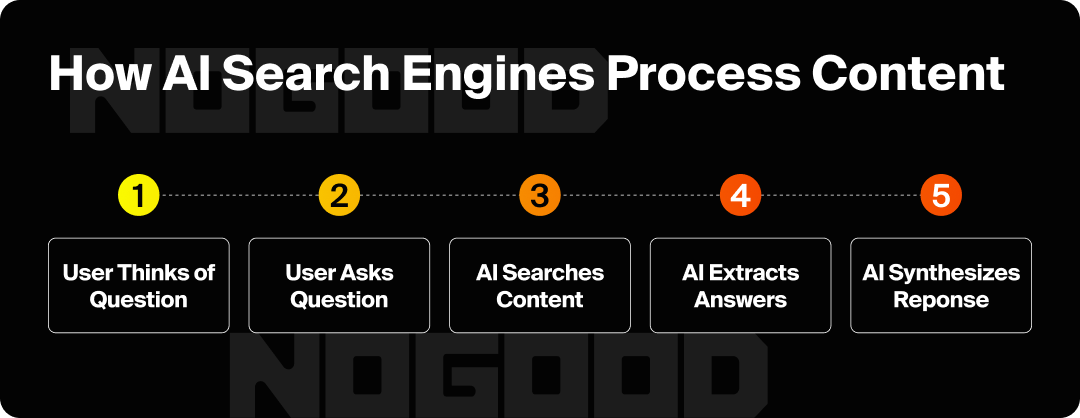
Blocking AI Crawlers in Robots.txt
Companies get nervous about new crawlers and block them by default. You need to ensure that crawlers from Google, Bing, OpenAI, Anthropic, and other AI platforms are allowed to access your content. Regularly review your robots.txt file and server logs and consider creating an LLMs.txt file.
Neglecting Content Quality, Structure & Freshness
AI only amplifies what’s already there. If your core content is thin, poorly written, or outdated, no amount of technical optimization can save it. Invest in substantive content improvements before layering on technical enhancements.
Forgetting a Clear Escalation Path to Human Support
No AI is perfect. If your chatbot or conversational interface doesn’t have a clear, easy-to-find option to connect with a human, you’re creating a dead-end that will destroy user trust. Always provide obvious escape hatches to human support.
Ignoring Analytics & User Feedback
Conversational optimization is not a “set it and forget it” task. Monitor your analytics. Look at which questions are being answered successfully and which ones are leading to no results. Track featured snippet appearances and AI citations. Pay attention to user feedback.
How to Measure Conversational Search Performance
Tracking conversational search success requires metrics beyond traditional keyword rankings.
- AI Overview Visibility: Monitor your content’s appearance in position zero results for question-based queries. Track both the quantity of AI Overview features and the specific queries that trigger these appearances.
- Long-Tail Topic & Prompt Performance: Focus on tracking for complete prompts and natural language phrases. Look for improvements in position for queries containing 5+ words and question modifiers.
- AI Platform Visibility: Monitor mentions of your brand, products, or content in ChatGPT responses, Perplexity AI citations, and other conversational AI platforms. Platforms like Goodie provide systematic tracking of brand visibility across AI platforms.
- User Engagement Metrics: Track time on page for question-based landing pages (target: 2-3 minutes minimum), scroll depth to measure content consumption patterns, click-through rates from featured snippets to full articles, and bounce rates specifically from AI-generated snippets.
- Conversational Query Growth: Track the growth in conversational query types (questions, long-tail phrases, natural language) driving traffic to your site. An increase in these query types indicates successful optimization.
- Site Search Analytics: If you have on-site search, analyze the queries users are entering. Are they typing complete questions? This indicates that users expect conversational search functionality on your site.
Establish measurement timeframes that account for the longer optimization cycles typical in conversational search. Unlike traditional keyword optimization, conversational search improvements often require 3-6 months to show significant results.
Your Next Steps: Implementing & Measuring Your Strategy
The path to conversational search optimization comes down to three core principles: answer the initial question directly, anticipate the follow-up questions, and structure your content to make it easy for machines to understand.
5-Step Quick-Start Implementation Plan
- Conduct Question Research: Use AEO tools and customer feedback channels to identify the top 10-20 questions your audience asks about your core topic.
- Audit a High-Value Page: Pick one important page and rewrite its headings as direct questions.
- Create Atomic Answers: For each question-based heading, write a concise, 40-60 word answer snippet directly below it.
- Build Conversational Bridges: Add at least 2-3 internal links from that page to other relevant content, using anchor text that poses a logical follow-up question.
- Implement Basic Schema: Add FAQPage or HowTo schema to the audited page to explicitly define its conversational structure for search engines and AI systems.
This is an ongoing process and you must adapt as you gather information. User behavior will continue to evolve, you must track your brands progress and changes in the industry as user behavior changes. Start with one page. Implement these principles. Measure the results. Then scale the approach across your most valuable content.
The shift from keyword-focused SEO and AEO to conversational optimization represents one of the most significant changes in digital marketing. Businesses that adapt will capture audiences across Google, ChatGPT, Perplexity, and every other platform where people search conversationally.
Conversational Search Optimization: Frequently Asked Questions
What makes conversational search different from traditional SEO?
Conversational search uses natural language processing to understand user intent rather than matching specific keywords. The shift involves moving from keyword targeting to question-based content that anticipates user needs throughout their search journey.
How do I identify conversational keywords for my content?
- Use Answer The Public, Also Asked, and Google’s “People also ask” feature to discover question-based queries in your industry.
- Analyze customer service logs, social media comments, and forum discussions to identify natural language patterns your audience uses.
- Focus on capturing complete questions rather than isolated keywords, paying special attention to queries beginning with who, what, when, where, why, and how.
Which schema markup types are most important for conversational search?
FAQ schema and Article schema provide the most immediate impact for conversational search optimization:
- FAQ schema helps search engines and AI systems identify and extract question-answer pairs, making your content more likely to appear in featured snippets and AI-generated answers.
- Article schema improves content categorization and authority signals that AI systems use to evaluate quality and relevance.
How can I get my content cited by ChatGPT and other AI search engines?
- Focus on creating authoritative, well-structured content that directly answers questions in your industry.
- Use clear question-based headings, provide concise answers within the first 40-60 words of each section, implement proper schema markup (especially FAQPage and Article schemas).
- Maintain content freshness.
AI search engines prioritize content that demonstrates expertise and is easy to parse and understand.
Some icons and visual assets used in this post, as well as in previously published and future blog posts, are licensed under the MIT License, Apache License 2.0, and Creative Commons Attribution 4.0.
https://opensource.org/licenses/MIT