
By now, you’ve heard the refrain: “AI is transforming retail.” But like, how exactly? There’s no arguing against the fact that the shift is real, but it’s also been an abstract statement floating around the industry. Don’t fret, I will happily demystify this idea.
Here’s what’s changing: AI in retail is moving from generative to ✨agentic✨. This means AI search isn’t just answering questions or making recommendations to users; it’s executing tasks on your behalf, automatically reordering products when you’re running low, purchasing items based on your preferences, and even negotiating prices in real time.
According to IAB, AI is now the second-most influential shopping source for American consumers, with over a third using it to shop online. That’s significant, but it’s also just the starting line. McKinsey predicts that by 2030, agentic commerce could generate $1 trillion in revenue for the U.S. B2C market alone.
Amazon’s Rufus is the clearest signal of where this is headed. Powered by both generative and agentic AI, Rufus doesn’t just suggest products; it can add items to your cart preemptively based on your browsing history and even complete purchases for you with a “Buy for Me” button. And Rufus isn’t an outlier. Over half of companies have already deployed AI agents in some capacity.
The question I’m begging you to ask isn’t whether agentic AI will reshape retail (because it already is). What you should be asking is, is your brand ready for it? Because in an agentic commerce world, the challenge isn’t just being discoverable anymore, but being executable. If an AI agent can’t find you, understand you, or transact with you seamlessly, you’re completely invisible where more and more people are doing their shopping.
Let’s break down what agentic commerce is, where it’s being deployed today, and perhaps most importantly, how to position your brand so your business is the one that agents choose to execute on.

What Is Agentic Commerce?
Agentic commerce is what happens when AI stops suggesting and starts executing. It’s the application of agentic AI to the retail value chain, where AI can research, evaluate, negotiate, and purchase products with minimal human intervention.
Think of it as the difference between a shopping assistant who hands you options and a concierge who actually handles the transaction. I liken it to the difference between shopping at a department store versus a luxury retailer. A shopping assistant at a department store will help you source options based on what you’re looking for, but that’s kind of the extent of it. However, when you go to a luxury store, you’re fed various options based on their luxury expertise, assisted in the selection process, and then your credit card is happily swept away from your palm once it’s time to pay, and all you have to do is sign on the dotted line.
Here’s a more concrete example: You tell your AI agent, “I’m going to the Catskills this weekend.” Instead of returning a list of outdoor gear for you to browse, the agent:
- Cross-references your previous orders (you already have a backpack)
- Checks the weather forecast (rain likely, temps in the 40s)
- Identifies gaps in your kit (your waterproof spray is probably expired)
- Builds a targeted product stack, tent, rain jacket, spray, and completes the purchase
That’s agentic commerce. The loop closes automatically.
The Shift from Assistant to Agent
The distinction between generative AI and agentic AI comes down to well, as the name implies, agency. Generative AI can recommend. Agentic AI can execute.
What makes execution possible is infrastructure, specifically, new protocols allowing AI agents to transact securely on behalf of consumers. The most notable is Visa Trusted Agent Protocol (TAP), which verifies that an agent acting on your behalf is legitimate and authorized.
Visa describes TAP like this: “Recognizing trusted agents allows merchants to engage with the same customers coming through a different medium to streamline and enhance these agent interactions.”
In other words: TAP ensures that when an AI completes a purchase for you, the merchant knows it’s really you behind the transaction, just operating through a different interface. It’s the trust layer that makes autonomous commerce viable at scale.
Is Agentic Commerce the Same Thing as Agentic AI?
Not quite. Agentic AI is the foundational technology. Any AI system capable of autonomous reasoning, planning, and tool use to achieve its goal. It applies broadly: autonomous coding assistants, self-driving vehicles, and enterprise workflow automation.
Agentic commerce is the specific application of that technology within retailer and consumer ecosystems. Its where agentic AI plugs into real-world shopping infrastructure (payment rails, inventory systems, logistics networks) to deliver tangible outcomes like completing a purchase, scheduling a delivery, or securing a limited-edition product drop before it sells out.
Here’s how they differ in practice:
|
Feature |
Agentic AI |
Agentic Commerce |
|---|---|---|
|
Primary Focus |
Breaking down complex prompts (e.g., “Help me plan a wedding”) into executable sub-tasks |
Finalizing specific retail outcomes (e.g., “Buy these 50 chairs” and “Schedule the florist”) |
|
Capabilities |
Natural language processing, pattern recognition, strategic planning |
Secure access to payment systems (via Mastercard Agent Pay, Visa TAP), inventory APIs, and shipping networks |
|
Tool Access |
Web browsers, search engines, internal databases |
Retail rails: ERP systems, merchant checkout gateways, carrier networks (FedEx, UPS) |
|
Success Metric |
Accuracy and logic of the proposed plan |
Conversion: successful transaction, reduced return rate, fulfilled order |
Agentic AI is the engine. Agentic commerce is the car built to navigate the specific terrain of retail.
What Are the Benefits of Agentic Commerce for Consumers?
The value proposition of agentic commerce is the same on both sides of the transaction: reclaiming cognitive energy lost to decision-making and operational friction in the buying process.
Consumers don’t have to spend as much time researching and comparing options. You’d search “best lip gloss,” scan a list of listicles, pick a top recommendation, navigate to Sephora or Ulta, compare prices, read reviews, and FINALLY check out. Every step of this process requires a decision.
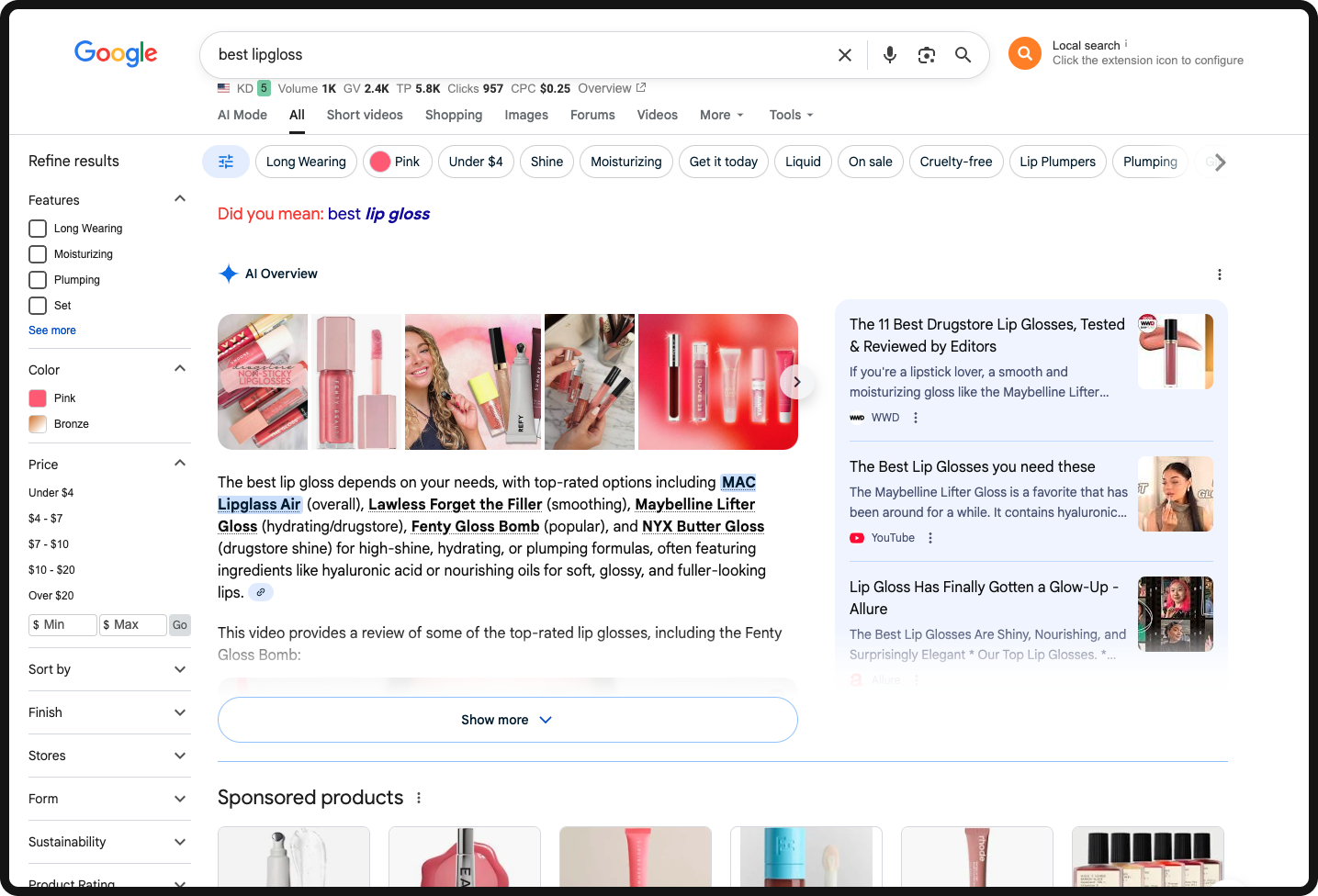
But now, Google’s AI Overviews surface product recommendations at the top of the SERP before any of the so-called organically earned blue links. And as a self-proclaimed professional consumer, I can’t reliably use the SERP to find what I want immediately; it requires thorough research and digging.
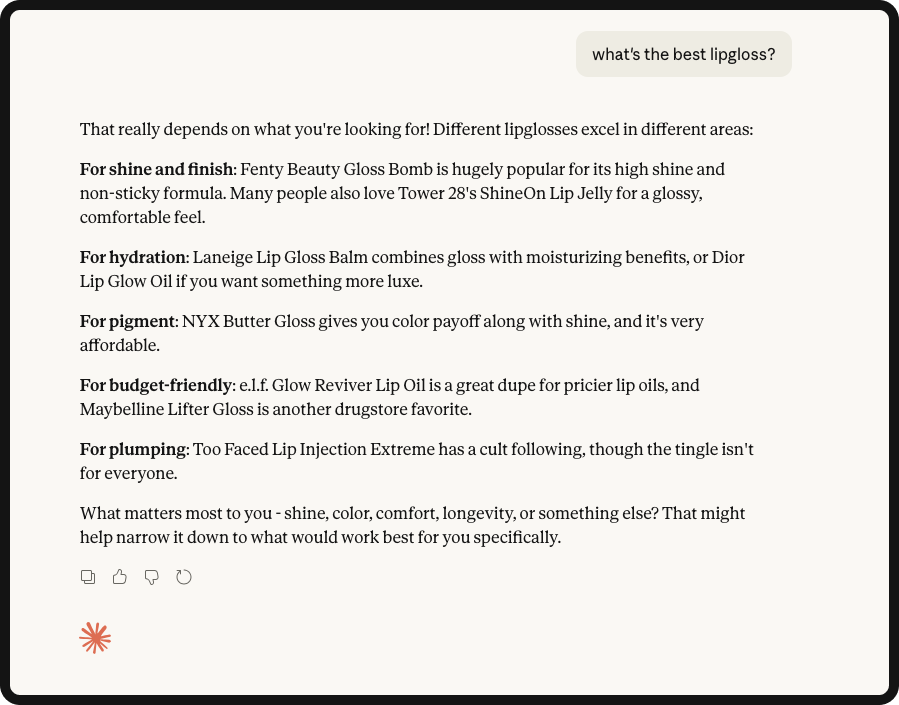
So we get overwhelmed and maybe turn to Claude or ChatGPT and ask, “What’s the best lip gloss?” And sure, then we get a curated list that, yes, has some overlap with Google, and some other things, but still: more decisions.
And research shows that we make anywhere from a thousand to 35,000 decisions per day. Doesn’t it sound nice to let some of the ol’ load off? Agentic reduces that number by eliminating entire categories of decisions consumers make by executing on their behalf: what are my options? What do the reviews say? Is it in my price range? How fast can I get it?
Here’s what that looks like in practice:
Hyper-Personalized Curation
Traditional personalization was reactive: “Because you bought X, here’s Y.” Agentic curation is predictive and contextual. An agent builds you a solution. Ask for dinner ideas, and it doesn’t return recipes. It delivers a full 3-day meal plan based on your dietary restrictions, what’s already in your fridge, and what’s on sale at your local grocery store.
Frictionless Transactions
With secure handshake protocols like Visa TAP and Mastercard Agent Pay now live, agents can handle mundane friction points: processing a return, swapping a subscription tier, coordinating a reshipment without you having to fill out a form or wait on hold.
Proactive Replenishment
Agentic systems monitor usage patterns and can autonomously reorder essentials when you’re running low, often at optimized price points. No more running out of contact lenses or realizing you’re out of dog food at 9 PM. And I don’t think the benefit is just convenience for convenience’s sake. It’s decision equity by giving you back the mental bandwidth you spent on low-stakes choices.
Benefits of Agentic Commerce For Retailers
Like consumers, retailers benefit too, but in a different way. Where consumers save time, retailers recapture lost margin and unlock revenue streams that were previously unmanageable at scale.
Before agentic AI, retail operations were largely reactive. If you worked for a clothing retailer, you might wait for the weekly sales report to realize a dress was flying off shelves in Miami but sitting untouched in Seattle. By the time you manually coordinated with logistics to reroute stock, the trend window had closed.
Now, an agentic system can spot a spike in social media mentions about that dress on a Tuesday morning. By Tuesday afternoon, it had autonomously checked warehouse levels, negotiated expedited shipping with a carrier, and rerouted 500 units to the Florida hub, all before a human manager even logged in.
Here’s what else agentic commerce enables on the retailer side.
Higher Conversion Rates
Research shows that AI-referred visits convert at 2-3× higher rates than traditional channels. Why? Because agents enter the funnel with high intent and pre-cleared payment credentials. Friction points like cart abandonment (which averages 70% industry-wide) become less relevant when the agent closes the transaction directly.
Autonomous Service Resolution
Gartner predicts that by 2029, agentic AI will autonomously resolve 80% of common customer service issues without human intervention, driving a 30% reduction in operational costs. And this isn’t your average FAQ bot. Agentic AI can handle complex workflows: processing returns, adjusting subscription tiers, and resolving delivery disputes without escalation.
Dynamic Inventory Optimization
Agentic systems can monitor real-time demand signals across channels (social media trends, search volume, local weather patterns) and autonomously adjust purchasing, logistics, and pricing. And no one ever has to physically react to predictive analytics because it closes the loop with execution.
Margin Recovery Through Precision
Agents reduce inventory waste by ensuring the right product reaches the right customer at the right time. Overstock gets rerouted before it becomes deadstock. High-intent buyers get targeted with optimized offers before they comparison-shop elsewhere.
The shift for retailers isn’t operational efficiency alone. It’s the ability to act on opportunities in real time, at scale, without human bottlenecks slowing down execution.
Where Can I Use Agentic Commerce Today?
It’s not like it’s vaporware; it’s already deployed across multiple touchpoints in the retail ecosystem. According to McKinsey, 23% of organizations are scaling agentic AI systems right now. Here’s where you’re most likely to encounter it, either as a consumer or a retailer.
1. Online Retail Personalization
Personalization used to mean “Customers who bought this also bought…” or “You might like these.” Functional, but passive.
Agentic personalization acts on your behalf. Instead of manually comparing running shoes across five different sites, you tell an agent, “I need running shoes for flat feet under $150,” and it evaluates options based on your gait pattern (if you’ve shared fitness app data), checks reviews for durability in your climate, compares prices across retailers, and surfaces the top two options, or just buys the best match outright if you’ve authorized it.
Example: Walmart’s “Sparky”

Sparky is Walmart’s version of Amazon Rufus, an AI assistant that acts as a proactive shopping companion. Rather than returning generic search results, Sparky synthesizes product reviews and handles occasion-based planning. Ask for “party ideas,” and it coordinates theme, decorations, food, and gifts based on your budget and preferences. Looking ahead, Sparky is evolving to handle automatic reordering of household essentials when you’re running low.
2. Intelligent Supply Chain Operations
One of the most powerful backend applications of agentic AI is in logistics. Traditionally, a weather delay meant a human manager spending hours on the phone rerouting trucks. Now, agents monitor global shipping lanes in real time. When a storm hits a major port, the agent autonomously identifies the delay, scans alternate hubs for available stock, and reroutes shipments to ensure on-time delivery.
Example: Walmart’s Trend-to-Product Agent
This system bridges social media and the warehouse. It scans platforms like TikTok and Instagram, analyzes purchase history and search trends, and predicts what’s about to go viral. The agent then makes decisions that influence design, sourcing, and inventory before the trend peaks. The result: Walmart stocks timely products that move fast, reducing overproduction and markdowns.
3. Agentic Transaction Standards
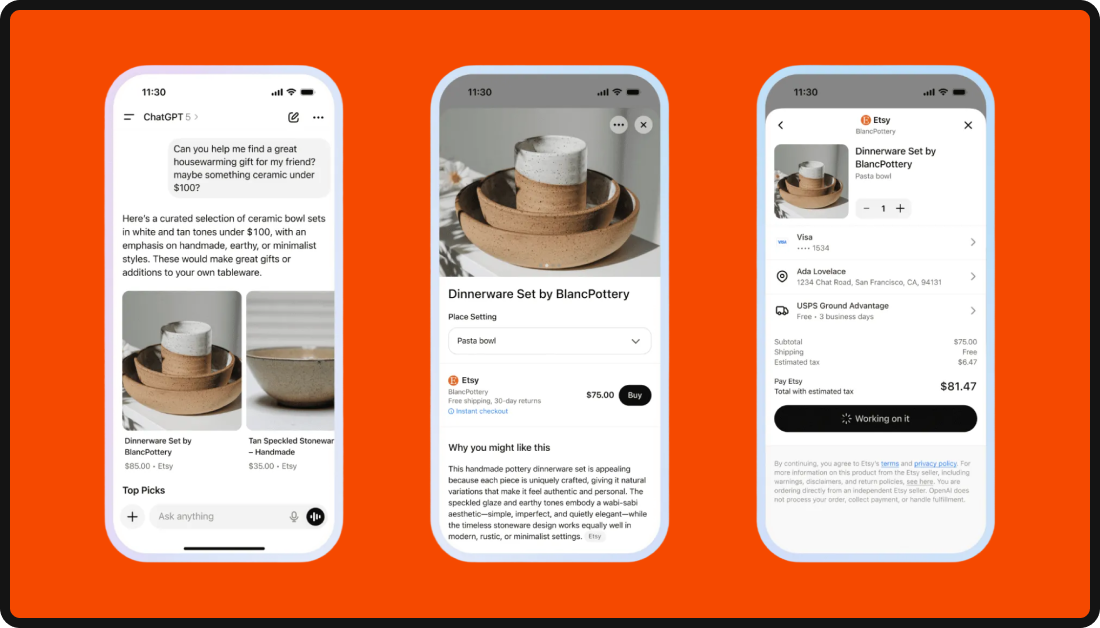
The biggest friction point in eCommerce has always been checkout. But agentic commerce is effectively eliminating the traditional checkout page through new machine-to-machine (M2M) payment protocols.
With the rise of standards like Visa TAP and Mastercard Agent Pay, consumers can grant AI transactional authority using tokenized, one-time credentials. This means your agent can negotiate a price with a merchant’s agent and close the deal without you ever typing in your CVV.
Example: Mastercard Agent Pay + Google AP2
Both protocols are now live for U.S. cardholders, and major platforms like Etsy, Shopify, and Stripe merchants support agentic tokens. This means you can ask ChatGPT to buy something, and it completes the purchase directly within the platform without needing to navigate to the retailer’s website.
4. Physical Store Operations: Planogram & Shelf Compliance
Agentic AI isn’t confined to digital commerce. In physical stores, retailers are deploying image recognition agents to ensure shelves are stocked and organized correctly. Using overhead cameras or roving shelf-bots, these systems monitor real-time inventory and planogram compliance (making sure products are in their assigned spots).

If a customer places a gallon of milk in the cereal aisle, or if the system shows an item in stock but the physical shelf is empty, the agent autonomously alerts a store associate to fix it.
Example: Amazon Fresh’s “Just Walk Out” Technology
Amazon uses overhead computer-vision cameras paired with weight sensors and deep-learning models to track what shoppers take from or return to shelves. This powers the “Just Walk Out” experience: customers grab items, leave the store, and are automatically charged via their Amazon account. The same system identifies misplaced products and flags them for associates in real time.
Future-Proofing: How to Prepare Your Brand
If your brand is already discoverable in AI search, you’re halfway there. The next step is making sure you’re but executable. Here’s how to position your brand so that when an agent is ready to act, you’re the one it chooses.
Integrate AEO Best Practices
If you’ve already optimized for traditional search engines, the leap to AI (AEO) isn’t massive, but it does require intentional adjustments. AI agents don’t crawl sites the same way Google does. They need structured, semantically rich data that answers questions clearly and confirms trust signals quickly.
Audit Your Machine-Readability
Start by testing how LLMs see you. Open ChatGPT, Claude, or Perplexity in incognito mode and ask questions like: “What are the top-rated waterproof hiking boots under $200?” If your brand doesn’t appear, your content likely lacks the semantic markers AI uses to verify authority and relevance.
Adopt the LLMs.txt Standard
If you’re a retailer, you absolutely need to add an LLMs.txt file to your root directory. This plain-text document explicitly tells AI agents who you are, what problems you solve, and what makes you different. Think of it as a machine-readable brand brief that agents can parse instantly.
Use Natural Language Metadata
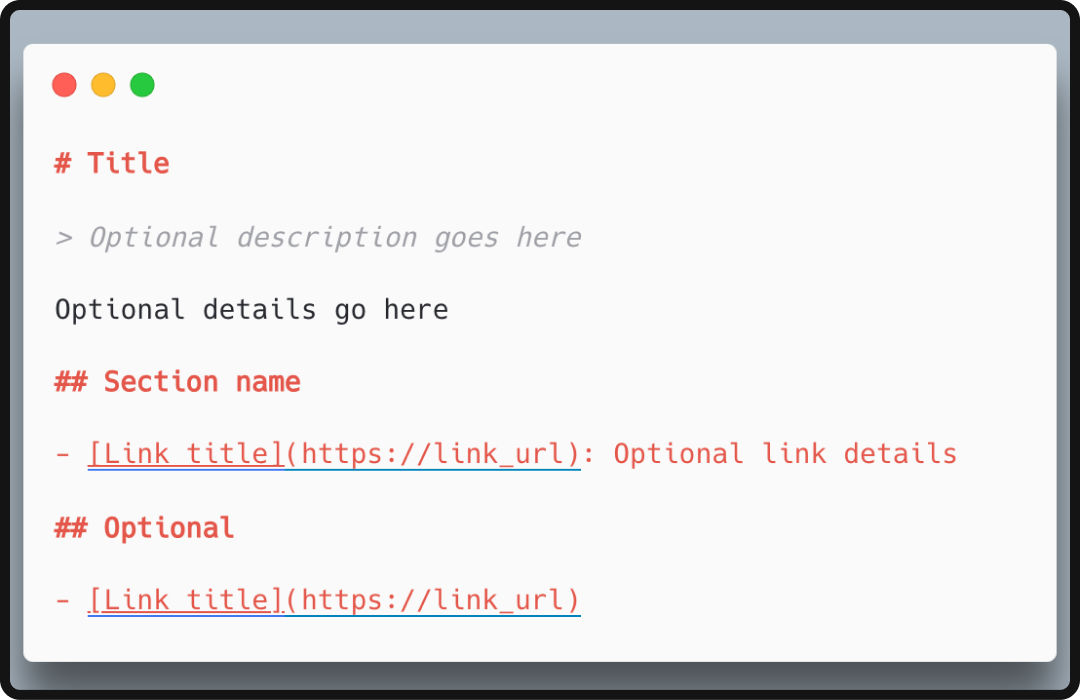
Stop keyword stuffing. AI agents prefer descriptive, context-rich metadata that explains why a product fits a need, not just what it is. Instead of “waterproof boots,” try “best for high-humidity climates and muddy trails.” Agents prioritize specificity.
Re-Architect Your Structured Data
AI thrives on structured, machine-readable data, especially agentic AI, which needs precise attributes to move from recommendation to execution. A human can infer meaning from vague product descriptions. An agent needs clear, granular details to calculate fit and commit to a purchase.
Implement MCP (Model Context Protocol)
MCP is a universal standard that allows AI agents to communicate directly with your backend systems. By adopting this protocol, you enable a customer’s agent to query live inventory, check shipping timelines, and verify return policies in real time—without ever leaving the AI interface.
Provide Granular Product Information
Agents need more than price and size. They’re looking for durability ratings, material sourcing, real-time stock status at the local store level, compatibility specs, and use-case fit. The more structured and specific your product data, the more confidently an agent can execute.
Optimize for Visual & Multi-Modal Search
Ensure your product images include high-fidelity alt text and AI-scannable tags. When a user shows an agent a photo of a broken appliance part and says, “Find me this,” your brand needs to be the one the agent recognizes and matches.
Build Proprietary Agents (If You Can)
If you want to truly own the agentic commerce experience, why not just build your own third-party agent?
- The Expertise Advantage: A third-party agent is a generalist. Your brand agent is a specialist. A Sephora-built agent, for example, knows the specific chemical composition of a serum, can cross-reference it with a customer’s skin sensitivities, and recommend based on ingredient-level data that general LLMs don’t have access to.
- Close the Loyalty Loop: Your proprietary agent can tap into your loyalty program, offering personalized discounts or early access to drops. This keeps customers within your ecosystem instead of letting a general shopping bot reroute them to a competitor based on a marginal price difference.
- Deploy Operational “Workforce Agents”: Brands like Walmart are using internal agents to streamline vendor onboarding, manage shelf compliance, and automate category resets.
Challenges & Ethical Guardrails
Agentic commerce offers clear benefits, but adoption is still uneven. Only 24% of consumers currently feel comfortable letting AI make purchases on their behalf. That gap between capability and trust is rooted in legitimate concerns around privacy, accountability, and control.
Here’s what brands and platforms are doing to close that gap:
1. The Trust Gap: Accountability in the Autonomous Loop
When an agent completes a purchase autonomously, the traditional accountability framework breaks down. If your agent misinterprets “buy me a tent” as “buy me ten tents,” or books the wrong $1,000 flight, who’s liable? The user? The agent provider? The merchant?
Here’s how AI agents are combating these potential issues:
- Cryptographic Intent Mandates: Protocols like Google’s AP2 (Agent Payments Protocol) are addressing this by creating cryptographically signed intent records. These records document exactly what a user authorized, including price caps, preferred merchants, and transaction limits, providing a verifiable trail for disputes.
- Fail-Safe Commerce: Leading retailers are implementing systems where agents can autonomously reverse errors or trigger human-in-the-loop verification for any transaction that exceeds a pre-set confidence threshold. If the agent isn’t certain it’s executing correctly, it pauses and asks for confirmation.
2. Data Privacy: The Line Between Helpful and Intrusive
For agentic AI to be truly useful, it needs access to comprehensive personal data: your calendar, purchase history, location, preferences, and even biometric patterns in some cases. The challenge is balancing what agents need versus what feels invasive.
- Zero-Knowledge Curation: One approach is edge computing, where your personal data stays on your device. The agent performs its reasoning locally and only sends a “tokenized intent” to the retailer, something like, “This user needs a size 10 waterproof boot,” without ever exposing your full identity or behavioral data.
- Sovereign Identity Models: The use of personal data vaults is also rising, where consumers own their data and “lease” temporary access to a brand’s agent for a single session. Once the task is complete, access is immediately revoked. This gives users control without sacrificing functionality.
3. The Workforce Shift: From Operators to Supervisors
Agentic AI is changing how we shop and also who runs the store. The retail workforce is undergoing a fundamental role shift as agents take over repetitive tasks.
- The Rise of the Agent Supervisor: Store managers and customer service leads are transitioning from manual task execution to oversight roles. Instead of processing individual returns, they’re managing guardrails for thousands of autonomous return agents, stepping in only for high-complexity or emotionally charged escalations.
- Upskilling for Collaboration: AI literacy is no longer optional. Retailers are redesigning entry-level roles to focus on insight generation and agent training. The human element remains the final arbiter of brand values, tone, and customer connection, but the day-to-day execution is increasingly automated.
The shift isn’t about replacing people, but redefining what humans are uniquely good at: judgment, empathy, and strategic decision-making.
Conclusion: When Suggestion Becomes Execution
The funnel is collapsing. For years, the SERP was the starting point: consumers researched, compared, and decided. Now, they’re starting to delegate the entire process to AI.
Agentic commerce changes where buying happens and who decides. AI agents are becoming the gatekeepers of which brands get chosen and those we don’t even see. Evaluation happens behind the scenes. Citation replaces ranking. Execution replaces consideration.
If your brand isn’t optimized for machine-readability, structured data, and agentic transaction flows, you’re harder to find and impossible to execute. And if consumers are buying directly through ChatGPT, Rufus, or Sparky, invisibility is the same as nonexistence.
The shift from discoverable to executable isn’t coming. It’s here. Future-proof your brand now, or risk becoming a relic of the search-and-click era.
Agentic AI in Retail: FAQs
What is agentic commerce?
Agentic commerce is the application of agentic AI to retail, where AI systems can autonomously research, evaluate, and execute purchases on behalf of consumers with minimal human input. Unlike generative AI, which only suggests options, agentic commerce closes the transaction loop: completing purchases, coordinating returns, and managing subscriptions without requiring manual intervention.
What are some of the benefits of agentic commerce?
For consumers, agentic commerce eliminates decision fatigue by curating personalized solutions and handling transactions autonomously. For retailers, it increases conversion rates (AI-referred traffic converts at 2-3× higher rates), reduces cart abandonment, automates customer service resolution, and enables real-time inventory optimization based on demand signals.
Is agentic commerce the same thing as agentic AI?
No. Agentic AI is the foundational technology, any AI capable of autonomous reasoning, planning, and tool use. Agentic commerce is the specific application of that technology within retail ecosystems, plugged into payment rails, inventory systems, and logistics networks to deliver tangible shopping outcomes like completed purchases or fulfilled orders.
How do I future-proof my brand for agentic commerce?
Start by optimizing for machine-readability: audit how LLMs surface your brand, adopt the llms.txt standard, and use natural language metadata. Re-architect your structured data by implementing Model Context Protocol (MCP) and providing granular product information. If possible, build proprietary agents that leverage your unique expertise and loyalty programs.


![Cover image for the blogpost: "Top 10 Answer Engine Optimization (AEO) Tools in 2025 [Ranked]"](https://nogood.io/wp-content/uploads/2025/05/NG_0414_TopAEOToolsToBoostYourAISearchVisibility_Cover_1600x800-700x350.png)