

Lowkirkuenly you’re jestermaxxing by not having an X marketing strategy, but if you follow this guide, you can learn how to aura farm and money mog the competition.
Okay, so if you didn’t understand any of that, then you’re what we call an “NPC” and you’re in the right place; I’m going to give you the long and short of how X works for marketers. If you understood all that, then I’m genuinely sorry for the cortisol spike; hopefully, you find value in the strategy suggestions below.
And if you’re reading this months or years from now (“now” being early 2026), then this is probably the most dated thing you’ve seen in a while. You’re welcome.
All that is to say, X moves fast. Trends like the language around looksmaxxing I referenced above might only last a couple of weeks or a month. X is real-time, text-forward, tech-centric, and genuinely chaotic in a way that no other platform has managed to replicate.
Whether you are building your first X presence or rethinking an existing one, this guide covers what an X marketing strategy actually involves, how to put one into practice, what the advertising picture looks like today, and whether the platform still makes sense for your brand in 2026. If you think it doesn’t, we have a guide for that, too.
TL;DR
- X marketing is audience, voice, cadence, KPIs, and an organic-to-paid mix; documented before you post anything.
- Video and consistent engagement drive results. The algorithm boosts posts with visuals.
- Ad revenue is down 40%+ since 2022. Costs are low, but brand safety still requires active oversight.
- 245M+ daily active users, dominant for real-time news. Worth it for the right brand, a distraction for others.
- Let organic posts tell you what works, then put paid behind the winners.
What Is an X Marketing Strategy?
An X marketing strategy is a documented plan for how your brand will show up on the platform we used to call Twitter (rip): what it will post, how often, in what voice, toward what goals, and how you will measure whether any of it is working.
That might sound obvious, but plenty of brands treat X as an afterthought, resharing content from Instagram or LinkedIn without accounting for how differently the platform moves. X is a microblogging environment built around speed and conversation. Users expect real-time updates, witty replies, a steady posting cadence, and often a fair bit of edginess (if your brand will allow it). Showing up once a week with a polished graphic rarely lands here. LinkedIn is down the hall to the left.
A real X strategy covers a few core areas:
- Your target audience on X specifically, not just your general buyer persona
- A defined brand voice that fits the platform’s tone
- A content calendar that supports consistent posting
- KPIs tied to real business goals such as brand awareness, website traffic, or lead generation
- A mix of organic content and paid promotion
- A process for monitoring performance and adjusting over time
The B2C and B2B use cases on X look quite different. B2C brands tend to win through humor, speed, and direct audience engagement. B2B brands are more likely to find traction through thought leadership threads, industry commentary, and targeted outreach to decision-makers. Both approaches can work, but they require different content types and different definitions of success.

Wendy’s was a pioneer in edgy viral marketing on X. Many of the viral clapbacks and trend-jacking posts from brands you see these days are downstream from what their social team started 10 years ago.

Anthropic, on the flip side, presents a more serious use case for X. They use it to share their latest updates and AI research. Their work does numbers thanks to the massive following they’ve garnered, as well as genuine interest from the X tech community.
How Do You Use X for Marketing?
X has changed a lot since Elon Musk acquired it in October 2022. The name is different. The verification system is different. The algorithm, the ad product, the ownership structure, all different. What has not changed is the basic reason brands show up there: it is still the internet’s town square, which makes it an important marketing lever.
Start with your profile. Your bio, header image, and pinned post form the first impression for anyone who clicks through from a post. Keep the bio tight and specific, include a current link to your site or latest campaign, and make sure your branding is consistent with what you use elsewhere. Verification (blue checks) through X Premium adds a credibility signal and is a baseline requirement for most brand accounts. It can also boost your visibility, since blue checks are boosted in replies.
Know Your Audience Before You Post Anything
X rewards authenticity, but authenticity still requires knowing who you are talking to. Study the demographics and interests of your target audience on this platform specifically. X skews heavily male and indexes strongly toward news, politics, finance, and technology. If your audience lives there, great. If they do not, that is worth knowing before you invest significant resources in the channel.
Run a Competitor Audit
Look at what other brands in your space are posting, how their audience responds, and where the gaps are. Pay attention to when they post and whether their engagement comes from replies and reposts or just passive impressions. This gives you a benchmark and often surfaces content angles they are missing.
Define Your Brand Voice & Stick to It
X is one of the few platforms where brand personality comes through most clearly in plain text. Whether your voice is sharp and witty, straight-shooting and authoritative, or warm and conversational, it needs to be consistent across every post and reply. If you have a team managing the account, document the voice clearly enough that any post could have come from the same person.
Build a Content Mix That the Platform Actually Rewards
Video is the highest-performing content format on X right now. X users watched 8.3 billion videos daily in 2024, a 40% year-over-year increase, and the platform launched a dedicated video tab in early 2025. GIFs and image posts also outperform plain links. That said, text-only posts still have a distinct place for commentary, hot takes, and thought leadership, especially for B2B accounts where a well-framed thread can drive significant engagement.
A Word on Hashtags: Skip Them
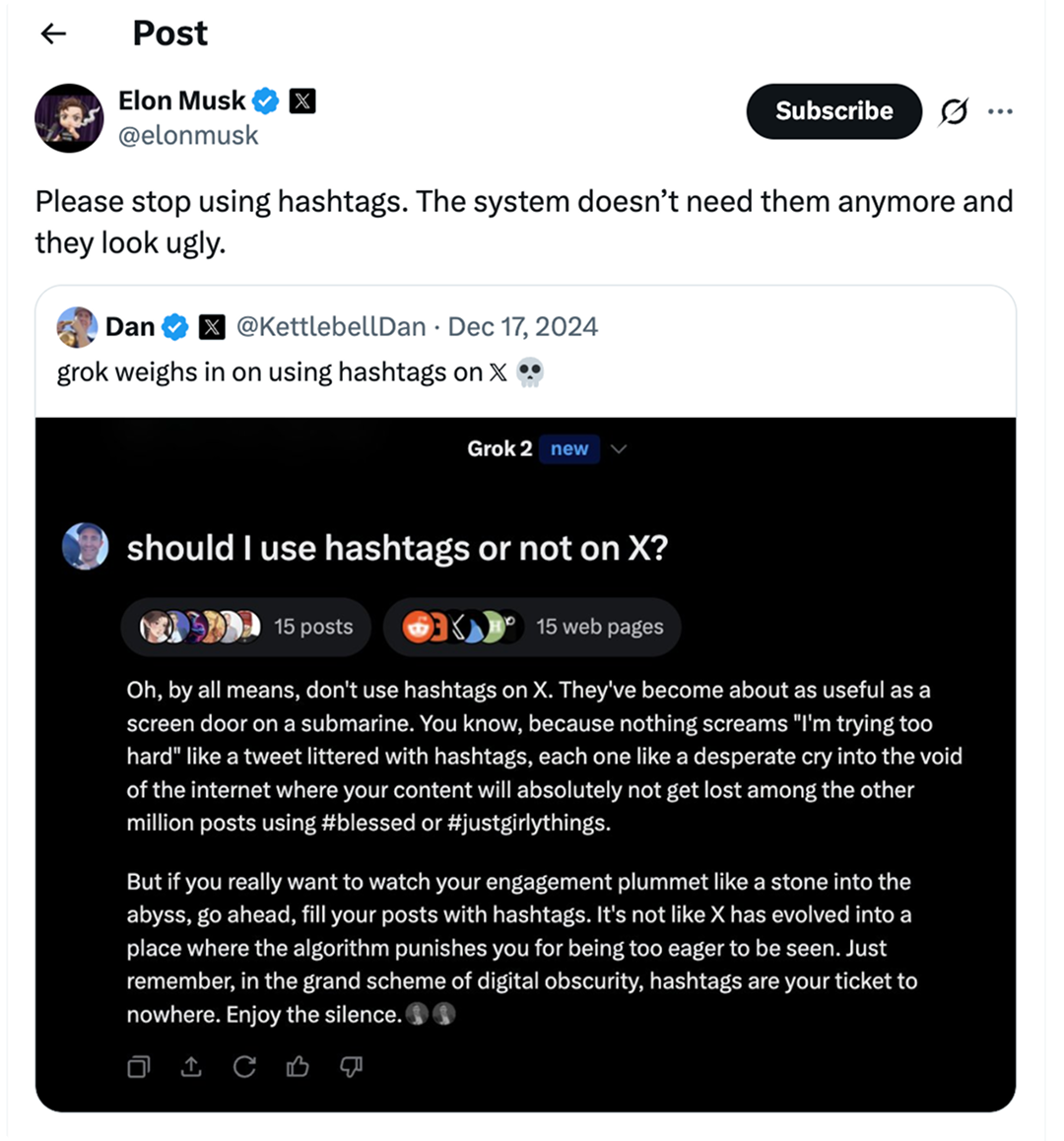
Ok, fair, “skip them” is two words.
The algorithm no longer relies on hashtags to surface content, and using them now signals to anyone paying attention that your social media team has not kept up. Leave them out.
A few tactical specifics that hold up:
- Post between one and three times daily. Consistency matters more than volume. Posting heavily one week and going dark for two weeks breaks momentum and audience habit.
- According to Sprout Social, Tuesdays through Thursdays between 10 a.m. and 5 p.m. generally see the strongest brand engagement, though your own analytics will tell you more about your specific audience than any general benchmark.
- Develop a bank of evergreen posts, so you always have content ready, and layer in timely posts around trending topics or breaking news in your industry when relevant.
- Build a content calendar with themed days or recurring formats. This makes planning easier and gives your audience something to anticipate.
Engage, Don’t Just Broadcast
Posting content is only half of an X strategy. The platform is conversational by design, and brands that show up only to push content without joining or starting conversations tend to stall out. Reply to mentions, participate in relevant threads, and respond to customer questions and complaints publicly. Ignoring negative feedback on X is a fast way to make it worse. Addressing it openly, quickly, and without defensiveness consistently produces better outcomes.
Combine Organic & Paid Efforts
Use your organic posts as a testing ground. Track which content earns the most engagement, then shift those posts into targeted ad campaigns to extend their reach. This approach is more efficient than running cold paid creative, and it keeps your advertising consistent with the content your audience is already responding to.
Set Measurable Goals & Track Them
Depending on your goals on X, KPIs might include engagement rate, follower growth, link clicks, conversions, or brand mentions. X Analytics provides core performance metrics, but pairing it with UTM-tagged links (and ideally conversion tracking) is key to understanding how X-driven traffic behaves on your site. Review performance regularly and adjust based on actual data, not assumptions, especially as attribution and audience behavior can vary widely.
Is X Losing Advertisers?
Yes, significantly. The numbers tell a consistent story.
In 2022, the final year before Musk’s acquisition, Twitter generated $4.4 billion in total revenue, with the majority from advertising. By 2024, that figure had dropped to $2.2 billion, a decline of more than 46.4% in two years. WARC estimates the total hypothetical loss in ad revenue since the acquisition at $5.9 billion.
The causes are documented. Content moderation under Musk loosened significantly after the acquisition, and ads from major brands began appearing alongside extremist content. IBM, Disney, Apple, and the World Bank all suspended advertising on the platform, citing brand safety concerns. A Kantar survey found that only 4% of marketers considered X ads brand-safe, and a quarter of respondents said they planned to reduce spending further.
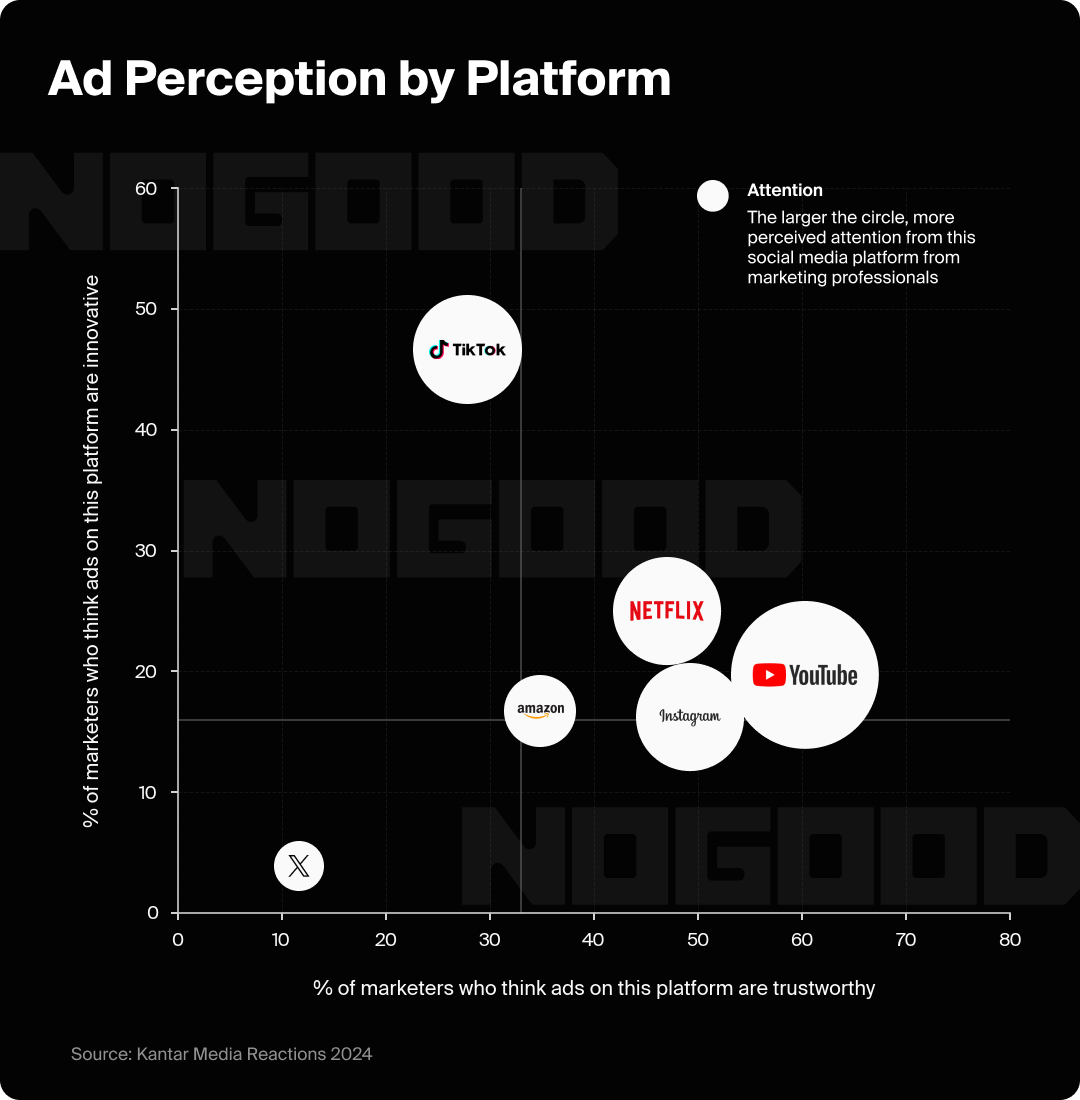
For brands considering advertising on X: the costs are competitive, with median CPM sitting at $2.09 versus $2.53 on Meta. The tradeoff is brand safety risk and the need to monitor ad placement carefully. Famously, the reason for IBM leaving the platform is that they found their ads were placed next to X posts praising Hitler and Nazism.
Is X still relevant in 2025?
The platform currently has approximately 586 to 600 million monthly active users and around 245 to 251 million daily actives. That makes it the 12th most widely used social platform globally. User numbers have been declining, and engagement metrics have softened across most categories. Its relevance is holding despite the myriad of controversies surrounding it.
X remains the dominant real-time information channel on the internet. About 75% of users say they find breaking news on X before any other platform. For brands in news, finance, technology, sports, or entertainment, that speed-of-information culture is still one of the most useful marketing surfaces available.
Engagement trends have been mixed but not uniformly bad. Influencer engagement rates on X jumped from 0.09% in 2024 to 0.39% in 2025, a significant shift. And with only 5.5% of marketers currently using X for influencer partnerships, there is real room to move on the influencer side of things before it gets saturated. The brands getting the most out of X in 2025 are the ones treating it as a relationship-building tool rather than a distribution channel.
X is not a default marketing channel. It is a choice. For brands whose audiences and objectives align with what the platform actually does well, that choice still makes sense.
Where Does This Leave You?
X in 2026 is a platform that rewards brands willing to do the work differently than they did three years ago. The playbook has shifted: hashtags are out, video is up, influencer partnerships are underutilized, and the organic-to-paid amplification model outperforms cold ad spend by a meaningful margin. The brands getting real returns here are the ones that have updated their approach to match where the platform actually is, not where it was when they first set up their account.
The bigger question is not how to use X but whether to prioritize it. That comes down to audience fit, category, and goals. If your target customers are active on the platform and your brand has something genuine to contribute to real-time conversation in your space, the investment is worth making. If the data shows your audience has moved on, the honest move is to scale back and put that energy somewhere it compounds. Either way, the decision should come from your analytics, not from defaulting to the platform because it used to be essential.