
The phrase “growth marketing” has been thrown around a lot since the 2010s. It quickly became a sharp and buzzy refrain in keynote speeches as it evolved from an abstract and novel way of looking at the modern marketing mix to an established doctrine. Even early practitioners like Brian Balfour pushed back on the hype, writing, “So much emphasis these days is placed on ‘The One Hack That Grew My Startup 5,243%’… but growth is about the long run.” Today, that long-run discipline is the standard for brands that want growth that’s measurable and sustainable.
Think about the user journeys you and I take part in every day. They zigzag across social, search, inboxes, and apps before we even ever consider clicking “buy”.
As marketers or brand leaders, we’re under constant pressure to generate demand, while keeping our customers engaged. The integrated approach of a strong growth marketing strategy is what’s key to unlocking scale for our ventures and projects.
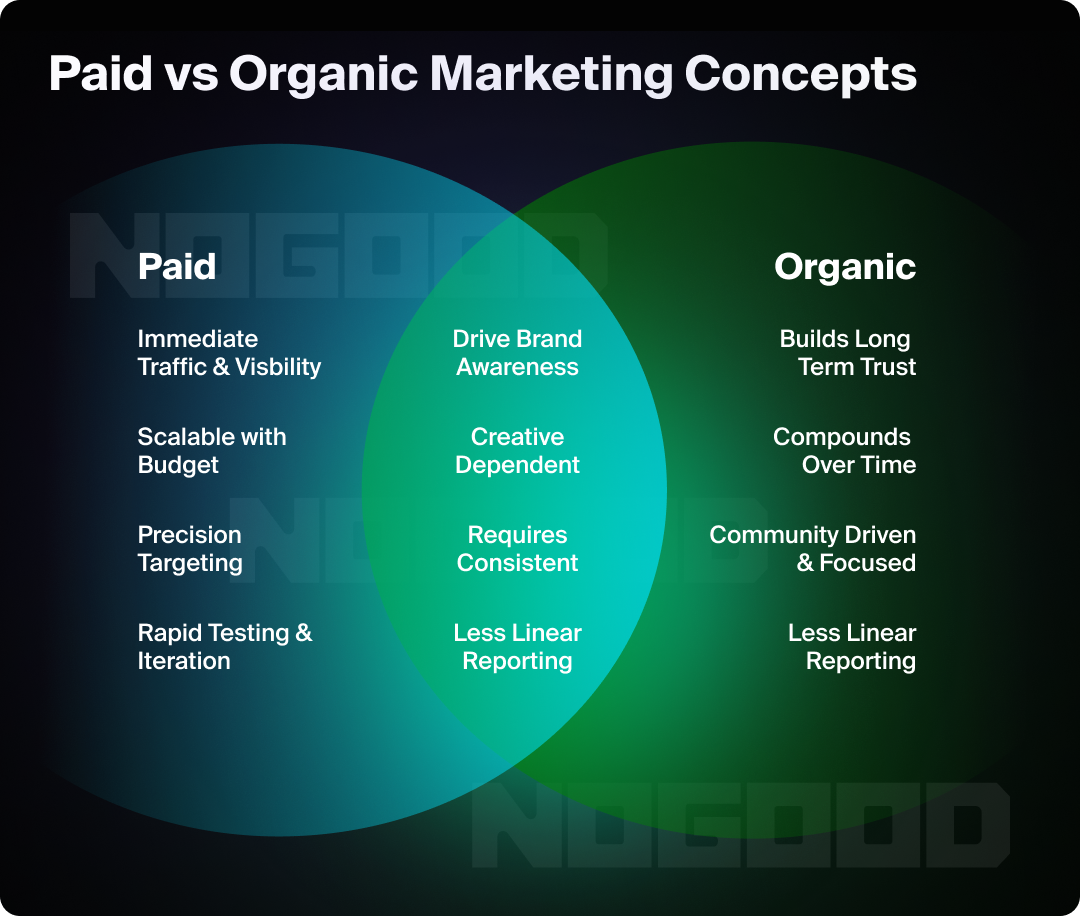
Paid and organic social marketing are the two of the most critical pillars in the temple of growth. Paid social drives immediate reach and sustained velocity (assuming ample budget), while organic builds long-term trust, authority, and brand equity. Organic channels are especially interesting, because over time and when curated with care, they can serve as full-funnel brand marketing engines that drive awareness, shape perception, and build community. They don’t require ad budgets, but they do require curation and community management; and, of course, content creators.
When paid and organic are integrated thoughtfully as part of a growth marketing strategy, they create a system that not only attracts and acquires new users, but also retains them more effectively.
This article outlines a framework for thinking about the integration of paid and organic channels, as well as a clear conceptualization of growth marketing. By understanding paid and organic’s unique roles and shared potential, marketers can design systems that prioritize adaptability, long-term brand equity, and performance without compromise.
What Is Growth Marketing?
Growth marketing is an iterative cycle of using experimentation, data, creativity, and design to drive incremental business growth. It focuses on optimizing every part of the customer journey, and converts paid and organic attention into momentum that has the potential to achieve broader business goals beyond just driving revenue.
This is what I love so much about this philosophy we call growth marketing. It’s a truly multidisciplinary practice. We get to whet our appetite across multiple domains of knowledge, including media, ad tech, design, creative strategy, experimentation, psychology, community, and storytelling. This discipline welcomes the curious, and rejects the thoughtless.
Growth marketers don’t just ask, “did it work?”; they ask, “why did it work and how can we make it better?”
What really helped it click for me is when I compared growth marketing to the scientific way of thinking. In science, each discovery, hypothesis (proven, or rejected) builds on itself, creating a sediment of knowledge, context, and understanding. Ego is stripped away, and the only thing that matters is the pursuit of knowledge. Similar to science, we find our truth in data and repeated experimentation. We’re not afraid to acknowledge when we are incorrect, and are satisfied as long as each iteration gets us closer to our ultimate goal of growth.
Growth marketing is such an effective doctrine, because it is a systematic approach. It considers the complexity of the customer journey, the variables at play, and respects the marketing organization as a whole. It is a machine built from many parts. All important in relation to one another.
Growth Marketing vs. Digital Marketing: What’s the Difference?
Digital marketing set the stage for growth marketing. Consider digital marketing as the domain, and growth marketing the discipline that evolved out of it.
It didn’t take long after the birth of the internet for digital marketing to take off. What started in the 90s with a clickable banner on hotwired.com, soon influenced marketing organizations the world over. As it matured, the once novel discipline began to mirror the traditional marketing industry. It soon became a construction of siloed experts, agencies, and disparate channels. This approach was very tactical, and campaign-focused, and caught in a loop of surface-level metrics.
Growth marketing, by contrast, operates at the brand level, not the campaign level. It is both the sail and the rudder of a brand’s journey, propelling the business forward, while always orienting towards long-term business growth. Growth marketing allows customers to experience the brand as a gestalt: an organized whole that is greater than the sum of its parts.
|
Digital Marketing |
Growth Marketing |
|
|---|---|---|
|
Focus |
Awareness and revenue |
Acquisition and lifetime value |
|
Collaboration |
Siloed teams and processes |
Cross-functional |
|
Agility |
Static evergreen campaigns |
Rapid experimentation and iteration |
|
Driver |
Channel |
Journey |
|
Metrics |
Traffic and purchases |
Revenue, customer retention, return on ad spend |
A central objective of growth marketing is to expand and reinforce the entire marketing funnel, along with the brand. This includes ensuring that acquisition efforts translate into meaningful longer-term outcomes including retention and lifetime value.
Organic social plays such a critical role in growth marketing because humans are wired for connection. We naturally seek out community; not just to feel a sense of belonging, but to help us define who we are to ourselves, and to the world at large.
Today, a huge part of how we express our identity happens both online, and through the products that we buy. Purchases aren’t just transactions. They’re signifiers. The clothes we wear, the music we listen to, the brands we align with emotionally; all of it communicates our values to the world. In that way, organic social isn’t just a marketing channel, it’s a modern forum for identity and affiliation. It’s critical that brands take their organic social strategy seriously, because it creates a fertile environment for communities to form.

Growth Marketing Philosophy
Marketing teams work best when they move with intention, treating growth not as a collection of isolated tasks but as a coordinated system built on structure, collaboration, and a deep understanding of the customers they serve.
1. Think Systematically
Think of your marketing organization as an ever-optimizing complex system where each team and contributor plays an essential role in the growth and evolution of the brands it supports. The growth marketing organization needs to be like a complex multicellular organism (one that is self regulating and shares resources across the organism in the most efficient way) in order to achieve the goal of survival and growth.
2. Collaborate to Ideate
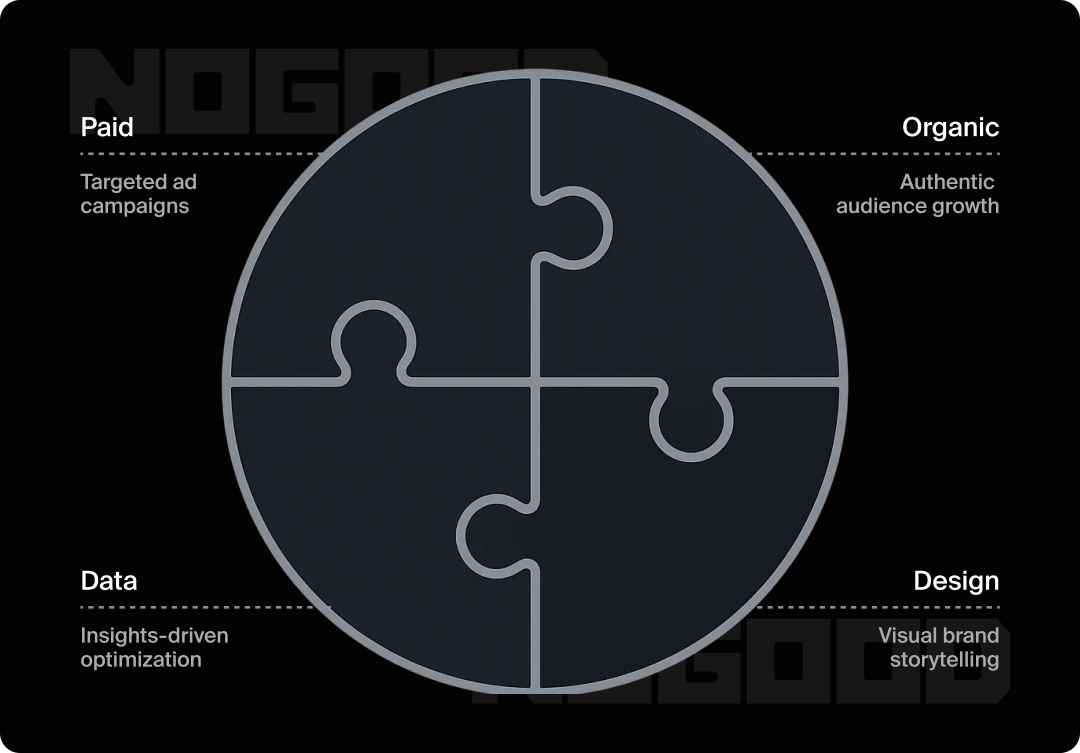
Collaboration between team members from paid, organic, data, and design is essential. Share insights and experiences to build a more complete user-centric strategy. Don’t assign channels to specific customer journey stages or keep them isolated. Map out how both paid and organic hits users along each stage of the journey, and discuss holistically how each initiative ties into the overall goal of strengthening and growing the brand.
3. Optimize Together
Have a weekly sync. Send a dashboard. The goal isn’t just visibility, it’s strategic and empirical alignment. Paid and organic teams should not only share performance data, but also align attribution frameworks and success metrics. This ensures both sides are measuring toward a shared goal, fostering collaboration and comprehension instead of competition.
4. People, Not Datapoints
At the end of the day, it’s not just about your reach and numbers; it’s about your customers. What do they want to see? What kind of content do they enjoy? What will they not like? Data and technology allows you to learn and listen along every touchpoint. It allows you to give your brand community quality content that provides them value and maybe even some entertainment.
Make their experience positive, not annoying, and not a waste of time. If you put them first, and take care of them, and can maintain that positive relationship as you scale, you honor their loyalty to your brand.
Why Paid & Organic Social Media Should Be Friends
Let’s acknowledge the internal tension. Paid and organic social media often operate as distinct groups or teams within a marketing organization. Each competes for limited resources, visibility, and stakeholder attention. While their day-to-day methods may differ, both teams ultimately share a common goal: to drive meaningful, and measurable business outcomes.
Paid social offers speed and decent accountability. Organic on the other hand, takes longer to build but creates durable brand value and community. The most effective growth teams recognize that neither approach is sufficient on its own. By understanding their complementary strengths, teams can design strategies where both paid and organic reinforce one another, and deliver outcomes that are greater than the sum of their parts.
Here’s how these channels can actually feed each other:
- Paid social media is a lab. You can test creative, messaging, and offers quickly at scale. Compared to organic, paid ad platforms allow you to isolate more variables, and test in a much more rigorous and controlled environment.
- Organic social strengthens the brand. The more traction your organic social channels have, the more discoverable, shareable, and credible your entire brand becomes. This brand equity increases the value of every paid impression.
- Shared learnings. There can be a lot of resonance in terms of what works for both paid and organic. At the end of the day, the brand identity will be consistent across both. You can apply learnings from paid to organic, and vice versa. For example, winning TikTok hooks can often create great Meta ads. It can all feed into each other systematically.
The growth mindset doesn’t choose sides; it considers all, and builds systems where diverse ways of thinking can be integrated towards achieving shared goals.
Benefits of Combining Paid & Organic Social in Growth Marketing
Paid and organic only reach their full potential when they operate as a unified ecosystem, shaping how people discover your brand, connect with it, and ultimately see themselves reflected in it.
1. Quality Through Community
People rarely make purchase decisions based on a single ad. Instead, they engage in a layered process of searching, browsing, observing (and, most critically) feeling. Emotional resonance plays a huge role in how people evaluate brands. A strong organic footprint across social, blogs, and other owned channels doesn’t just build visibility, it builds trust. More importantly, it fosters an ecosystem where individuals begin to see themselves reflected in the brand’s values and aesthetic. This can trigger a powerful psychological state: the sense of community membership, a deeply human need tied to belonging, identity formation, and social signaling.
One of the most striking and polarizing examples of this is the women’s fashion brand Brandy Melville. Its core audience doesn’t just like the clothes, they embrace what the brand represents about them as individuals. Meanwhile, those outside the community often express strong opposition to both the brand and what it signifies.
2. Efficiency Through Identity
Paid ads will get people in the door fast, but not as efficiently if those ads aren’t backed by a brand that feels trustworthy, relatable, and authentic. Getting served an ad for a brand with no organic presence or clear brand identity is like going to a party with no music, no lights, and no bar! Something just doesn’t feel right. If you combine paid and organic social, though, you extend your brand across much more of the user journey, and make the whole thing feel a lot less transactional.
Ultimately, organic helps to define the brand, and serves as the node for the community to form. Paid media then can help distribute that brand outwards, to new people who will resonate with it. At its best, it is a neverending feedback loop of listening, learning, and growing.
3. Compounding Creative Strategy
Your paid performance data is a goldmine for insights; and so is your organic performance data! What you can learn from performance data across paid and organic has value not just for each respective discipline, but for landing pages, blog strategy, and even product copy.
Repurpose organic posts into paid ads, spin emails into video scripts, turn top-performing LinkedIn content into landing page headlines. The more you reuse what works and share innovations and learnings across the team, the more efficient your creative pipeline becomes, and the more you can effectively cater to your brand’s community. When paid and organic strategy operates in harmony, you don’t just increase reach; you double your capacity to learn, iterate, and evolve in real time.
4. Lifecycle Optimization
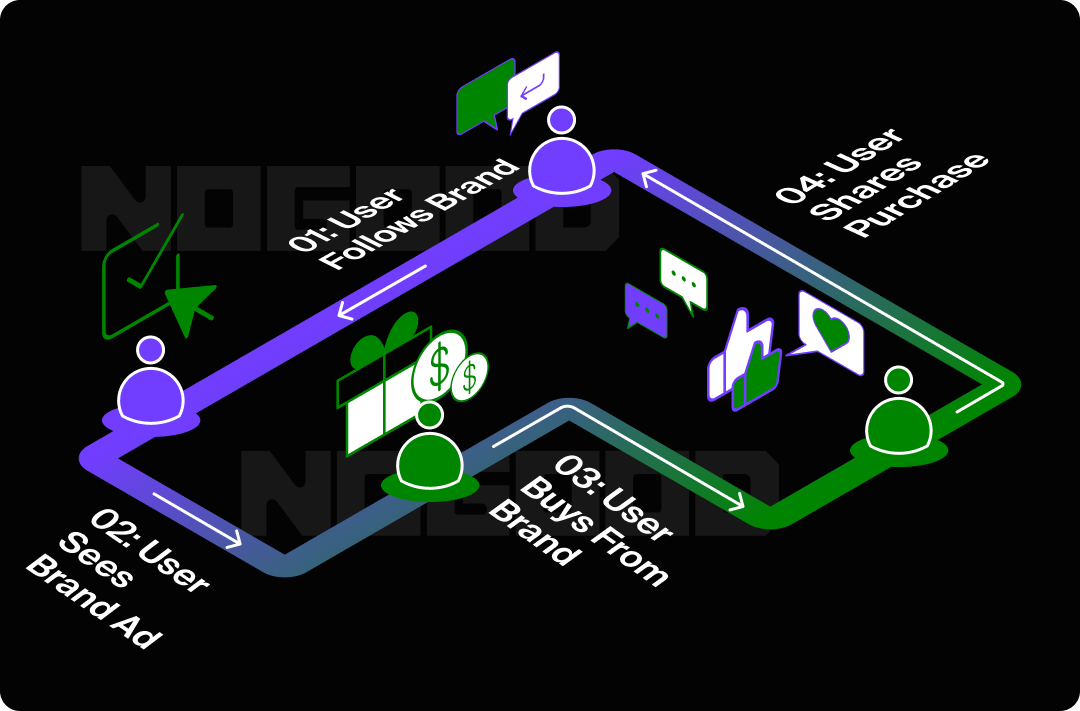
When blended, paid and organic social media help support a full customer lifecycle. For example, someone might follow your brand on TikTok after seeing a cool or thoughtful video, only to later be served a targeted ad for your new product that feels surprisingly relevant to their current needs. This isn’t because of luck, but because of their connection with your brand’s community, and they are now primed them to take a meaningful action on your paid ad.
This can also be seen working in reverse, where a paid impression could lead to a purchase, and then that purchase has now afforded this person membership into your brand’s community. This may lead them to share their purchase on socials, tag your brand, and then follow your brand.
Regardless of the sequence, the customer journey often walks along multiple paid and organic touchpoints before an action ever takes place. This synergy between paid and organic social media also increases the probability of further meaningful interactions with your brand taking place.
Real-World Brands Doing Growth Marketing Synergy Right
Mailchimp, Notion, and Canva all show how pairing paid acquisition with rich, community-driven organic content creates a self-reinforcing engine of trust, education, and long term brand affinity. What these brands do so well, is focusing their energy towards the organic and paid initiatives that really resonate with their core core user base.
Mailchimp
Mailchimp has been playing the long game with paid and organic content. Their blog ranks well for SMB marketing searches, and their YouTube channel includes everything from tutorial series to brand documentaries that feel more like your favorite podcast than B2B content. On social media, they share campaign ideas, seasonal trends, and creator partnerships that feel native to Instagram and TikTok, not like stale tech advertising.
Their paid strategy is a major driver of the platform’s ever expanding user base. Mailchimp’s use of paid for acquisition, and organic for both retention and brand education, is extremely effective for where the brand sits in the space.
Mailchimp found the synergy. Paid channels bring in high-intent users, while organic content keeps them engaged, educated, and loyal. It works because it mirrors the way small business owners actually buy. Slow to trust, but quick to buy once trust is built, and value is illustrated. Most importantly, both their paid and organic approaches acknowledge the fact that SMB owners are always looking to learn.
Notion
Notion’s growth strategy centers around an ecosystem of highly aesthetic, utility-driven content and platform-native storytelling. Their organic foundation includes a deeply optimized blog, an expansive template gallery, and active community forums that contribute to sustained discoverability and product education. On YouTube and TikTok, Notion regularly publishes workspace tours, creator spotlights, and productivity tutorials that highlight real-world use cases in a relatable way.
Paid campaigns tend to amplify these themes, emphasizing flexibility and integrations, reinforcing messages already familiar to users through organic channels.
This cohesion across channels has helped Notion scale while maintaining strong brand loyalty with minimal reliance on overly aggressive or performative tactics.
Canva
Canva’s landing pages rank for thousands of intent-rich queries (“Instagram Story templates,” “business card designs”), while their paid campaigns capture membership intent. On organic social, Canva publishes engaging content, celebrates creators, offers design inspiration, and showcases real users. Canva’s Instagram and TikTok feeds are filled with concise tutorials and trending design formats that both introduce the product to new audiences and reinforce value for existing users.
Canva does community really well. Their content strategy helps customers become more confident with the platform and also encourages discourse, which in turn supports continued engagement and that feeling of community; which, as we’ve covered, is just so powerful.
Canva’s paid social campaigns frequently amplify the top-performing organic content, using proven messaging and formats to expand reach efficiently. The result is a tight feedback loop between content, conversion, and retention that strengthens both brand and performance outcomes, while maintaining a growing online community.
Final Thoughts: Stronger Together
The best growth marketing teams understand that the real advantage doesn’t come from choosing between paid or organic, but in building integrated systems and ways of thinking where paid and organic social media campaigns thrive and fortify each other. When these efforts are aligned strategically, creatively, and operationally, the result is a more intelligent and durable growth marketing strategy.
Growth marketing synergy at its best is when every campaign and piece of content feel s less like noise to the customer, and more like a multi-media conversation worth having and paying attention to. Shared insights, consistent messaging, and unified goals across channels sets you up for success. Brands that foster this synergy are positioned not just to scale faster and more sustainably, but to do so in a way that builds brand equity, improves retention, and keeps them top of mind long after the first impression.