

The direct-to-consumer (DTC) model has transformed the exchange of goods, allowing brands to connect with customers in new ways. DTC brands are experiencing explosive growth, reaching $162.91 billion in 2024 (expected to reach $595.19 billion by 2033), signaling that consumers prefer buying directly from brands rather than intermediaries.
However, with the rise of DTC brands comes fierce competition. As more companies enter the market, being at the top of search results is essential for success. Statistics show that 0.63% of users click on something on the second page of results; if they even make it there.
Implementing effective search engine optimization (SEO) practices not only enhances visibility, but also drives organic traffic.
In this blog, we’ll cover six strategies for optimizing your eCommerce store for SEO and Answer Engine Optimization (AEO), designed to improve organic visibility, rankings, and conversions.
Drive organic traffic and boost conversions
Why SEO Is Essential for eCommerce
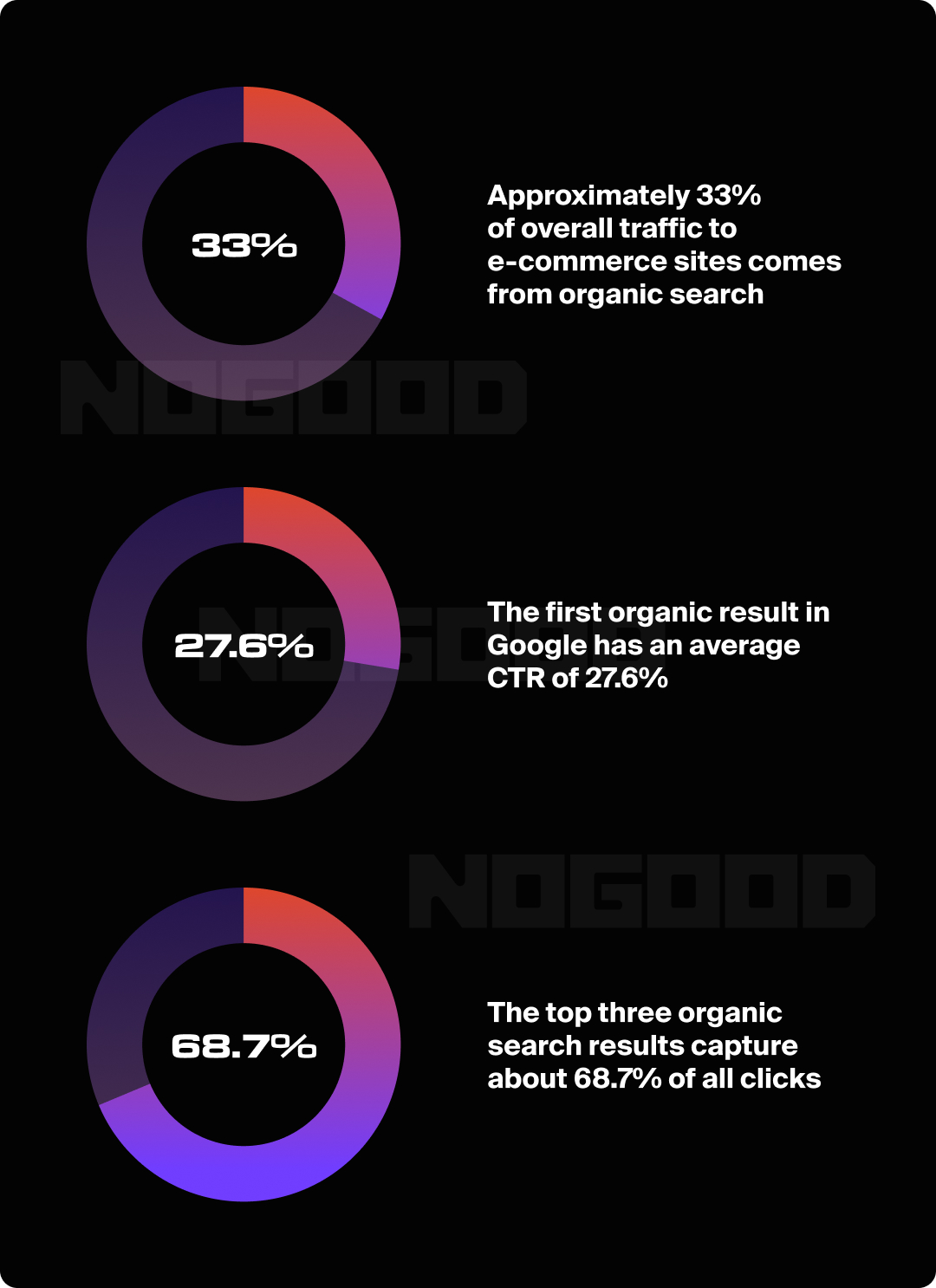
Though 39% of shoppers have reported using AI for shopping, organic search continues to be one of the most valuable channels for eCommerce brands. Since the majority of your customers are purchasing from your store by finding you on a Search Engine Results Page (SERP), brands need to continue to maximize visibility in the traditional search space. Organic search traffic tends to have higher conversion rates compared to other channels, as users coming from organic results are often more engaged and have a higher intent to purchase.
When your site ranks higher on SERPs, you’re more likely to be seen by shoppers who are actively looking for the products you offer. This increased visibility doesn’t just bring more eyeballs to your virtual storefront; it translates into higher chances of converting visitors into customers.
Incorporating effective SEO strategies means aligning your website with the algorithms of search engines. This involves a mix of keyword research, technical tweaks, content creation, and link-building efforts. Each component plays a role in enhancing your site’s authority and relevance, making it more attractive to both search engines and users.
6 SEO Strategies to Optimize Your eCommerce Site
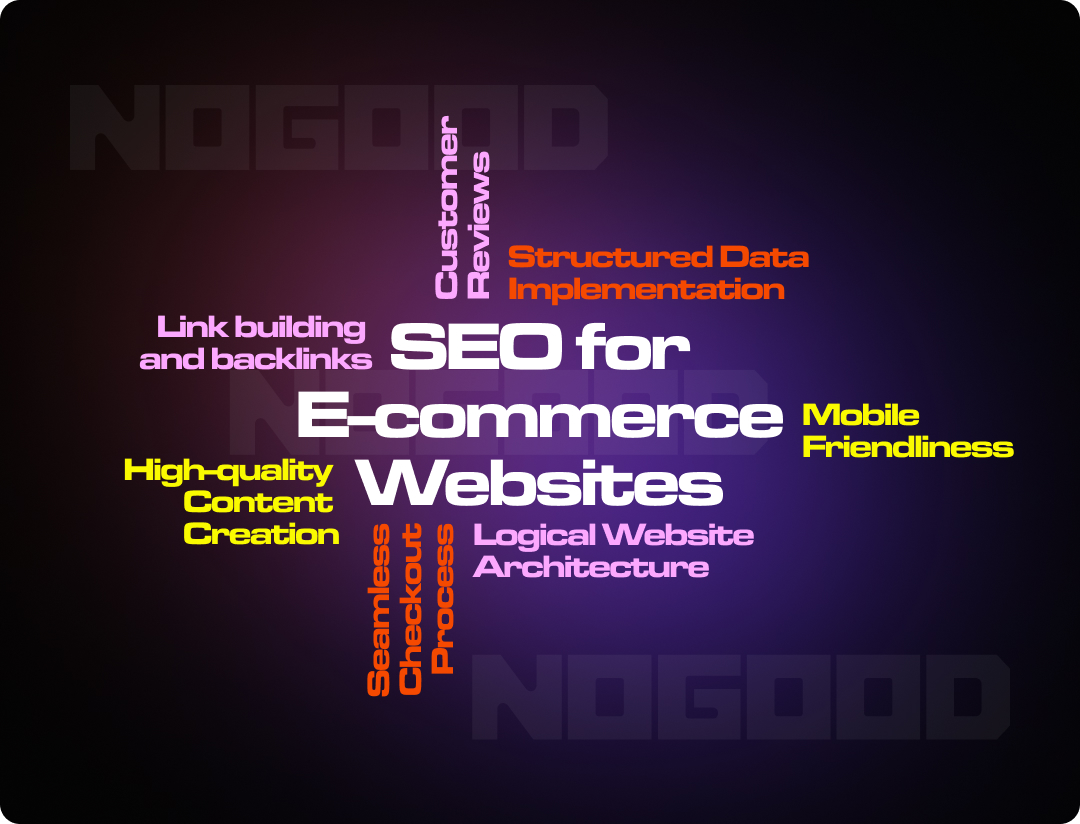
1. High-Quality Content Creation
Creating high-quality content is like planting seeds for future growth; not only does it engage your audience, it also significantly boosts SEO rankings. So, how do you keep your content garden blooming? Start by brainstorming fresh ideas.
User-generated content is a goldmine; think reviews, testimonials, or customer stories. These not only add authenticity but provide a steady stream of relevant material.
Blog posts are another powerful tool in your content arsenal. Dive into topics that resonate with your audience, offering insights and solutions to their problems. This not only positions your brand as an authority, it also targets informational keywords that enhance brand awareness.
Don’t overlook visual content. High-quality images and videos can make your content more engaging. For example, a video tutorial on how to use one of your products can be both informative and shareable, increasing your reach.
Pro Tip: No matter the type of content you’re creating, consistency is key. Regularly updating your content keeps it relevant and encourages search engines to visit your site more often.
Incorporate content marketing strategies that focus on storytelling, and share your brand journey, values, and the impact of your products on the environment or community. This not only differentiates your brand but also creates an emotional connection with your audience.
2. Link Building & Backlinks
Navigating the world of link building can feel daunting, but it’s necessary to improve your eCommerce SEO. Quality backlinks enhance your site’s credibility and improve your search engine rankings. So, how do you snag them?
One effective method is through collaborations and partnerships. Consider teaming up with brands or influencers to create content that naturally includes links to your store. This expands your reach and enhances your backlink profile.
In a similar vein, guest posting is another ideal strategy. By contributing valuable content to reputable blogs or sites, you can earn backlinks while showcasing your expertise.
Building a backlink profile isn’t just about getting more links; it’s about getting the right ones. Focus on securing backlinks from authoritative sites within your industry. These sources should have a high domain rating. These carry more weight with search engine algorithms, significantly boosting your rankings.
Think about creating shareable content: infographics, how-to guides, or engaging videos that others would want to link to. You could also reach out to industry publications or blogs with a compelling pitch for why they should feature your content.
Don’t underestimate the power of broken link building, either. This involves finding broken links on relevant sites and suggesting your content as a replacement. It’s a win-win: they fix their broken links, and you gain a valuable backlink. Remember, while quantity is important, quality reigns supreme. Each backlink should be a step towards establishing your eCommerce site as a trusted authority in your niche.
3. Technical SEO for eCommerce Sites
Schema Markup
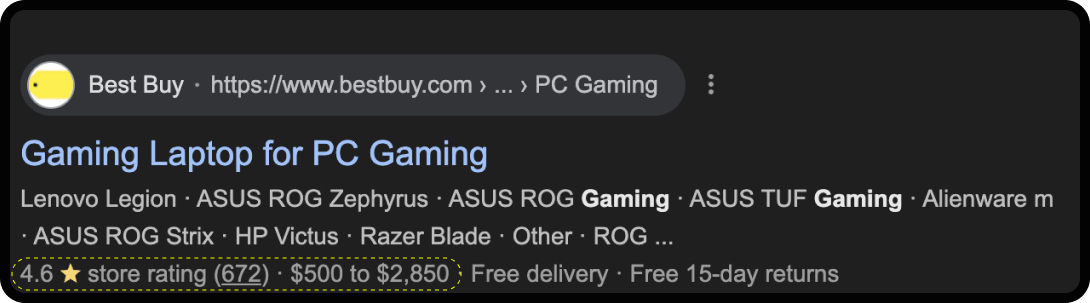
Structured data, particularly schema markup, tells search engines what your content is about. For example, you can add product schema to your product pages to tell search engines your prices, availability, shipping info, and return policies. This review schema will even display your ratings and reviews. This crucial data will then be displayed next to your product pictures and descriptions directly in search results.
For eCommerce, this is also vital for enhancing rich results and optimizing for AEO, as it makes your information machine-readable for AI Overviews, chatbots, and voice search.
Types of Schema
Four types of schema that are directly related to eCommerce SEO strategies include:
- Product: This type of schema can provide algorithms with detailed information about products (product name, description, price, availability, shipping info).
- FAQ: This schema allows you to present frequently asked questions and their answers directly in the search results. It enhances user experience by providing quick answers without needing to click through to a website.
- Review: Used to display ratings and reviews for products or services, this schema enhances credibility by showing user feedback directly in SERPs.
- Video: For websites with video content, this schema helps display video thumbnails and descriptions in search results, increasing the likelihood of clicks.
Page Speed
Your website speed is a significant factor in your search ranking and user experience. If the website itself is slow to load, or your checkout process is slow, users are likely to abandon your site (and their carts) before completing their purchase.
Google favors websites with fast page speed and a healthy Core Web Vitals score.
Tips to Optimize Site Speed
- Remove excess JavaScript and CSS from your website.
- Optimize image file size by converting to web-friendly formats like webp, and keeping image sizing under 100-150kb.
- Use an automatic caching plugin to remove excess data from your website.
Optimize for Mobile
Mobile browsing accounts for 66% of all online sales. Google also prioritizes mobile-friendly websites in its rankings, making responsive design essential for improving search visibility and user engagement.
Responsive design ensures that your site adapts seamlessly to various screen sizes, providing an optimal viewing experience across devices. All fonts should be legible without zooming, so you’ll need to use a font that’s at least 16px.
4. On-Page SEO for eCommerce Sites
Optimize Product Pages
Each product should have a unique description that provides comprehensive details about its features, benefits, and specifications. You should aim for at least 300 words that include relevant keywords that align with search intent.
Longer descriptions (over 1,000 words) can also improve rankings by providing more context for search engines. The standard best practice is to include a short description next to your product pictures, then add a more detailed description below the main product information.
For product photos, use high-resolution images and optimize them with descriptive alt text that includes relevant keywords. This not only helps with SEO, but improves accessibility for users who are using a screen reader.
Create a Seamless Checkout Experience
The more seamless your checkout experience is, the less strain there is on the user, resulting in quicker and more frequent purchasing. Here are some tips for creating a frictionless checkout:
- Reduce the number of fields in any form to just the essentials (“First Name” and “Last Name” can become “Full Name”). This helps prevent user fatigue from dragging the cursor to multiple boxes.
- Implement progress indicators to show users their progress in the checkout process. This transparency helps manage expectations and reassures customers about the time commitment involved.
- Enable auto-fill options for forms to save users’ time. For instance, when a user begins to enter their address, the field can search maps for their address and pre-fill their mailing address for them.
- Clearly display all costs up front, including shipping fees and taxes, to avoid surprises at checkout that could cause customers to abandon the cart.
- Include various payment options such as credit cards, PayPal, Apple Pay, and Google Wallet. Offering guest checkout options can also enhance convenience and reduce barriers to purchase.
URL Structure
A well-crafted URL helps search engines understand the content of your pages and provides potential customers with clear expectations about what they’ll find.
Incorporate keywords that accurately describe the content of the page. This not only helps search engines identify the page’s topic, but also improves click-through rates as users can see what to expect before clicking.
- Instead of using a generic URL like www.example.com/product123, a more descriptive URL could be www.example.com/shoes/running-shoes.
When creating URLs, use hyphens to separate words instead of underscores. Search engines treat hyphens as word separators, which improves readability and indexing.
- For instance, www.example.com/womens-running-shoes is preferable to www.example.com/womens_running_shoes.
Ideally, keep your URL structure to a maximum of three hierarchical levels. This approach strikes a balance between categorization and simplicity, making it easier for users to navigate your site.
- Think of your URL like a categorized directory; www.example.com/category/subcategory/product
If you have similar products that might generate duplicate content issues (e.g., different sizes or colors), use canonical tags to indicate the preferred version of a page to search engines. This prevents potential penalties for duplicate content while ensuring that users land on the most relevant page.
Customer Reviews
Google pulls data from customer reviews and ratings to determine which products to display both on traditional SERPs and in AI Overview, making them a key component of SEO and AEO. No matter which type of search you’re optimizing for, feedback from real customers helps signify trustworthiness and authoritativeness to Google and social proof to users.
Customer reviews are also helpful in voice search results, as voice assistants may read off customer reviews when responding to user queries. For example, if someone asks a voice assistant what the “best cookware sets for gas stoves” are, the voice assistant may read off a review that mentions using the product with a gas stove.
5. Optimizing Site Architecture for eCommerce SEO
A well-organized site structure is crucial for users and for search engines. Imagine walking into a store that has no labels or signs on the aisles… frustrating, right? The same goes for your online store. A logical site hierarchy, with clearly defined product categories, makes it a breeze for customers to find what they’re looking for and helps search engines understand your site.
Start by categorizing your products in a way that makes sense. For instance, if you’re selling electronics, break it down into subcategories like “Smartphones,” “Laptops,” and “Accessories.” This hierarchy guides users and allows search engines to index your pages more efficiently. All of these categories should be accessible from your main navigation, so users can find what they’re looking for with the fewest clicks possible.
Each page on your website should be no more than two to three clicks from the homepage. If your content is buried deep in your website architecture, it will be difficult for users to find the products they’re looking for.
6. Keyword Research
Keyword research helps optimize your eCommerce website and product pages for search engines. By identifying relevant keywords, eCommerce sites can enhance their visibility on search engine results pages (SERPs).
This increased visibility is essential because higher rankings correlate with more clicks. For instance, the first organic result in Google receives about 28% of all clicks, while the tenth result garners only 2.5%. Thus, targeting the right keywords can lead to a substantial increase in traffic.
Long-tail keywords (phrases that are longer and more specific) are particularly valuable in eCommerce SEO. These keywords often have lower competition compared to broader terms, making them easier to rank for while attracting targeted traffic.
For instance, instead of competing for the highly sought-after keyword “hiking shoes”, an online retailer might choose to target “men’s waterproof hiking shoes”, as a tactic to realize higher conversion rates.
When conducting keyword research, don’t forget to also consider the search intent of the keywords you choose. Search intent refers to what a user is truly looking for when they type a keyword into a search engine. Keyword research tools like Ahrefs and Semrush label all keywords by intent.
Types of Search Intent:
- Informational Intent: The search for information or answers (e.g., “how to choose running shoes”)
- Navigational Intent: Searching for a specific website or page (e.g., “Nike official site”)
- Transactional Intent: Users are ready to make a purchase (e.g., “buy running shoes online”)
- Commercial Investigation: The comparison of products before making a purchase decision (e.g., “best running shoes for flat feet”)
For product pages, eCommerce stores should use keywords with transactional and commercial search intent, while informational keywords are usually best for blog posts.
Best Tools for eCommerce SEO & AEO
Optimizing an eCommerce site for SEO and AEO requires the right toolkit. While manual efforts are foundational, leveraging specialized software can significantly streamline your processes. Here are some of the top tools marketers rely on to boost visibility, rankings, and conversions.
All-in-One SEO Platforms
These platforms offer a suite of tools for keyword research, site auditing, backlink analysis, and competitor tracking.
- Semrush: An industry leader providing data on keywords, organic traffic, competitor strategies, and technical SEO issues. Its site audit feature offers specific tools for tracking SERP features relevant to AEO.
- Ahrefs: Renowned for its backlink analysis capabilities, Ahrefs also offers keyword research, content gap analysis, and rank tracking tools. It’s particularly useful for competitive intelligence in the eCommerce space.
- Google Search Console: A free tool from Google. It provides data on how your site performs in search results, identifies crawl errors, mobile usability issues, and highlights opportunities for rich results; all critical for technical SEO and AEO.
Specialized Tools for Code & Markup
These tools help validate and implement structured data and technical improvements.
- Schema Markup Generators: While AI can generate schema, tools like Schema.org‘s official validator, as well as other plugins and builders (e.g., Yoast SEO Premium or Rank Math Pro for WordPress) help you create, test, and implement various types of structured data.
- Google’s Rich Results Test: Another free tool from Google that can test any URL to see which rich results are eligible for your page, as well as identify errors in your structured data.
- PageSpeed Insights: Free Google tools that analyze your site’s Core Web Vitals and provide recommendations for site-speed optimization.
- Screaming Frog SEO Spider: A website crawler for identifying technical SEO issues like broken links, redirects, and crawlability problems across your entire site.
Keyword Research & Intent Tools
Effective SEO and AEO hinges on understanding user intent. These tools help uncover the exact phrases your customers use and the intent behind them.
- Google Keyword Planner: A free tool from Google that identifies relevant keywords and estimates search volume. Useful for both broad and long-tail keyword research.
- Also Asked & AnswerThePublic: Excellent for finding natural language questions people are asking around a topic, which directly informs your AEO strategy for featured snippets and AI Overviews.
- Competitive Intelligence Tools (e.g., SpyFu): Helps you see what keywords your competitors are ranking for, including those driving traffic to their product and category pages.
Boost Organic Traffic With eCommerce SEO
The foundation of a successful eCommerce strategy lies in a holistic approach to both SEO and AEO, ensuring your website is optimized for search engines, LLMs and users. This means conducting thorough keyword research to target the right terms that align with your products and customer intent. Over 81% of Americans shop online, emphasizing the importance of appearing in search results to capture this audience early in their buying journey.
Investing time and resources into eCommerce SEO can yield substantial returns. Organic traffic remains the most cost-effective channel for acquiring new customers, as it continues to deliver results long after initial optimization efforts.