

Data bias in growth marketing is a well-documented and researched problem among data and machine learning scientists. However, its consequences are now becoming visible across hiring, finance, and marketing. Its impacts can be seen across many applications, but the loudest examples often come from AI-powered image recognition, recommendation systems, or predictive financial models.
In 2019, the world woke up to Entrepreneur David Heinemeier Hansson’s complaint against Apple Card for having a clear bias in its algorithm that led to assigning a lower spending power to his wife, who has similar or better credentials and credit history. More recently, Workday was sued, as it was alleged that its AI screening algorithm was biased against older and disabled candidates.
These cases serve as stark reminders that data and AI bias are not just theoretical problems; they have tangible repercussions that apply to growth marketing.
What Is Data Bias?
Data bias occurs when there is an error in the collection, processing, or analysis of data. The outcome of this error results in skewed, incorrect, or unrepresentative results. Data bias has existed long before the integration of AI into the systems and platforms we use every day; however, the introduction of artificial intelligence has led to a shift in how we look at and understand data bias.
What Are the Three Types of Bias in AI?
In the world of AI, data bias can happen in three primary ways:
- Selection Bias: The algorithm’s performance is a byproduct of the datasets used to train it. If a model is trained to predict future buyers, the data must be representative of those future buyers. For example, if you build a product recommendation engine based only on data from your most loyal customers, the model may fail to identify patterns for new customers or those who shop infrequently.
- Proxy Bias: This is a more subtle and dangerous form of bias. Algorithms, in their pursuit of correlations, can use seemingly neutral data points as proxies for sensitive, protected characteristics. For instance, a model might use a user’s location (ZIP code), browsing history, or music preferences as a proxy for socioeconomic status or age, leading to a biased outcome, making bias much harder to detect and mitigate.
- Human Bias: The people who collect, label, and clean the data can unconsciously encode their own biases into the dataset. For example, if a team tasked with creating training data for an AI art generator is not diverse, the generated images may consistently default to a specific race, gender, or body type when creating a picture of a “successful CEO” or a “happy family.”
It’s important to know that all data is to some degree biased. When you are the one implementing AI and Machine Learning strategies, you need to recognize your data biases early before they become detrimental to your efforts and costly to replace.
How Does Data Bias Impact Growth?
Data bias in growth marketing manifests itself in various ways that could easily hinder your product’s growth when algorithms start making the wrong predictions about your users. In addition to poor targeting, the business risks of bias extend to:
- Brand Reputation Risk: A biased ad campaign can go viral for the wrong reasons, leading to a PR crisis. Customers today are highly attuned to issues of fairness and will quickly call out brands they see as discriminatory.
- Legal & Regulatory Risk: The legal landscape around AI is rapidly evolving. We are seeing the rise of AI regulations (like the EU’s AI Act) that could impose significant fines on companies whose algorithms are found to be biased.
- Missed Market Opportunities: If your algorithms are biased against a certain demographic, you are potentially excluding a valuable customer base. An algorithm that disproportionately targets one group of people will consistently underperform in reaching others, limiting your total addressable market (TAM).
What Are the Most Common Types of Data Bias in Growth Marketing?
Here are the 4 most common data and algorithm biases we encounter across growth teams and tips on how to avoid them:
1. Datasets That Include Negative Consumer Behavior
As marketers, we often leverage predictive models to optimize our audience targets. However, feeding an algorithm data that only represents your “ideal” customer can create a confirmation bias loop as it learns to prioritize people who look like your past best customers, potentially overlooking new, high-value segments or future trends.
The most common mistake is uploading your entire customer list to Facebook’s Lookalike Audience tool, which creates the lookalike audience based on either user actions on your site or a manual upload of your customer list. This works against retention, as we know not to place each and every customer on the same plane.
For example, loyal and repeat customers with high LTVs are more profitable, while customers with negative consumer behaviors like high churn, high promotional consumption, and low LTVs tend to be less valued. So why are you still uploading your entire list of customers?
A modern approach involves using LTV and Recency, Frequency, Monetary (RFM) analysis as a more sophisticated way to segment your data. Instead of simply excluding customers, use your data to:
- Diversify Your Training Data: Include a representative sample of all customers, not just the “good” ones.
- Use Data Segmentation for Targeted Campaigns: Use AI to identify different customer behaviors (e.g., high-LTV, high-churn risk, frequent returners) and create tailored marketing campaigns for each group.
- Focus on the “Why”: Use these data points not just to predict behavior, but to understand the reasons behind it.
This also applies to the SaaS space. Focus on the customers that stick around, give positive NPS scores, have the highest LTV, and are getting the most value out of your product.
2. Platform Bias & Persona Validation
Very often, startups come to NoGood and say: “I thought my product would attract people in their mid-20s or early 30s, but when I tested on Facebook, it turned out my target age range was between 35 and 55.”
The first thing that comes to mind is: Is Facebook actually the right platform to test your product on younger Millennials or Gen Z? Facebook is actually known to be a ghost town for Gen Z, and even those who are on Facebook generally have the lowest engagement and the lowest activities compared to other generations. This issue is a form of dataset shift or population drift, where the audience on one platform may not be representative of your broader target market.
You are not going to use Snapchat or TikTok to target moms and dads, so why are you using Facebook to target the younger demographic? You need to consider who is actually active on different social media platforms, and what they are using them for.
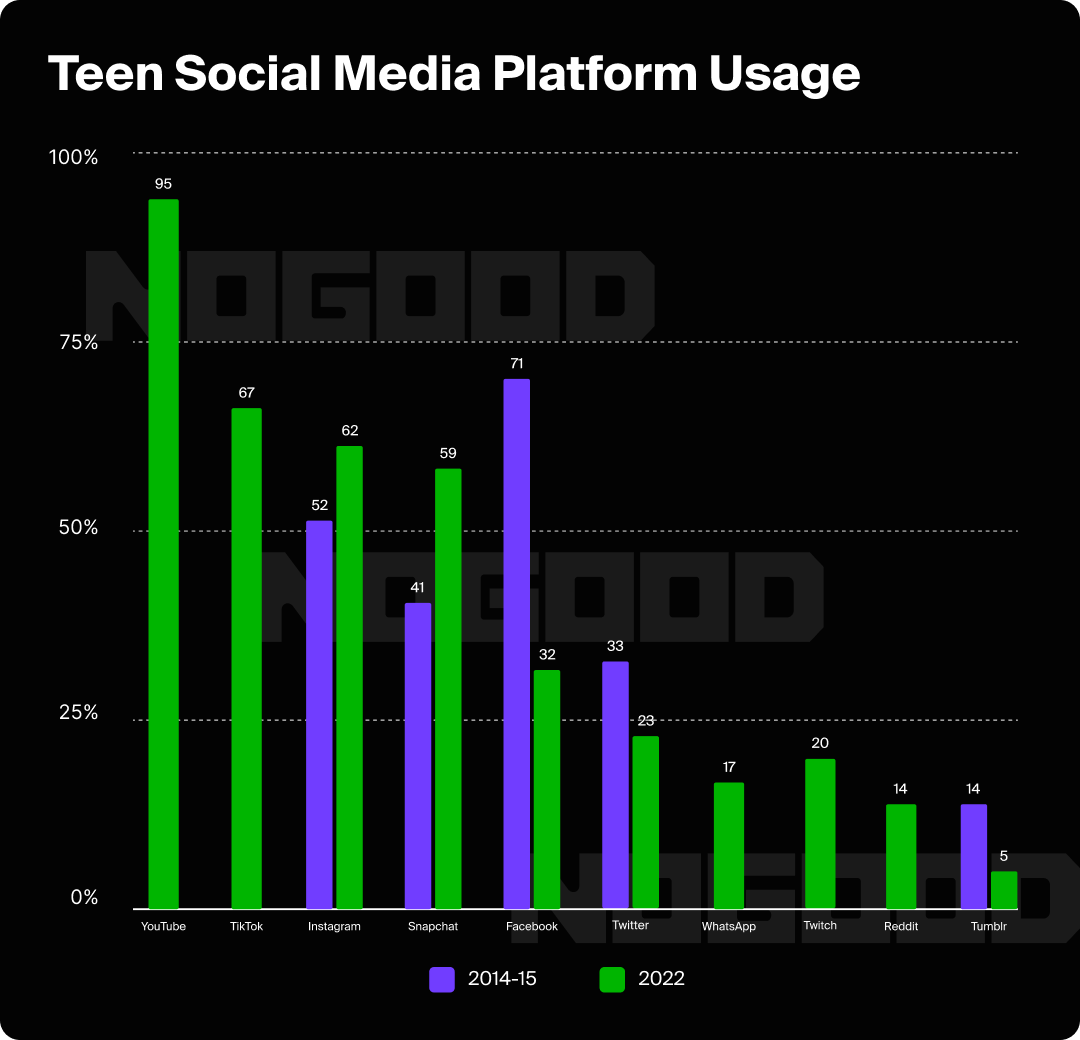
To overcome platform bias, you should diversify the platforms in your go-to-market strategy. Serve your ads across different channels to get a good mix of targeting. In addition, use search data as a benchmark, as the search audience is composed of people who are actively looking for your product.
Remember, this also applies to devices! If you are mostly running ads on social media, you should expect higher mobile usage since the majority of social media is consumed on phones.

3. Confirmation Bias in Marketing
When you launch a new product, initial marketing efforts are based on personas you assume would be your ideal consumers. Preliminary results are often used to justify the assumptions and hypotheses you’ve made about your potential consumers, and before you know it, all of your content and creatives are created to target these assumed personas. In data, this is called confirmation bias, which can be amplified by AI.
Confirmation bias occurs when marketers favor information and actions that support existing ideas with little to no predictive value. For example, if a marketer has a confirmation bias about their target audience, they might prompt a generative AI tool in a way that reinforces that bias in its outputs. Algorithms can also reinforce this bias by exclusively showing data for segments you already target, hiding promising new ones.
In order to avoid this bias, you need to question your idea of ideal customers every so often. You can use Audience Insights from Facebook and Google Audience Insights to learn more about your site visitors and find other common denominators that can lead you to new and promising customer segments. Set aside a budget for these “exploratory campaigns” specifically designed to challenge existing assumptions.
Also, avoid trying to replicate attributes or exhaust campaigns that over-performed in the past. It’s difficult to collect all the data and understand all the factors that lead to a successful campaign, so don’t waste time retracing the steps of your old campaign or increasing your budget when you’re seeing diminished returns. Instead, you should be designing new creatives based on the new customers you have acquired.
4. Predictive Lead Scoring
This point is critical for SaaS and other businesses that rely on lead scoring models. Sales teams often hunt for the biggest and easiest leads to close, which can lead to a bias toward revenue opportunities over long-term customer health. A modern approach involves building a lead scoring model that incorporates metrics beyond revenue. Score leads based on factors like:
- Whether they will get the most value out of the product or service.
- If they have the highest NPS (Net Promoter Score).
- If they will be a long-term customer.
This helps ensure that the new accounts you acquire will improve the overall health of your business, not just your bottom line.
Don’t Be a Victim of The Algorithm
AI clearly comes with unprecedented efficiency and automation benefits, but it still requires human attention and consciousness to avoid its negative impacts. The key to mitigating bias is to establish a human-in-the-loop framework. This involves:
- AI Governance: Implement clear company policies and ethical guidelines for all AI usage in marketing. This ensures that every team member understands their responsibility to prevent and report bias.
- Explainable AI (XAI): Prioritize using models that marketers and data scientists can understand and audit. Being able to explain why an algorithm made a certain decision is crucial for identifying and correcting biases.
- Continuous Monitoring: Bias is not a one-time fix. It requires a permanent process of auditing and re-evaluating models, as data and user behaviors change over time.
Remember that AI’s value starts and ends with the input of both human observation and critique. Algorithms are unable to imagine a future that is different from the past, so be mindful of where your data is coming from and if there is misrepresentation in your datasets. The output of AI is not the be-all and end-all, and it should not serve as the foundation on which you make key decisions in your growth.
Want More?
Watch our short video on data bias in growth marketing.
This article was meant to lay out how data bias in growth marketing can affect our growth results, but there is more to understand through tried and true practice. So if you are a small to medium-sized business generating $3M+ in annual revenue, looking for an agency to take the hard work of data manipulation off your plate, reach out to our team for a consultation.





This is good content. I wasn’t aware that bias could have such impact.
This part sums it up for me “Algorithms are unable to imagine a future that is different from the past. Be mindful of where your data is coming from and if there is misrepresentation in your datasets”