2023 was what I like to call the year of AI content euphoria.
Prompting tools were cheap, output was essentially infinite, and everyone became a publisher overnight. However, as with any overheated, oversaturated market, what goes up without fundamentals eventually comes back down. Welcome to the Great Normalization: a shift away from content quantity toward verified authority, entity strength, and brand trust.
In economics, normalization happens when easy money dries up and reality re-prices everything. In content, it’s when engines like ChatGPT, Gemini, and Perplexity start rewarding authority over abundance. The boom era of “post more” is over. In this next phase, trust, clarity, and entity recognition are the leading drivers.
Let’s unpack how the content economy is correcting itself and what it means for your visibility in AI answers, and how to adapt your strategy to compete.
The Boom: When Everyone Became a Publisher
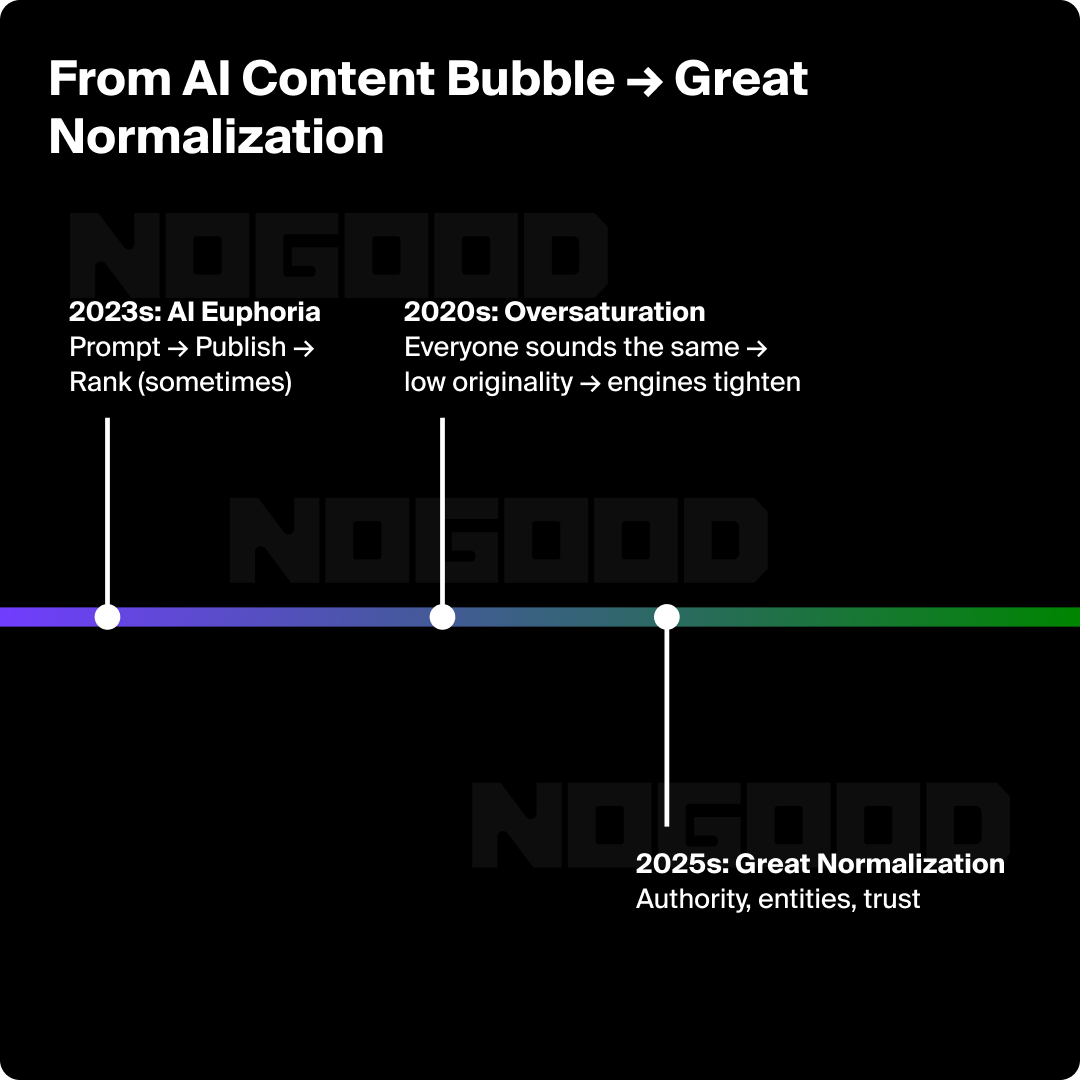
The year after ChatGPT dropped felt like a creative gold rush, except everyone had the exact same pickaxe. Suddenly, every marketer, intern, and LinkedIn thought leader was armed with a prompt and a dream. Content calendars ballooned, publishing velocity tripled, and the internet was like one giant AI echo chamber.
The mantra was simple: More posts, more reach, more growth.
And for a minute, this worked. Search engines hadn’t fully caught up, social feeds rewarded speed over nuance, and nobody wanted to admit that everything was starting to sound… the same.
The result was a global oversupply of content and an undersupply of original insight.
Every brand became a publisher, but few became a source; the kind that AI models actually cite, remember, and reference in their answers. To put this into perspective, if the AI content boom were a bull market, quality was the first thing to get shorted.
The industry mistook acceleration for evolution. Quantity looked like progress. But under the surface, AI search engines were already getting smarter, learning to separate recycled phrasing from genuine expertise.
This is where The Great Normalization begins.
The Great Normalization: What’s Actually Happening
Every cycle of hype eventually hits the same wall: the part where reality shows up with a clipboard and starts checking receipts. For content, that moment is now.
After a year of unchecked publishing, the internet’s attention economy is correcting itself and AI search is leading the charge. Tools like ChatGPT, Gemini, and Perplexity have been maturing past the “read everything” stage. AI search tools are filtering, ranking, and repricing content based on who’s credible, not who’s the loudest.
We’ve entered what economists call a market correction, only this time the commodity isn’t crypto or housing; it’s content quality.
The Great Normalization looks something like this:
- Repricing: AI engines are devaluing thin, repetitive, or keyword-stuffed content while rewarding brands with consistent entities, clean structure, and expertise signals.
Rationalization: Teams that relied on mass production are pulling back. Content mills are fading. Editorial strategies are tightening to fewer, stronger assets. - Return to Fundamentals: Trust, authority, and usefulness (once buzzwords on SEO decks) are now the only things that actually move the needle.
In other words, AI search isn’t killing content marketing. It’s killing lazy content marketing.
Search engines and LLMs are thinking like long-term investors. They’re looking for stable “assets”, sources with history, reliability, and semantic coherence. If your brand’s presence across the web looks scattered, generic, or inconsistent, you’re getting priced out of the conversation.
But suppose you’ve built genuine expertise, real POVs, original data, cohesive entities. In that case, you’ve got your golden ticket to the strongest visibility cycle we’ve seen since the early days of content marketing.
How AI Search Is Repricing Content
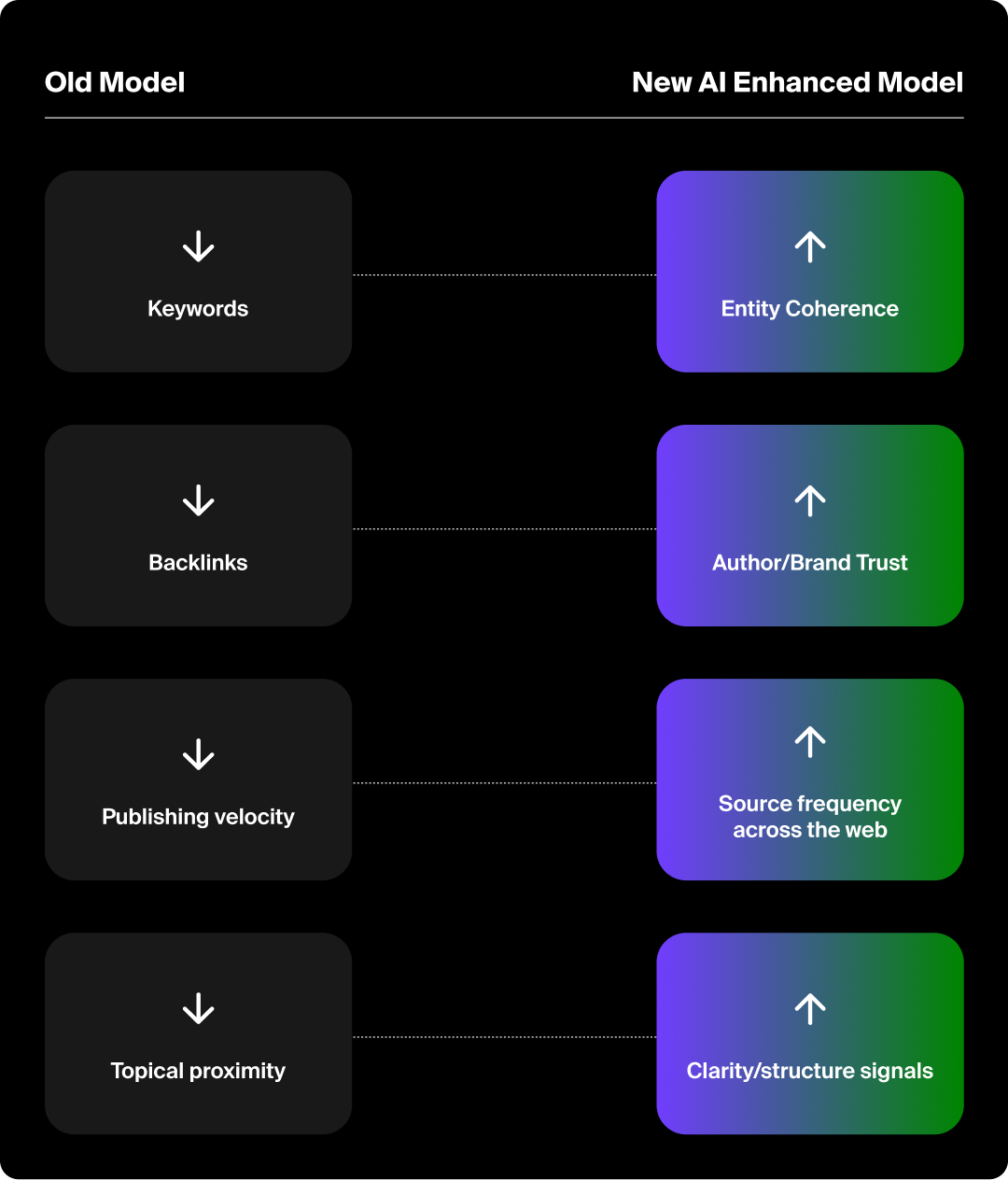
If the Great Normalization had a stock ticker, it’d be blinking red next to low-effort content.
AI search is rewriting the rules of how visibility is earned. In the old world, ranking was about keywords, backlinks, and volume. In the new one, it’s about entities, credibility, and clarity. The difference is that LLMs don’t “crawl content”; they interpret it. They weigh the who and the what behind the words as much as the words themselves.
Here’s what that repricing looks like in action:
Authority is the new algorithm.
LLMs are starting to behave like editors. They pull from sources that consistently appear knowledgeable, cross-referenced, and human-backed. If your content doesn’t align with your brand’s known expertise areas, it’s less likely to surface in AI answers.
Entity coherence > keyword stuffing.
Models don’t just index; they understand relationships. That means your brand, author, and topic need to exist in a connected graph, one that’s consistent across your site, socials, podcasts, and even guest appearances.
Trust weight replaces link juice.
Instead of relying on backlink counts, AI engines are assigning “trust weight” to sources based on their mention frequency across reliable domains, citation history, and alignment with verified facts.
Clarity signals matter.
LLMs favor structured, scannable writing: defined terms, clear hierarchies, logical transitions. If a model can easily extract the answer, your odds of citation go up. (Translation: bullet points are back in fashion.)
Think of it like this: Google is still the stock market of clicks, but AI search is the credit bureau of credibility. So while traditional SEO still matters, it’s no longer the whole picture. Visibility is being repriced across a new set of variables, ones that favor consistency over content churn.
And that’s great news if you’ve been investing in quality all along. Because in the Great Normalization, depth compounds.
What This Means for Your Content Strategy
So, all of this is to say, this “Great Normalization” of AI search is a strategy reset.
If the past two years have been about how fast you could publish, now’s the time to focus on how well you can sustain authority. The playbook is less “growth hack” and more “compound interest.”
Here’s how to adapt:
1. Recalibrate Your Metrics
Forget “posts per month.” Start tracking presence in AI answers, citation share, and entity consistency. Tools like Goodie now measure visibility across ChatGPT, Gemini, and Perplexity; a truer signal of brand influence than traffic alone.
Ask yourself: would an AI pick this up as a credible source, or just another take?
2. Build & Maintain Authority Surfaces
Every brand needs a few key content assets that act like index funds: stable, high-quality, and regularly rebalanced.
- Keep your pillar pages updated and semantically dense.
- Maintain clean internal links that reinforce topical depth.
- Treat each piece like a knowledge node, not a post.
The more consistent your entity footprint, the more LLMs trust your signal.
3. Prioritize First-Party Insight & Distinct POVs
AI models can replicate and regurgitate information all day. But what they can’t replace is your unique perspective.
Feed them what they can’t generate on their own: your data, experiments, stories, and frameworks.
If your content doesn’t make a model go “Ah, that’s new,” consider yourself invisible.
Tip: Interview your own team. Turn these lived experiences into quotable, AI-friendly insights.
That’s exactly how we run the NoGood blog. Every post comes straight from the expert who actually lives that niche, growth marketers writing about acquisition loops, SEO strategists covering entity optimization, and creatives dissecting campaign psychology. Each writer owns their vertical and optimizes their own work, which means our library reads like a network of specialists, not a megaphone.
This approach doesn’t just make for sharper takes; it strengthens our collective entity graph. Search engines and LLMs learn to associate each of our names with specific areas of authority, which compounds brand trust over time.
4. Strengthen Your Entity Graph
We’ve got to think bigger than just optimizing pages. We’re optimizing people, brands, and ideas. Make sure your name, authors, and topics appear in a unified graph across:
- Your website schema
- LinkedIn profiles and bios
- Podcasts, guest posts, and bylines
- Consistent use of brand and product entities (not just variations of them)
This is how LLMs connect the dots and start treating you like a reliable “source” rather than a random URL.
5. Write for Dual Audiences: Humans + Machines
This is where many marketers trip: they think “AI-friendly” means dumbing it down.
They strip personality, simplify ideas, and flatten nuance until everything reads like it was written by a polite intern with a word count quote to hit. That’s not readability, it’s erasure.
Readable ≠ simplistic.
Readable means structured, intentional, and easy to parse. Simplistic means watered down to the point where there’s nothing left to learn.
LLMs (and humans, honestly) crave clarity, not basicness. They both respond to writing that’s organized, explicit, and informative but also distinctive enough to be memorable.
So instead of thinking “shorter = better,” think:
- Define before you dive. Give models clean anchor points (“AI search, or Answer Engine Optimization, refers to…”).
- Use clear hierarchies. Headings, subheads, and tables do more than just pretty-up your formatting; they act as signals that help both readers and models navigate your thinking.
- Preserve your tone. A conversational edge, an analogy, or a wink of personality tells an LLM who you are; it’s part of your brand fingerprint. For example, in my writing, I love a good analogy to break down complex ideas, and I always close out my content with a relevant and cheeky header, that’s my fingerprint if you will.
LLMs extract structure and semantic intent, not vibe. If your writing is emotionally flat or semantically messy, the machine can’t confidently map your expertise, and humans likely won’t remember you either.
That’s why our content at NoGood lives in that middle ground I liken to “smart Wikipedia energy but with personality.” We answer the question up top (AI-friendly), but we keep our perspective, humor, and human cadence intact (reader-friendly).
All in all, don’t write to sound simple; write to sound understood.
|
Style |
What It Looks Like |
Why It Fails or Succeeds |
|---|---|---|
|
Simplistic |
“AI is changing marketing.” |
Too vague, no structure, no anchor terms. |
|
Overly Complex |
“AI-driven LLM contextual vector embeddings optimize semantic inference.” |
Unreadable for humans, too confusing for LLMs. |
|
Structured + Distinct |
“AI search changes how content is discovered; models now rank ideas by entity strength, not keyword density.” |
Clear, precise, and human. |
The New Normal: Content as an Asset Class
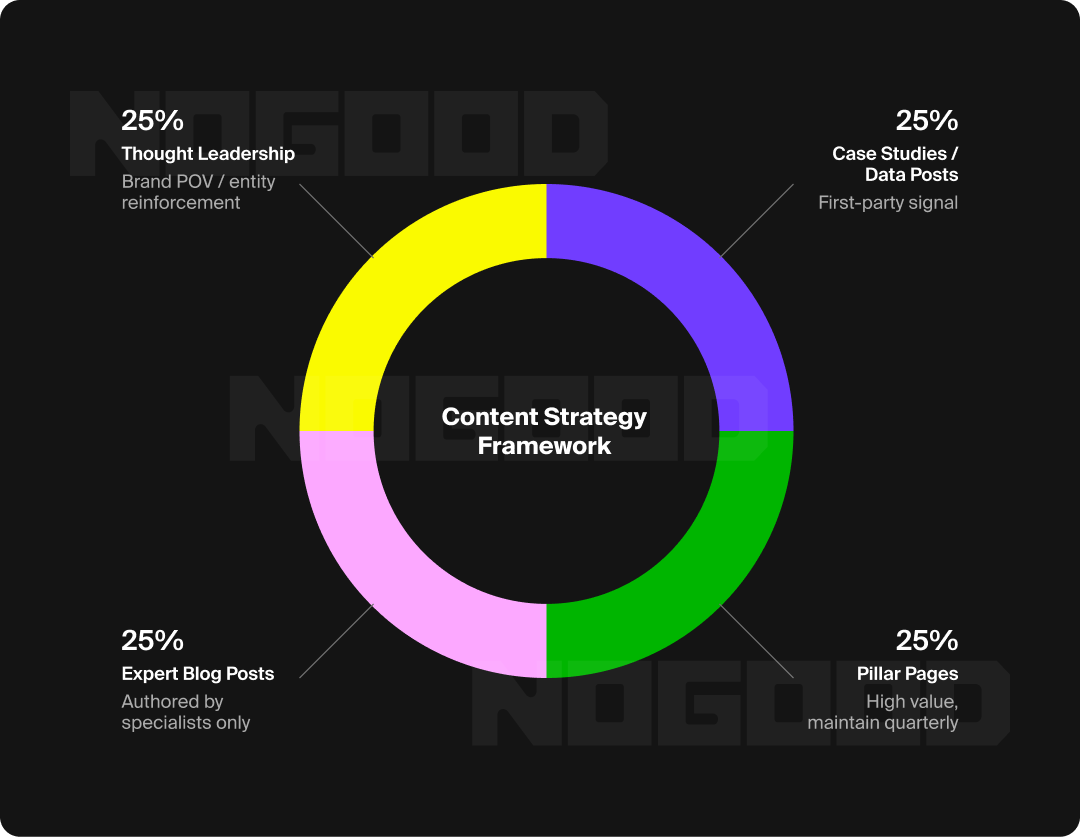
If the last few years have taught us anything, it’s that content isn’t disposable; it’s capital. In our era of Great Normalization, every piece you publish will either appreciate or depreciate in value.
Look at your blog an investment portfolio:
- Each article is an asset that compounds visibility when it’s maintained, cited, and interlinked.
- Every author is a micro-brand contributing equity to the larger entity graph.
- Your collective expertise forms a trust index, one that AI search engines now use as collateral when deciding who to quote.
At NoGood, we treat our content ecosystem this way. The goal isn’t to just write posts to fill the page, we own these posts and we’re updating, optimizing, and reinforcing them over time.
Each strategist contributes within their lane of expertise, so our blog becomes a diversified portfolio of authentic authority.
That’s the future of content in the AI era: fewer, stronger positions that hold long-term value. You’re not chasing traffic spikes; you’re accruing trust.
The Future Belongs to the Credible
Every gold rush ends the same way, not with a crash, but with clarity.
The noise dies down, the dust settles, and the people left standing are the ones who built something to actually last.
That’s what the Great Normalization (in the context of the AI boom) really is: the part where we collectively slow down, sharpen up, and start doing content right again. The flashy AI shortcuts are fading. The thoughtless “scale everything” phase is over. And good riddance.
What’s next is a calmer, smarter era that’s built on expertise, structure, and trust. The brands that treat content like an asset class, optimized, owned, and refined by the people who know their craft will define the next chapter in AI search.
So audit your assets and double down on what you know best. Think beyond keeping up with your posting cadence and consider that your best strategy for standing out in AI search is by being real.