

Did you know that if you’re a podcaster, musical artist, SoundCloud-turned-Spotify-rapper, or even any old Spotify nerd, it’s possible to increase your visibility in Spotify? It’s called Spotify SEO, and, not to burst your bubble, but it’s a more common strategy than you think.
Social and AI search have already taken over. 67% of Gen Z uses Instagram (and 62% uses TikTok) to find information, not Google, and LLM usership continues to reach new heights (¼ of Millennials and ⅓ of Gen Z); and Spotify has a hand in both metaphorical pies (that’s a saying, right?)
The reality is, Spotify has always been a search engine of its own. But now that Spotify is directly integrated with ChatGPT (if you missed it, this happened in October of 2025), now is as good a time as any to learn the strategies that can push your music, your playlist, your artist profile, or your podcast into both in-platform user feeds and LLMs.
Is There SEO for Spotify?
Yes, Spotify SEO (and even Spotify AEO) are legitimate, and increasingly important, strategies. Just like optimizing for Google Search or AI search engines, you can optimize your Spotify content to boost visibility in search results. In short, Spotify SEO involves optimizing your profile, playlists, titles, descriptions, and metadata to help the Spotify algorithm better understand and distribute your content (whether it be to users or to LLMs).
Spotify uses sophisticated technology, including content-based filtering, collaborative filters, and natural language processing, to categorize content. This means strategic optimization of your artist profile, podcast show page, episode descriptions, and playlist creation can significantly impact your discoverability.
How Spotify’s Search Algorithm Works
There are four primary ways for content to be discovered on Spotify: search, playlists, Spotify’s featured recommendations, and being cited within AI responses. From an SEO and AEO perspective, these mirror keywords, backlinks, algorithm preferences, and brand visibility.
Understanding Spotify’s Ranking Factors
Spotify’s algorithm employs artist-sourced metadata, audio signal analysis, and NLP models to effectively categorize and distribute content, enhancing discoverability. The platform analyzes:
- Artist-sourced metadata: Information from your Spotify for Creators profile and pitch forms
- Raw audio signals: Numerical values assigned to track attributes like danceability, energy, and valence
- Natural language processing: Analysis of lyrics, web-crawled data from music blogs, and user-generated playlist patterns
This backend data provides context that helps algorithms serve users more relevant content (similar to technical SEO and technical AEO helping crawlers understand your site).

Disclaimer: We do have far, far less data on how to get cited in LLMs from the perspective of Spotify SEO, so in this guide, I’ll be giving you some AEO tactics that have been proven to work across traditional search surfaces and their potential applications for Spotify optimization.
Spotify SEO & AEO: 4 Tactics
Battling with Spotify’s search algorithm, indexability in traditional search results in Google, and ChatGPT’s somewhat recent integration with Spotify, it might feel like you’re fighting an uphill battle with organic discovery.
That’s why I’m here 🙂These four tactics will help you maximize visibility across Spotify’s platform, Google search, AI Overviews, ChatGPT, and any other generative AI search engines that decide to cite Spotify directly (or indirectly) in their responses.
Tactic 1: Cross-Platform Keyword Optimization
The ultimate goal with effective keyword optimization is more than showing up in Spotify’s internal search (especially in this novel search ecosystem); your keywords should work across Spotify, Google Search, ChatGPT queries, and AI Overviews simultaneously.
Fair warning: This guide is going to get realllllll search nerd-y real fast. So if you’re looking for a quick way to game the system, you can click off of this page. You’re in the wrong place.
Understanding Multi-Platform Keyword Discovery
To know where you should be found, you should first figure out where you can be found. Research how audiences describe music across different search platforms. The language varies by context:
- Google searches are specific and lack filler words (“best synthwave playlist 2026”)
- ChatGPT queries are often conversational (“recommend some retro electronic music with vocals”)
- Spotify searches tend to be brief (“workout beats”)
Your keyword strategy must account for all three patterns. Analyze search results directly within each platform. Understanding these nuances helps you choose keywords that perform across platforms, or zero in on a specific platform you want to improve your visibility on.
Strategic Keyword Placement for SEO & AEO
Once you’ve identified high-value keywords, deploy them strategically across your entire digital presence:
|
Within Spotify |
Beyond Spotify (Google & AI Search) |
|---|---|
|
Playlist Titles: Front-load primary keywords |
Website Artist & Podcast Pages: Use keywords in headers, meta descriptions, and body content |
|
Playlist Descriptions: Weave keywords naturally throughout the first 100 characters |
Social Media Bios Across Platforms: Consistent keyword usage strengthens entity recognition |
|
Show Titles & Episode Titles: Include descriptive keywords that reflect themes |
YouTube Video Titles & Descriptions: Google indexes these heavily |
|
Artist Bio & Podcast Descriptions: Balance keywords with authentic storytelling |
Blog Posts & Press Releases: Keywords here feed into AI training data |
|
Track Titles (When Appropriate): Without compromising artistic integrity, of course |
Structured Data on Your Website: Helps AI understand your content categorization |
The Lyric Opportunity
While Spotify’s lyrics aren’t directly indexed by Google as standalone pages, they still impact discoverability:
- Spotify’s natural language processing analyzes lyrics for locations, brands, and people mentioned in songs to create additional context.
- When listeners remember a lyric fragment and search it on Google, the search engine pulls from lyrics sites like Genius and MusixMatch (not directly from Spotify, though Spotify does use MusixMatch).
- ChatGPT, on the other hand, can identify songs based on lyric descriptions using its training data.
This means having your lyrics accurately transcribed and distributed across multiple lyric platforms (Genius, MusixMatch, AZLyrics, etc.) increases your chances of being discovered through both traditional search and AI assistants.
Monitor Cross-Platform Keyword Performance
Track which keywords drive engagement across different platforms.
- Within Spotify, analyze which search terms lead to your profile views and follow through Spotify for Creators analytics.
- Use Google Search Console to see which queries bring traffic to your Spotify links.
- Test ChatGPT regularly by asking it to recommend music based on your target keywords and noting whether your content appears in responses.
Creatives Beware: Don’t hyperfocus on keyword targeting, though (especially not at the expense of your sound or your artistic freedom). TikTok and “coworker music” jokes aside, there are plenty of other ways to get discovered other than saying so directly in your music.
Tactic 2: Keyword-Rich Playlist Strategy for Multiple Discovery Channels
Playlists function as discovery tools across multiple platforms, not just within Spotify. An intentionally optimized playlist can rank in Spotify’s internal search, appear in Google Search results, get recommended by ChatGPT, and surface in AI Overviews, multiplying your visibility exponentially.
Building Playlists That Rank Everywhere
Your playlist title is the single most important element for cross-platform discovery. It needs to work for:
- Spotify’s algorithm: Clear, keyword-focused titles that match user search behavior
- Google Search: Descriptive titles that appear in search results when people look for playlists outside Spotify
- ChatGPT recommendations: Titles that make sense when AI describes them conversationally to users
- AI Overviews: Concise titles that AI can easily summarize and reference
For example, “Vocal Synthwave Retrowave” targets specific genre keywords that fans actively search across all platforms. Someone might search “synthwave playlist” on Google, ask ChatGPT for “retro electronic music with vocals,” or type “vocal synthwave” directly into Spotify. If they do so, this title would be perfect because it captures all three discovery paths.
Creatives Beware: This is another place where I’ll warn you about throttling your creativity for the sake of discovery. You shouldn’t make it a hard and fast rule to avoid clever or abstract playlist titles. My job might depend on my content being indexed, surfaced, and written, but yours also depends on the human emotion and feelings behind your art.
Optimizing Playlist Descriptions for SEO & AEO
Your playlist description should serve multiple audiences simultaneously: Spotify users browsing playlists, Google’s web crawlers, and AI models analyzing context. In my opinion, this is where you have the room to get a bit more technical with optimizations.
Structure descriptions with this multi-platform approach:
- First sentence: If it fits, include your primary keyword and core value proposition. This appears in search snippets on Google and gets prioritized by AI summarization tools.
- Middle content: Add secondary keywords naturally and describe the mood, intended use, or theme. If you can, include relevant entities (genre names, similar artists, cultural references) that strengthen AI understanding.
- Final sentence: Optionally include a frequency note that you update when you add to the playlist; this signals freshness to algorithms.
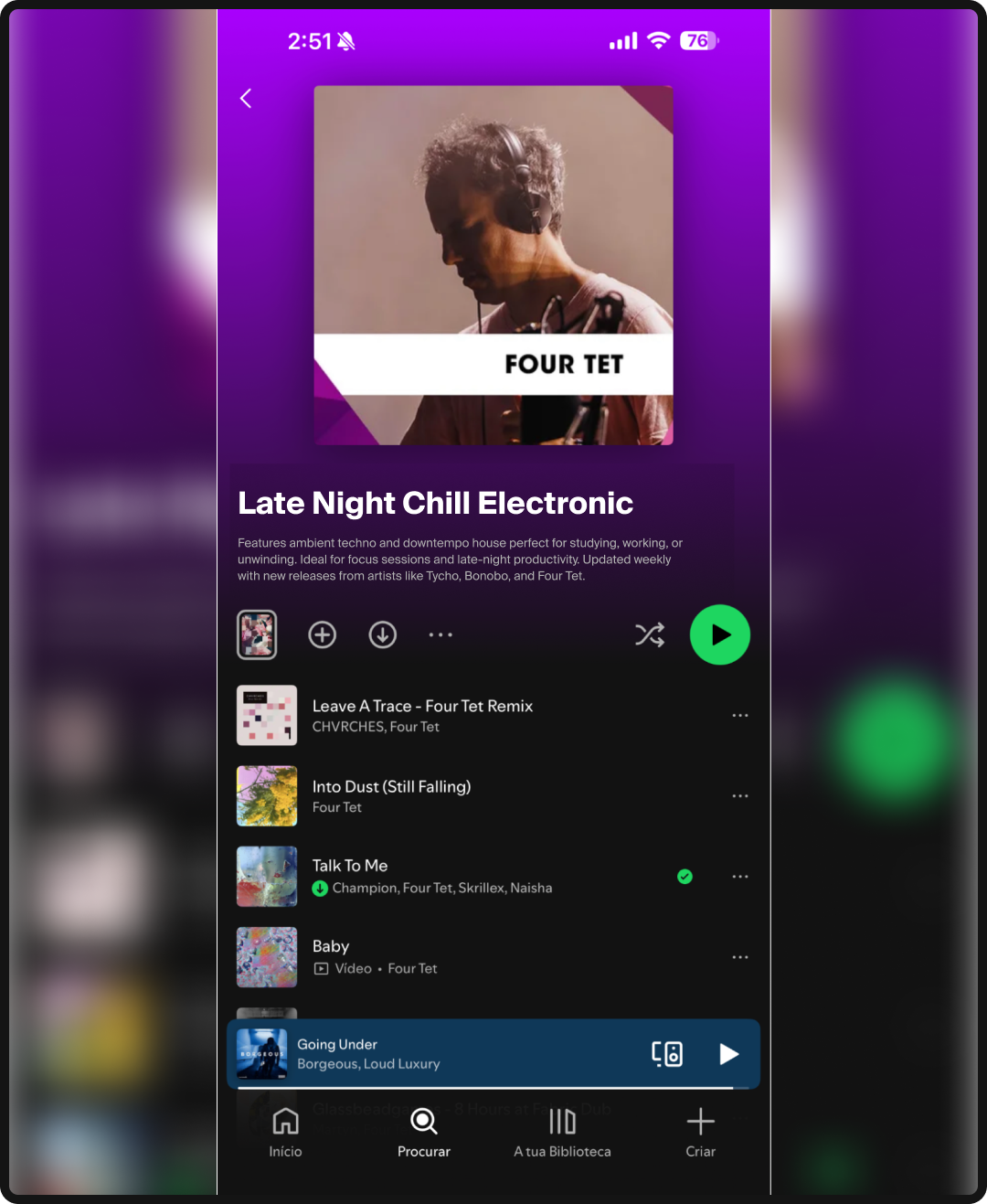
This description works for Spotify users seeking context, includes searchable keywords for Google, and gives AI models clear categorization signals for accurate recommendations.
Strategic Track Selection for Algorithm Signals
Combining your content with established artists serves dual purposes:
- Within Spotify, popular tracks boost playlist growth and introduce listeners to your work through the 30-second rule (streams count after 30 seconds, signaling to algorithms that your content resonates).
- In Google, playlists containing well-known artists may rank higher in search results because they have more perceived authority. When someone searches “best synthwave playlists,” Google often prioritizes lists that include recognized names alongside emerging artists.
- For ChatGPT and AI recommendations, having your tracks alongside established artists in well-described playlists helps AI models understand your musical positioning. ChatGPT can describe your sound in fan-friendly language and help you understand how your music fits into different playlist contexts.
The more your songs appear in genre-specific, keyword-optimized playlists with similar artists, the more accurately Spotify, traditional search, and AI tools can recommend your music.
Visual Optimization for Click-Through Rates
I’d be remiss if I didn’t mention your overall ✨vibe✨ at least once in this article. Just like the actual music you put out, or the playlists you make, your playlist cover art impacts performance across platforms.
- On Spotify, eye-catching, theme-appropriate artwork improves click-through rates in search results (be sure to keep to platform dimension requirements of 3000x3000px)
- On Google, when your playlist appears in image search or regular search results, compelling artwork makes your listing stand out.
- Even in ChatGPT conversations, when users click through to recommended playlists, professional cover art builds credibility.
Tactic 3: Artist & Podcast Profile Optimization Across Search Ecosystems
When you zoom wayyyyyy out (like I did when I first stepped out of the line of traditional SEO), you’ll learn that your Spotify profile is part of a broader digital ecosystem that includes Google Search results, social media platforms, and AI knowledge bases.
Optimizing your profile means that you, too, need to think beyond Spotify’s platform to how your content appears across all discovery channels.
I’m going to split this section up into “for podcasters” and “for musical artists”; there’s no personal beef here, we’re all creatives. The strategies just look a little different is all.
For Podcasters: Multi-Platform Profile Strategy
Your show page optimization should account for how different systems discover and understand your podcast. Spotify’s internal algorithm, Google’s web crawlers, podcast directories, and AI models all parse your metadata differently.
|
Tactic |
How to Do It |
|---|---|
|
Show Title Optimization |
|
|
Description Architecture |
|
|
Episode-Level Optimization |
|
|
RSS Feed Optimization |
|
For Musical Artists: Building Cross-Platform Entity Authority
Your artist profile serves as the authoritative source for search engines and AI models to understand who you are, what you sound like, and why listeners should care. Optimization extends far beyond Spotify (but that’s why you’re here, right?)
|
Tactic |
How to Do It |
|---|---|
|
About Page as SEO Foundation |
|
|
Weave Keywords in Naturally |
|
|
Add Critical Profile Elements |
|
|
Consistency Across Platforms |
|
|
Competing Against Established Artists |
|
Tactic 4: Entity Optimization for ChatGPT & AI Search
As AI search tools reshape music discovery, optimizing for entity recognition (how AI models understand and categorize your work) is becoming as important as traditional SEO. I won’t lie, it’s tedious, and it’s not an exact science, but it is worth it if discoverability is the goal.
ChatGPT’s Spotify integration, Google AI Overviews, and other generative engines are now primary discovery mechanisms for millions of listeners.
Step 1: Testing Your AI Visibility
Since ChatGPT now integrates with Spotify, you can ask it to recommend music based on specific criteria and see if your content appears. Regular testing reveals how AI systems perceive and categorize your work:
ChatGPT test prompts for musicians:
- “Recommend emerging [your genre] artists similar to [established artist in your niche]”
- “Find music with [specific attributes of your sound] on Spotify”
- “What are the best [mood/vibe] playlists featuring [your genre]?”
- “Create a playlist for [use case that fits your music] with indie artists”
ChatGPT test prompts for podcasters:
- “Recommend podcasts about [your topic] similar to [popular show in your niche]”
- “What are the best [your topic] podcasts for [your target audience]?”
- “Find podcast episodes discussing [specific topic you’ve covered]”
Document your results monthly. If your content doesn’t appear in relevant responses, it signals optimization opportunities. Note which entities (genres, moods, similar artists, topics) ChatGPT associates with your work, then adjust your metadata to strengthen accurate associations while correcting mischaracterizations.
Step 2: Embedding Content Across Your Digital Ecosystem
AI crawlers gather context from how your content appears across the web, not just from Spotify’s database. The more places AI finds your music or podcast paired with relevant keywords and context, the stronger your entity associations become.
Strategic Embedding Tactics
|
Website |
Social Media |
Press & Coverage |
|---|---|---|
|
Embed Spotify players on key pages |
Ensure all social media bios link to your Spotify |
Ensure press coverage links back to your Spotify profile |
|
Surround embedded players with descriptive text |
Cross-post content across platforms |
Seek features in music blogs, podcast directories, and digital media outlets |
|
Include structured data markup (Schema.org) |
Tag relevant entities (other artists, genres, moods) when appropriate |
Submit to playlist curators who write about their selections on blogs |
The more diverse sources mention your work with consistent language, the more confidently AI models can categorize and recommend you.
You’ve heard me use the word “consistent” enough that it’s probably lost all meaning. But I’ll stress this: clean, consistent data matters enormously. When AI models encounter conflicting information across sources (different genre labels, varying artist name spellings, inconsistent descriptions), they lose confidence in their categorization, which reduces the likelihood of recommendations.
Step 3: Strategic Playlist Features for Entity Building
Getting featured in playlists that contain keywords you’d like to rank for strengthens your association with those terms across search ecosystems. Each playlist placement builds your entity relationships within specific contexts.
Actively pursue playlists that:
- Have keyword-rich titles matching your target search terms
- Are created by influencers, music blogs, or media outlets (higher authority)
- Match your content’s specific mood, use case, or characteristics
- Are publicly shareable and appear in Google search results
- Have active curation and regular updates (signals quality)
- Contain similar artists in your niche (strengthens entity clustering)
Step 4: Leveraging Spotify’s Natural Language Processing
Spotify’s algorithm analyzes lyrics, web-crawled data from music blogs and digital media, and user-generated playlists to understand context. While you can’t directly control Spotify’s NLP, you can influence the signals it receives:
- Ensure your lyrics are accurately uploaded and synced across platforms
- Engage with music blogs and get your work written about using your target keywords
- Participate in playlist communities where curators discuss their selections
- Encourage fans to create and share playlists featuring your work with descriptive titles
This contextual information feeds into how algorithms categorize your content, which in turn affects how AI tools recommend your music to users.
The Compounding Effect
This seems like a lot of work (even my brain got tired from researching and writing this), but here’s the deal: entity optimization works cumulatively.
Each properly targeted keyword, each optimized profile, each playlist placement, each piece of press coverage, and each metadata field across platforms strengthens Spotify’s, Google’s, and AI’s understanding of your work.
Over time, this creates a compounding effect: the more clearly the algorithms that be understand you (who you are, what you create, where you fit in the musical landscape), the more confidently it recommends your content.
Ready to SEO-ify Your Spotify Presence?
Boosting your work’s visibility on Spotify requires meeting your audience where they are: in-platform optimization, in search engines, and in LLMs.
There’s just one more word of wisdom I’d like to leave you with, however: the key to this type of visibility strategy is consistency. It’s not a one-and-done process, and it’s not an easy one (if it is, nobody would need to do it).
Regularly update your metadata across all platforms, engage with your audience through social media, stay informed about algorithm changes and keyword performance, and adapt your strategy as search behavior continues to evolve (and when it does, you can find updates about it on NoGood’s blog 😉).
As LLMs deepen their Spotify integration, as Google continues refining its search algorithm and AI Overviews, and as Spotify’s algorithm evolves to prioritize new engagement metrics, staying current with optimization best practices across in-platform, traditional SEO, and AI discovery channels will keep you ahead of the curve and ensure your music or podcast continues reaching new listeners organically.