If you’re sitting in meetings all day and thinking, “I’ll get to AI visibility tracking eventually,” I’m going to hold your hand when I say this: “eventually” was six months ago.
Before you get mad at me, I need you to know that I get it: the AI search landscape has been moving at a pace that makes even the most on-it marketers feel like they’re perpetually behind (don’t I know it).
But here’s where we are in 2026 (and it’s only February, as of the writing of this post):
- ChatGPT has over 800 million weekly active users (and they’re also starting to run ads; ruh roh)
- Google’s AI Mode went from beta experiment to default search experience
- Wikipedia’s owners have entered into a content training deal with Microsoft and Meta
And your brand? Well, it’s either showing up in those AI answers, or it’s not. There is no such thing as “kind of visible”.
The discipline of making sure you show up has a few names floating around: Answer Engine Optimization (AEO), Generative Engine Optimization (GEO), LLM Optimization (LLMO), and (the most basic one, in my opinion) AI SEO. Whatever we end up calling it, here’s what actually matters: the tools built to track and improve your AI visibility have gotten dramatically better in the past year. Some of them are purpose-built for this ✨ whole new world ✨. Others are legacy SEO platforms that sticky-tacked on an AI dashboard and called it innovation (it’s harsh, but somebody had to say it).
What I’m trying to say is, there are so many players in this space, and without a sherpa, you’re flying blind. Well, here it goes. We’ve tested the top AI visibility platforms on the market, separated the signal from the noise, and ranked them based on what actually matters to working marketers (and we know what counts, because that’s what we are, too).
Drum roll please… here’s what we found.
The Ranking Methodology
Before we get into the rankings, let me be transparent about how we actually got to them in the first place. We evaluated each tool across five weighted categories:
- AI engine coverage (25%): How many LLMs and AI platforms does the tool track? It might seem silly to weigh this so heavily at first, but the simple truth is that ChatGPT alone just isn’t enough in 2026.
- Depth of insights (25%): Does the tool just tell you that you showed up, or does it tell you why, how, and what to do about it?
- Actionability (20%): Dashboards are nice, but once they’re analyzed, do you know your next steps? I’m talking content recommendations, optimization hubs, and workflow integrations; they all count here.
- Pricing and accessibility (15%): Is the tool accessible to teams beyond the Fortune 500? Does pricing scale reasonably?
- Unique differentiators (15%): What does this tool do that none of the others do?
We factored in all of the above, but real peoples’ real experiences matter, too. That’s why we also factored in user reviews, publicly available case studies, and our own hands-on experience running AEO campaigns at NoGood.
Top AI Visibility Tools: Quick Overview
|
Rank |
Tool |
Best For |
Pricing |
|---|---|---|---|
|
1 |
Goodie |
End-to-end AEO optimization, monitoring, and content strategy |
Pricing is entirely custom |
|
2 |
Semrush AI Visibility Toolkit |
Teams who are already in the Semrush ecosystem |
$99 per month add-on; Semrush One from $199 per month |
|
3 |
Amplitude |
Product-led teams that need AI visibility tied to revenue |
Free (included with Amplitude plans) |
|
4 |
AthenaHQ |
Agencies and eCommerce brands at scale |
From $295 per month |
|
5 |
Hall |
Startups and SMBs getting started with AI visibility |
Free tier, with paid plans starting at $199 per month |
|
6 |
BrightEdge AI Catalyst |
Enterprise SEO teams expanding into AI search |
Fully custom pricing |
|
7 |
SE Ranking AI Visibility Tracker |
All-in-one SEO teams looking to add AI visibility |
From $65 per month + AI add-on |
|
8 |
Surfer SEO AI Tracker |
Content-first teams optimizing for AI citations |
$95 per month add-on for 25 prompts |
|
9 |
LLMrefs |
Budget-conscious teams needing basic LLM tracking |
Free plans available, with Pro starting at $79 per month |
|
10 |
Nightwatch |
Traditional SEO teams dipping into LLM monitoring |
From $39 per month |
Look at that beautiful table. I know you’re probably dying for more information on these tools, so let’s get into it.
Top AI Visibility Tools: Full Breakdown
1. Goodie
- Best For: End-to-end AEO monitoring, optimization, and content strategy
- Pricing: Pro plan at $495 per month (annual); Team and Enterprise plans available as well
- AI Engines Tracked: ChatGPT, Google AI Overviews, AI Mode, Perplexity, Gemini, Claude, DeepSeek, Grok, Meta AI, Copilot, Rufus
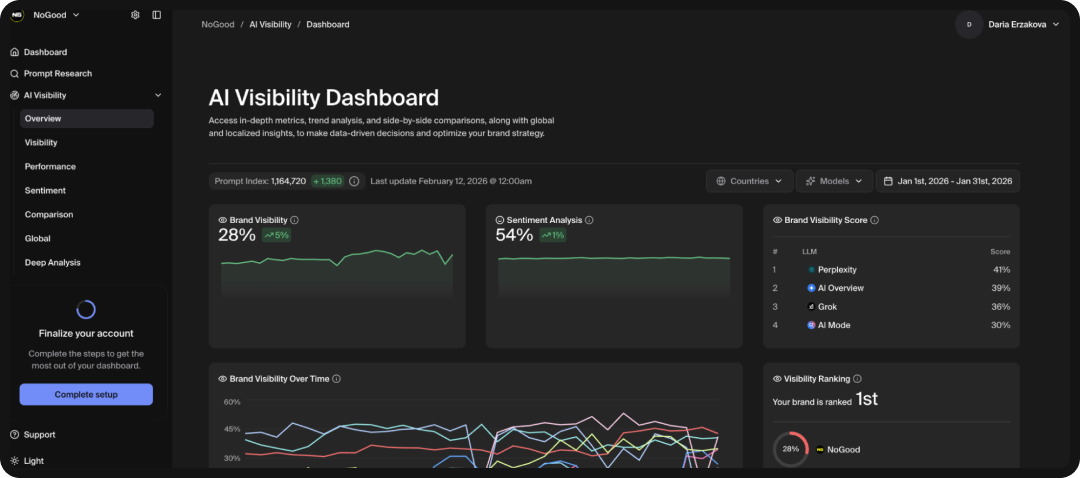
Goodie was built from the ground up for AEO (aka, it’s not a traditional SEO tool with AI sticky-tacked on). The platform was created by a team led by the person that literally coined the term “Answer Engine Optimization” (shout-out to Mostafa ElBermawy, who launched the concept at SXSW a few years ago).
And this isn’t a flex; that pedigree matters because the tool reflects a deep, native understanding of how LLMs discover, evaluate, and cite brands.
What truly sets Goodie apart (besides the sheer clout) is its breadth of features packed into a single platform.
- Its AI Visibility Monitoring dashboard gives you real-time tracking across 11+ AI models (one of the widest coverages in the market, by the way).
- The Optimization Hub goes beyond “here’s your data” and provides actionable recommendations on semantic content, schema markup, and structural improvements.
- The Topic Explorer surfaces areas where your brand is weak or absent in AI conversations.
- The Sentiment Analysis feature tracks whether AI responses frame your brand positively or negatively.
- For teams that need to move from insight to content, the AEO Content Writer generates optimized content tailored for AI search.
- Traffic and Attribution connects AI mentions to actual site visits and conversions.
Goodie also recently launched an Agentic Commerce Optimizer for eCommerce brands, as well as AI Crawler and Agent Analytics for tracking how AI bots interact with your site.
The platform supports global monitoring across multiple markets and languages, making it a particularly strong fit for enterprise brands. Case studies show meaningful results, too:
- Rathbones, a UK wealth management firm, saw 2.3x growth in AI visibility after using Goodie to identify platform-specific opportunities.
- Dermalogica, a leading skin care brand, saw an 85% uptick in AI searches after working with Goodie.
The one caveat (and I’m debating whether this counts as a caveat): Goodie doesn’t include traditional SEO features like backlink crawlers or site audits. It’s purpose-built for AEO. If you need a combined SEO + AEO tool, you’ll want to pair it with something else (or talk to us at NoGood about a full-stack approach 😉)
2. Semrush AI Visibility Toolkit

- Best For: Teams already using Semrush who want to add AI visibility without switching platforms
- Pricing: $99 per month for a standalone add-on; Semrush One bundles start at $199 per month
- AI Engines Tracked: ChatGPT, Google AI Overviews, AI Mode, Perplexity, Gemini
If you work in SEO, Semrush doesn’t need an introduction. Its AI Visibility Toolkit, though, might not be as familiar. It launched alongside Semrush One in October 2025, extending Semrush’s massive keyword and backlink database into the world of AI search.
The strongest play with this tool is integration. Semrush already tracks over 27.5 billion keywords and 43 trillion backlinks. Adding AI visibility into that ecosystem means you can connect and correlate your traditional SEO performance with your AI presence in a single dashboard.
- The Visibility Overview report gives you an AI Visibility Score benchmarked against competitors.
- Prompt Tracking lets you monitor up to 25 daily prompts (more with higher plans).
- The AI SEO Audit checks your site’s readiness for AI crawlers, which is something most standalone AEO tools don’t offer.
There are a few places where Semrush falls a bit short:
- This is still a generalist SEO platform with AI added on top, not a purpose-built AEO tool.
- The standalone $99 per month plan only includes one domain and 25 prompts, so scaling is probably going to get expensive, and fast (each additional domain is another $99 per month, and each additional user is another $99 per month).
I’ve experienced the struggles of Semrush’s pricing model myself (in all honesty, it can get a little penny-pinchy), so if you’re an agency managing multiple clients, be prepared for the math to get ugly quickly.
That said, if you’re already a Semrush customer, the AI Visibility Toolkit is a no-brainer add-on. It’s the easiest way to start tracking AI visibility without adding another tool to your stack.
3. Amplitude
- Best For: Product-led growth teams that need AI visibility connected to actual business outcomes
- Pricing: Free for all Amplitude customers; limited free version for non-customers
- AI Engines Tracked: ChatGPT, Google AI Overview, Claude
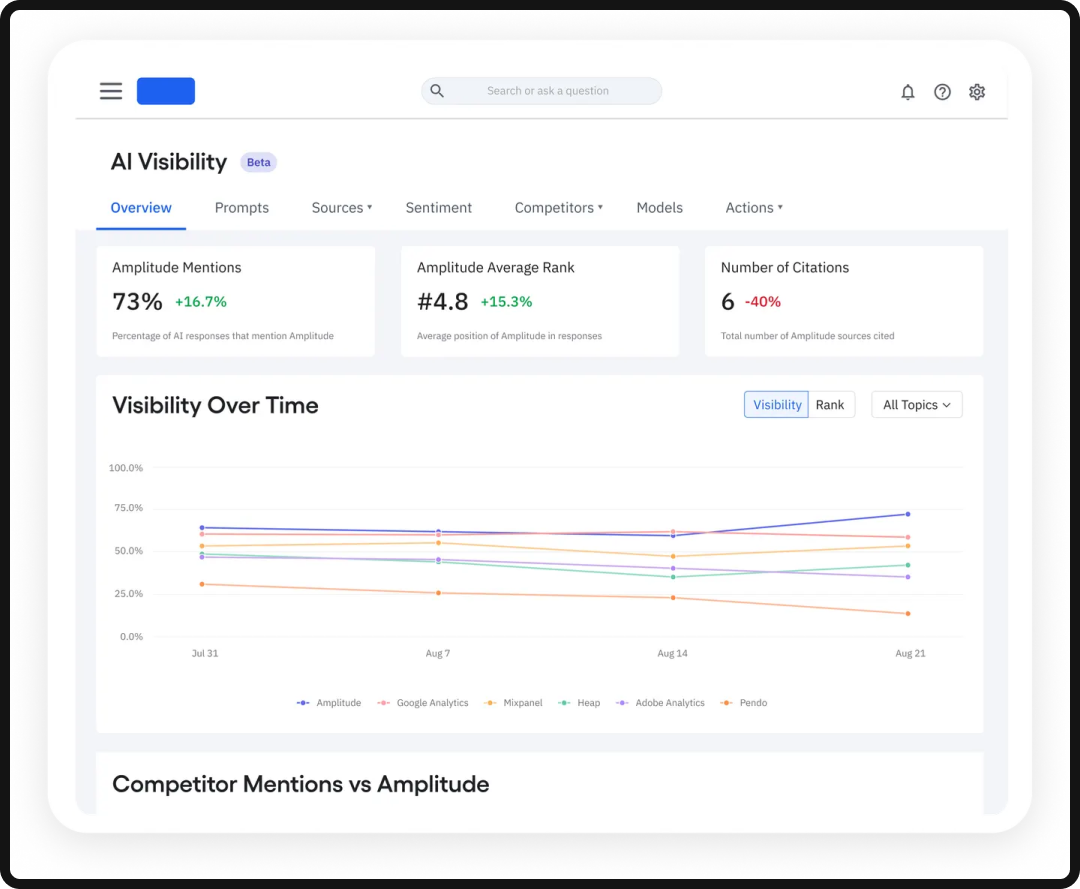
Here’s where things get interesting. Amplitude isn’t an SEO company; they’re a digital analytics platform used by over 4,300 companies including Atlassian, Under Armour, and NBCUniversal. But their AI Visibility feature, launched in October 2025, brings something to the table that most other AEO tools can’t match: direct attribution to revenue.
Because AI Visibility is built into Amplitude’s analytics platform, you can track an AI mention all the way through to conversion:
- Did that ChatGPT recommendation actually drive a session?
- Did that session convert?
- What was the revenue impact?
No other AI visibility tool on this list can answer those questions as natively. Amplitude’s AI visibility tool includes a Visibility Score, competitive rankings, prompt and source analysis, and actionable recommendations. It’s updated weekly and covers ChatGPT and Google AI Overview (Claude was also added super recently).
The catch? AI engine coverage is limited compared to dedicated AEO tools. You won’t find Perplexity, Gemini, or Grok tracking here (which studies from Goodie show are crucial for industries like B2B SaaS or Finance).
The optimization recommendations (though they do exist) are also more basic since Amplitude is an analytics company, not an AEO agency. But the price-to-value ratio is hard to beat: it’s free for existing customers, and there’s a limited free version for everyone else.
For product teams that care more about proving ROI than running AEO playbooks, Amplitude is definitely a compelling pick.
4. AthenaHQ

- Best For: Agencies and e-commerce brands that need AI visibility with revenue attribution
- Pricing: Self-Serve from $295 per month; custom Enterprise pricing available, too
- AI Engines Tracked: ChatGPT, Claude, Gemini, Perplexity, Copilot, Google AI Overviews, and more
AthenaHQ comes out of a strong pedigree: founded by former Google Search and DeepMind leaders, Y Combinator-backed, and purpose-built for GEO (which is another way to say AEO, but the industry hasn’t quite settled on a naming convention yet).
- The platform’s biggest differentiator is its Action Center, which goes beyond passive monitoring. Instead of just flagging content gaps, AthenaHQ uses automated agents to help you fill them.
- The Knowledge Gap Detection feature is particularly clever. It identifies concepts where AI models lack sufficient data to form an opinion about your brand, not just standard SEO keyword gaps.
- For eCommerce brands, the Shopify and GA4 integrations connect AI visibility directly to revenue, similar to Amplitude but with deeper GEO-specific workflows. Agency teams get dedicated infrastructure including Pitch Workspaces and a lead routing program.
Now for the downside, and I regret to inform you that it is, in fact, price. The price itself is still lower than some of the tools on this list, but:
- At $295 per month for the Self-Serve plan (with a $95 introductory first month), it’s a significant commitment.
- The credit-based consumption model can also be unpredictable since every AI response costs one credit, and heavy monitoring across multiple engines burns through your 3,600 monthly credits faster than you’d expect.
- Advanced features like persona targeting are locked behind the Enterprise tier.
5. Hall

- Best For: Startups and growing teams taking their first steps into AI visibility
- Pricing: Free tier available; paid plans at $199 per month and $599 per month; Enterprise plans start at $1,499 per month
- AI Engines Tracked: ChatGPT, Claude, Copilot, DeepSeek, Gemini, Google AI Overviews, Meta AI, Perplexity
Hall positions itself as the most comprehensive GEO platform, and for teams just getting started with AI visibility, it serves as a strong entry point. Hall was built by a team with experience at Atlassian, Intercom, and Rokt, and it raised a $2M pre-seed round. The free tier lets you track one project with 25 questions and weekly data updates with no credit card required (the way I see it, that’s generous enough to actually learn something before committing budget).
The platform covers four core capability areas:
- Generative answer insights (where and how your brand shows up)
- Website citation insights (which of your pages get referenced)
- Agent analytics (how AI crawlers interact with your site)
- Conversational commerce tracking
The breadth of engine coverage puts them towards the top of the running on that factor alone, spanning eight major AI platforms.
Another factor that sets Hall apart is that the interface of the tool itself is clean and approachable (considering that not everyone doing AEO work is an SEO or a search specialist, that rocks).
The tradeoff here is depth. At the free and lower tiers, data updates only weekly (compared to other tools like Goodie, which updates daily), and the number of tracked questions is capped. The jump from free to $199 per month is steep, and some users note that the platform is still young with limited public reviews.
All of this being said, if you’re in search of a starting point or are part of a team just starting to explore AI visibility on a budget, Hall delivers.
6. BrightEdge AI Catalyst
- Best For: Large enterprise SEO teams that want AI visibility within their existing BrightEdge workflow
- Pricing: Custom (enterprise-level)
- AI Engines Tracked: Google AI Overviews, ChatGPT, Perplexity, Copilot
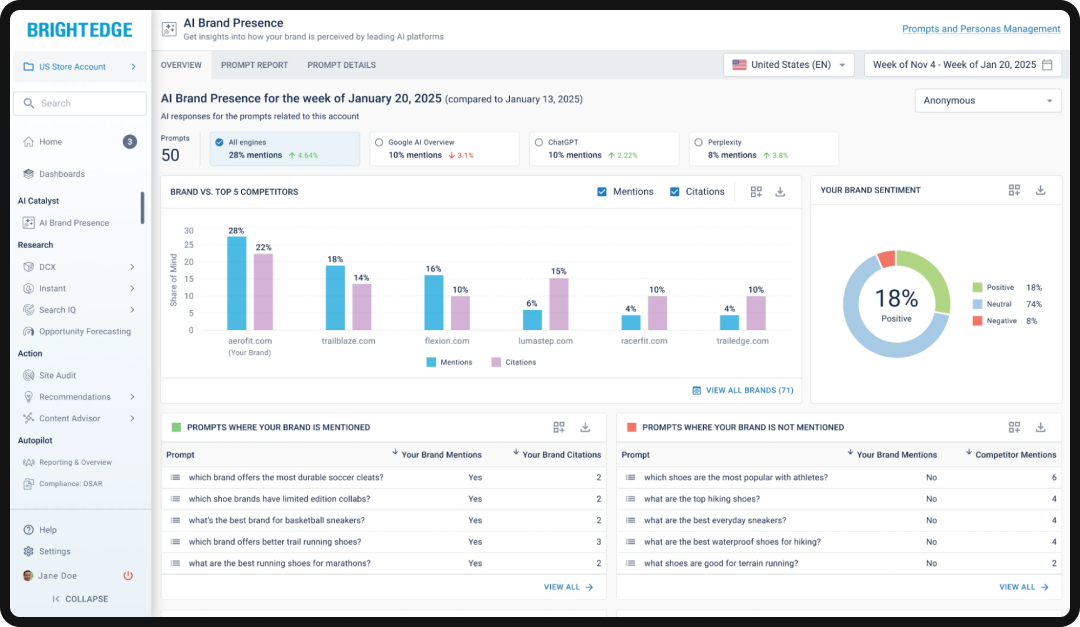
BrightEdge has been in the enterprise SEO game since 2007, serving over 57% of the Fortune 100. Similar to Semrush’s AI Visibility Toolkit, AI Catalyst is BrightEdge’s answer to the AI visibility question. Also in a similar fashion to Semrush, AI Catalyst leverages BrightEdge’s massive proprietary dataset (tens of billions of keywords and over four billion data points) to track brand presence in AI-generated responses.
The platform shows real-time data on where, why, and how often content appears in AI responses. BrightEdge Copilot (their AI assistant, not to be confused with Microsoft’s, though I question the logic behind the naming of the tool) provides optimization recommendations, and the system identifies keywords likely to trigger AI overviews before competitors find them.
The advantage here (I recognize that I’m starting to sound like a broken toy repeating myself this much), is the same as Semrush’s: ecosystem depth. If you’re already running BrightEdge for enterprise SEO, AI Catalyst integrates seamlessly and layers AI visibility data on top of your existing workflows. The decade of historical context adds dimension that newer tools simply can’t match.
The disadvantages here are three-fold:
- BrightEdge is custom-priced for enterprise, which puts it well out of reach for SMBs.
- Some users report a 48-hour data freshness lag for AI-specific data, which can be a concern for fast-moving brands.
- The platform’s complexity means a steeper learning curve, especially for teams new to AI visibility concepts.
7. SE Ranking AI Visibility Tracker

- Best For: All-in-one SEO teams that want AI visibility without switching platforms
- Pricing: From $65 per month for the Essential tier, with an AI Search add-on starting at $89 per month
- AI Engines Tracked: Google AI Overviews, AI Mode, ChatGPT, Perplexity, Gemini
SE Ranking has built a solid reputation as the affordable, well-rounded SEO suite; now, their AI Visibility Tracker extends that philosophy into AI search. The offering actually includes three distinct tools:
- An AI Overviews tracker for Google snippets
- An AI Mode tracker for Google’s conversational search
- A unified LLM visibility tracker across ChatGPT, Perplexity, and Gemini
Users on Reddit have called it “the most well-rounded AI SEO checking tool,” and the “No cited” feature, which shows where competitors are mentioned but you aren’t, has been described as “gold for content ideas”. The local SEO capabilities are also pretty solid, allowing tracking by specific ZIP codes and cities.
Admittedly, the confusing part is SE Ranking’s product structure. They offer both the AI Search Toolkit (as an add-on to SE Ranking) and SE Visible (a separate standalone platform), which creates decision paralysis. The base plan’s AI tracker includes only 50 prompts, so meaningful coverage requires upgrading to higher tiers.
The thing is, once you layer the AI add-on onto the SEO suite, you’re basically looking at expenditures anywhere from $150 to more than $240 per month, at which point the price accessibility gap starts to close between SE Ranking and other tools on this list.
Still, for teams that want traditional SEO and AI visibility in one place at a somewhat reasonable price, SE Ranking is a solid choice. The interface is intuitive, the data is reliable, and the feature set covers the essentials.
8. Surfer SEO AI Tracker

- Best For: Content teams already using Surfer that want to add AI visibility tracking
- Pricing: 5 prompts are included with the Scale plan at $219 per month; $95 per month add-on for 25 prompts
- AI Engines Tracked: ChatGPT, Google AI Overviews, AI Mode, Perplexity
Surfer SEO has long been the go-to platform for on-page content optimization (I’m quite fond of it myself). Their AI Tracker, launched in July 2025, adds AI visibility monitoring as a paid add-on. The combination makes sense: Surfer already helps you create content that ranks in traditional search, and now it can show you whether that content is getting cited in AI answers, too.
- The tracker captures real responses (not API data) from ChatGPT, Google AI Overviews, AI Mode, and Perplexity.
- You get prompt-level insights, source transparency showing which pages get cited, and weekly trend reports.
- The integration with Surfer’s Content Editor means you can identify an AI visibility gap and immediately start optimizing content to fill it.
Though the sentiment from early adopters is positive, the limitation is scope. At $95 per month for 25 prompts, when you do the math, it’s relatively expensive per prompt compared to dedicated AEO tools. Ergo, the AI Tracker is an add-on to a content optimization platform, not a standalone AEO solution.
If you’re not already using Surfer for content, the total cost (base plan + AI Tracker) can be hard to justify over purpose-built alternatives. But if you’re a Surfer power user, it’s a convenient natural extension of your workflow.
9. LLMrefs

- Best For: Budget-conscious teams and SEO practitioners who want basic AI visibility tracking
- Pricing: Free (for 1 keyword); Pro plans (50 keywords) start at $79 per month; custom Enterprise pricing available
- AI Engines Tracked: ChatGPT, Google AI Overviews, AI Mode, Perplexity, Gemini, Claude, Grok
LLMrefs takes a different approach from most tools on this list. Instead of asking you to define prompts, you enter keywords, and the platform automatically generates prompts based on a dataset of 4.5 million real ChatGPT conversations (the workflow makes it feel like a traditional SEO tool, which can make it an easier starting point for some).
The proprietary LLMrefs Score (LS) quantifies your AI visibility in a single metric, and the dashboard is clean and straightforward. For $79 per month, you get 50 keywords tracked across all major AI engines with weekly updates. If you haven’t been keeping track, I am: that’s one of the most affordable entry points in the market.
The tradeoff (once again) is depth. LLMrefs is a lightweight tracker, not a diagnostic tool. You see that you’re mentioned, but not always the full context of how. There’s no sentiment analysis, limited source analysis, and no traffic attribution. The monthly refresh cycle (rather than daily or weekly) means you’re working with somewhat stale data. And there’s no content optimization layer, so you’ll need separate tools to act on whatever insights you get.
For teams that just want to check whether their brand shows up in AI search (literally just the AI visibility piece) without a big commitment, LLMrefs delivers on that promise. But if you need strategic depth, there’s a high chance that you’ll outgrow it quickly.
10. Nightwatch
- Best For: SEO professionals who want LLM monitoring alongside traditional rank tracking
- Pricing: 14-day free trial; paid plans start at $39 per month (for 250 keywords) and scale to $699 per month (for 10,000 keywords)
- AI Engines Tracked: ChatGPT, Claude, Perplexity, Google AI Overviews
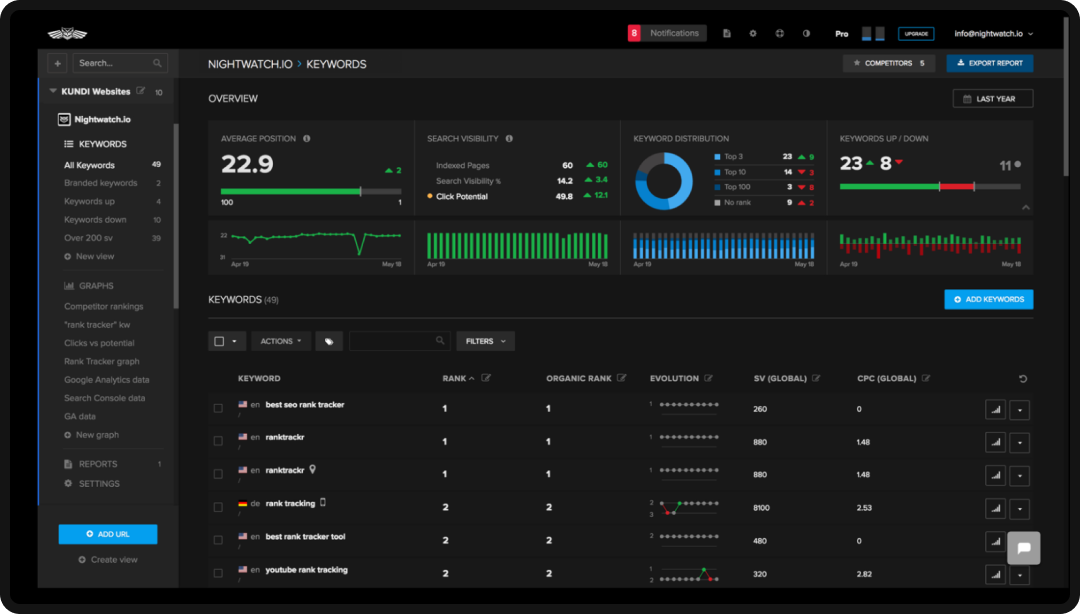
Nightwatch has been a reliable traditional SERP ranking tracker for years, so it’s not really any surprise that their LLM tracking feature extends that reliability into AI search. The appeal is unification: you can track traditional Google rankings and AI visibility in a single dashboard with a single subscription.
The platform adds LLMs as selectable “search engines” alongside Google and Bing, which feels super intuitive for anyone who is already familiar with traditional rank tracking. You get metrics like Average Rank in list-based AI answers, mention frequency, share of voice against competitors, and sentiment analysis.
What Nightwatch offers that many competitors don’t is dual-layer tracking. It monitors both the final AI response and the web searches that AI systems perform to gather real-time data (sort of a mimicked query fan-out situation). This gives you visibility into how AI discovers information about your brand, not just what it ultimately says.
The limitation is maturity. The LLM tracking feature is relatively new, and I had trouble finding specific user reviews. AI engine coverage is narrower than dedicated AEO platforms (no Gemini, Grok, or Meta AI yet). And while Nightwatch is great at tracking and providing information, it doesn’t have the content optimization or actionability layer that more specialized tools do.
So, What’s the Next Step for AI Visibility Monitoring?
It’s no secret that AI visibility isn’t optional anymore (and if this is your first time hearing as such, where the hell have you been?)
The brands that show up in AI answers today are building compounding advantages that will be hard for competitors to overcome tomorrow. Whether you go with a purpose-built AEO platform like Goodie, add AI visibility to your existing SEO stack with Semrush or SE Ranking, or start with a lightweight tracker like LLMrefs to test the waters, the important thing is to start measuring.
As someone who spends most of her working hours thinking about this stuff (sorry, occupational hazard), my honest advice is this: pick the tool that matches where you are today, not where you want to be in two years. A free Hall account that you actually use is worth more than an enterprise AEO platform that sits untouched because your team wasn’t ready for it.
The AI search landscape is moving fast. The tools are catching up. And the marketers who lean in now are the ones who’ll be writing the playbooks everyone else follows.