
Whether the view out of your apartment window is Times Square or not, ads are everywhere you look. On buildings, on billboards, at bus stops, and most commonly, in the palm of your hands.
Scroll through your feed for more than 30 seconds and you’ll realize that everyone is trying to sell you something. But which ads do you end up remembering? As designers and strategists, it’s our job to get you to stop scrolling, to come up with creative ideas that actually grab and retain your attention.
How Ads Become Memorable
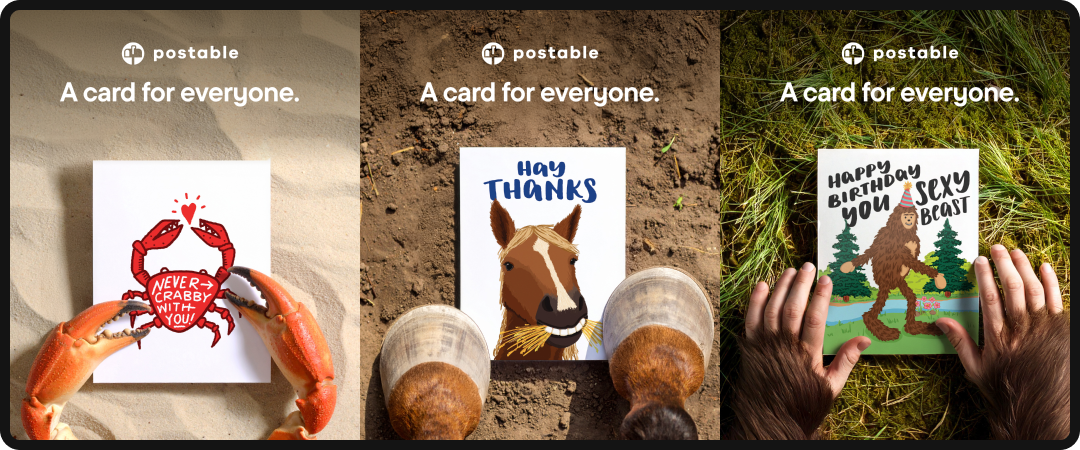
Ad campaigns don’t just try to get you to buy their products; they connect to something larger by understanding their audience and provoking emotion. For instance, a greeting card company wouldn’t center their strategy around just selling cards. They would work to remind us that everyone deserves to be thought of.
AI Saturation (& AI Slop): How to Stand Out
AI technology is now widely accessible (and becoming increasingly affordable for companies), meaning that everyone is jumping on the train to use it for creative development. The standard for basic visuals will be rising, but so will the need for human ingenuity. What do I mean by that?
Good ideas will become the differentiator.
When everyone has access to the same AI tools, what separates mediocre ads from memorable ones? It’s the intention and strategy behind the creative concept.
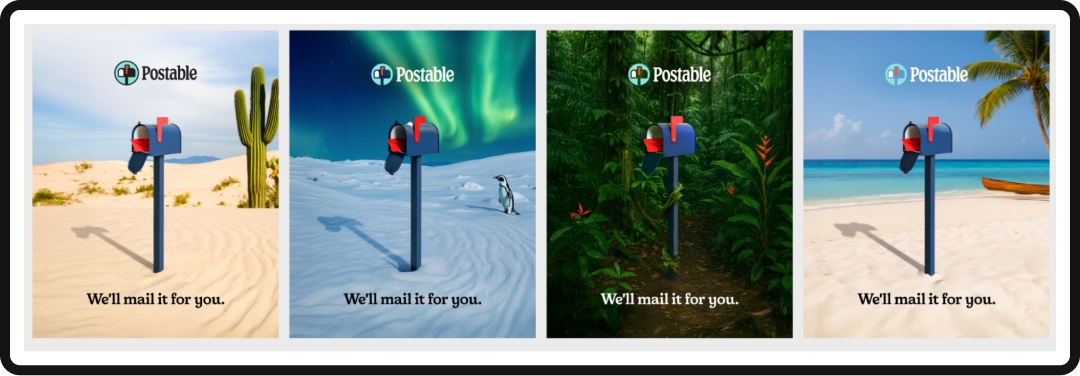
For example, anyone can use Adobe Firefly or Gemini to generate a beautiful beach (like the one you see below). The differentiator is what you do with that beach. Pair it with an unexpected headline, integrate it into a larger story, or use it to communicate something relevant rather than just be aesthetically pleasing.

The headline “We’ll mail it for you” across different landscapes changes a basic scenic image to a narrative that audiences can now interpret for this card company.
The Creative Thinking Challenge
The obvious truth is that thinking creatively is hard. Many people think creativity is an innate ability that can’t be taught. But creativity isn’t a mysterious gift. Your brain is a muscle, and therefore should be treated like one: it needs consistent exercise to stay sharp.
Just as you can’t run a marathon without training, you can’t expect out-of-the-box ideas without practicing creative thinking. Every time you generate one more concept or explore an unconventional angle, you’re strengthening those neural pathways in your beautiful creative brain. Designers who consistently produce innovative work have simply trained their minds to think differently through repetition.
This is why having a structured ideation process matters. When you have a framework, you’re not starting from a blank canvas every time. You’re building a system that helps your brain stretch in new directions, instead of hoping that inspiration will “strike” every time you need to make something.
How to Design a Concept: A Step-by-Step Guide
Creative ideation shouldn’t always have to rely on waiting for that lightbulb moment. It’s about asking the right questions and following a process. Let’s go through a step-by-step guide of how to
Step 1: Ask the Right Questions
Before sketching concepts or opening design files, understand the foundation:
Who is the audience?
- Age range, location, and lifestyle
- What type of content they engage with
- Their goals and values
How does this brand or product benefit them?
- What specific problem does it solve?
- What transformation does it enable?
- Why choose this over alternatives?
What are their pain points?
- Daily frustrations
- Obstacles preventing their goals
- What would make their life easier?
What is the brand really about?
- Tone and personality
- How it makes people feel
- What’s the story?
Dive into brand guidelines, read customer reviews, study competitors, and gather past learnings. The more intimately you understand the product and audience, the more authentic your concepts will be.
For example, when creating concepts for a wellness wearable, you might discover that your audience isn’t just interested in tracking metrics, but instead are stressed professionals seeking work-life balance. That insight shifts your direction from “track your health data” to “reclaim your peace of mind.”
Step 2: Complete the Story
Great ads don’t just show products; they show possibilities.
What happens when someone uses this product? Walk through their journey. If it’s a meditation app, what does their morning look like when they wake up calmer? If it’s a project management tool, how does chaos become organized?
What is their immediate reaction? Capture that moment. Is it relief? Excitement? Confidence? The emotional peak helps you identify what feeling to center your creative around.What problem gets solved? Be clear about the before and after. Will a busy mom finally have more time to herself after using an easy mailing card service?

What is the result after? Think beyond immediate benefits. What does life look like one month after adopting this product? Or what’s the result if they don’t use the product? Create a sense of urgency. Greeting cards usually look better when your kid is a cute baby and not an angsty teenager. So send them while they’re still cute.
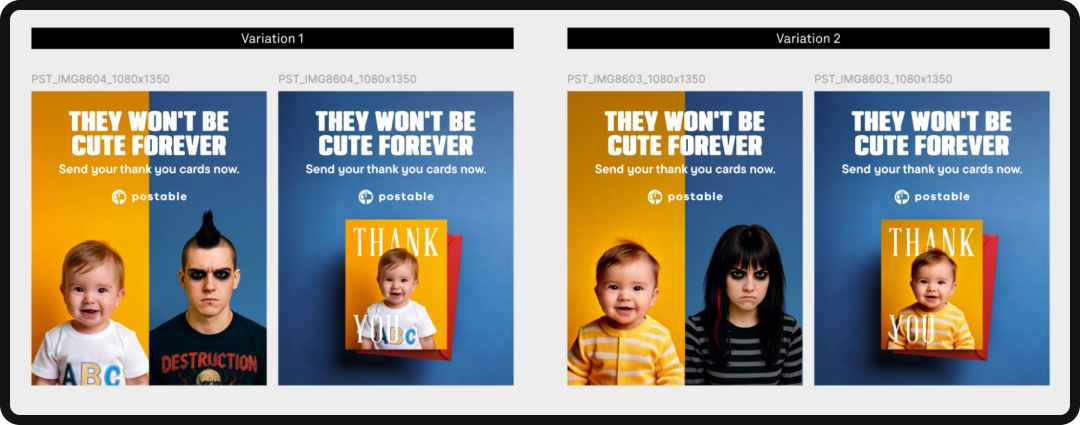
This framework helps you move from features to benefits to emotional outcomes. A story can last longer than a message. The connection is what audiences remember and the feeling is what drives action.
Step 3: Learn From What’s Already Working
Smart creative ideation builds on proven insights.
Analyze key metrics:
- A/B test results from previous campaigns
- What type of imagery and language works best?
- What demographic is being targeted?
Identify patterns:
- Did testimonials outperform product-focused ads?
- Do static ads do better than video ads?
- Which CTAs converted the most?
When it comes to ideating for Oura, concepts that focus on the CGI ring with a bold attention-grabbing headline often perform better than lifestyle imagery of people.
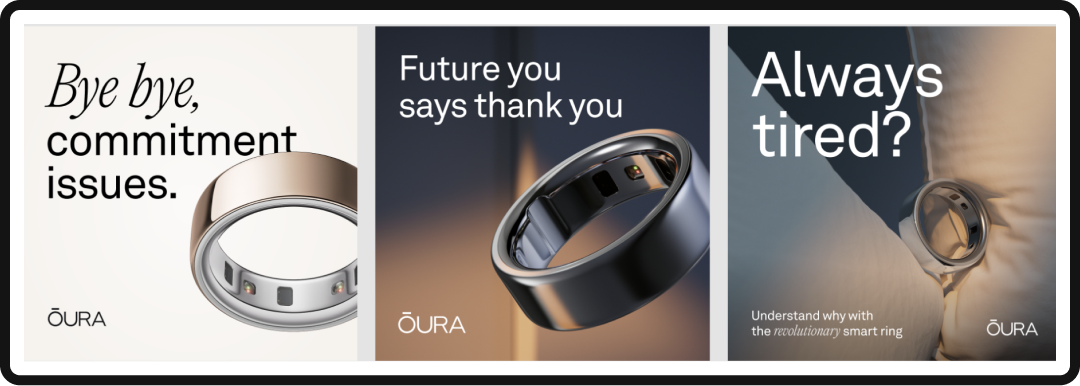
With such a tech-forward brand, it’s important to showcase the product in the clearest quality to interested customers.
It’s also crucial to understand why an idea worked. Past learnings provide guardrails that keep creative ideas grounded while leaving room for innovation. Test your ideas and optimize the ones that do the best.
Step 4: Think in Extremes
It might sound a little counterintuitive to say this right after you’ve been told to think based off of learnings and data, but thinking in extremes can also help with ideation.
Braindump as many ideas as you can (no matter how bad they are). Thinking through extreme connections can help you reach ideas in unexpected angles and creative outcomes. Once ideas are all out of your brain, you can use Step 3’s learnings to check if it’s on brand, or if an idea can be toned down. Keep shooting your shot, and you’re bound to make one.
And remember; it’s okay to fail! Keep trying and fail harder. No one is bound to come up with a winning idea on the spot. It takes trial and effort. Be sure to celebrate your failures, too, as they often lead to victories.
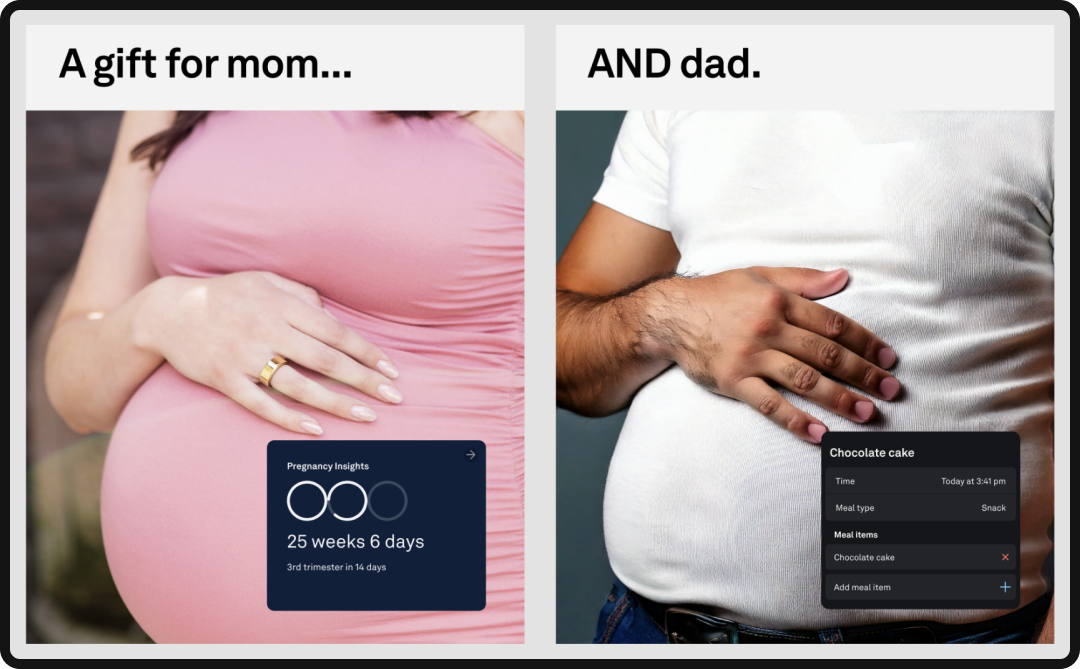
Here’s a rough concept of an ad to promote Oura Ring’s meal feature. The tone is definitely a deviation from their usual branding, but it was a fun idea to get the creativity flowing nonetheless. Even though this concept was scrapped, we were able to quickly produce and share this rough idea and convey the message with the help of AI generation without too much effort being wasted.
Using AI as Your Creative Thinking Partner
As much as the core of creativity is human, it’s undeniable that AI makes a great helper for creative ideation. But don’t let AI take over; instead…
Use AI prompts and tools to help you think faster.
Think of AI tools, like Claude or ChatGPT, as a creative sparring partner that’s always available. You can brainstorm multiple angles in minutes, explore “what if” scenarios, generate variations, and break through creative blocks.
Here’s how to effectively use AI for creative ideation:
Give context. Don’t just ask “give me ad ideas.” Share what you’ve learned:
Example Prompt: “I’m creating a campaign for [product] targeting [audience]. Their pain points are [X, Y, Z]. Our brand voice is [personality]. Past successful campaigns featured [insights]. I want to explore concepts around [theme]. Give me 10 different directions.”
Use outputs as thought starters, not final answers. When AI suggests “show the before and after,” that could spark your idea for a split-screen comparison, time-lapse transformation, or day-in-the-life narrative. AI can plant the seeds, but you need to cultivate them.
Iterate conversationally. Ask follow-ups:
- “Make concept #3 more emotional.”
- “Give me more ideas based on this direction.”
- “How can we add more humor?”
Each iteration, no matter how many questions you ask, might just light a spark that leads to the final idea.
Use AI visual tools to help visualize concepts quickly:
- Create mood boards and style references
- Generate placeholder imagery for pitch decks
- Explore different visual directions before committing to production
- Develop early concepts to “show” clients instead of “tell”
In a marketing agency environment, designers are required to produce multiple ads for multiple clients (and each ad will likely have multiple variations). Even if you’re a one-man team or working in a different fast-paced environment, AI can help execute ideas that never would have been possible before. The more ads you test, the better, increasing your odds of landing on something breakthrough.
The Importance of the Human Touch
AI can help you ideate faster and generate content, but it cannot replace human judgement and strategic thinking. Treating AI outputs as finished products is where it can all go wrong.
Quality control is your responsibility.
AI-generated content often includes generic phrasing, logical gaps in storytelling, visual elements that feel “off,” concepts that miss cultural nuance, and ideas that work in theory but fall flat in execution. Your job is catching these issues. Review everything critically:
- Does this feel authentic to the brand?
- Would our audience actually connect with this?
- Is there a better angle?
- What’s the human insight that would elevate this from good to great?
Fixing Issues & Fill In Gaps Within AI-Generated Designs
When AI generates imagery:
- Refine the composition
- Match the image to brand standards
- Prompt in specific detail for consistency
In this carousel, different creatures are specifically prompted in color and profile view to maintain a consistent art direction.

When AI generates copy:
- Add brand-specific language and personality
- Sharpen vague statements into specific benefits
- Ensure tone matches brand voice
Ensuring brand alignment:
Every element must align with brand guidelines and strategy. AI doesn’t inherently understand that your brand never uses exclamation points, that your visual style needs to be minimal, or that messaging should feel aspirational rather than prescriptive. You need to ensure consistency across campaigns.
Adding your human touch:
This transforms AI-assisted work into something genuinely creative:
- Cultural references and relevant moments AI might miss
- Fixing any AI generated imagery through Photoshop or other design tools
- Authentic storytelling that feels real
- Design adjustments based off specific client feedback and learnings
Here’s an example of using AI to assist with this Postable ad that prepares customers for the upcoming holiday season.
A combination of AI, human design skills, and brand knowledge.
- AI: Adobe Firefly generated the image.
- Human Design: The composition was made in Adobe Illustrator and the final image Photoshopped.
- Brand Knowledge: Based on our data and relationship with the client, we know that cards sell the most during the holiday season.
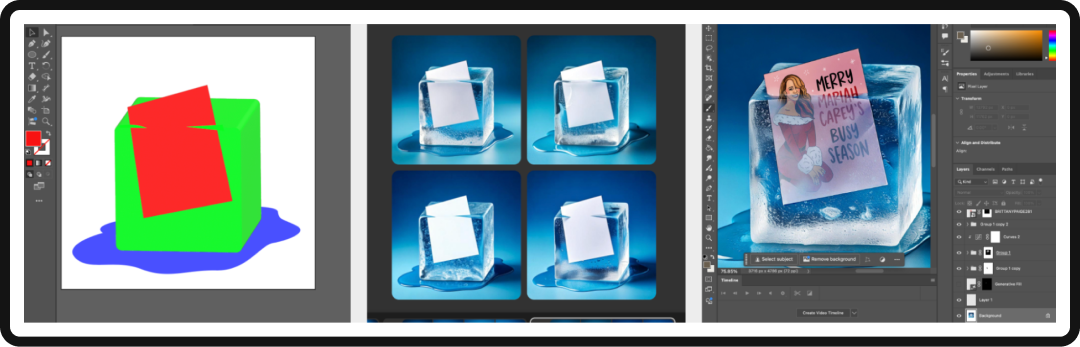
Although this ad was made with the help of AI, the key takeaway is the cultural nuance that is created by including a defrosting Mariah Carey that could only be thought of (and, in return, understood) by human minds.

Creativity x AI
Creative ideation requires both structured and bold thinking. It means asking the right questions, understanding your audience deeply, and learning from data. It also means pushing beyond the obvious and exercising your creative muscles.
While your creative mind is the driver, AI tools are powerful accelerants. They help generate more ideas, visualize concepts faster, and iterate efficiently. But don’t forget that the ideas worth remembering come from human insight, empathy, and creativity. When everyone has the same tools, your differentiator is the quality of your thinking.
Your next steps? Keep exercising that creative muscle. Ask deeper questions. And remember that the most powerful ads have ideas that last in people’s minds, even after they put down their phones.