

Are you pouring money into Google Ads but unsure if you’re squeezing out the best return on investment? This is a common concern among advertisers. To optimize your ad spend and improve conversions, picking the right bidding strategy is crucial.
Imagine having a toolkit where each tool is tailored to fit different advertising goals and industries. That’s exactly what Google Ads offers with its range of bidding strategies. Whether you’re aiming for heightened visibility, generating leads, or boosting revenue, understanding these strategies can make all the difference in hitting your business objectives.
Understanding Google Ads Bidding
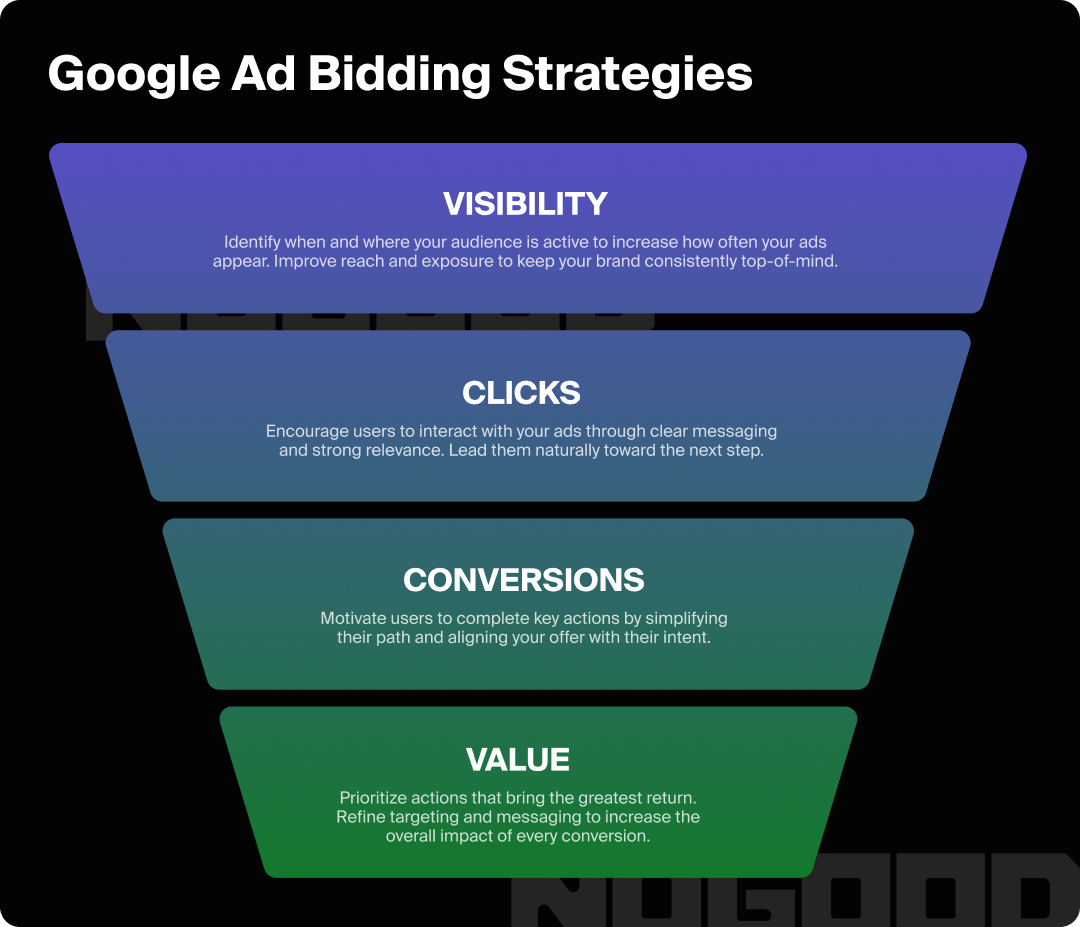
You didn’t think we would just hand you the fish and tell you, “Here is the best bidding strategy, now go make some money,” did you? No, we’re going to teach you to fish by equipping you with all the knowledge you need to be able to determine the best bidding strategy for your business at every stage.
Ever wondered how some ads always seem to pop up at the right time? That’s the role of Google Ads bidding strategies. At its core, Google Ads bidding is a dynamic auction system. Here, advertisers compete for ad placements by setting bids, which are essentially the maximum amount they’re willing to pay for a click or impression. But it’s not just about who throws the most money on the table.
The bid amount is crucial, but so is ad quality and relevancy to the search query. Together, these elements determine your ad’s visibility and cost-per-click (CPC).
Now, aligning these bidding strategies with your business objectives is essential. Want to boost brand awareness? Perhaps a strategy focused on impressions is your best bet. Chasing conversions? You’ll need to hone in on strategies that prioritize actions over mere views. By tailoring your approach, you ensure that every penny spent is driving you closer to your goals.
Smart Bidding vs. Manual Bidding Strategies
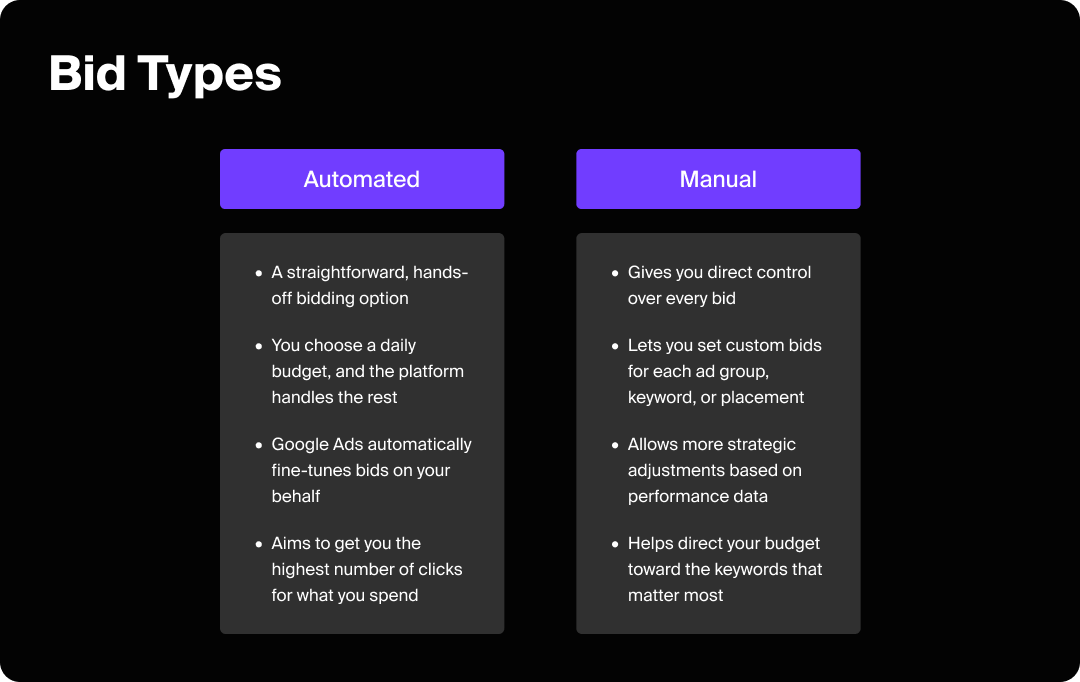
Smart Bidding
Picture this: Alex is a digital marketer,and he’s on the brink of a breakthrough. With a tight budget and ambitious goals, Alex turns to smart bidding, leveraging AI to take the guesswork out of the equation.
Smart bidding uses sophisticated algorithms and real-time signals to optimize conversions, making strategies like Target CPA (Cost Per Acquisition) and Maximize Conversions highly effective. By analyzing patterns and behaviors as they happen, smart bidding adjusts bids dynamically, ensuring that Alex gets the desired results at the cost he determines, hence the name, Target CPA.
What makes smart bidding highly efficient?
- It significantly boosts conversion rates by focusing on high-intent clicks, which means more sales and leads without the hassle of constant manual bid adjustments done by Alex.
- It saves time,and lots of it. Alex no longer needs to babysit campaigns or tweak bids manually. The AI handles it all, freeing up precious hours for other creative pursuits. All Alex needs to do is tell the algorithm what to focus on, like the number of conversions, the value of conversions, a specific ROAS, or a CPA, and let AI do its magic.
Manual Bidding
Imagine you’re a small business owner who thrives on having the reins firmly in your grasp. Manual bidding might just be your cup of tea. It offers you the power to control each penny spent on individual keyword bids, adjusting in real time based on signals like device type or even time of day.
Why choose manual over automated options? It’s all about precision. You can tweak bids to reflect actual business priorities, ensuring that every click aligns perfectly with your strategy. For instance, if your data shows that mobile users are more likely to convert, you can increase bids specifically for mobile devices.
However, it’s not all sunshine and rainbows. Manual bidding demands constant vigilance. Without regular monitoring and adjustments, you might miss opportunities or waste your budget on underperforming keywords. It’s a bit like tending a garden,neglect could lead to wilting results.
The strength of manual bidding lies in its tailored approach, giving you the flexibility to respond swiftly to market shifts. But it also means rolling up your sleeves and regularly diving deep into the data. For those who relish the challenge and have the time to invest, manual bidding can be a rewarding strategy that pays off in spades.
Which Bidding Strategy Is Better?
Generally, we do not recommend using manual bidding strategies. It may come as a surprise, but manual budding is equally as tedious for big businesses or agencies with large budgets and many campaigns as it is for small businesses.
Small business owners are extremely busy managing the actual business, and don’t have time to manually adjust every aspect of a campaign. Plus, their accounts could grow as their businesses grow, so it’s very likely that they’ll need to switch to smart bidding regardless.
Understanding Google Ads Smart Bidding Strategies
Conversion-Focused
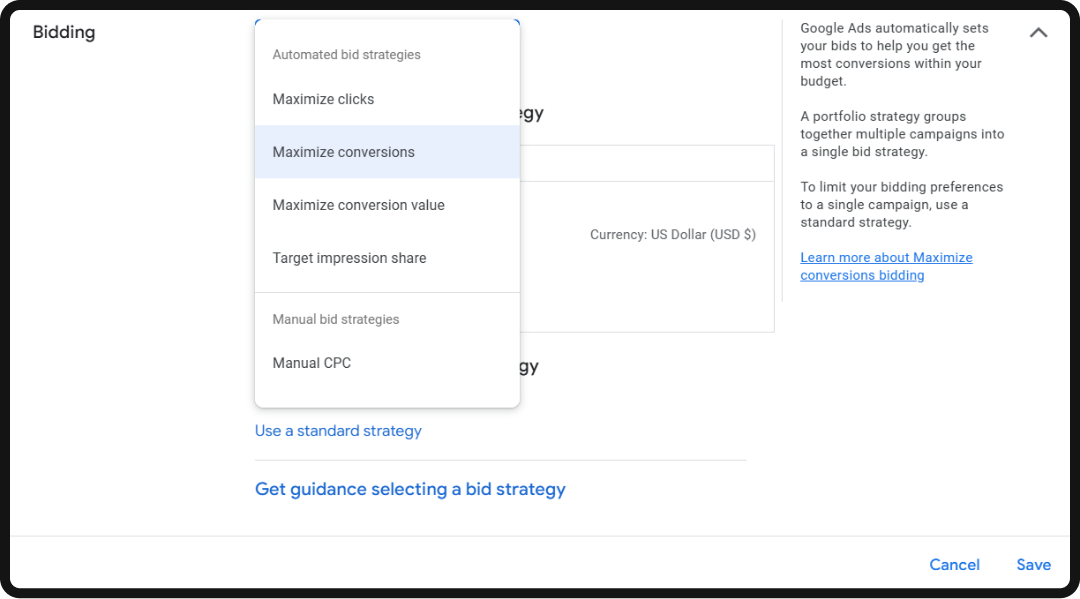
The following bidding strategies are conversion-focused, making them excellent choices if your goal is to generate leads, purchases, app installs, or in-app conversions. Let’s dive into some of the key strategies available.
- Target CPA (Cost Per Acquisition) focuses on acquiring conversions at a specific cost (within your budget) that is determined by you, making it ideal for campaigns with historical data. You can set a Target CPA bidding strategy once you generate a minimum of 30 conversions over the previous 30 days, or when Google recommends using a tCPA on the Recommendations page.
- Target RoAS (Return on Ad Spend) aims to generate a certain return for every dollar spent, making it perfect for eCommerce businesses looking to maximize profit. Again, your campaign has to have historical data, 30 conversions over 30 days, before you can use this bidding strategy.
- Maximize Conversions lets Google’s AI do the heavy lifting to get as many conversions as possible within your budget. It’s good for lead-generation campaigns, and after 30 conversions in 30 days, you can switch to the Target CPA bidding strategy we talked about above.
- Maximize Conversion Value, on the other hand, lets Google focus on the conversions that are most likely to generate the highest value, not just any conversion,this bidding strategy is perfect for campaigns with a sales objective. Then, after 30 conversions over 30 days, you can switch to Target RoAS, continuing to increase that target gradually to maximize your profit.
- Enhanced CPC is a mix of manual and automated bidding strategies. It allows you to set your desired target CPC, just like a manual bidding strategy. However, it focuses on generating conversions rather than just clicks, and increases bids for the clicks that are most likely to generate a conversion. A manual bidding strategy doesn’t take into account the likelihood of those clicks becoming conversions.
Now, why do these strategies matter? They all tie back to auction factors like maximum CPC (Cost Per Click), Quality Score, and Ad Rank Thresholds.
- Maximum CPC is the most you’re willing to pay for a click.
- Quality Score reflects the relevance and quality of your ads.
- Ad Rank Thresholds determine your ad’s position in the search results.
Together, these factors influence how Google decides where and when your ad appears.
Choosing the right bidding strategy is not just about picking a name from a list. It requires understanding your campaign goals and how these strategies can help you achieve them. For instance, if your goal is to generate the lowest cost per acquisition or action (CPA), Maximize Conversions might be your go-to strategy. But if you’re zeroed in on the value of those conversions, you might lean towards Maximize Conversions Value.
By aligning your bidding strategy with your campaign objectives, you ensure that your ad spend is working as efficiently as possible.
Google Ads Bidding Strategies
|
Search |
Shopping |
Display |
YouTube |
|
|---|---|---|---|---|
|
Manual CPC |
✅ |
✅ |
✅ |
|
|
Enhanced CPC |
✅ |
✅ |
✅ |
|
|
Target CPA |
✅ |
✅ |
✅ |
|
|
Target ROAS |
✅ |
✅ |
✅ |
|
|
Maximize Clicks |
✅ |
✅ |
||
|
Maximize Conversions |
✅ |
✅ |
||
|
Maximize Conversion Value |
✅ |
|||
|
Cost Per View |
✅ |
|||
|
Viewable CPM |
✅ |
✅ |
||
|
Target CPM |
✅ |
Google Ads Manual & Automated Bidding Strategies
Within manual and automated Google Ads bidding strategies, there are traffic-focused and visibility-focused bidding strategies. And as if it couldn’t get any more granular, each of those two sub-types has even more subtypes within them. Let’s start with traffic-focused
Traffic-Focused
The following bidding strategies are traffic-focused,the goal of using them is to generate as much traffic to the website as possible, regardless of conversions.
Not many businesses use them as they don’t usually drive conversions or revenue, but they drive a ton of traffic. This could come in handy if you’re a local store owner and your customers exist around your business in a small area, or if you have an extremely limited budget that’s not enough to get you conversions.
For example, if you sell products priced at $100 or more, and your CPA is around $25 to $30, but your daily budget is only $5 to $10, you may only get a conversion every two to three days. In this case, focusing on driving traffic to your website and gradually building brand awareness could be a better approach. This strategy may lead to offline conversions through your physical store, and as more people become familiar with your brand, converting on your website will become easier, ultimately lowering your average CPA.
Manual CPC
If your budget is so limited that you need to control exactly how much you pay for every click, and your goal is driving traffic to the website at the lowest cost per click possible, then Manual CPC is your go-to strategy. If you haven’t already guessed from the name, it‘s a manual bidding strategy.
With Manual CPC, you set the maximum CPC bid you’re willing to pay in order for someone to click on your ad and visit your website.
You can set the same CPC bid across all your keywords, or you can assign different bids to different keywords. Increase it for the most relevant keywords to be more competitive on the most relevant traffic and decrease it for the least relevant ones. Another strategy is to decrease it for the keywords with low CPC; if you can pay $0.25 to get a click from a specific keyword, and you’re getting a decent number of clicks from that keyword compared to the others on your account, why would you bid $1?
With that bidding strategy, you can also adjust bids for devices. Maybe you want more traffic from mobile phones than computers and tablets. You can also adjust bids for locations, countries, or states if you favor some over others, and finally, you can adjust for audiences, increasing the bid for your top-performing audiences and decreasing it for the low-performing ones.
Maximize Clicks
This is a manual bidding strategy for generating as many clicks as possible within your budget at the lowest cost. You have to manually set the CPC bid for every keyword, device type, location, or audience.
Again, this bidding strategy guarantees clicks but not conversions. If your goal is revenue or leads, then it’s not for you.
However, there is a possibility that it can generate conversions if used with brand keywords or in remarketing campaigns.Users who are looking for your brand specifically have a higher chance of converting, even with a Maximize Clicks bidding strategy.
Visibility-Focused
The following bidding strategies focus on generating impressions and views, which might come in handy if your goal is increasing brand awareness.
Target Impression Share
There are several scenarios where the automated bidding strategy Target Impression Share can be useful. The goal of this campaign is to get as many impressions as possible. It can generate way more impressions than any other bidding strategy, but that doesn’t necessarily mean that the people who see your ad will click or convert, except for one case,which I’ll explain in a minute.
When setting a target impression share, you get to choose one out of three placements.
- Top, which will show your ad above the organic search results.
- Absolute top, which will show your ad as the number one result on the search page.
- Anywhere, which will show your ad anywhere in the search results.
Then, you set your actual target impression share. if you choose 60% on the top of the page, Google will automatically set your CPC bids to help show your ad on the top of the page 60% of the possible amount of times it could show.
Remember I mentioned a case where Target Impression Share can possibly generate conversions? Advertisers usually use it for brand awareness campaigns to get the maximum impression share on their branded keywords. Since the search query will be a branded keyword, there is a good chance that the user will click on the ad, even though the goal is impressions,and if they click, they might convert. That is one of the few cases where the target impression share bidding strategy may generate conversions.
Another reason, and the main reason, for using this bidding strategy is generating and increasing awareness. If you start a shoe business and you’re competing with some of the giants in the industry, you can use the Target Impression Share bidding strategy to increase your brand awareness. You can also use it if you’re introducing a new product or a service that you want users to know about.
CPV
The Cost-Per-View (CPV) bidding strategy, as the name suggests, allows you to pay per ad view, but also per unit for other interactions,like clicks. The reason why it’s called a view and not an impression is because it’s used with video ads.
There are 2 types of CPV bids you can use,Target Cost-Per-View (tCPV), and Maximum Cost-Per-View (Max. CPV).
- tCPV allows you to set the average amount you’re willing to pay for each view.
- Max. CPV allows you to set the maximum amount you’re willing to pay for every view.
vCPM
Choose this manual bidding strategy, Viewable Cost Per Mille, if you care about the number of people viewing your ad, whether they click on it or not.
The “v” in vCPM stands for viewable because this bidding strategy is used with Display ads. With this bidding strategy, you pay for every 1,000 views on the Google Display Network.
How to Choose the Right Bidding Strategy for Your Industry
I often hear business owners say, “I want to drive a ton of traffic to my website to increase my brand awareness and generate lots of conversions so I can buy my own yacht.”
Okay, the yacht part isn’t true,but the rest is. The issue with that statement is, there are three different goals in one sentence: traffic, brand awareness, and conversions, and each one requires its own strategy.
If you don’t have an unlimited budget, it’s hard to achieve all three. Here’s how to narrow down your goals and pick the right strategy to reach them:
Step 1: Set a Specific Goal
Set a specific goal for your marketing efforts. Can you afford to spend a marketing budget for a month without generating revenue or leads? If not, then you should choose one of the conversion-focused bidding strategies. If yes, then, by all means, go for a traffic or brand-awareness-focused bidding strategy, but you need to have a plan for what to do next with that traffic and brand awareness and how you can leverage them to generate revenue.
Many business owners get excited about the thousands of visits they get from traffic bidding strategies and the millions of views their ads earn from brand awareness ones.
By the end of the quarter, though, they face the fact that they’ve spent all their budget on non-profitable bidding strategies, satisfied their egos, and cared a lot about vanity metrics like clicks and impressions,all the while ignoring the ones that mattered, like conversions and RoAS.
Step 2: Choose Your Bidding Strategy
Let’s assume that you decided to go with a conversion-focused bidding strategy. Which one should you choose?
If you run an eCommerce business or a business where the revenue comes directly from the website through an action the customer takes (think purchasing or subscribing), go for Maximizing Conversion Value:
- Once your campaign generates 30 conversions in a period of 30 days or less, switch to Target RoAS, and set your target RoAS to be similar to the previous 7 to 14 days.
- If your campaign stops spending after setting your target RoAS, decrease it and monitor it for 48 hours, and keep decreasing the target RoAS till the campaign starts spending.
- Once it starts spending, and if you have more budget, increase the budget by 20% at a time,don’t just double it.
- Keep adjusting your target RoAS according to your actual RoAS every 7 days, assuming that your campaign is spending its full budget.
However, if you run a service-based business where you generate revenue through a sales team that has to call your potential customers or leads to close a sale, then go with the Maximize Conversions bidding strategy:
- After your campaign generates 30 conversions in 30 days or less, switch to Target CPA.
- Apply the same steps mentioned above for the Target RoAS.
Step 3 (Optional): Advanced Strategies & Adjustments
Bidding strategies should align with the purpose of each campaign. A brand campaign typically aims to capture high-intent searches, while competitor campaigns focus on awareness and traffic. Remarketing campaigns target people already familiar with your brand and can be optimized to maximize visibility. Choosing the right bidding approach for each type ensures that budget is spent efficiently and results match the campaign’s objectives.
Let’s say that your brand campaign shows a 30% impression share (this is low for a brand campaign). Here, you can test a brand awareness bidding strategy, like Target Impression Share, which will definitely increase your impression share. However, you should continue to keep an eye on your conversions, CPA, and RoAS. Those are users who are looking for your brand, so they may convert regardless of the bidding strategy.
Another strategy is using a traffic-focused bidding strategy like Maximizing Clicks with your competitors’ campaigns, where you target competing brands. It’s hard to get someone looking for your competitor to convert on your website, so if you’re not going to get conversions out of that campaign anyway, you can at least introduce them to your website and increase your brand awareness at a cheaper cost. They may even look for you next time.
One final strategy, which is similar to the first one, is to use a brand awareness or traffic-focused bidding strategy with display or YouTube “remarketing” ads. Past purchasers, existing lead lists, or website visitors are easier to convert than cold audiences, so you can test Maximizing Clicks or a brand awareness bidding strategy to get as many eyeballs on your ads as possible. There’s a good chance that they’ll click and convert.
Choosing the Right Bidding Strategy for Your Industry
The bidding strategy you choose should match what matters most in your industry, whether that is revenue, lead volume, app installs, visibility, or nurturing. Aligning bidding with business goals ensures your budget is used efficiently and drives the right results.
eCommerce
For online stores, revenue is the main metric. Start with Maximize Conversion Value to capture as much revenue as possible. Once you have enough data, move to Target ROAS to balance growth with profitability.
B2B & SaaS
In these industries, conversions often mean form fills, demo requests, or sign-ups rather than immediate revenue. Begin with Maximize Conversions to grow lead volume. After building enough conversion history, switch to Target CPA to scale while keeping acquisition costs sustainable.
Healthcare & Services
For industries where each lead has high value but revenue is not tracked directly online, the same structure applies. Use Maximize Conversions first, then move to Target CPA once there is sufficient data to control costs.
Brand Awareness & Competitive Markets
When conversions are less frequent, as in crowded consumer industries, use Target Impression Share or Maximize Clicks. These strategies help you stay visible, introduce users to your brand, and build awareness at a lower cost.
Remarketing Campaigns
For industries with long sales cycles such as enterprise SaaS, remarketing with Maximize Clicks or an awareness-focused bidding strategy keeps your brand in front of warm audiences until they are ready to convert.
Aligning Bidding Strategies With Campaign Goals
Now that you’ve learned how to fish, you’re able to choose the best bidding strategy for your goal and type of business. Once you have a clear goal for your campaigns and marketing efforts, everything else logically falls into place.
Looking to generate revenue? Max Conversion Value. Want leads for your sales team? Max Conversions. Need to increase your brand campaign’s impression share because your competitors are bidding on your brand name? Target Impression Share (and yes, your competitors can do that).
Don’t shy away from testing and experimenting with different strategies, and keep yourself updated with the latest trends in Google Ads. What’s working now may not work in a year or two.