
Year after year, millions of people around the world look forward to one thing in the first week of December. And no, it’s not Christmas; it’s the annual Spotify Wrapped.
Since its launch in 2015, Spotify’s annual year-in-review initiative has exponentially grown to become a viral cultural phenomenon that unequivocally marks the first week of December every year.The combination of human-centric data storytelling and creative personalization catapulted Spotify to previously uncharted success, making it an excellent case study for brands and marketers that want to understand how to achieve cultural relevance, virality, and user retention in a scalable and sustainable way.
To put things into perspective, nearly 60 million Spotify Wrapped stories and graphics were shared across various social media platforms in 2021. The year after, over 156 million users engaged with Wrapped. From 2020 to 2021, there was a staggering 461% increase in the volume of tweets about Spotify Wrapped. More recently in 2025, Spotify saw over 200 million engaged users within the first 24 hours.
While these stats certainly indicate the staggering success of Spotify Wrapped as a user engagement and retention tactic, it also highlights the immense cultural impact that Spotify Wrapped has, as well as its longevity in the form of ability to consistently spark organic conversations amongst users year after year. With that in mind, let’s take a look at what exactly makes Spotify Wrapped so strategically impressive and take a deeper look at the psychology behind the “wrapped” formula that has now become much bigger than Spotify itself.
Spotify Wrapped Through a Consumer Psychology Lens
If there’s one thing that Spotify Wrapped has unequivocally done right, it’s the understanding of the paradox of human psychology: a constant tension between the need for belonging and the desire for individuality. We want to feel connected to others through shared experiences and similarities, but we also crave validation for what makes us unique.
Spotify Wrapped brilliantly satisfies both of these psychological needs simultaneously, which is a large part of why it resonates so deeply with users year after year.
On one hand, Wrapped creates a massive sense of belonging by turning a personal experience into a collective cultural moment. When millions of users share their results in the first week of December, there’s an implicit understanding that “we’re all doing this together.” Participating in Wrapped means you’re part of something bigger: a global ritual that signals that you’re in the know, are culturally relevant, and are connected to a community of music lovers.
Seeing your friends, influencers, and even brands participating makes you feel like you’re part of an in-group, and opting out means potentially missing out on conversations and connections.
At the same time, Wrapped celebrates individuality in a way that feels genuinely personal (and mostly accurate, though that’s been up for debate these last couple of years). Your “Top Artists” list repositions a statistic as a reflection of your identity, your taste, and your year.
The way that Spotify frames listening data as “your soundtrack” or “your musical DNA” (it’s highly unlikely that naming convention was unintentional) transforms raw numbers into markers of uniqueness. Even if thousands of other people also listened to Taylor Swift or Bad Bunny as their top artist, the specific combination of songs, genres, and listening patterns feels distinctly yours.
This framing allows users to showcase their individuality while still participating in the collective moment, striking that delicate balance between fitting in and standing out.

This psychological duality is also why Wrapped is so effective at driving social sharing. When users post their results, they’re signaling both their belonging to the Wrapped phenomenon and their unique identity within it. A niche indie artist in your top five might differentiate you from mainstream listeners, while a trending pop artist shows you’re culturally connected. Either way, Wrapped gives users a socially acceptable way to talk about themselves and invite others to engage.
FOMO-Fueled Social Sharing & Social-First Creative Direction
In the first week of December 2020, Spotify saw a 21% increase in mobile app downloads after the year’s Spotify Wrapped was released. This was largely driven by FOMO (Fear of Missing Out) and the viral nature of social sharing.
Spotify Wrapped creates an annual cultural moment that users don’t want to miss out on, especially as their friends, favorite influencers, and even brands flood social media with personalized Wrapped recaps. The campaign transforms Spotify from just a music streaming app into a social badge of identity and taste.
Not to mention, seeing everyone else’s Wrapped stories can compel non-users to sign up, just so they can participate and share their own data-driven highlights.
That said, the FOMO effect isn’t as potent as it once was. With countless hobby apps and brands now creating their own versions of a “wrapped” campaign and Apple Music Replay gaining traction over the past few years, the exclusivity of the year-end recap format has started to diminish.
Users are no longer scrambling to download Spotify just to participate in a wrapped experience; they have options. This saturation has shifted Wrapped’s competitive advantage away from sheer novelty and toward creative execution (no doubt a first-mover advantage they’re striving to maintain).
Winning on Earned Media
The most successful marketing campaigns operate across all three elements of paid, earned, and owned media. While Spotify certainly invests in paid promotion and leverages its owned channels (in-app notifications, email, and social accounts), the real magic happens in earned media: the organic, user-generated content that floods social platforms every December.
The key isn’t that Spotify outspends competitors on ads; it’s that they’ve built a campaign so shareable that users essentially become their marketing team. Every Instagram Story, TikTok video, and Twitter thread about Wrapped is essentially free advertising that reaches audiences far beyond Spotify’s own follower base.
This earned exposure is what separates Wrapped from Apple Music Replay and countless other year-end recaps that fail to generate the same magnitude of cultural buzz.
Designing With Shareability in Mind
What makes Spotify Wrapped so effective at driving earned media is how every creative and UI decision is intentionally optimized for social sharing. Spotify’s design team reverse-engineers the entire experience from social platforms inward.
Wrapped slides are purposefully crafted in a 9:16 vertical format, perfectly sized for Instagram Stories and TikTok, thereby eliminating any potential friction through having users crop or reformat assets. Rather than dumping all the data into one overwhelming graphic, Spotify breaks Wrapped into bite-sized, scrollable slides that mirror how people naturally consume content.
The vibrant gradients, playful animations, and high-contrast colors are designed to stand out in crowded feeds. A prominently placed share button makes it effortless to post results with a single tap, with pre-formatted assets that (of course) include subtle Spotify branding.

Why Data Storytelling Matters: Surveillance, but Make It Fun?
Another big reason why so many people resonate with Spotify Wrapped is because of the way it approaches data storytelling. Data storytelling, as the name suggests, is the practice of collating and analyzing large sets of user data to create a narrative that conveys clear, cohesive and creative insights to a specific audience.
Part of data storytelling is using data visualizations like charts, graphs, and maps to present the data in a digestible manner, but a large part of it is also about selecting the right datapoints, drawing relevant correlations, and weaving everything into a story that resonates with your target audience.
Spotify Wrapped excels at data storytelling because they make user data feel deeply personal and emotionally relevant. Instead of overwhelming users with raw numbers, Spotify distills users’ listening habits into engaging narratives that highlight individuality; your top artist becomes “your soundtrack,” your most-played song is “your anthem,” and your unique combinations of genres are celebrated as your “musical identity.”

What’s interesting about this strategy is how Spotify has effectively reframed data collection (something that typically triggers privacy concerns and surveillance anxiety) into something users actively anticipate and celebrate.
Given that consumers are increasingly wary of how tech companies track and monetize their behavior, Spotify managed to flip the script and was one of the first mainstream apps that repositioned data tracking as something valuable rather than invasive. In many ways, Spotify Wrapped has both popularized and normalized data tracking in a way that set the stage for many other brands (e.g. Beli, SoulCycle, Strava) to release their own versions of a “Wrapped” campaign.
Spotify Has Popularized the “Wrapped” Formula; Can It Stay Ahead?
The true indication of cultural impact is when a brand initiative begins to create ripple effects across other brands, communities, and audiences that may not cross over with those of the original brand. Spotify not only pioneered the concept of a year-end listening recap with Wrapped, but also turned it into a cultural phenomenon that transcends the platform itself.
What began as a clever marketing strategy for the music streaming app has now become a blueprint for brands across industries, from media tracking apps like Letterboxd to lifestyle tools like Beli and Oura Ring. Each of these brands has adopted its own version of an annual “wrapped” or “recap,” showcasing personalized data to engage users and celebrate individuality.
Similar to Spotify Wrapped, brands are using user data to create interesting data stories that go a step further than simple data visualizations, such as Oura showing which element you’re most like, or Beli highlighting what your dream dinner party might look like.
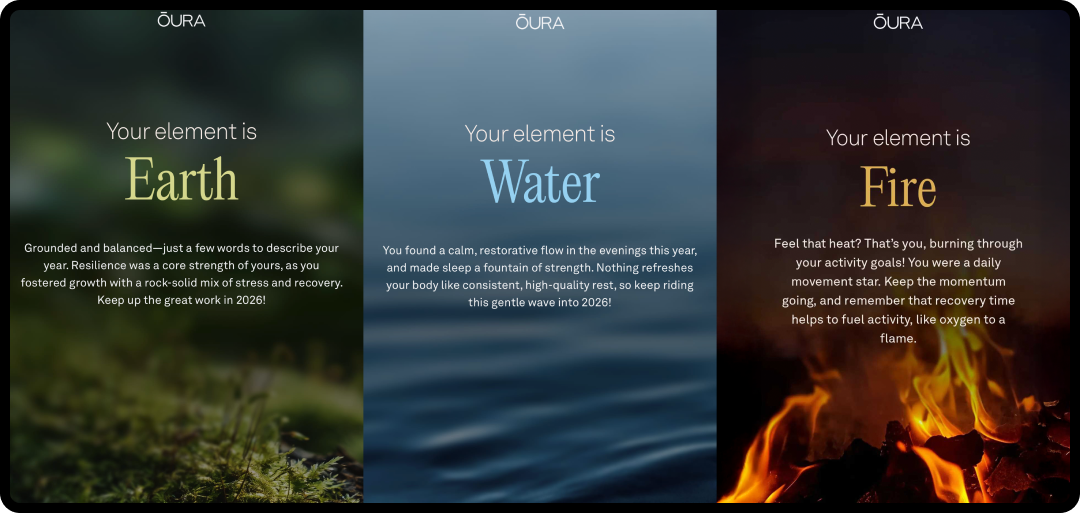
By 2024, the “wrapped” format has become so ubiquitous that it’s almost expected. What was once a differentiator for Spotify has become table stakes; users now effectively anticipate a personalized year-end summary from virtually every app they use regularly.
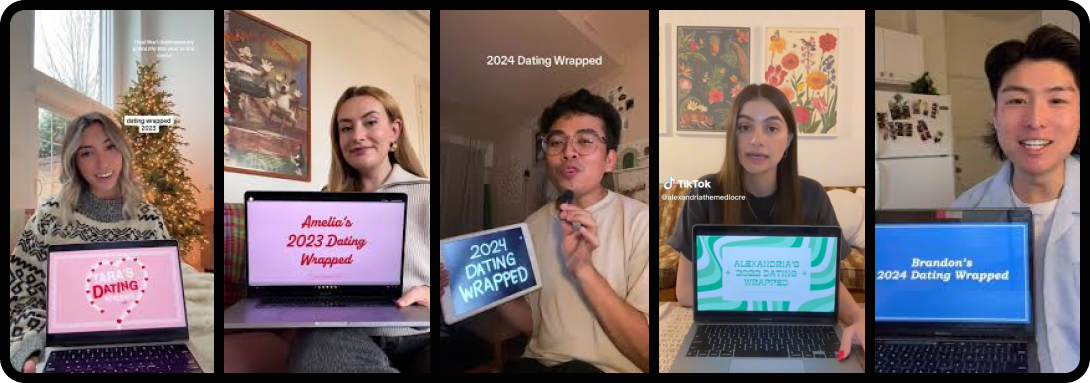
The influence of the “wrapped” formula goes beyond just brands, too. In recent years, TikTok users have popularized a “Dating Wrapped” trend that takes the year-end recap phenomenon to a whole new level through a combination of humor, creativity, and self-reflection. Inspired by the viral success of Spotify Wrapped, individual users and creators have begun crafting their own personalized presentations that break down their romantic escapades over the past year.
These DIY recaps often include statistics like the number of first dates they went on, how many ended in ghosting, their “most compatible zodiac sign,” or even a highlight reel of their “top 3 cringe moments.”
And, of course, this conversation wouldn’t be complete without AI; the user-fueled wrapped movement has since expanded even further, with TikTok users asking ChatGPT to analyze their chat history and generate year-end recaps summarizing their most-asked questions, recurring themes, and even the emotional tone of their conversations.
The organic demand was so strong that OpenAI responded by launching an official “Your Year with ChatGPT” feature in December 2025, complete with personalized awards like “Creative Debugger” for users who spent the year problem-solving, along with custom poems and AI-generated images reflecting their topics of interest. What started as user-generated content on TikTok became so culturally resonant that it pushed a major tech company to formalize the experience; a testament to how deeply Spotify’s wrapped formula has embedded itself into digital culture and consumer expectations.
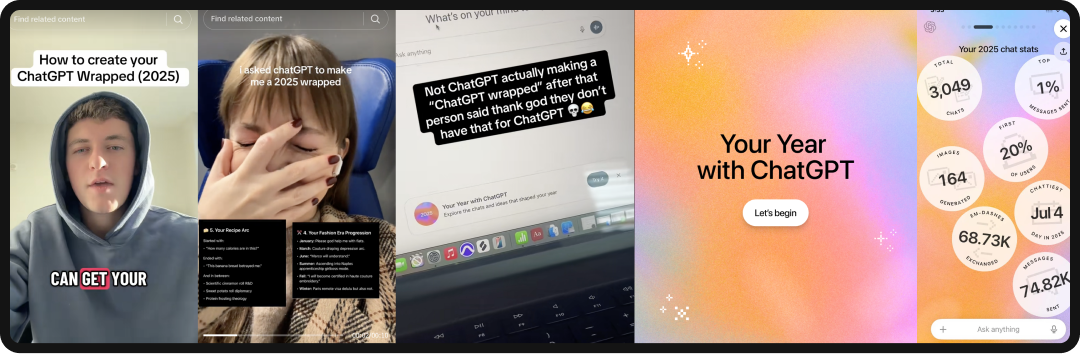
Beyond its comedic value, trends like “Dating Wrapped” and “ChatGPT Wrapped” indicate a societal shift around being more and more comfortable with turning data into markers of identity and storytelling. Just as Spotify Wrapped highlights a user’s music tastes as a reflection of who they are, these DIY recaps transform everything from relationship highs and lows to AI conversation patterns into badges of individuality. It shows how people are increasingly using personal data as a way to connect with others and make sense of their year.
This saturation presents both a validation of Spotify’s influence, but also a strategic challenge. On one hand, the fact that “wrapped” has become a verb and a cultural expectation proves just how deeply Spotify shaped consumer behavior and marketing trends.
On the other hand, when everyone else is also doing a “wrapped”, Spotify’s version needs to work harder to stand out. The novelty that once drove virality has been diluted by competition, meaning Spotify can no longer rely on the format alone; execution, creativity, and unexpected insights become the standard for success that needs to be elevated year after year.
Spotify Wrapped vs. Apple Music Replay
Let the Apple vs. Spotify debate begin again; any Apple Music users reading this might be thinking: but Nic, what about Apple Music Replay?
Apple Music Replay is Apple’s answer to Spotify Wrapped, offering users a recap of their listening habits over the past year. On paper, the concept is nearly identical: highlighting top songs, artists, and albums with personalized data insights.
Yet, despite Apple’s massive resources and a user base of over 100 million subscribers, Replay consistently fails to generate anywhere near the cultural buzz or viral appeal that Spotify Wrapped commands every December.
The most glaring difference lies in presentation. While Spotify Wrapped dazzles users with bold, dynamic graphics and animations tailored for social sharing, Apple Music Replay is comparatively understated. Apple’s tight brand guidelines present a serious challenge, making Apple Music Replay’s interface feel more utilitarian than celebratory, lacking the vibrant design elements that make Wrapped so fun to share.
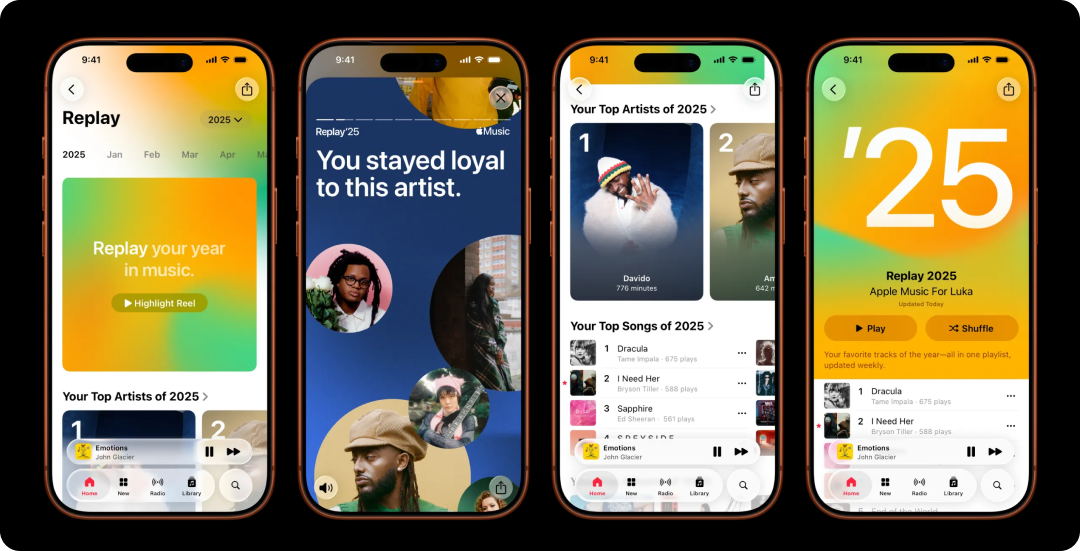
Replay also misses the mark on storytelling. Spotify excels at weaving users’ listening data into a personalized narrative, but Apple Music’s recap feels more like a static report. The emotional resonance that comes from celebrating music as part of one’s identity is largely absent.
As such, Apple Music Replay doesn’t generate the same buzz on social media. Replay feels like an afterthought, released quietly and without the fanfare that makes Wrapped so highly anticipated. While Apple Music Replay is a nice-to-have feature for existing subscribers, it lacks the strategic brilliance of Spotify Wrapped as a tool for user acquisition, retention, and cultural impact.
In short, Apple Music Replay does little more than (slightly) narrowing the FOMO gap for Apple Music users when Wrapped gets released.
Apple Music Replay is a perfect example of how having the right idea isn’t enough. Apple built a feature that technically exists, but culturally doesn’t matter. And in the attention economy, that distinction is everything.
Spotify Wrapped Over the Years: A Timeline
Since its launch in 2015, Spotify Wrapped has continuously evolved from a simple year-end listening recap into an increasingly sophisticated and culturally embedded experience. Each year, Spotify experiments with new features, data insights, and creative storytelling approaches; some landing as viral hits, and others falling flat.
Tracking Wrapped’s evolution reveals how Spotify has refined its understanding of what resonates with users, leaning into personalization, gamification, and unexpected insights that spark conversation.
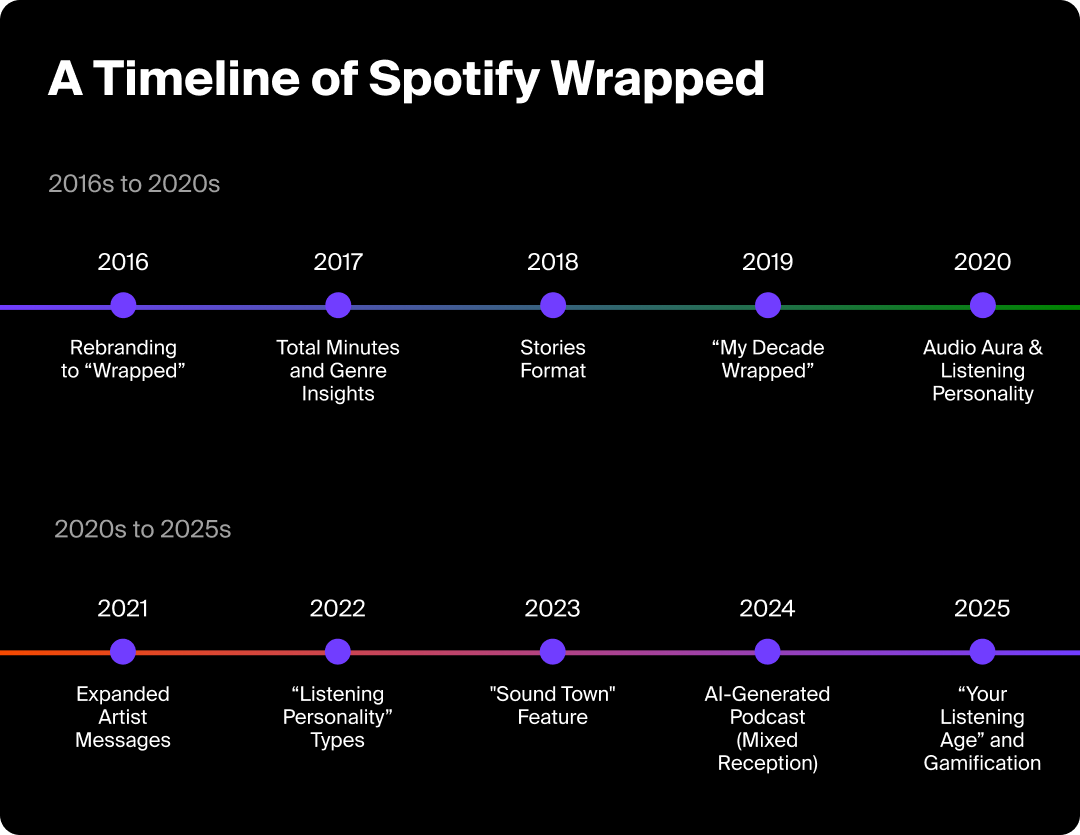
Here’s how Spotify Wrapped has evolved over the past decade:
- 2015: The Beginning Spotify launches “Year in Music,” the precursor to Wrapped, offering users a basic recap of their most-played songs and artists. The experience is simple and web-based, with minimal social sharing functionality.
- 2016: Rebranding to “Wrapped” Spotify rebrands the campaign as “Spotify Wrapped” and begins emphasizing shareability with more visually appealing graphics designed for social media.
- 2017: Total Minutes & Genre Insights Wrapped introduces total minutes listened and expands genre breakdowns, giving users a more comprehensive view of their listening habits throughout the year.
- 2018: Stories Format Spotify adopts the Instagram Stories format, creating swipeable, vertical slides optimized for mobile sharing. This marks a turning point in Wrapped’s virality as the format becomes perfectly tailored for social platforms.
- 2019: “My Decade Wrapped” To celebrate the end of the 2010s, Spotify releases a special decade-long recap alongside the annual Wrapped, highlighting users’ most-played artists and songs over the prior ten years.
- 2020: Audio Aura & Listening Personality Spotify introduces “Audio Aura,” a colorful gradient visualization representing users’ listening moods, along with playful categories like “Pioneer” or “Specialist” to describe listening personalities. These quirky features become highly shareable.
- 2021: Expanded Artist Messages Top artists record personalized thank-you messages for their listeners, adding a layer of connection between fans and musicians. Wrapped also introduces fun stats like “minutes listened” rankings.
- 2022: “Listening Personality” Types Spotify refines its personality typing system, categorizing users into archetypes like “The Replayer” or “The Early Adopter,” tapping into gamification and identity-based storytelling.
- 2023: “Sound Town” Feature Wrapped introduces “Sound Town,” matching users to cities around the world based on their listening habits and musical preferences. The feature generates buzz but also sparks debate about accuracy.
- 2024: AI-Generated Podcast (Mixed Reception) Spotify partners with Google’s NotebookLM to create AI-generated podcasts analyzing users’ listening habits. The feature receives backlash for feeling impersonal and straying from the human-centric storytelling that made Wrapped so beloved. Many users also noted the absence of quirky, unexpected insights from previous years.
2025: “Your Listening Age” & Gamification Spotify doubles down on gamification with features like “Your Listening Age,” which calculates how “young” or “old” your music taste skews based on release dates and trending popularity. The year also sees a return to more playful, unexpected data points after the 2024 AI backlash.
Spotify Wrapped’s 2024 AI Backlash & 2025 Comeback
If you were a Spotify user prior to 2024, you may have a strong opinion on this question: was 2024 the worst year of Spotify Wrapped to date?
Users were quick to point out that the 2024 Spotify Wrapped felt lackluster and underwhelming compared to previous years. That year, Spotify had teamed up with Google AI’s NotebookLM and made their year all about an AI-generated personalized podcast that dove into users’ favorite tracks and artists. Though it was interesting, it simply missed the mark on what Spotify users were eager to see.
Here’s a not-so-hot take: Just because something’s AI-driven doesn’t automatically make it interesting. In previous years, Spotify dropped unconventional data moments like listening personality types and city matches, but in 2024 there was none of that to be found.
Spotify Wrapped is a viral moment each year for a reason, and personalization and data-driven insights are at the heart of what makes Spotify Wrapped so much better than Apple Music Replay. The 2024 Wrapped lacked the human touch and playful creativity that their AI podcast couldn’t mimic, and the negative reaction from the community signaled a clear message: users wanted the quirky, shareable insights back.