Fair warning: I’m about to sound like a broken record, but I have to intro this article somehow. We all know the power of AI search (and if you don’t, you better catch up to the 37% of consumers who start searches with AI instead of Google).
And when a new search surface appears (and takes paying eyeballs off of older ones) tech-savvy brands immediately start chomping at the bit to figure out how to game the system: thus, Generative Engine Optimization (GEO) was born.
You may have read some of our articles on GEO already, but here’s the problem I’ve seen play out a thousand times already: most enterprise brands have no idea how AI engines perceive them, what’s being said about their products, or whether their competitors are the ones dominating these AI interactions.
Traditional SEO tools weren’t built for this new landscape. Enterprises looking to compete in today’s ecosystem need something more specified.
Not to go all “2000s TV infomercial” on you, but does this sound like you? Then you’re in the right place. Welcome to a breakdown of the 10 best GEO tools for enterprise brands in 2026. Check out the quick overview guide below or keep reading to learn more about each tool on this list (and why it’s there).
The Best Enterprise GEO Tools: Overview
|
Tool |
Best For |
Compliance |
Pricing |
|---|---|---|---|
|
Goodie |
Mid-market and enterprise brands seeking end-to-end AI visibility with actionable optimization |
SOC 2 Type II |
Custom pricing |
|
Prerender.io |
Enterprise websites with JavaScript-heavy architecture needing crawler accessibility |
N/A |
Free tier available, scales to paid enterprise tiers |
|
Rankscale |
SEO teams and agencies needing granular AI visibility data with affordable entry points |
N/A |
From $20 per month to $780 per month depending on the tier |
|
Scrunch |
Large enterprises managing multiple brands across regions with strict security requirements |
SOC 2 Type II |
From $250 per month and scales to custom pricing for enterprise plans |
|
Profound |
Fortune 500 enterprises requiring deep analytics, compliance, and dedicated support |
SOC 2 Type II HIPAA |
From $499 per month, with Growth and Enterprise tiers available |
|
Conductor |
Fortune 500 brands seeking unified SEO and GEO workflows with enterprise integrations |
SOC 2 Type II ISO 42001 ISO 27001 |
Fully custom pricing |
|
Bluefish AI |
Fortune 500 brands requiring brand safety, reputation management, and enterprise-grade security |
N/A |
Completely custom, formal sales process |
|
AthenaHQ |
Brands prioritizing speed-to-content and automated optimization workflows |
N/A |
$270 per month Lite plan; enterprise plans cost over $2,000 per month |
|
Gauge |
Data-driven teams in AI-forward industries requiring real search intent mapping |
N/A |
From $99 per month with custom enterprise tiers available |
|
Evertune |
Fortune 500 brands prioritizing actionable content recommendations and strategic guidance |
N/A |
Starts at $3,000 per month |
1. Goodie: The Gold Standard for Enterprise GEO

After thoroughly reviewing and using multiple GEO platforms, Goodie clearly stands out as the most complete solution for enterprise brands. It combines monitoring where your brand appears while actively helping you improve and action your visibility across every major AI engine and attribute and measure the impact which is critical for enteprises.
Goodie covers 11 Models, more AI platforms than any competitor: ChatGPT, Perplexity, Gemini, Claude, DeepSeek, Google AI Overviews and AI Mode, Grok, Meta AI, Microsoft Copilot, and Amazon Rufus. That’s right; Goodie has pioneered the agentic commerce optimization space, making it more than suitable for eCommerce and retail enterprises.
The Optimization Hub is unlike tools that simply report data, providing specific tasks and optimization recommendations ranked by impact, allowing your teams to take immediate action.
Key Features
- Full Model Coverage: track performance across 11+ major AI engines
- Brand Intelligence Engine: Reveals how AI interprets your value propositions, competitive positioning, and sentiment
- Optimization & Actions Hub: Prioritized, actionable recommendations with one-click export to project management tools
- Attribution Dashboard: Connects AI visibility to sessions and assisted revenue through UTM tracking
- Shopping Analysis Optimization; Track product recommendations in AI shopping features like ChatGPT’s Instant Purchase
- Agent Analytics: Reveals how AI crawlers access content
- Enterprise Security: SOC 2 Type II compliance with role-based access controls
Goodie customers report measurable citation lifts in 4-6 weeks for long-tail prompts, with headline terms showing improvement within 3-4 months. The platform’s multi-agent optimization layer actively improves content and addresses citation gaps, making it more than just an analytics tool. Check out their case studies on SteelSeries and Dermalogica for more.
Pricing: Pricing is custom upon requesting a demo. Final costs scale based on prompt volume, topics, and brand scale.
2. Prerender.io

While most GEO tools focus on monitoring and optimization, Prerender.io solves a critical foundational problem: ensuring AI crawlers can actually see and index your content. For JavaScript-heavy sites built with React, Angular, Vue, or other modern frameworks, Prerender.io is essential infrastructure.
Prerender.io operates between your hosting environment and incoming requests, delivering pre-rendered HTML snapshots to AI crawlers in just 0.03 seconds on average. This ensures bots see the full content while maintaining the interactive experience for human users.
Features
- Universal Framework Support: Works with React, Angular, Vue, and all major JavaScript frameworks
- AI Crawler Optimization: Ensures visibility for ChatGPT, Perplexity, Claude, and Gemini crawlers
- Performance Boost: Improves Core Web Vitals while solving indexing issues
- Zero Maintenance: Plug-and-play setup with no code rewrites required
- Enterprise Scale: Handles millions of pages across multiple domains
Customers report indexing speeds improving by 260%, with organic traffic increasing by an average of 80%. One customer reported a 300% increase in referral traffic after adding ChatGPT user agents to their configuration.
Pricing: Flexible based on number of renders and cache refreshes. Free tier available for testing, with paid plans scaling for enterprise needs.
3. Rankscale

Rankscale was built specifically for measuring brand visibility in generative search rather than retrofitting traditional SEO tools. With a 4.8/5 average review score and strong endorsements from marketing leaders, Rankscale delivers technical depth at accessible price points.
Rankscale tracks visibility across ChatGPT, Claude, Perplexity, Gemini, Mistral, and DeepSeek with daily monitoring. What makes Rankscale unique is its granular approach to citation analysis, showing where you’re mentioned and providing insights into why certain content gets selected.
Rankscale measures key metrics including Share of Model (SoM), citation frequency, sentiment classification (positive, neutral, negative), and geographic coverage with worldwide reach and localizable insights by country.
Features
- Daily Tracking: Prompts refresh daily for up to date visibility data
- Citation Analysis: Reverse analysis of source domains rather than just brand mentions
- Model-Specific Tracking: Granular tracking across query variations
- Google Looker Studio Integration: Export and visualize data in BI environments
Rankscale operates on a credits system, meaning costs can scale quickly with prompt volume. The platform is also more technical than some alternatives, with users noting a learning curve. It’s primarily a monitoring tool rather than an optimization platform, requiring other tools for content execution.
Pricing: Starter plans begin at $20 per month, with two additional tiers (Growth and Professional), and enterprise tiers scaling up to $780 per month.
4. Scrunch
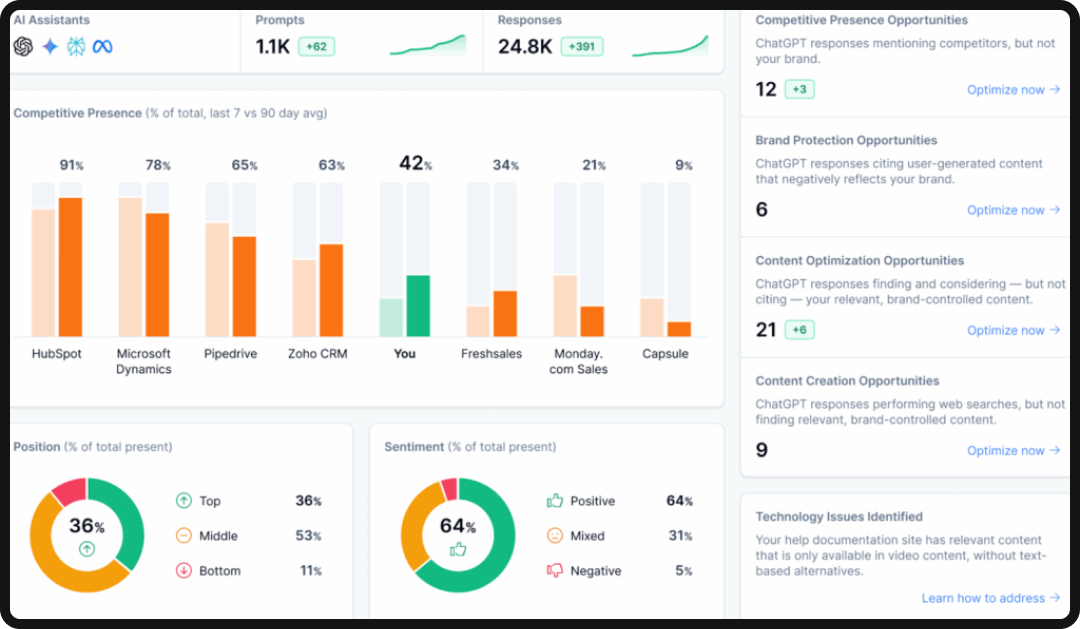
Scrunch is backed by $19 million in venture funding (including a $15 million Series A led by Decibel). With clients like Lenovo, Dell, SKIMS, and Penn State University, Scrunch serves over 500 brands focused on AI-driven customer journeys.
Scrunch successfully completed SOC 2 Type II audit, offers role-based access controls (RBAC) for team management, and supports multi-brand, multi-domain, and multi-region deployments with all language localizations.
Scrunch monitors across ChatGPT, Claude, Perplexity, Meta AI, Google AI Mode, Google AI Overviews, and Gemini, with data refreshing every three days as standard.
Features
- Prompt-Level Tracking: Organize by topics, personas, customer journey stages, and geographic regions
- Multi-Brand Support: Enterprise clients monitor millions of prompts across hundreds of thousands of pages
- Direct Integrations: Plug into internal systems, dashboards, and AI workflows
- GA4 Integration: Track AI traffic and attribution
Scrunch is primarily a monitoring platform focused on visibility and competitive intelligence. Teams report that it provides actionable insights but lacks built-in content optimization or creation tools.
Pricing: Starts at $250 per month and scales to custom pricing for Enterprise plans.
5. Profound
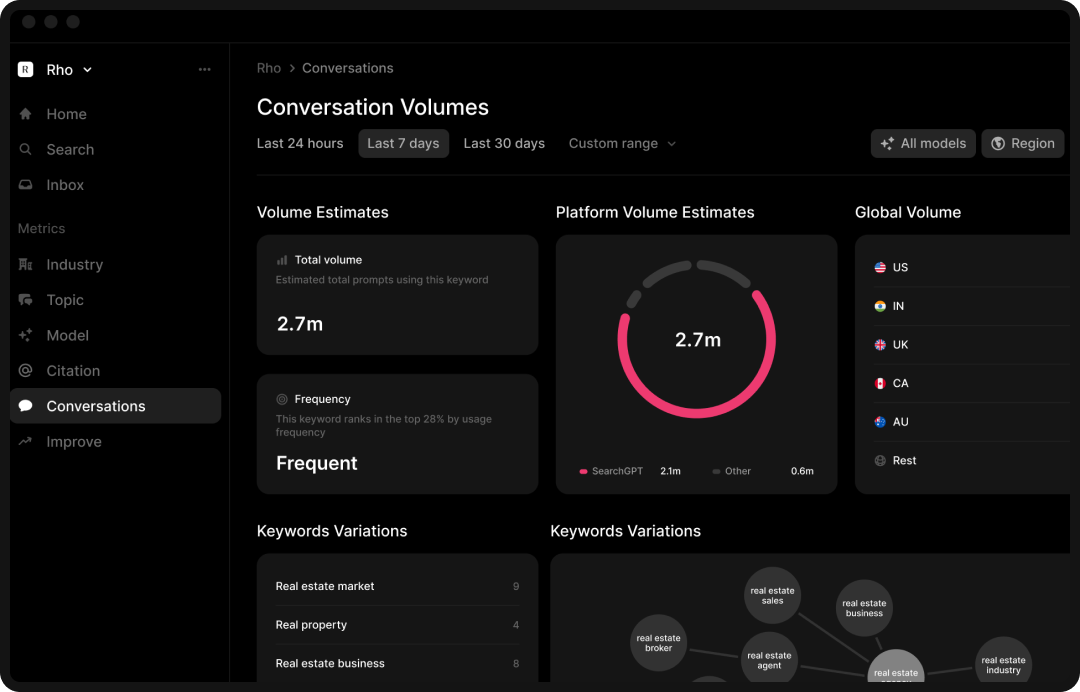
Profound is a monitoring powerhouse in the GEO space, backed by $58.5 million in total funding (including a $24 million Series A from Kleiner Perkins). One cool feature of Profound is its Conversation Explorer, which provides access to real user conversations with LLMs. This enables brands to identify which conversations actually cite their websites.
Their Answer Engine Insights tracks your brand’s GEO performance and share of voice across 10+ engines including ChatGPT, Claude, Perplexity, Google AI Overviews, Gemini, Microsoft Copilot, DeepSeek, Grok, and Meta AI.
Features
- SOC 2 Type II & HIPAA Compliance: Essential for regulated industries
- Brand Relevant Prompts: Identifies which conversations cite your brand versus competitors
- Shopping Analysis: Track product visibility in ChatGPT shopping recommendations
- Enterprise Integrations: WordPress and GCP integrations for seamless workflows
Profound’s strength is in diagnostics and research rather than execution. Teams will need to implement recommendations manually or use other tools for content creation. The platform also uses a tiered approach where full model coverage requires enterprise pricing.
Pricing: Entry point starts at $499 per month, with Growth and Enterprise tiers offering expanded capabilities. Agency plans are available with pitch workspaces for client prospecting.
6. Conductor

Conductor has evolved from a leading SEO platform into combining traditional search optimization with AI visibility tracking. They serve global brands including Citi, Sephora, and FedEx.
Unlike point solutions that force teams to cobble together multiple tools, Conductor unifies the entire workflow from insight to action to impact. Conductor’s AI Search Performance tool tracks brand visibility across ChatGPT, Perplexity, Google AI Overviews, and other major LLMs, providing both traditional SEO metrics and AI visibility data in one interface.
Features
- Synthetic Prompt Generation: Uses website data to generate targeted, relevant prompts
- Content Creation at Scale: Writing Assistant generates content optimized for both traditional search and AI
- 24/7 Website Monitoring: Real-time technical health alerts prevent revenue-impacting issues
- Advanced Integrations: Connects with GA4, Looker, HubSpot
- Compliance: ISO 42001, ISO 27001, and SOC 2 Type 2 certified
Pricing: Pricing is fully custom.
7. Bluefish AI

Bluefish AI has carved out a distinct position as the premier enterprise platform for brand protection in the AI era. Bluefish focuses on helping enterprises understand and control how AI systems represent their brands.
Bluefish’s monitoring extends across ChatGPT, Gemini, Perplexity, Google AI Mode, with advanced metrics like favorability, sentiment, brand safety, and accuracy. The platform consistently passes infosec reviews with SOC 2-aligned controls (though they are not officially certified), strict data handling policies, and workflows designed for large, regulated organizations.
Features
- Model-Aware Diagnostics: Reveals source influence, citation patterns, and semantic drivers for each model
- Brand Safety & Crisis Detection: Real-time monitoring for misrepresentation, incorrect claims, and reputation risks
- Custom Audiences: Tailor monitoring to specific user groups and market segments
- Enterprise Security: SSO, RBAC, and permissioned data governance
Bluefish focuses on defensive metrics (things like brand safety, crisis detection, and reputation management). This makes it valuable for corporate communications, PR, and enterprises where brand integrity is paramount.
Pricing: Completely custom enterprise pricing with a formal sales process. Contact sales for detailed quotes. No free trial or public API advertised.
8. AthenaHQ
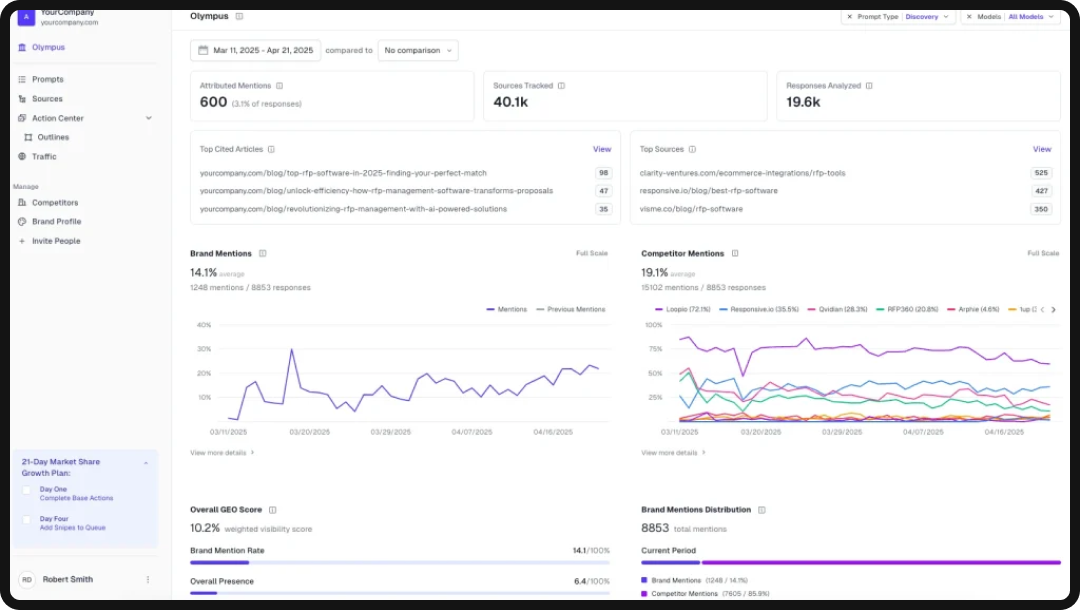
Founded by former Google Search and DeepMind engineers and backed by Y Combinator, AthenaHQ takes a fundamentally different approach to GEO: automation. The platform automatically generates and publishes AI-optimized content designed to improve rankings.
AthenaHQ moves from insight to published content in under 4 hours (I’ll do the math for you: that’s 20x faster than manual methods). The platform’s automated content engine eliminates human bottlenecks by producing AI-ready articles rapidly.
Features
- Automated Content Production: Generate optimized articles within hours
- Query Volume Estimation Model (QVEM): Predicts search volumes with 95%+ accuracy
- Enterprise Controls: Brand guidelines, approval workflows, and team dashboards
- Competitive Gap Analysis: Identify and address visibility gaps versus competitors
AthenaHQ’s automation-first approach may not suit brands requiring highly customized content or extensive editorial oversight. The platform is designed for velocity, which means some personalization may be traded for speed.
Pricing: Pricing starts at $270 per month for the Lite plan, with Enterprise plans starting at $2,000 per month on the very low end.
9. Gauge

Gauge differentiates itself through what it calls an “engineering over marketing” philosophy. It was built by technical teams with deep data experience, researching real search intent volumes and mapping competitor web presences.
Unlike platforms that rely solely on API calls, Gauge pulls real data from the web experiences that models surface to users. This results in higher correlation to real-world user experiences compared to naive API implementations. The platform tracks 7+ AI engines including ChatGPT, Claude, Gemini, Perplexity, CoPilot, AI Mode, and AI Overviews, with 600+ prompts tracked per brand.
Features
- Real Web Data: Monitors actual user interfaces, not just API responses
- Ask Gauge AI Agent: Provides intelligent guidance and insights at high velocity
- Content Engine: Built-in tools to generate high-ranking, AI-optimized content
- GA4 & GSC Integration: Tracks AI referral traffic and search data
- Query Fan-Out Tracking: Deeper insights into how AI models search the web
Typical Gauge customers see 3x-5x visibility uplift within the first month of implementation. Standard Metrics doubled their AI visibility from 9.4% to 23.8% in just two weeks, while LedgerUp achieved a 34.4% increase in under three months.
Pricing: Pricing starts at $99 per month with scaling tiers for additional features and prompt volume. Enterprise options are also available for large-scale deployments.
10. Evertune
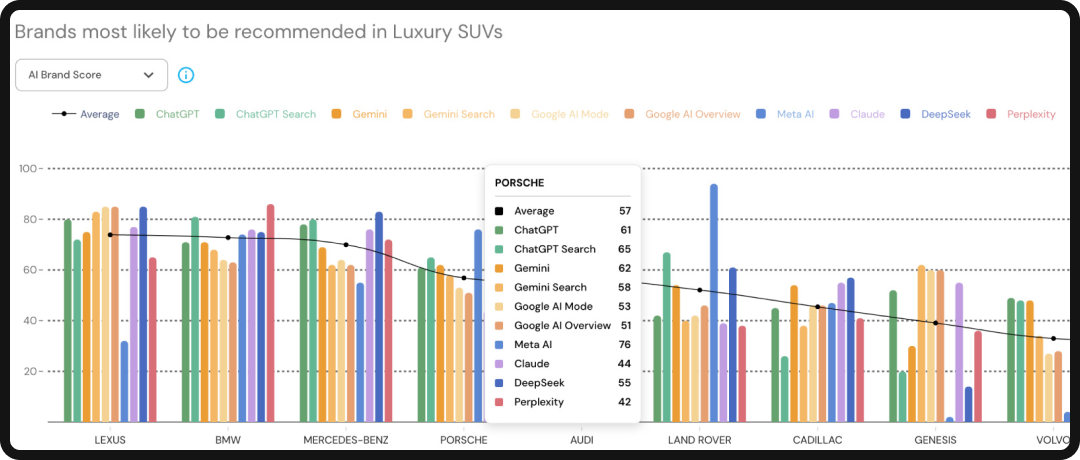
Founded in 2024 by early team members from The Trade Desk and backed by $19 million in funding, Evertune positions itself as an action-oriented GEO platform.
Their core differentiator is a focus on transforming visibility data into specific content strategy. While other platforms report metrics, Evertune’s Content Studio delivers approximately 150 tested messages per brief with ready-to-publish blog content.
The platform works across 11 models including ChatGPT, Google AI Overview, AI Mode, Gemini, Claude, Perplexity, Meta AI, DeepSeek, and Copilot.
Features
- Word Association Analysis: Understand messaging priorities and brand perception
- Content Analytics: Source-level optimization recommendations
- Content Studio: Ready-to-use content recommendations based on testing
Evertune emphasizes consultative guidance alongside software, providing ongoing training and strategic support.
Pricing: Enterprise pricing starts at a steep $3,000 per month.
What Are the Best Tools for Enterprise Search Optimization?
As comprehensive as this list is, the “best” tool for enterprise search optimization depends entirely on your organization’s specific needs, resources, and goals. Here’s a handy breakdown of the landscape:
- For Comprehensive End-to-End Optimization: Goodie leads the pack with the most complete platform combining monitoring, optimization, content creation, and attribution. It’s the clear choice for enterprises that want a single platform to own their entire GEO strategy.
- For Deep Research & Analytics: Profound provides data intelligence with its Conversation Explorer and enterprise-grade compliance. It’s ideal for large organizations with dedicated teams to implement insights.
- For Technical Infrastructure: Prerender.io is great for JavaScript-heavy sites. Without proper rendering, no amount of optimization will help if AI crawlers can’t see your content.
- For Budget-Conscious Teams: Rankscale offers affordable entry points starting at $20 per month.
- For Automation & Speed: AthenaHQ’s velocity approach means rapid improvements for brands that need to scale content production quickly.
Something else that enterprises serious about AI visibility could consider is to combine multiple tools. For example, you might use Prerender.io to ensure crawler accessibility, Goodie for comprehensive monitoring, and Conductor to unify GEO with existing SEO workflows.
Making Your Choice & Final Recommendations
Choosing the right GEO platform for your enterprise comes down to three key factors: your current situation, your resources, and your strategic priorities. Start by assessing your foundation, defining your needs, and considering your resources. Here’s a short guide to help you decide:
- Just getting started? Begin with accessible platforms like Rankscale or AthenaHQ to understand the landscape
- Scaling up? Move to comprehensive platforms like Goodie or Scrunch as AI search becomes a strategic priority
- Ready to go all-in? Goodie’s good for this too! So are platforms like Profound and Conductor
Early adopters in GEO are like early adopters in SEO 20 years ago: they’re establishing authority and trust that compounds over time. The difference is that the window for early-mover advantage is shorter in AI search because the technology is evolving so rapidly.
Your customers are already using AI to search (we all knew this). The only question is whether your brand will be in the answer.
Enterprise GEO Tools: FAQs
What is the best generative engine optimization tool?
“Best” is contextual, but If we had to crown a single “best” GEO tool, Goodie takes the title for most enterprises. It:
- Has SOC 2 compliance
- Has role-based access controls, and integrates with analytics tools that already exist in your marketing stack (GA4, Looker, HubSpot)
- Features the broadest coverage (over 11 models, more than any competitor)
- Includes an Optimization Hub that provides prioritized actions for implementation, as well as an integrated AI Content Writer
- Connects AI visibility to business outcomes through Attribution dashboards
Is GEO better than SEO?
This question misses a fundamental point: GEO and SEO are not competing strategies, and the importance of one sure as heck doesn’t negate the need for the other.
Think of it this way: AI engines are using search tools to retrieve data from the internet. At the end of the day, GEO (and AEO) are still search optimization tactics, just with additional considerations for how AI crawlers work and how LLMs select sources.